Your new post is loading...

|
Scooped by
I2BC Paris-Saclay
September 25, 6:42 AM
|
How the polarisability of its environment shapes the electronic excited states of lutein, a key pigment of photosynthesis.
Lutein helps plants harvest sunlight and protect themselves from excess light. Ultrafast laser spectroscopy at I2BC shows that the polarisability of its environment reshapes its electronic excited states and their lifetimes. In plant leaves, lutein, a yellow carotenoid also abundant in spinach and egg yolk, is bound to the proteins that collect sunlight for photosynthesis. It helps capture light, stabilises these proteins and, under strong illumination, contributes to dissipating excess energy safely. All these functions rely on the electronic excited states that lutein reaches after absorbing a photon, which last only a few picoseconds (trillionths of a second). Inside these proteins, lutein is thought to sit in a highly polarisable environment, that is, one whose electron clouds readily deform in response to the pigment. How this polarisability affects its excited states was unknown. I2BC researchers compared lutein in two solvents of very different polarisability: tetrahydrofuran (THF, low) and carbon disulfide (CS2, high). Combining femtosecond transient absorption with femtosecond stimulated resonance Raman spectroscopy (FSRRS), which selectively records the vibrational fingerprint of each electronic state, they identified the same set of excited states in both solvents: a vibrationally 'hot' S1 state, the relaxed S1 state, a weak charge-transfer contribution and a 'dark' state called S*. High polarisability, however, changes how these states behave. The S1 absorption shifts to lower energy and broadens, and the molecule barely reorganises after excitation. The S* state lives almost twice as long (about 29 instead of 16 picoseconds), and its vibrational frequency deviates from the trend expected from the length of the conjugated chain. Polarisability therefore does not simply lower the energy of the excited states: it alters their nature and dynamics. These results provide a reference for understanding how the protein environment tunes the excited states of lutein, and thus its roles in light harvesting and photoprotection. More information : Contact : Manuel Llansola-Portoles manuel.llansola@i2bc.paris-saclay.fr
|
|
Scooped by
I2BC Paris-Saclay
September 14, 9:44 AM
|
Total synthesis and structural characterization of a novel protein scaffold from the snail Biomphalaria glabrata.
Total synthesis and structural characterization of a novel protein scaffold from the snail Biomphalaria glabrata, the host of the parasite schistosoma. Schistosomiasis, also known as bilharzia, remains one of the most widespread tropical diseases, affecting over 280 million people, particularly in Africa. This acute and chronic parasitic disease is caused by flatworms of the genus Schistosoma, whose complex life cycle alternates between vertebrate hosts and freshwater snails, the latter serving as intermediate hosts.
In collaboration with Oleg Melnyk and Jérôme Vicogne from the MinT team at the Institut Pasteur de Lille (CIIL/CNRS), Solange Moréra’s team at the I2BC studied miniproteins (schistosomins) of approximately 80 residues from the snail Biomphalaria glabrata. These miniproteins are conserved in gastropods and belong to a long-standing orphan family whose structure and biological roles had until now remained unknown.
A recently published study describes the total chemical synthesis and structural characterization of a schistosomin isoform. Using solid-phase peptide synthesis, chemoselective peptide ligation, and controlled oxidative folding, the miniprotein was crystallized and its structure resolved. This structure, unprecedented in the Protein Data Bank, reveals a novel disulfide-rich fold with remarkable thermal stability. In silico analyses suggest that the two natural isoforms (which differ by only a single residue) exhibit very similar structural and dynamic properties.
Transcript and protein analyses across different snail tissues provide the first spatial expression map of schistosomin. These findings establish schistosomin as the prototype of a new family of gastropod miniproteins, whose biological roles in mollusc-parasite interactions remain to be explored. More information : https://pubmed.ncbi.nlm.nih.gov/42554520/ Contact: Solange Morera solange.morera@i2bc.paris-saclay.fr
|
|
Scooped by
I2BC Paris-Saclay
September 10, 5:18 AM
|
A new path to Rubisco processing
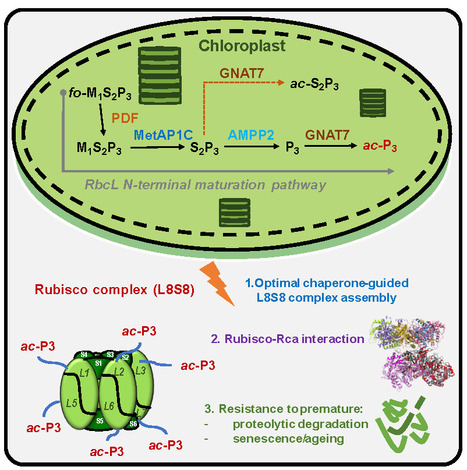
A unique plant machinery comprising three dedicated components ensures N-terminal processing of Rubisco’s catalytic subunit, enabling its proper accumulation and activity as Earth’s most abundant protein. RuBP carboxylase/oxygenase (Rubisco)—the central enzyme of carbon dioxide assimilation and plant autotrophy— is Earth’s most abundant protein and a major carbon and nitrogen reservoir, which can be remobilized during stress and development. The catalytic large subunit of Rubisco (RbcL) undergoes a highly conserved maturation process that results in N-terminal proline acetylation, a modification not reported in other biological systems. Until now, both the enzymatic machinery responsible for N-terminal maturation and its associated functional implications have remained unknown. In this study, we uncover a specialized chloroplast processing pathway, composed of two aminopeptidases and one N-terminal acetyltransferase, specifically evolved to catalyze RbcL maturation. Proper processing of RbcL by this machinery is tightly coupled to chaperone-mediated assembly of the hexadecameric holoenzyme, enhances activation by Rubisco activase, and safeguards the fully modified complex from premature degradation during senescence. Disruption of this pathway compromises both the reactivity and accumulation of Rubisco. These findings reveal a specialized maturation mechanism that underpins the exceptional abundance and persistence of Rubisco in photosynthetic organisms, and more broadly, its central role in sustaining life on Earth. This paves the way for enhanced photosynthesis, stronger crop yields, and more effective carbon capture. More information : https://www.science.org/doi/full/10.1126/sciadv.aeh5060 Contact : Thierry Meinnel thierry.meinnel@i2bc.paris-saclay.fr
|
|
Scooped by
I2BC Paris-Saclay
August 3, 9:33 AM
|
Confocal microscopy workshop 2026
|
|
Scooped by
I2BC Paris-Saclay
July 27, 4:36 AM
|
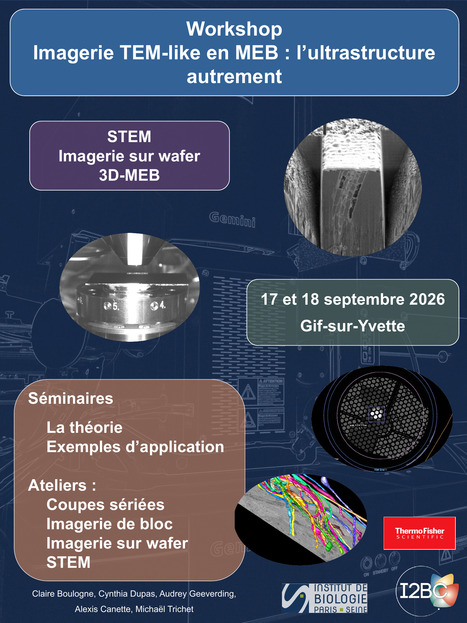
Workshop in Sept. @I2BC: Come & Explore the Many Facets of Scanning Electron Microscopy
|
|
Scooped by
I2BC Paris-Saclay
June 18, 10:35 AM
|
NMR-based detection of ultra-weak antibody–excipient interactions to optimize therapeutic monoclonal antibody formulations.
The aggregation and high viscosity of monoclonal antibodies at high concentrations restrict their administration by subcutaneous injection. We developed an NMR-based approach to detect ultra-weak interactions between mAbs and excipients, enabling rational screening of excipients and formulation conditions. The INTGEN team at I2BC, in collaboration with the NMR facilities at CEA Saclay and ICSN in Gif-sur-Yvette, and the formulation department at Sanofi's Research & Development center in Vitry-sur-Seine, investigated antibody–excipient interactions in highly concentrated monoclonal antibody (mAb) formulations designed for subcutaneous injection. At high concentrations, mAbs tend to self-associate, increasing viscosity and complicating administration. By combining NMR spectroscopy, rheology, and light scattering, the research team identified excipients capable of improving mAb solubility and characterized the relationship between excipient binding and its effect on viscosity. Lysine was identified as an excipient that significantly enhances mAb solubility and also directly binds to the antibody. In contrast, sucrose also binds to the mAb but does not reduce viscosity, demonstrating that binding alone is not sufficient to predict solubilizing efficacy. This work establishes an NMR-based approach for uderstanding the molecular mechanisms governing mAb viscosity and for rationally optimizing therapeutic antibody formulations. More information : https://www.tandfonline.com/doi/full/10.1080/19420862.2026.2685366 Contact : Sophie Zinn-Justin sophie.zinn@i2bc.paris-saclay.fr
|
|
Scooped by
I2BC Paris-Saclay
June 16, 4:26 AM
|
Structural analysis reveals how Ku recruits and stimulates WRN.
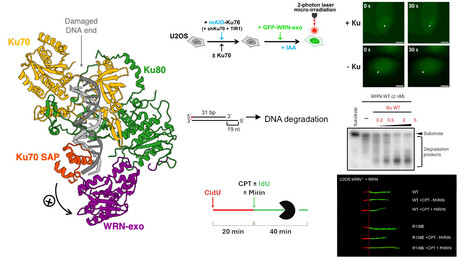
Combining cryo-EM, biochemistry and cell biology, this study reveals how the DNA repair factor Ku recruits and activates the WRN exonuclease, uncovering a new mechanism that protects genome stability during replication stress. The Werner syndrome protein (WRN) is a key factor in the maintenance of genome stability, but the molecular mechanisms regulating its exonuclease activity have remained unknown. In this study, we combine cryo-electron microscopy, biochemistry, and cell biology to uncover how the DNA repair factor Ku recruits and stimulates WRN.
Our structural analysis reveals the molecular interface between the Ku70–Ku80 heterodimer and the WRN exonuclease domain, explaining how Ku positions WRN at DNA ends to stimulate its exonuclease activity. Biochemical assays demonstrate that Ku directly enhances WRN-mediated DNA degradation in vitro. In cells, disruption of the Ku–WRN interaction impairs WRN recruitment to DNA double-strand break (DSB) sites and compromises replication fork remodeling under replication stress, highlighting the physiological importance of this interaction.
Together, these findings demonstrate that Ku directly regulates WRN exonuclease activity and clarify the molecular basis of WRN recruitment and activation at DNA ends, providing new insights into DNA end processing and the response to replication stress. More information : https://doi.org/10.1038/s41467-026-71888-w Contact : Virginie Ropars virginie.ropars@i2bc.paris-saclay.fr
|
|
Scooped by
I2BC Paris-Saclay
June 8, 9:21 AM
|
HP1 targets the RNA exosome to chromatin
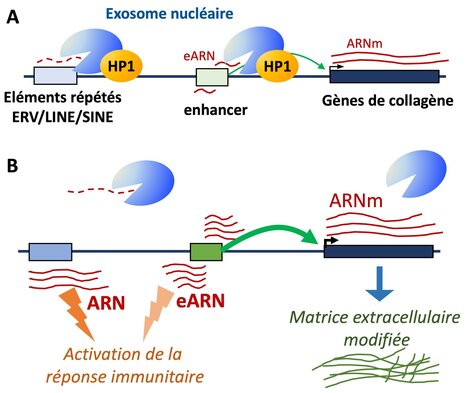
A novel role for the HP1 proteins in targeting the RNA-exosome to chromatin for the turnover of repetitive RNAs and enhancer RNAs. Heterochromatin protein 1 (HP1), a hallmark of pericentromeric heterochromatin, is a chromatin-bound regulator of co-transcriptional processes including alternative splicing, but its role in RNA degradation remains unexplored. Here, we uncover a direct interaction between HP1 and nuclear RNA exosome complexes, major RNA decay machineries. In mouse embryonic liver cells, inactivation of all three HP1 isoforms leads to accumulation of retrotransposon-derived RNAs and stabilization of enhancer RNAs. These changes coincide with increased activity at a subset of liver enhancers particularly sensitive to reduced exosome activity, many of which regulate genes encoding extracellular matrix components such as collagen genes. Stratifying hepatocellular carcinoma samples by HP1 expression further reveal that tumors with low HP1 are marked by reduced RNA degradation, and increased expression of a similar subset of genes encoding extracellular matrix components and possibly contributing to tumor stiffness. These results suggest that HP1’s impact on RNA turnover contributes to its function in cancer biology. More information: https://www.nature.com/articles/s41467-026-72504-7 Contact : Carl Mann carl.mann@i2bc.paris-saclay.fr
|
|
Scooped by
I2BC Paris-Saclay
June 5, 3:49 AM
|
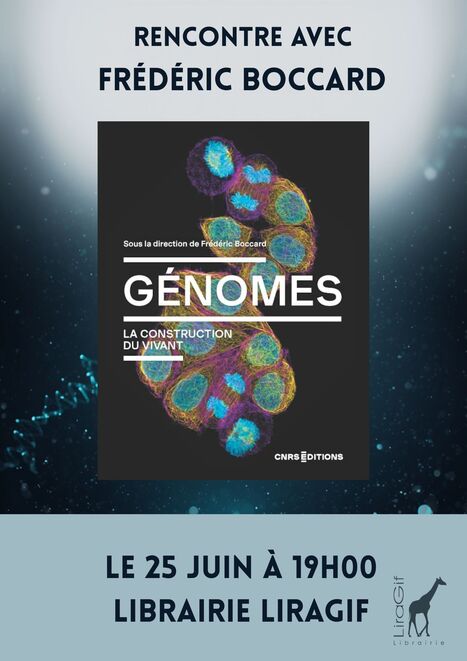
New Release: Génomes: la construction du vivant
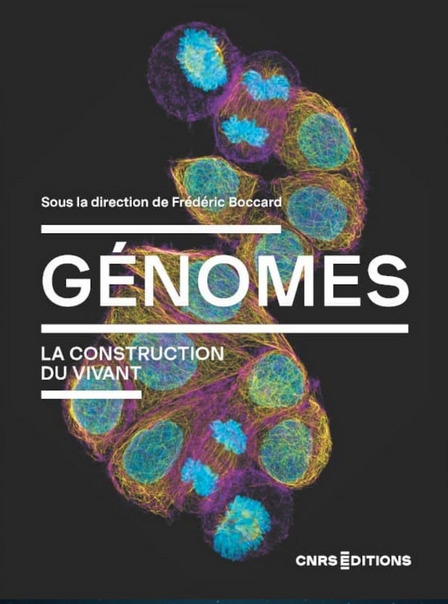
From DNA sequencing and studies of genome function and organization—covering viruses, bacteria, archaea and eucaryotes, this collective book explores genomes and their role in life, evolution, and diversity. A collective book that traces the history of genetics and the major discoveries surrounding genomes. The genome, the complete set of genetic information, builds, operates, and reproduces all living beings, serving as the engine of their evolution. Thanks to DNA, genetic information is stored, decoded, duplicated, and transmitted. But the study of the genome goes much further: it allows us to understand life, trace the history of species, and identify non-coding DNA regions that are nonetheless essential for life, the protection of genetic material, and its diversity. From DNA sequencing and genome function to the mechanisms of evolution—covering viruses, bacteria, archaea and eucaryotes, —the book explores how scientists today are striving to understand genome function and evolution. Coordinated by Frédéric Boccard, Director of the I2BC, this book brings together chapters written by several French scientists, including Mireille Bétermier, Group Leader at the I2BC. More information: https://www.cnrseditions.fr/catalogue/biologie-et-sante/genomes/ Contact: Frédéric Boccard frederic.boccard@i2bc.paris-saclay.fr
Le pôle des plateformes de biophysique de l’Institut de Biologie Intégrative de la Cellule (I2BC, CNRS/CEA/UPSaclay, Gif-sur-Yvette) a le plaisir d’accueillir Viola Caroline D’mello, qui a rejoint le CEA en mars 2025 en tant qu’ingénieure-chercheuse. Après une licence en chimie à l’université de Mumbai et un master en chimie analytique à l’université de Mangalore, elle a réalisé sa thèse au Tata Institute of Fundamental Research (TIFR) à Mumbai. Ses travaux portaient sur l’étude en phase gazeuse de liaisons hydrogène dans des molécules aromatiques azotées par spectroscopies dans les domaines de l’ultraviolet (UV) et de l’infrarouge (IR) nanoseconde – ces liaisons hydrogène étant similaires à celles présentes dans l’ADN et l’ARN. En 2019, elle a rejoint en tant que chercheuse postdoctorante le groupe de recherche LIDYL de l’institut IRAMIS au CEA Saclay, où elle a étudié les paires d’ions et le repliement de peptides en phase gazeuse. Après un court passage dans l’industrie à Bangalore (Inde), elle est revenue à la recherche académique comme postdoctorante au Département de Physique de l’Université de Göteborg, où elle a contribué à la mise en service d’un spectromètre de masse haute résolution couplé à une source à jet supersonique. Depuis son arrivée au sein du Pôle de biophysique de l’I2BC, elle est responsable des plateformes de spectroscopies électroniques, de spectroscopie Raman de résonance et de spectroscopie infrarouge : elle supervise l’accès des utilisateurs et veille à ce que les expériences soient conçues et réalisées dans des conditions optimales. Elle accompagne et conseille régulièrement les utilisateurs sur un large éventail de techniques, incluant l’absorption UV-Visible, l’absorption transitoire ultrarapide (de la femtoseconde à la milliseconde), la spectroscopie infrarouge à transformée de Fourier (FTIR) et la spectroscopie Raman, dont la spectroscopie Raman femtoseconde (plateforme LUMA). L’étendue de son expertise en méthodes photophysiques, associée à sa fiabilité et à son attitude ouverte et collaborative, fait d’elle un pilier central du Pôle de biophysique. -> Contact : Viola-Caroline D'mello (Viola.Dmello@cea.fr) Plug In Labs Université Paris-Saclay : cliquer ICI I2BC / Plateforme de spectroscopies électroniques. La plateforme de Spectroscopies Électroniques (Institut de Biologie Intégrative de la Cellule) offre ses services appliqués aux biomolécules à des équipes de recherche françaises et internationales. Nous sommes capables de suivre des changements spectroscopiques au niveau de la protéine dans des cellules intactes. La plateforme est équipée de plusieurs spectromètres d'absorption et de fluorescence (y compris un certain nombre de spectromètres PAM spécialisés) ainsi que des spectromètres à thermoluminescence. Pour certaines configurations, des cryostats sont disponibles pour les études à basse température, jusqu'à 77K ou 4K. La plateforme a développé (et continue à améliorer) un montage unique de spectroscopie optique résolue dans le temps (ca. 300 ps), surpassant les montages conventionnels (commerciaux) en sensibilité et en résolution temporelle. Ce type de méthodologie est particulièrement déterminant pour l'élucidation de processus irréversibles et/ou de processus qui se produisent dans des fenêtres temporelles allant de quelques centaines de picosecondes à des dizaines de nanosecondes, où les montages conventionnels performent mal ou ne peuvent pas être utilisées du tout. Cette plateforme fait partie du pôle des plateformes de Biophysiques de l'I2BC qui comprend les plateformes de RPE, FTIR, Résonance Raman, Spectroscopies Electroniques et Microscopie de fluorescence à super-résolution. I2BC / Plateforme de spectroscopie RAMAN de résonance. Cette plateforme met à disposition des équipements de spectroscopies avancées Raman et FLN (7 spectromètres, avec plusieurs accessoires, large gamme de température possible (thermostats 273-320 K, cryostats 4-250 K)). Analyses faisables sur échantillons de toutes formes physiques, en particulier ceux qui contiennent des molécules pigmentées (voir ci-dessous). Le laboratoire se spécialise sur les propriétés physico-chimiques des cofacteurs pigmentés en biologie (caroténoïdes, chlorophylles, hèmes, flavines, …), y compris des études in vivo des réactions biochimiques, photo-induites et régulatrices. L'état de l'échantillon (liquide, poudre, gel, solide, …) limité seulement par la taille du signale (présence de molécules pigmentées nécessaires pour des mesures en milieux complexes). Exemples récents : processus régulatoires dans des membranes photosynthétiques in vivo (feuilles entières et micro-organismes), structure moléculaire des caroténoïdes et opsines dans la rétine humaine ex vivo. Cette plateforme fait partie du pôle des plateformes de Biophysiques de l'I2BC qui comprend les plateformes de RPE, FTIR, Résonance Raman, Spectroscopies Electroniques et Microscopie de fluorescence à super-résolution. I2BC / Plateforme de spectroscopie IRTF. La plateforme de spectroscopie IRTF est située au Laboratoire des Mécanismes Fondamentaux en Bioénergétique (UMR 9198). Elle met à disposition des utilisateurs des spectromètres IRTF avancés et elle est équipée pour répondre à la plus grande partie des besoins des analyses IRTF. La plateforme comprend 4 spectromètres avec plusieurs accessoires : cellule à transmission, accessoires ATR, cellule électrochimique, thermostats, cryostats pour expériences à basse température... Elle permet l'étude d'échantillons sous différentes formes (liquide, solide, poudre..). Le laboratoire est spécialisé dans la spectroscopie IRTF différentielle, résolue dans le temps, à basse température, et possède une bonne expertise dans l'étude de réactions biochimiques et photo-induites. La plateforme de spectroscopie IRTF fait partie du pôle des plateformes de Biophysiques de l'I2BC qui comprend les plateformes de RPE, FTIR, Résonance Raman, Spectroscopies Electroniques et Microscopie de fluorescence à super-résolution. A propos de l’Institut de Biologie Intégrative de la Cellule (I2BC - UMR 9198). L’I2BC est une Unité Mixte de Recherche (CEA, CNRS, Université Paris-Saclay), accueillant une soixantaine d’équipes de recherche et hébergeant 17 plateformes technologiques, réparties en 6 pôles. 2025 a aussi été une année clé pour l’I2BC : cette unité a fêté ses 10 ans !
Via Life Sciences UPSaclay
|
|
Scooped by
I2BC Paris-Saclay
May 11, 7:04 AM
|
A new training reference for Unix skills in bioinformatics
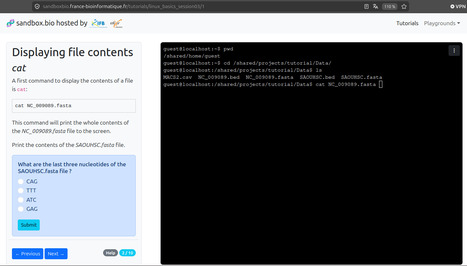
Master Unix for bioinformatics with a free, progressive skills sheet and interactive Sandbox.bio tutorials—no install needed! Check it out here: https://sandboxbio.france-bioinformatique.fr/ As data generation in life and health sciences accelerates, mastering core bioinformatics skills—especially Unix command-line proficiency—has become essential. In response, the e-learning working group of the IFB (Institut Français de Bioinformatique), in which Claire Toffano-Nioche from the BIOI2 facility of I2BC participates, developed a progressive Unix skill sheet tailored for life scientists with little or no prior experience, recently published in PLoS Comput Biol. This skills sheet summarises the most commonly used Unix commands in the field of bioinformatics. Skills are organised according to increasing levels of difficulty and thematic groups and are cumulative, meaning that skills acquired at a given level are required at the next level. Each skill has been defined operationally by following Bloom's taxonomy of learning objectives. This framework can be freely reused (CC BY 4.0) - by learners as well as tutors - and serves as inspiration for defining the competencies or prerequisites of a training course, or for evaluating the level of a student. Following this sheet, the e-learning working group directly implemented progressive, interactive sessions that can be used for self-paced learning or in classroom settings. These sessions are deployed via Sandbox.bio, an open-source platform leveraging WASM (WebAssembly) technology. This ensures seamless access from any browser—no installation required—while enabling computations to run locally on the user’s machine. To further support self-paced learning, BIOI2 also offers autotraining course materials on their website (https://bioi2.i2bc.paris-saclay.fr/training). These resources draw inspiration from—and contribute back to—multiple open courses, including those from the IFB, creating a collaborative cycle of shared knowledge and continuous improvement. More information: Contact: contact-bioi2@i2bc.paris-saclay.fr
|
|
Scooped by
I2BC Paris-Saclay
May 11, 2:59 AM
|
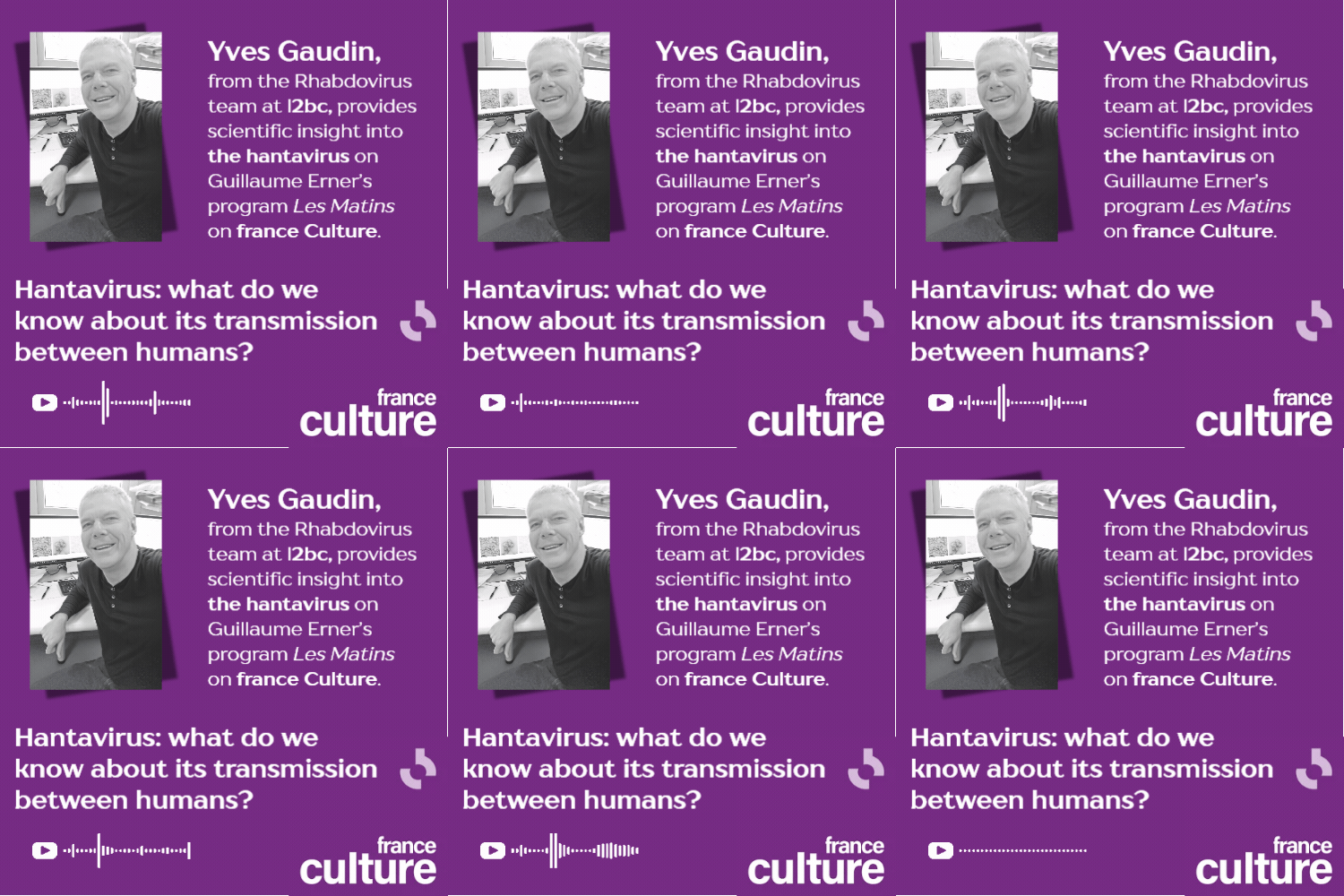
Yves Gaudin de l'équipe Rhabdovirus à L'i2BC apporte un éclairage scientifique sur l'hantavirus dans Les Matins de France Culture de Guillaume Erner.
|
|
Scooped by
I2BC Paris-Saclay
May 4, 4:38 AM
|
PizzaTech - Workshop: the 3rd technical and scientific event organised by the I2BC’s Imagerie-Gif facility in collaboration with Leica Biosystems.
In March, the 3rd PizzaTech-Workshop took place—a technico-scientific event organized by the Imagerie-Gif facility of the I2BC. Benoit Maury from Leica Biosystems presented the brand-new THUNDER Imager Cell photonic microscope equipped with a Spinning Disk (CICERO), a setup designed for live cell imaging. This allows the observation of rapid cellular biological phenomena in real-time and 3D, thanks to two key components: - Optics: The spinning disk provides optical sectioning and reduces phototoxicity.
- Image Processing: The THUNDER application eliminates out-of-focus residual light, enhancing contrast and resolution to reveal finer details.
PizzaTech & Presentation: After enjoying pizza, researchers explored the technical and functional features of the system, including: - Confocal spinning disk and widefield modalities, both compatible with THUNDER image processing.
- Key applications: live cells, 3D cultures, organoids, spheroids, thick tissues, and model organisms.
Demo Week on the Photonics Microscopy Facility – Imagerie-Gif: Researchers, PhD students, and engineers tested the THUNDER Imager Cell / Spinning Disk CICERO with their own samples for a week. The setup included: - Spinning Disk CICERO module (pinhole size: 50 µm; pinhole spacing: 250 µm; disk rotation speed: ~15,000 rpm; field of view: 22 mm).
- Excitation lasers (405, 470, 555, 640 nm).
- Two sCMOS cameras (Hamamatsu Fusion; Photometrics Kinetix22).
- Inverted microscope (Leica DMi8) with motorized AFC (Adaptive Focus Control).
The system was fully equipped with: - THUNDER 2D/3D (opto-digital clarification).
- Adaptive Immersion (stabilized water objectives).
- SmartCORR (automatic aberration correction).
- Sample Finder (automatic sample navigation).
- Incubator for live cell imaging.
Participating Research Teams: - Institut des Neurosciences Paris-Saclay
- I2BC (teams: Giordano / Lipid trafficking and membrane contact sites, Le Clainche / Cytoskeleton dynamics and motility, Kühl / Mammalian mitochondrial gene expression in health and disease, Urvoas / B3S Protein Engineering and Modeling, Imagerie-Gif facility engineers)
- Institut Curie Orsay
- Genethon
Image credits: - Esther GIL HERNANDEZ, Equipe de GIORDANO Francesca, ERL INSERM. Lipid trafficking and membrane contact sites
- Sharbatanu CHATTERJEE & Md Amit HASAN, Institut NeuroPSI - UMR9197, Circuits neuronaux & comportement
- Aleksandr BALATSKII, Genethon
- Light Microscopy facility, Imagerie-Gif.
More about the THUNDER Imager Cell Spinning Disk: https://www.leica-microsystems.com/products/light-microscopes/p/thunder-imager-cell-spinning-disk/ More information about the facility: https://www.i2bc.paris-saclay.fr/bioimaging/
|
|
|
Scooped by
I2BC Paris-Saclay
September 22, 8:11 AM
|
JIP3 and JIP4 proteins: much more than simple adapters for vesicle transport.
The JIP3 and JIP4 proteins (JIP3/4) do not merely serve as adapters linking the molecular motors kinesin-1 and dynein to their vesicular cargoes for bidirectional transport along microtubules. They also act as key regulators of this transport, capable of activating these motors by relieving their autoinhibited state. In a recent study published in the Journal of Biological Chemistry, scientists from I2BC (CNRS/CEA-Jacob/Université Paris-Saclay, Gif-sur-Yvette) characterized the interaction between JIP3/4 and KIF5B in vitro. To do this, they employed molecular biology techniques alongside a biophysical approach known as MicroScale Thermophoresis (PIM platform, I2BC). The study identified the minimal regions of these proteins required for their interaction: the N-terminal N-RH1 domain of JIP3/4 and the CC4 region of KIF5B. An unexpected discovery emerged from the study: JIP3 and JIP4 exhibit a 40-fold difference in affinity for KIF5B. To further investigate these mechanisms, the researchers conducted extensive site-directed mutagenesis on the N-RH1 region of JIP3/4, targeting accessible charged residues and sequence differences between JIP3 and JIP4. Their results reveal the existence of multiple negatively charged, low-affinity binding sites and the involvement of the unstructured N-terminal domain; together, these elements define an extensive interaction surface with KIF5B on the JIP3 N-RH1 domain.
This work sheds new light on how JIP3/4 might relieve kinesin-1 auto-inhibition. Indeed, in its auto-inhibited form, kinesin-1 is stabilized by the CC4 region. By interacting extensively with the latter, JIP3/4 destabilize this conformation, thereby enabling activation of the molecular motor. More information : https://www.jbc.org/article/S0021-9258(26)02227-1/fulltext Contact : Paola Llinas paola.llinas@i2bc.paris-saclay.fr and Julie Ménétrey julie.menetrey@i2bc.paris-saclay.fr
|
|
Scooped by
I2BC Paris-Saclay
September 14, 5:09 AM
|
Sensing forces: How plants convert mechanical cues into biological responses
Plants adapt their growth to the mechanical stresses of their environment, such as wind, for example. However, the mechanisms by which a mechanical stimulus is translated into a biological response are only just beginning to be understood. Plants encounter mechanical constraints from environmental forces and morphogenesis. Sensing these constraints induces downstream responses that are crucial for plant development and its plasticity in a changing environment. Here, we first provide an overview of the mechanical constraints acting on plants at multiple scales, ranging from organelles to organs. We then focus on the coupling between mechanical stimuli and biological signaling, referred to as mechanotransduction. We highlight distinct modes of coupling, including the sensing of lipid compaction and cell wall status by receptors and channels, as well as the mechanically induced reorganization of cellular components such as the cytoskeleton and plasma membrane. Finally, we discuss the diversity of downstream responses triggered by mechanotransduction and their temporal dynamics.
We propose that the diversity of mechanotransduction modalities allows plants to decode mechanical signatures characterized by specific stimulus intensities, durations, and frequencies, thereby eliciting adaptive cellular and developmental responses. More information: 10.1016/j.devcel.2026.05.003 Contact: Sébastien Thomine sébastien.thomine@i2bc.paris-saclay.fr
|
|
Scooped by
I2BC Paris-Saclay
September 4, 4:22 AM
|
Different Photons, Same Chemistry: Identical Mechanism and Efficiency of Fatty Acid Photodecarboxylase under Blue and UV Excitation.
Blue or violet, FAP plays by the same rules: both wavelengths trigger the same photocycle with identical efficiency, intermediates, and products, overturning the proposed model of violet-enhanced activity. Fatty acid photodecarboxylase (FAP) is a promising photoenzyme for light‑driven hydrocarbon synthesis and a versatile chassis for photobiocatalysis. A recent study proposed that UV/violet illumination enhances FAP activity relative to blue light by accessing a distinct, more efficient photochemical regime. Here, steady-state and time‑resolved fluorescence, transient absorption spectroscopy under single‑turnover conditions, and product quantification under continuous irradiation show that the quantum yield of decarboxylation, the identities and kinetics of reaction intermediates, and the overall chemical yield are identical for blue and UV/violet excitation. These findings establish that FAP operates through a single, wavelength‑independent photocycle, overturning the proposed “violet‑enhanced” reactivity model. More information : https://doi.org/10.1021/acscatal.6c04891 Contact : pavel.muller@i2bc.paris-saclay.fr
|
|
Scooped by
I2BC Paris-Saclay
August 3, 9:14 AM
|
Training session on TEM in cell biology - 13-16 October 2026
|
|
Scooped by
I2BC Paris-Saclay
July 20, 9:20 AM
|
Study on protein–bicelle interactions using switchSENSE technology with the PIM facility at I2BC
Using bicelles as membrane mimetics and switchSENSE technology available at the PIM facility, we uncover new insights into the dynamic mechanisms governing weak protein–membrane interactions, revealing how proteins recognize and interact with membrane environments. To investigate the association of human dystrophin with biomimetic phospholipid bicelles, we employed switchSENSE®, a fluorescence-based biosensing technology that relies on dynamic DNA nanolevers operating in a microfluidic environment while requiring only minimal sample amounts. We demonstrate that this technology enables real-time kinetic analysis of weak and transient interactions, providing a significant advantage over conventional biophysical methods, which often struggle to detect low-affinity protein–lipid binding events. Focusing on two functionally relevant fragments from the central rod domain of dystrophin (R1-3 and R11-15), we quantified their interactions with zwitterionic and anionic bicelles using two complementary experimental configurations: either the proteins were immobilized and the bicelles served as analytes, or vice versa. Both approaches yielded consistent micromolar affinities, in agreement with our previous microscale thermophoresis data, while additionally providing association and dissociation rate constants. This study represents the first kinetic characterization of dystrophin–bicelle interactions. Our results reveal that the observed low affinity is largely driven by the rapid dissociation of the resulting complexes. Notably, the R11-15 fragment displayed a faster association rate and a slower dissociation rate than R1-3, indicating a more stable and long-lasting interaction with lipid assemblies. Beyond providing new mechanistic insights into the reversible membrane association of dystrophin—a process thought to contribute to maintaining sarcolemmal integrity during cycles of muscle contraction and stretching—our work highlights switchSENSE® as a versatile platform for quantifying weak protein–lipid interactions. By delivering kinetic resolution for interactions that lie at the detection limits of conventional techniques, switchSENSE® offers a powerful approach for investigating the dynamic interplay between structural proteins and lipid assemblies. For more information: Article: https://link.springer.com/article/10.1007/s00249-026-01829-4 Contact: sophie.combet@i2bc.paris-saclay.fr ; paloma.fernandez-varela@polytechnique.edu Facility web site: https://www.i2bc.paris-saclay.fr/structural-biology/pim/
|
|
Scooped by
I2BC Paris-Saclay
June 16, 4:34 AM
|
Reassessing Carotenoid Photophysics: Shedding Light on Dark States.
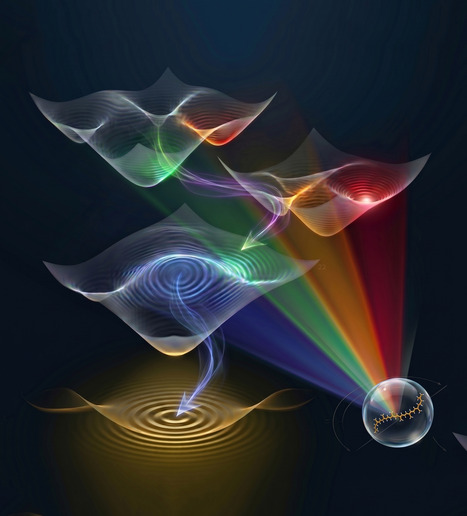
The dark excited states of carotenoids have been debated for decades. Researchers at I2BC now use femtosecond stimulated resonance Raman spectroscopy to determine the nature and symmetry of three of them, resolving controversies that have long obscured our understanding of photosynthetic light harvesting. Carotenoid molecules are critical in photosynthesis, performing functions at the heart of both light-harvesting and photoprotection. As both these processes involve excitation energy transfer, fully understanding them requires a precise description of the electronic states involved. The excited-state manifold of carotenoids is not yet fully characterised, and includes several dark electronic states that remain elusive. Using femtosecond stimulated resonance Raman spectroscopy, where the vibrational contributions of each excited state can be observed selectively as a function of the Raman excitation, we reveal the nature and symmetry of no less than three different dark states. These results end long-standing controversies in carotenoid research, shining new light on the photophysics of these essential molecules and establishing a spectroscopic framework for characterising their multiple roles. The figure is an artistic representation of the excited states in carotenoids. More information : https://pubs.acs.org/doi/10.1021/jacs.6c03864 Contact : Manuel Llansola-Portoles manuel.llansola-portoles@i2bc.paris-saclay.fr
|
|
Scooped by
I2BC Paris-Saclay
June 10, 9:28 AM
|
The final of the interuniversity 3-Minute Thesis (3MT®) competition
Linnéa Strandberg, PhD student from Photobiology, Photosynthesis, Photocatalysis team in I2BC, will present her thesis project “When breaking the heart of a plant”. The Institut Polytechnique de Paris will host the final of the interuniversity 3-Minute Thesis (3MT®) competition. Developed by The University of Queensland, the 3MT® is more than a competition—it’s a platform for PhD students to strengthen their communication skills in english and share their research with a non-specialist audience in a clear and engaging manner.
Join on June 25, from 2:00 pm to 4:00 pm at Télécom Paris (Thévenin lecture hall) to support the finalists and vote for the Audience Award (free registration required): https://www.ip-paris.fr/form/3-minute-thesis-registration.
|
|
Scooped by
I2BC Paris-Saclay
June 8, 9:13 AM
|
3R 2026: A Great Edition in La Grande-Motte
The 3R Congress brings together researchers working on DNA Replication, Repair and Recombination, from fundamental molecular mechanisms to clinical applications, promoting scientific exchange within the community. Twenty-two participants from the B3S and Genome departments of I2BC attended the 16th 3R Congress, which took place in La Grande-Motte from May 18 to 21, 2026. High-quality science, lively discussions and a friendly atmosphere once again made this edition a great success. Many thanks to all our sponsors, and especially to I2BC, for their valuable support.
Rencontre-Dédicace avec Frédéric Boccard, Mireille Bétermier, Sarah Lambert et Bernard Dujon Le 1er Juillet 2026 de 19h00 à 20h00 Librairie Liragif 15 Square de la Mairie , 91190 Gif-sur-Yvette Pour Génomes, la construction du vivant paru aux éditions CNRS Une présentation des génomes, de leur séquençage et des innovations permises par leur analyse en biologie. Les auteurs exposent comment l'étude de cette information génétique permet de dévoiler les mécanismes de l'évolution, de retracer l'histoire adaptative des espèces ou encore de décrypter le fonctionnement intime des virus. Frédéric Boccard est directeur de recherche CNRS, directeur de l’Institut de Biologie Intégrative de la Cellule – I2BC (CNRS/CEA/UPSaclay, Gif-sur-Yvette). Il sera accompagné de Mireille Bétermier directrice de recherche à l'I2BC, Sarah Lambert et Bernard Dujon. -> Contact : frederic.boccard@i2bc.paris-saclay.fr
Via Life Sciences UPSaclay
|
|
Scooped by
I2BC Paris-Saclay
May 13, 4:22 AM
|
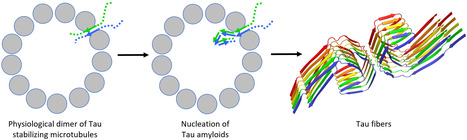
A coherent structural picture of the interaction of Tau with tubulin provides a link to its aggregation.
Tau is a protein regulating microtubule dynamics which also forms neurofibrillary tangles in pathological conditions. Recent results suggest that a physiological dimer of Tau could serve as a nucleus for its aggregation. Tauopathies are a group of neurodegenerative diseases characterized by the presence of insoluble filaments of the Tau protein in the brain. In physiological conditions, Tau is involved in the regulation of microtubule dynamics. The study of its interaction with different tubulin assemblies, using various experimental approaches, leads to a seemingly disparate picture. In this opinion-type article, we integrate this information into a model of how Tau participates in microtubule assembly and stabilization. Related to its intrinsically disordered nature, the binding of Tau to microtubules involves both specific interactions, along protofilaments, and non-specific ones, with the C-terminal region of tubulin subunits. In addition, a Tau:tubulin structure that we recently determined leads to a model of a functional Tau dimer targeting a microtubule aperture between protofilaments. This model also provides a framework for a Tau aggregation that would be initiated on the microtubule. More information : https://www.jbc.org/article/S0021-9258(26)01958-7/fulltext Contact : Benoît Gigant benoit.gigant@i2bc.paris-saclay.fr
|
|
Scooped by
I2BC Paris-Saclay
May 11, 4:50 AM
|
The Rapid Mechanically Activated channel transduces increases in plasma membrane tension into transient calcium influx
In Arabidopsis, RMA ion channel is a candidate for mediating cytosolic calcium signaling in response to high frequency mechanical stimulation. Plants respond to mechanical stimuli by a rapid increase in cytosolic calcium. The intensity and kinetics of the calcium changes define calcium signatures important for biological responses. In this study carried in the BioCell department of I2BC , we determine the properties of a calcium-permeable force-gated channel localized at the plasma membrane called Rapid Mechanically Activated (RMA).
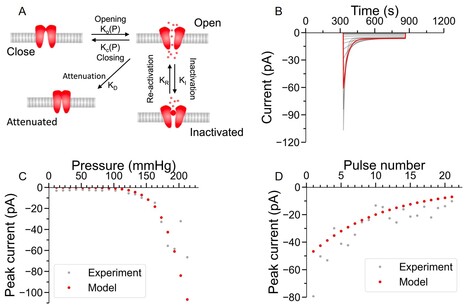
Using patch clamp and pressure clamp, we characterized the kinetics of the Arabidopsis thaliana RMA channel upon stimulation by pressure pulses applied onto the plasma membrane. Combining pressure pulse protocols at different frequencies with modeling, we investigated the channel's capacity to transduce high frequency mechanical stimuli.
The RMA channel rapidly activates in response to membrane tension, then it inactivates during prolonged stimulation. Upon repeated stimulations, the RMA current amplitude decreases irreversibly indicating that it undergoes attenuation. The channel kinetics were modeled with four chemical states and the model predicts that it behaves as a pass band filter in the 10 Hz–1 kHz range.
In conclusion, due to its activation/inactivation, the RMA channel is a candidate for mediating cytosolic calcium signaling in response to mechanostimulation. Its attenuation and filtering properties suggest its involvement in the transduction of high frequency mechanical stimulation, such as those produced by insects' vibrations.
More info: http://doi.org/10.1111/nph.71241 Contact: jean-marie.frachisse@i2bc.paris-saclay.fr
|
|
Scooped by
I2BC Paris-Saclay
May 7, 7:30 AM
|
Programmed DNA Elimination in Paramecium: towards the third dimension
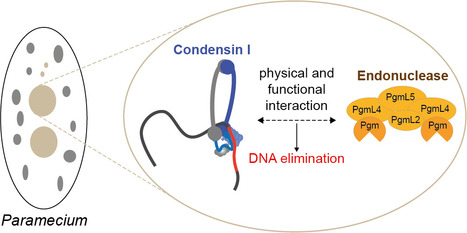
A condensin I complex, known for shaping chromosome organization in eukaryotes, is essential to DNA elimination in Paramecium During development, many organisms eliminate specific germline DNA sequences to shape their somatic genome. But how do cells target which sequences to remove? The team “Programmed Genome Rearrangements” has addressed this question in the ciliate Paramecium tetraurelia. Because of its nuclear dimorphism, this unicellular eukaryote provides a powerful model to study somatic differentiation at the genomic scale. At each sexual cycle, a new somatic macronucleus (MAC), specialized for gene expression, is formed from a copy of the germline micronucleus (MIC), inherited from the previous generation. This process involves the elimination of one third of germline sequences, including transposable elements and satellite DNA, to ensure proper gene function and progeny survival.
In collaboration with scientists from the Institut Jacques Monod, the authors have uncovered a surprising new role for a development-specific condensin I, a complex from the SMC family (Structural Maintenance of Chromosomes) generally known for organizing chromosomes in three dimensions. Using TurboID and protein co-immunoprecipitation, combined with quantitative mass spectrometry, we found that the developmental condensin I complex interacts with the PiggyMac (Pgm) endonuclease, an enzyme essential for cutting and removing specific germline DNA sequences during MAC development. High-throughput sequencing of the DNA extracted from purified new MACs revealed that when cells are depleted of condensin I, the germline genetic material is massively retained in the somatic genome. This demonstrates that condensin I plays a key part in programmed DNA elimination.
This discovery suggests that 3D genome organization may help target which sequences are removed. The condensin complex localizes to the developing new MAC, where it stabilizes Pgm and its partners. However, the exact level at which spatial genome architecture influences PDE remains an open question. More info: https://doi.org/10.1093/nar/gkag351 Conatct: Mireille Bétermier mireille.betermier@i2bc.paris-saclay.fr
|