Your new post is loading...
The evolution of the modern corporation is the fascinating story of a series of self-serving legal and societal mutations over hundreds of years, which have morphed the original concept and endowed corporations with freedom of activity, rights, and limitations on liability that would shock their original “inventors”. As we all know, for many years most corporations were established by way of an exceptional “charter” by a sovereign, granted only in specific cases where: (a) large amounts of capital were needed (b) to conduct investments and activities that served public or national interests and had good profit potential, but (c) where the risks were so large that few parties would invest if their risk were not shared with many others and/or limited to the amount of money they invested. In the 1600s and 1700s, the activities that sovereign nations felt met those requirements were the exploration of foreign lands on the other side of the globe, the creation and administration of colonies there, and conducting lucrative trade on long (and dangerous) sea routes to and from those colonies. Thus, the most well-known early corporations include organizations such as the British East India Company (the original “too-big-to-fail company), The Dutch East India Company, the Hudson’s Bay Company, and companies to construct the Erie Canal.
U.S.-China relations have not been so tense since before President Jimmy Carter and Chinese leader Deng Xiaoping agreed to exchange ambassadors in 1979. Attitudes have hardened especially in the last two months, in part because of the Covid-19 pandemic, and in part because of the troubling developments in Hong Kong. Some voices in the Washington establishment are even advocating a “decoupling” of the deep, complex business connections between the two countries that have been built up over decades. [...] To understand their China risks, U.S. executives and boards need to start a discussion. As we see it, the agenda should include the following five questions:
(1) Are we too dependent on Chinese supply chains?
(2) Are we too dependent on sales to China?
(3) What is our exposure to legal changes in Hong Kong?
(4) How much should we collaborate with Chinese companies?
(5) How secure are our company’s IT systems?
The economic disruptions caused by COVID-19 are causing many to question whether a new wave of investment losses are on the horizon and whether a corresponding wave of investor-led litigation reminiscent of financial crisis era litigation will follow. In a significant decision for defendants, the New York Supreme Court Commercial Division recently reminded would-be plaintiffs of the challenges of proving a fraud claim arising out of investment losses in times of crisis; critically, it requires proving that the alleged fraud—and not the intervening crisis—caused the plaintiff’s loss. On Friday, May 8, 2020 the New York Supreme Court Commercial Division entered an order granting summary judgment in favor of Merrill Lynch, dismissing an investor plaintiff’s fraud claim arising out of its investment in a 2006 collateralized debt obligation (“CDO”) that had been arranged by Merrill Lynch. [1] The court dismissed the plaintiff’s claim because the plaintiff failed to raise a triable issue of fact demonstrating that its investment losses in the CDO were caused by Merrill Lynch’s alleged misrepresentations or omissions, as opposed to the broader 2007-2009 financial crisis that affected the entire CDO market. This decision, arising from the financial crisis of over a decade ago, highlights the significant hurdle for investors contemplating securities fraud actions arising out of the COVID-19 pandemic.
As of this writing, the US COVID-19 pandemic impacts include 100,000 dead and almost 40 million newly unemployed. The reopening process is anticipated to yield a “roller coaster” recovery in which businesses will restart and then shut down again in response to workforce and regional outbreaks. Although all members of society are affected by this extended crisis, the pain is unequally distributed, with front-line workers and people of color among the hardest hit. The pandemic is testing all of us, and it is also a litmus test for the 2019 pledge of 183 corporate CEOs to operate their businesses in the interests of employees, consumers, suppliers, and communities, as well as shareholders. [...] If stakeholder capitalism is to be made real, shouldn’t there be corresponding rules and concepts of stakeholder governance? Isn’t there a need for a coherent set of legal and operational principles for implementation? How will the fiduciary duties of directors and executives change to reflect these new commitments?
Investors and companies increasingly focus on corporate social responsibility (CSR). For example, Larry Fink, the CEO of BlackRock, the world’s largest asset manager, argued in 2020 that, “… a company cannot achieve long-term profits without embracing … the needs of a broad range of stakeholders,” such as customers, employees, suppliers, and the communities where the company operates. In 2019, the Business Roundtable, a group of U.S. CEOs, committed to investing in their employees, dealing fairly and ethically with suppliers, and protecting the environment. Moreover, about 1500 international companies with almost $90 trillion of assets were signatories to the United Nations-supported Principles for Responsible Investing. While many companies express support for CSR, CSR activities differ markedly across firms and countries, raising questions about what determines CSR.
The coronavirus disease 2019 (“COVID-19”) outbreak continues to impose significant and unprecedented economic harm and uncertainty for companies across numerous sectors. As companies continue to evaluate the impact of the pandemic on stock market volatility and company performance, an important issue to be addressed from both a private and public company perspective is how to address the impact of the pandemic on performance-based compensation; specifically, establishing new performance-based compensation awards for 2020, adjusting existing performance goals for both annual and long-term incentive compensation and revisiting the form and vesting terms for equity-based compensation. This post discusses selected issues that companies may face and strategies that companies may take to continue to retain top talent, with the ultimate goal of ensuring alignment between the goals of companies and the incentives of their key employees during this challenging period.
S&P Global, Northern Trust and T. Rowe Price recently announced the expansion of their ESG analytics offerings: S&P Global has launched its proprietary S&P Global ESG Scores which covers more than 7,300 companies; Northern Trust has launched its ESG Analytics Summary which provides investors with snapshots of their portfolio’s ESG performance; and T. Rowe Price moved forward with deep integration of their proprietary “Responsible Investing Indicator Model” (RIIM) into buy-side investment professional analyses of individual companies and overall portfolio holdings and plans to implement portfolio-level ESG reporting into certain product offerings. The S&P Global ESG Scores use data from the SAM Corporate Sustainability Assessment (CSA), an annual evaluation of companies’ sustainability practices which was acquired by S&P Global from RobecoSAM last year. Northern Trust has partnered with ratings agency IdealRatings to provide data for its ESG Analytics Summary. T. Rowe Price’s RIIM builds an environmental, social and ethical profile for companies and the overall portfolio, and the UN Sustainable Development Goals are represented across the range of RIIM-measured factors.
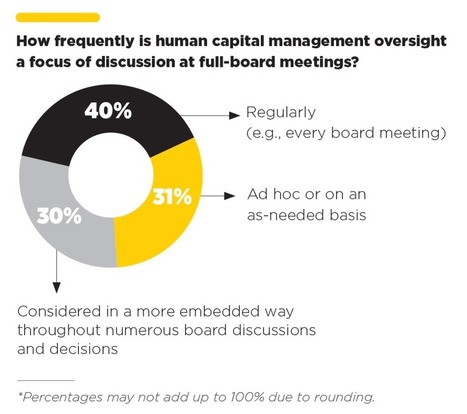
The focus on human capital and talent in corporate governance is intensifying, as more stakeholders—led by large institutional investors—seek to understand how companies are integrating human capital considerations into the overarching strategy to create long-term value. After all, a company’s intangible assets, which include human capital and culture, are now estimated to comprise a significant portion of a company’s market value. Many influential groups, including the Global Reporting Initiative, the Embankment Project for Inclusive Capitalism, the Business Roundtable and the Sustainability Accounting Standards Board (SASB), have identified human capital as a key driver of long-term value. Recent developments reflect a clear and growing market appetite to understand how companies are managing and measuring human capital. This includes influential investors making human capital an engagement priority with directors, as well as comment letters from various stakeholders to the U.S. Securities and Exchange Commission supporting greater human capital disclosure and asserting the importance of human capital management in assessing the potential value and performance of a company over the long term.
Does weak investor protection exacerbate capital fragility? In this paper, we examine this issue within an important investment vehicle—hedge funds—across countries that differ substantially in the quality of their institutions, as reflected in country-level investor protection. Hedge funds are lightly regulated investment vehicles with minimal disclosure requirements. Consequently, investors may lack relevant information to assess the operational risks of the investment manager. Specifically, the absence of regulatory oversight can increase the risk of management fraud and, in turn, generate large losses for fund investors. In addition, hedge funds’ use of leverage can expose investors to the risk of fund failure and legal risks related to asset recoveries during liquidation proceedings. We contend that, in environments with weak legal rules related to investor protection and poor enforcement of these rules, concerns about operational risks are amplified. Hence, in such environments, funds experience more outflows of investor capital following poor performance and, in this sense, exhibit greater fragility.
In the current climate of market volatility prompted by the COVID-19 pandemic, more and more public companies with valuable US tax assets (e.g., net operating loss carryforwards) may, or at least should, consider adopting a shareholder rights plan in order to preserve those tax assets. These plans are commonly referred to as “NOL rights plans” (or “NOL poison pills”). An NOL rights plan is a variation on the traditional takeover defense rights plan, but is designed to protect a corporation’s US NOL carryforwards and other US tax attributes, rather than simply deter takeovers and other hostile attacks not supported by the board of directors. NOLs and other tax attributes can be irreversibly limited if the corporate stock undergoes an “ownership change” (as determined under US tax principles), which can be triggered by certain acquisitions of the corporation’s stock. An NOL rights plan is intended to discourage acquisitions of the stock that might trigger an ownership change.
Should firms target short-term objectives or long-term performance? The question of the optimal horizon of corporate policies has received considerable attention in recent years, with much of the discussion focusing on whether short-termism destroys value. The worry often expressed in this literature is that short-termism—induced, for example, by stock market pressure—may lead firms to invest too little (see Asker, Farre-Mensa, and Ljunqvist, 2015; Bernstein, 2015; Gutierrez and Philippon, 2017, for empirical evidence). Another line of argument recognizes, however, that while firms must invest in their future if they are to have one, they must also produce earnings today to pay for doing so. In line with this view, Giannetti and Yu (2018) find that firms with more short-term institutional investors suffer smaller drops in investment and have better long-term performance than similar firms following shocks that change an industry’s economic environment.
In periods of market stress and volatility, a company may find itself with an acute need for additional sources of financing and liquidity. Whether to finance existing operations or acquisitions, to refinance existing debt or to build a cushion of available cash in periods of uncertainty, a PIPE (private investment in public equity) transaction offers public companies an attractive source of capital. Issuers in need of capital and investors looking to deploy funds nimbly are attracted to PIPE transactions—an investment in a private, non-registered issuance of securities in a public company—because they can be done quickly and discretely without disclosure to the market until a deal is signed. PIPEs enable parties to tailor investment terms to their commercial goals and, particularly for the issuer, signal to the market that it is worthy of investment by sophisticated investors.
The novel coronavirus (COVID-19) pandemic has posed unprecedented health risks and has led to global economic disruptions. The World Economic Forum (WEF), an international organization that fosters public-private cooperation on global, regional and industry agendas, released this month the “Stakeholder Principles in the COVID Era” (Stakeholder Principles) as part of its COVID Action Platform and called businesses to action stating that, during this time of crisis, “[t]he business community’s contribution: [is] to be leaders of responsiveness and stewards of resilience.” In January 2020, the WEF made headlines by issuing its Davos Manifesto 2020, challenging companies to incorporate stakeholders into their corporate purpose, as well as issuing, through its International Business Council (IBC) a draft corporate sustainability disclosure framework, “Towards Common Metrics and Consistent Reporting of Sustainable Value Creation.”
|
(A) Stock ownership guidelines are a common element of today’s pay programs for executives and directors which reinforce one of the key objectives of equity awards: building and maintaining stock ownership over an individual’s career.
(B) Compliance with those guidelines can be problematic in times when there is considerable volatility in financial results and stock prices as most companies are currently experiencing.
Companies may want to examine the structure and administrative practices associated with their guidelines to ensure they align with the spirit and intent behind them.
(C) Some companies already have guideline provisions that mitigate stock price volatility (e.g., using an average stock price to assess ownership compliance) and recognize the highest long-term incentive weighting is typically on performance shares (e.g., not fixed time for compliance).
(D) Ownership guideline designs and administrative provisions can and should vary by company, recognizing there is no universal approach mandated by the Securities and Exchange Commission or the stock exchanges.
With only one month remaining in the 2020 proxy season, an examination of early voting statistics [1] among Russell 3000 companies reveals that climate-related investor concerns are having a meaningful impact on the 2020 season. This is not surprising given the focus paid to this topic by both BlackRock and State Street in their respective CEO letters published in January of this year. We saw this impact not only through increased support for climate-focused shareholder proposals, but also as a notable factor influencing the degree of support for director elections. The impact of climate concern is affecting other “traditional” governance-focused shareholder proposals as well, such as those seeking to separate the roles of board chair and CEO. Beyond climate-focused proposals, an examination of environmental and social (E&S) shareholder proposals generally shows that diversity-focused proposals are also garnering significant shareholder support this season. A look at governance shareholder proposals illustrates that measures seeking to remove supermajority vote requirements, implement shareholder rights to act by written consent or to call a special meeting are still receiving strong shareholder support. Support for proposals seeking to separate the roles of chair and CEO appears to be increasing significantly this season.
It is accepted almost as a truism that without robust and efficiency-driven legal institutions, markets are limited in their ability to sustain capital market growth. Beyond early stages of market development, local alternatives are expected to give way to certain traits of corporate capitalism if further growth is to be achieved. This prevailing expectation is shared among development theorists, law and finance researchers, and comparative corporate governance scholars and has been the basis of rich academic writing and international policy. Four decades of economic development in China challenge these conventions. In my paper The Politicization of Corporate Governance—A Viable Alternative?, forthcoming in the American Journal of Comparative Law, I contrast the prevailing approach above with the role played by political institutions in the governance of Chinese firms. Despite their apparent similarities, Chinese public firms, and the domestic capital markets within which they operate, sustain strong idiosyncrasies that go against many fundamentals in economics and legal thought. China’s public firms continue to rely on political influence as a substitute for conventional notions of sound corporate governance. With modern firms with global prominence and a capital market that is the second largest in the world, corporate governance in China seems to have passed the point of an “adjust or perish” prognostic.
After steady annual increases over the past decade, the number of VSMs jumped significantly in the first five months of 2020. [1] This is due to several factors related to the COVID-19 pandemic, including: social distancing guidelines from federal, state, and local authorities that dissuade groups of people from gathering; company travel restrictions on management, directors, and staff; and temporary permission to hold “virtual-only” shareholder meetings by several states that otherwise restrict them. Apart from factors related to the pandemic, the number of VSMs was expected to increase modestly year-over-year as familiarity with them grows among companies and shareholders, and as the greater shift toward digital communications unfolds. [...] Key Metrics for VSMs Held between January 1 and May 22, 2020:
Total Number of Meetings: 860 [3]
Average Duration of Meetings: 22 minutes
Average Attendance: 59 shareholders and guests [4]
Average Number of Shareholders Voting ‘Live’ at the Meeting: 4 (highest 178)
Average Number of Questions from Shareholders: 6 (highest 316)
Shareholder Proposals: 132 meetings had one or more shareholder proposals.
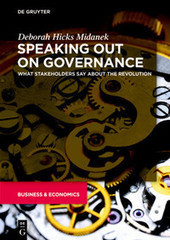
Speaking Out on Governance presents a range of viewpoints concerning the role of today’s corporation and its board of directors. The author engages in candid discussion with subject matter experts including boardmembers, corporate attorneys, academics, institutional investors, regulators, and activists. These interviews of leading authorities in the corporate governance arena provide the reader with unique insight into the vitally important but often misunderstood role played by the board. Deborah Hicks Midanek discusses perspectives regarding what directors of businesses actually do and should do; the true motivations and concerns of the various parties seeking to influence corporate behavior; legal issues surrounding the board; and the key similarities and differences of opinion that may help improve effectiveness of all parties and increase board and director effectiveness. This book is essential reading for corporate directors and would-be directors, senior managers, attorneys, consultants and anyone interested in what drives organizational behavior.
Posts published by the Harvard Law School Forum on Corporate Governance have had considerable influence on the discourse and literature in the field of corporate governance, as measured by citations of Forum posts. Since the Forum was established in 2006, Forum posts have been cited more than 1400 times, and such citations have appeared in more than 800 articles. [...] Established in 2006 by Professor Lucian Bebchuk and the Harvard Law School Program on Corporate Governance, the Forum has become the leading online resource and the central outlet for the exchange of ideas and debate in the field of corporate governance. In an article about the Forum that was featured in the Harvard Law Bulletin a few years ago, former Chief Justice Leo Strine observed that “[i]t is amazing to see the [Forum] become required reading among the intelligentsia … of corporate governance.” The success of the Forum has been made possible by the contribution of numerous authors, as well as by the engagement of the Forum’s ever-growing readership. As we celebrate another record-breaking year, we are deeply grateful for the support of our contributors and readers and look forward to continued fruitful engagement!
At its core, the director role is primarily one of stewardship rather than execution. While “pay for performance” has become a mantra for executive compensation in the last decade, the concept does not extend in the same way to director pay. Rather, director pay structures are oriented toward compensating for time commitments and leadership. Retainers and per-meeting fees for board and board committee services reflect the time spent on company-related activities. Supplemental retainers for board chairs, lead directors, and board committee chairs reward the additional responsibility of service in leadership positions. To be sure, equity grants are widely used but, rather than being linked to specific performance measures, they are meant more generally to establish an ongoing interest in the long-term prospects of the business.
As leaders wrestle to guide their organizations through the Covid-19 pandemic, decisions running the gamut from where to sell to how to manage supply chains hinge on expectations about the future of globalization. The pandemic has prompted a new wave of globalization obituaries, but the latest data and forecasts imply that leaders should plan for — and shape — a world where both globalization and anti-globalization pressures remain enduring features of the business environment. The crisis and the necessary public health response are causing the largest and fastest decline in international flows in modern history. Current forecasts, while inevitably rough at this stage, call for a 13-32% decline in merchandise trade, a 30-40% reduction in foreign direct investment, and a 44-80% drop in international airline passengers in 2020[i]. These numbers imply a major rollback of globalization’s recent gains, but they do not signal a fundamental collapse of international market integration.
As noted in our earlier alert concerning securities fraud litigation under Section 10(b) of the Securities Exchange Act, the spread of COVID-19 and its effect on the global economy have caused extreme market volatility and, beginning in mid-February, the largest decline in stock prices since the 2008 financial crisis. Market volatility has historically precipitated increased securities litigation and might be expected to have an outsized impact on claims under the Securities Act, given rescissory damages and the absence of a requirement that plaintiffs plead and prove loss causation. [...] The following analysis of offerings during late 2019 and early 2020, immediately prior to and during the COVID-19-induced market volatility, and the Securities Act complaints filed against some of those issuers amid the market unrest provide preliminary insights into whether, when and on what basis recent issuers—and their underwriters and auditors—are facing Securities Act litigation.
COVID-19 has impacted virtually every aspect of our lives. Compliance pros may be wondering whether and how corporate compliance will ultimately be affected. Mark Delgado, Mitratech’s Managing Director of GRC, offers insights into how companies can meet compliance mandates as they emerge from COVID lockdowns. Once the planet has passed beyond the uncertainties of this outbreak, when the business world is on surer footing, what will corporate compliance look like? Will the systems and processes behind compliance be truly and deeply transformed, or will we return to the familiar, pre-pandemic ways of pursuing compliance?
We live in ever-changing times with the presence of COVID-19 affecting every aspect of our business and personal lives. The world of venture capital is not exempt. The outbreak has effectively curtailed, in record time, what had been a steadily growing market opportunity for venture-backed companies and investors. Over just a few weeks, venture-backed companies have shifted from seeking new paths to growth, to seeking new paths to merely survive. Likewise, companies must decide whether to raise money now or delay fundraising plans. Companies must make these decisions, and investors must make their investment decision, without significant time for deliberation and must consider the company’s current funding needs, any actual or potential market liquidity constraints, extended sales and payment cycles, and the economic outlook postpandemic.
New digital technologies have upended conventional business models, organizational structures, and operating processes in most industries. Almost every aspect of business — customer relations, supply chain management, after-sales service — has been radically altered. Nowhere is that more evident than in brick-and-mortar companies’ innovation processes. Facing tough competition from digital upstarts that are creating and capturing value in new ways, incumbents are trying to figure out how to keep up. While the need for innovation in the digital age may be an open-and-shut case, CEOs of these companies aren’t sure whether their innovation processes should be open, shut, or both. Many businesses that used to depend only on internal innovation have begun to tap external innovation to quickly acquire the digital capabilities they need to navigate the constant stream of new technologies.
|