Your new post is loading...
Nothing in either corporate or securities law requires companies to notify investors what they will be voting on before the record date for the meeting. In a forthcoming paper, we show that, overwhelmingly, they do not. The result is “hidden agendas”: for 88% of shareholder votes, investors cannot find out what they will be voting on before the record date. This poses an especially serious problem for investors who engage in securities lending: they must decide whether the expected benefit of voting exceeds the expected benefit of continuing to lend their shares (or making them available for lending) without knowing what they will be voting on. All investors who engage in share lending are affected, but the problem is particularly acute for large investment managers that have fiduciary duties related to voting. At present, they must discharge these duties in the dark

|
Scooped by
Institut sur la gouvernance (IGOPP)
August 11, 2021 10:52 AM
|
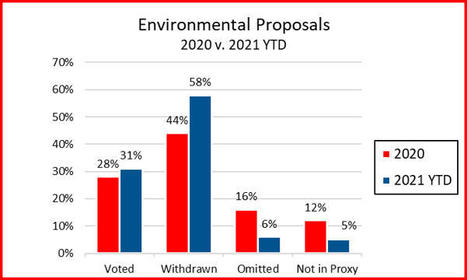
Shareholder proposals submitted on environmental matters and, in particular, climate-related proposals have increased for the second consecutive year, exceeding even the number of proposals submitted in 2018 following former President Trump’s withdrawal from the Paris Agreement in 2017 (115 in 2021 compared to 110 in 2018). The substantial majority (85) of these proposals were climate-related. [....] Environmental proposals were withdrawn at a meaningfully higher rate this year compared to last year. Given the increased focus of institutional investors (including BlackRock, Vanguard and State Street) on climate-related issues, many companies may have preferred engaging with a proponent rather than taking the proposal to a vote. Of the 115 environmental proposals submitted, over half (70 total) were withdrawn (compared to 39 in 2020).
|
|
Scooped by
Institut sur la gouvernance (IGOPP)
August 10, 2021 10:12 AM
|
Confidence in the institutions that form the bedrock of society is perilously low. Surveys show that many people have lost faith in government, the media, and the police, among other institutions. Meanwhile, corporations have emerged as leaders. They’re now the most trusted institution in the US according to the Edelman Trust Barometer. Maintaining this trust, and seizing the opportunities it presents, should be a priority for every company. [...] It’s one of the most important macro trends facing companies—and the world. As we continue our exploration of the board’s role in setting and overseeing strategy, let’s take a closer look at what directors need to know.
|
|
Scooped by
Institut sur la gouvernance (IGOPP)
August 5, 2021 11:26 AM
|
The year-long pandemic and economic lock-downs that denoted 2020 gave way to a dynamic 2021 annual meeting season as investors wielded their proxy votes to express their views on an array of environmental, social and governance proposals issues, executive compensation plans and corporate board quality and effectiveness. Environmental and social (E&S) resolutions drew some eye-popping support levels, including over a dozen on diversity, climate change and political spending that scored over 80% (see Table 1). A total of 34 E&S proposals have received majority support to date— surpassing last year’s record 21—and included six that were unopposed by the boards. Some newly emergent resolutions on racial audits, access to COVID-19 medicines and say-on-climate (SOC) advisory votes also did remarkably well for their first year, reaching vote averages in the 30% range.
|
|
Scooped by
Institut sur la gouvernance (IGOPP)
August 4, 2021 11:14 AM
|
Public officials face an inherent tension in getting feedback on proposed rules and regulations—the best-informed parties are also very likely those with an interest in seeking particular outcomes. If you’re interested in, say, the costs and benefits of green energy requirements, utility companies could surely provide expert advice on the costs and benefits of such rules. The very same experts, however, might be tempted to minimize the benefits and overstate the costs, in an effort to minimize the regulatory burden imposed on their businesses. Relative to private companies, non-profits and research institutions may be seen as more impartial or even adversarial to corporate perspectives. If regulators hear the same message from, say, both utility companies and non-profits like Greenpeace or Earthjustice, they might give more weight to their suggestions.
|
|
Scooped by
Institut sur la gouvernance (IGOPP)
August 2, 2021 10:38 AM
|
Several of the highest-paid CEOs of big names in U.S. fossil fuel production, refining and transportation saw their compensation increase in 2020 despite the record-low crude prices and COVID-19 pandemic demand deficit that brought the industry to its knees. [...] Top executives at many exploration and production companies elected to reduce annual cash compensation as a commodity price crisis took shape, while others took action on bonus payouts and long-term incentive awards, such as stock options. [...] "There is this fundamental lack of accountability that we're seeing from the boards. ... Anything negative that happens is simply blamed on the commodity, and management teams were simply victims of their circumstances," Mark Viviano, Kimmeridge's head of public equities, said in a recent interview. "We saw that last year with the number of boards that changed performance metrics at the depths of the [oil price] crisis once it became clear companies would miss their operational and financial targets." He added that real change will be hard to implement until boards bring in more "independent" representation from outside the oil and gas sector.
|
|
Scooped by
Institut sur la gouvernance (IGOPP)
August 2, 2021 10:20 AM
|
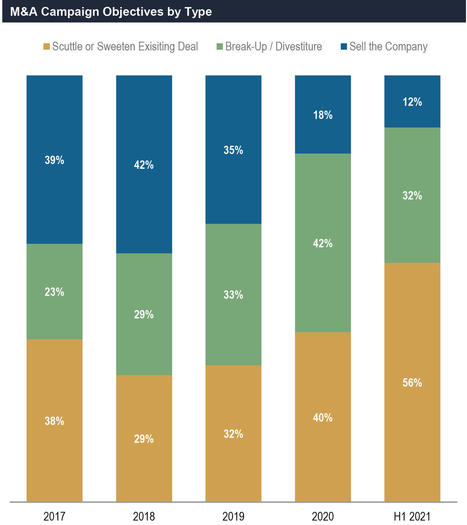
• 94 new campaigns were initiated globally in H1 2021, in line with H1 2020 levels
• H1 was distinguished by several high-profile activist successes at global mega-cap companies, including ExxonMobil (Engine No. 1), Danone (Bluebell
and Artisan Partners) and Toshiba (Effissimo, Farallon, et al.)
• U.S. share of H1 global activity (59% of all campaigns) remains elevated relative to 2020 levels (44% of all campaigns) and in line with historical levels
• After only initiating one new campaign in Q1 2021, Elliott launched five campaigns in Q2 2021 and returned to being the period’s most prolific activist
• H1 2021 activity in Europe slowed following a record-setting end to 2020; the region’s 21 new campaigns included Elliott’s agitation at GlaxoSmithKline and Bluebell’s campaigns at Danone and Vivendi
Small, growing companies can be faced with numerous challenges in addition to those noted. These challenges may include:
- Thin trading volume and Limited or no interest on the part of equity research analysts
- The absence, or the immaturity and/or lack of sophistication, of internal controls, disclosure controls, and other processes for timely, accurate, and complete financial reporting
- A limited ability to forecast and prepare forward-looking financial plans and Limited or no C-suite experience in leading a public company [2]
- Inadequate understanding of regulatory matters, including SEC and stock exchange rules, or accounting principles and what they require, including the costs of compliance and/or the consequences of noncompliance
- A lack of attitudinal preparedness for being public and the many corporate and personal matters that need to be disclosed—the “goldfish bowl” syndrome
- A lack of understanding of fiduciary duties and to whom they are owed
[...] For these and possibly other reasons, smaller companies are much more likely than larger companies to be subjected to another type of challenge: activist campaigns.
Companies are increasingly providing disclosure about their current efforts and future commitments on environmental and social (E&S) matters. [1] The percentage of S&P 500 companies publishing sustainability or corporate social responsibility (CSR) reports that address E&S matters continues to grow, reaching 90% in 2019. [2] Similarly, one study found that, in 2020, 98% of the top 100 companies by revenue in the United States reported on their sustainability efforts. [3] Consistent with this trend, 78% of companies responding to a survey by the Society for Corporate Governance in January 2021 reported publicly disclosing E&S goals, metrics or information, [4] up from 67% of respondents in a similar May 2019 survey. [5]
What motivates board oversight of racial equity: The following risks and opportunities motivated directors’ increased focus on racial and ethnic diversity, equity, & inclusion (DE&I): reputation, strategy, financing, regulatory and compliance, and human capital. Directors did not cite the potential economic impact of racial inequity as a key motivator. Oversight in practice: Directors referenced one or more of the three major committees—audit, compensation, and nominations and governance—as having explicit oversight of racial and ethnic DE&I. Most boards undertake a hybrid approach to oversight—discussing the issue in committee, but also making it a full-board topic. The full-board discussions often center on the interplay between DE&I and strategy and on DE&I as a component of corporate culture.
[...] Prior to Nine West, it has been axiomatic that, when selling a solvent company, the directors are tasked with obtaining the highest price for the selling shareholders. What happens to the business in new hands has not been the concern of selling shareholders, and all the more so when sophisticated lenders are financing the acquisition and sophisticated investors are contributing new equity to the transaction. But now: if something goes awry or differently than as may have been hoped at the time of the transaction, as is often the unfortunate case in corporate transactions, are former directors now effectively charged with being guarantors of the company’s future success under new directorship— lest they face liability? Is the state of the law now that if a corporate transaction goes south, the legal blame can be placed on the doorstep of the selling directors, as opposed to (or perhaps in addition to) the actions of the subsequent directors in the post-transaction period?
|
|
Scooped by
Institut sur la gouvernance (IGOPP)
August 25, 2020 10:32 AM
|
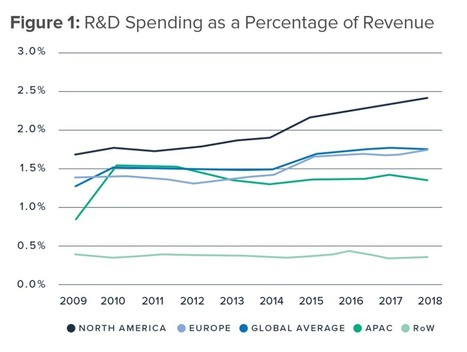
Effective long-term capital allocation is fundamental for innovating and creating value; investment in research and development (R&D) fuels this growth. Successful R&D can be transformational for an organization and for broader society. But while worldwide spending on R&D has slowly increased, R&D returns have been declining. What’s driving this decline? Emerging evidence suggests a short-term mindset lies at the heart of this puzzle. R&D spending, especially long-horizon R&D project spending, faces a unique set of short-term pressures relative to other types of long-term investment. When facing short-term financial pressures, behavioral biases including manager risk aversion and uncertainty around forecasting potential future returns (among other things) lead to a tendency among management teams to cut long-horizon projects first. The declining tenure of managers, the lack of innovation-linked metrics in incentive compensation plans, the typically asymmetric return profile of long-horizon projects, and an investment community that often ignores the potential impact of long-horizon innovation spending in a company’s valuation analysis all contribute to this problem. Our research suggests the tendency to cut long-horizon projects has left companies and investors with unbalanced innovation portfolios, favoring short-term projects that offer more certain, albeit ultimately lower, incremental returns. Unfortunately, it is often those same long-horizon projects, left on the cutting room floor, that deliver the most long-term value creation potential. The overweighting of short-term projects sacrifices significant return potential offered by long-horizon, transformational innovation, and similarly transformational returns.
|
|
Scooped by
Institut sur la gouvernance (IGOPP)
August 21, 2020 10:44 AM
|
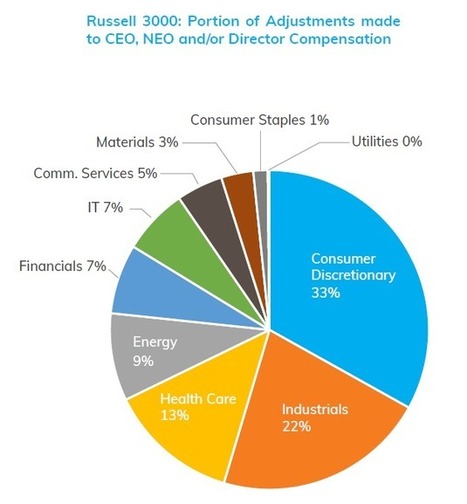
The COVID-19 pandemic has had a major impact on the US economy. Businesses that have seen financial impact have laid off or furloughed employees, cut salaries, and in some cases, received state aid in order to preserve cash and stay afloat. In addition to these measures, some businesses have taken an additional step and adjusted the compensation practices for their Executives and Board Members (mainly in form of reduced base salaries and cash fees). So far in 2020 we have seen 634 companies listed on the Russell 3000 (114 of which are listed on the S&P 500 index) issue some type of pay adjustments to Executives, and to their Board of Directors. As a result, the total amount of base salary reductions for CEOs of these companies are expected to approximately equate to USD 180 million in 2020. For this study, CGLytics looked at the 554 companies that had issued pay adjustments to Executives and their Board as of May 31, 2020. The study examines how companies have reduced CEO, NEO and Director pay, and questions if enough is being done in light of the pandemic. Executive compensation has always been a topic of controversy. It is often unclear whether multi-million dollar payouts accurately reflect the performance of the company and its Executives. Analysis by CGLytics found that roughly one-third of the S&P 500 and the Russell 3000 are overpaying their C-suite compared to their company’s performance based on Total Shareholder Return (TSR). Furthermore, we have seen that, compared to last year, the average CEO granted pay is up 9% for the S&P 500 companies and down 6% for Russell 3000. The median CEO granted pay has increased 11.5% in the Russell 3000 index. For both indexes, the Named-Executive Officers’ (NEO) granted compensation increased compared to the previous year.
|
|
|
Scooped by
Institut sur la gouvernance (IGOPP)
August 11, 2021 10:56 AM
|
Il n'aura pas fallu longtemps à Vivendi pour corriger le tir. Le 19 juillet dernier, le projet de cession de 10 % de sa filiale Universal Music Group à un SPAC (un instrument financier conçu pour acquérir normalement des entreprises) piloté par William Ackman , pour 3,5 milliards d'euros avait échoué. La SEC et une partie des actionnaires du SPAC ne voulant soutenir cette opération. Mardi, soit moins de quatre semaines plus tard, l'opération se concrétise à hauteur de 7,1 % sur la même base de valorisation, mais avec pour point de chute Pershing Square Holdings, le fonds spéculatif contrôlé par le même financier américain. « M. Ackman a la possibilité d'acquérir, d'ici au 9 septembre 2021, jusqu'à 2,9 % du capital d'UMG supplémentaires par l'intermédiaire de fonds qu'il dirige ou dont il détient la majorité des intérêts économiques, sur la base de la même valorisation », a ajouté Vivendi dans un communiqué. A ce stade, Vivendi va encaisser 2,8 milliards de dollars pour une valorisation de la maison de disques des Beatles ou de Lady Gaga de 35 milliards d'euros.
|
|
Scooped by
Institut sur la gouvernance (IGOPP)
August 10, 2021 10:23 AM
|
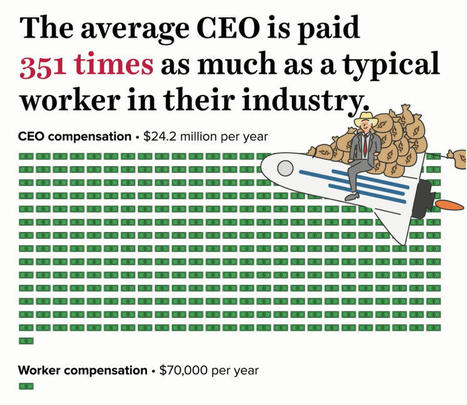
Corporate boards running America’s largest public firms are giving top executives outsize compensation packages that have grown much faster than the stock market and the pay of typical workers, college graduates, and even the top 0.1%. In 2020, a CEO at one of the top 350 firms in the U.S. was paid $24.2 million on average (using a “realized” measure of CEO pay that counts stock awards when vested and stock options when cashed in rather than when granted). [...] Several policy options could reverse the trend of excessive executive pay and broaden wage growth. Some involve taxes: - #1. Implementing higher marginal income tax rates at the very top would limit rent-seeking behavior and reduce the incentives for executives to push for such high pay.
- #2. Another option is to set corporate tax rates higher for firms that have higher ratios of CEO-to-worker compensation. Clifford (2017) recommends setting a cap on compensation and taxing companies on any amount over the cap, similar to the way baseball team payrolls are taxed when salaries exceed a cap.
- #3. Other policies that could potentially limit executive pay growth are changes in corporate governance, such as greater use of “say on pay,” which allows a firm’s shareholders to vote on top executives’ compensation.
|
|
Scooped by
Institut sur la gouvernance (IGOPP)
August 9, 2021 10:43 AM
|
My new book, Labor in the Age of Finance: Pensions, Politics, and Corporations from Deindustrialization to Dodd-Frank (Princeton University Press, 2021), is an economic history of organized labor’s engagement with shareholder activism, corporate governance, and financial regulation in the 1990s and 2000s. An epilogue carries the narrative to the present. The proximate cause of labor’s financial turn in the U.S. was the waning of its numbers and clout in the private sector. Traditional methods for adding new members were failing in the face of a more aggressive anti-union stance by employers. Seeking countervailing power, unions developed new organizing approaches, a part of which included shareholder activism and other finance-based tactics. With the assets in their reserve funds and multiemployer pension plans, and with support from other institutional investors, labor harnessed capital to restore its strength. Outside the shareholder realm, unions added financial regulation to their political agenda. Not since the early 1900s, the previous era of financialization, had labor given so much attention to finance writ large.
|
|
Scooped by
Institut sur la gouvernance (IGOPP)
August 4, 2021 11:16 AM
|
Emerging themes from this year’s Say on Pay and proxy voting season suggests a fundamental shift in shareholder and proxy advisor perspectives on compensation. The primary themes of the 2021 proxy season include:
#1. S&P 500 companies have received more scrutiny and lower vote results.
#2. Shareholders have been highly critical of special awards and long-term incentive adjustments.
#3. Environmental and social proposals received greater support, especially involving matters on EEO, diversity and inclusion, and climate impact.
|
|
Scooped by
Institut sur la gouvernance (IGOPP)
August 3, 2021 10:54 AM
|
The accountability processes of government and business are each ideal for optimizing different policy issues, and we get into trouble when we let one take on the role of the other. What has made the US capital markets the most robust and respected in the world is the combination of market- and government-based structures and especially the comprehensive transparency of our public companies. The nature of capitalism is to maximize profits, and it is up to the government to make sure that happens without externalizing costs onto the public who have no capacity to provide a market-based response. Corporate executives would always prefer less disclosure. Investors would prefer more. Because of the collective choice problem, there is no way for investors to make a market-based demand for more information as effectively and efficiently as having the government set the floor for what must be disclosed.
|
|
Scooped by
Institut sur la gouvernance (IGOPP)
August 2, 2021 10:32 AM
|
The decision made by Ben & Jerry’s board to cancel its license with its Israeli affiliate is putting parent company Unilever in a tight spot. In the U.S., 33 states have passed laws that restrict government investment or contracting in companies that boycott Israel; if Unilever does not act to reverse the board’s decision, it could face divestment and losses. [...] How unusual was Ben & Jerry’s? In 1998 among the 2,000 largest publicly traded firms in the U.S., 58.6% had staggered boards, 1.78% had unequal voting shares, 14.4% had super majority rules and 10.8% had dual class shares. Each one of these provisions makes a company less democratic. But Ben & Jerry’s had all of them: something that can be said of less than one percent of the 2,000 largest firms in the U.S. That’s what I mean by ESG with no G.
|
|
Scooped by
Institut sur la gouvernance (IGOPP)
August 2, 2021 10:15 AM
|
My recently published book, Rethinking Securities Law (Oxford University Press 2021) (ISBN 978-0-19-758314-2), focuses on many key aspects of securities regulation and recommends meaningful reforms that should be implemented. The book addresses such fundamental subjects as the disclosure regimen of the federal securities laws, exempt offerings (for issuers as well as in the resale setting), the Securities Act registration framework, corporate governance, private securities litigation, insider trading, mergers and acquisitions, and the SEC itself. The book’s final chapter provides a summary of recommendations for adoption, numbering about 125 such recommendations.
[...] The growing influence of ESG data and ratings on the allocation of capital will undoubtedly bring with it increased scrutiny. Two main areas that have drawn media attention and investor criticism towards ESG ratings providers are: (1) their focus on past performance and lack of predictive value over future performance; and (2) the sometimes-diverging opinions of ESG ratings providers for the same company. The lack of global reporting standards and agreement on what should be deemed as material for each sector has led to ESG data and ratings providers each adopting their own methodologies and processes, making it difficult for companies to manage their narrative on sustainability and determine how best to allocate internal resources regarding sustainability reporting. Further complicating the landscape for companies is the fact that a growing number of investors are developing their own ESG ratings by leveraging multiple data sources.
Among the most important issues in modern corporate governance of public companies is how such companies should respond to approaches made by activist investors. The recent responses by Duke Energy Corporation to overtures from activist investor Elliott Management are a case study in how not to deal with an activist investor. Duke Energy is underperforming and overcompensating its executives relative to its peers. Proxy advisors have noted that there is a misalignment between executive pay and corporate performance, and pay-for-performance models show a weak connection between executive compensation and company performance. In light of this, it was hardly a surprise when, on May 17, 2021, the activist investor Elliott Management, one of Duke Energy’s largest shareholders, disclosed that it was in touch with the Duke Energy management.
The momentum toward universal mandatory reporting and disclosure on climate risk and sustainability has gained additional strength with recent developments at the international, domestic and state levels. These steps follow years of calls from investors for standardized and comparable climate-related disclosures. International. In June, the G7 Finance Ministers and Central Bank Governors issued a statement calling for mandatory climate-related financial disclosures based on the recommendations of the Task Force on Climate-related Financial Disclosures (“TCFD”) framework.
|
|
Scooped by
Institut sur la gouvernance (IGOPP)
August 28, 2020 10:45 AM
|
A new WSJ op-ed: “‘Stakeholder’ Capitalism’ Seems Mostly for Show” (Lucian Bebchuk and Roberto Tallarita, Harvard Law School Program on Corporate Governance) posits that the corporate CEOs that signed onto the Business Roundtable’s (BRT) updated Statement of Purpose of a Corporation last year appear to have done so primarily to generate positive PR rather than to reflect real change in how their companies operate based on the fact that few signatory CEOs sought or obtained board approval or ratification. The conclusion rests on the theory that if CEOs believed that signing onto the updated statement was an “important corporate decision,” they would not have signed on without their board’s approval as a matter of good corporate governance. The assertion that few signatory CEOs sought or obtained board approval or ratification is based on responses to the authors’ inquiries from 48 companies, or approximately 27% of all CEO signatories, and the authors’ extrapolated expectation that the balance of companies that did not respond to their inquiry would have responded similarly.*
|
|
Scooped by
Institut sur la gouvernance (IGOPP)
August 24, 2020 11:18 AM
|
Directors of most for-profit U.S. corporations have long considered the corporation’s relationships with customers, employees, suppliers and the communities in which they operate—sometimes referred to as “stakeholders” —in the course of overseeing the building, operating and growing of the corporations’ businesses. In more recent years, the concepts of “stakeholders” and “stakeholder interests” have greatly expanded, with the interests generally falling under the umbrella of environmental, social and governance (ESG) matters. [...] This article, through stating a series of guiding principles, attempts to “cut through it all” like the Gordian Knot, bring clarity to the discussion and provide real-world guidance for director decision-making.
Principle 1: Directors’ statutory mandate and fiduciary duties contemplate consideration of long-term value.
Principle 2: Stakeholders interests may support long-term value.
Principle 3: Many proponents of stakeholder interests believe they support long-term value.
Principle 4: Stakeholder interests that support long-term value align with stockholder interests.
Principle 5: Boards should exercise oversight with respect to stockholder-aligned interests.
Principle 6: Directors should focus on the relevance of stockholder-aligned interests.
Principle 7: Boards should carefully manage processes relating to stockholder-aligned interests.
Principle 8: Pursuit of stockholder-aligned interests is subject to business constraints.
Principle 9: Business judgment rule protection for directors is achievable.
|