Your new post is loading...
[...] Board seats are in-line with prior year averages
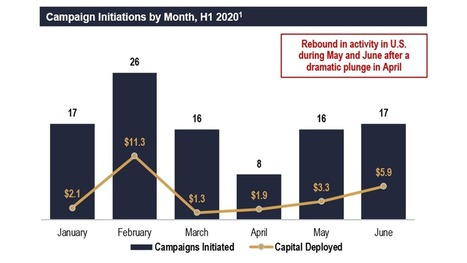
86 Board seats won by activists in H1, up ~6% from the prior year period in spite of relatively lower campaign activity
- Starboard and Elliott alone accounted for 29 Board seats, 34% of the H1 total
Only 10 Board seats (12% of total) were won through a final proxy vote – 8 alone won by Starboard at GCP – reflecting pressure to settle pending disputes amid the COVID-19 pandemic
Activist focus is shifting amid COVID challenges
Only 34% of H1 campaigns featured an M&A objective, down from ~47% in 2019, reflecting headwinds created by an uncertain M&A environment
- ~30% of all H1 M&A campaign activity occurred in February alone, prior to the onset of COVID-related volatility
The share of campaigns focused on Board change (34% of all H1 campaigns), operational improvements (20%) and management change (7%) outstripped multi-year average levels
Multiplying approaches to activism
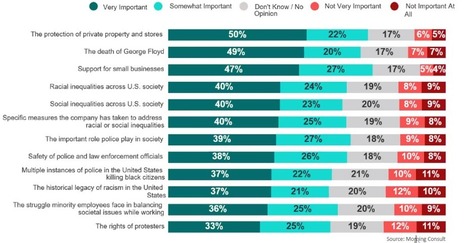
CEO Summit participants were in strong agreement: CEOs must speak up about racism and companies must take concrete actions to become more inclusive. Even companies that are already taking action must do more. The starting point, in the view of many CEOs, is to initiate conversations, which can be difficult. This involves communicating with employees, giving them a voice, and listening carefully and with empathy. Kyle Dropp of Morning Consult shared survey findings that show how Americans are thinking and feeling. Among the findings:
(1) No single person or group is viewed as doing a good job of addressing the protests. Governors and mayors fare best, but political leaders (Donald Trump, Joe Biden, and members of Congress), religious leaders, the police, media, and business leaders are all viewed unfavorably in addressing the protests.
(2) Americans want to hear from CEOs and companies, with about 70% looking to business leaders to speak up about racial and social inequalities, along with specific measures their company is taking.
(3) Most people believe brands should not stay silent. Brands supporting political and social issues is a divisive matter, especially along racial But inaction has consequences, as nearly 25% of adults said they would have a less favorable view of a brand if it didn’t make an official statement. Common actions that Americans want brands to take include:
(4) Setting up a fund for small businesses impacted by looting
(5) Donating to community cleanup
(6) Conducting racial sensitivity training
(7) Donating to social justice causes
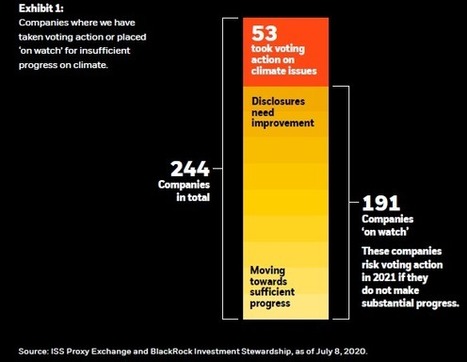
This past January, BlackRock wrote to clients about how we are making sustainability central to the way we invest, manage risk, and execute our stewardship responsibilities. This commitment is based on our conviction that climate risk is investment risk and that sustainability-integrated portfolios, and climate-integrated portfolios in particular, can produce better long-term, risk-adjusted returns. Our efforts around sustainability, as with all our investment stewardship activities, seek to promote governance practices that help create long-term shareholder value for our clients, the vast majority of whom are investing for long-term goals such as retirement. This reflects our approach to sustainability across BlackRock’s investment processes, in which we use Environmental, Social, and Governance factors in order to provide clients with better risk-adjusted returns, in keeping with both our fiduciary duty and the range of regulatory requirements around the world. As a result, we have a responsibility to our clients to make sure companies are adequately managing and disclosing sustainability-related risks, and to hold them accountable if they are not. While we have been speaking with companies for years on sustainability issues, our investment stewardship team has intensified its focus and dialogue this year with companies facing material sustainability-related risks. Our approach on climate issues, in particular, is to focus our efforts on sectors and companies where climate change poses the greatest material risk to our clients’ investments. ‘Climate risk’ may include a company’s ability to compete in a world that has transitioned to a low-carbon economy (transition risk), for example, or the way climate change could impact its physical assets or the areas where it operates (physical climate risk).
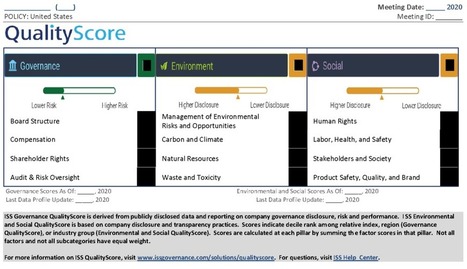
Corporate boards should partner with management to ensure appropriate and regular oversight of environmental issues critical to the long-term economic success and reputation of the company. Either the board or an authorized committee should receive briefings on environmental matters/risks that may jeopardize a company’s reputation and corrective action undertaken to address those risks. Management should monitor environmental disclosures and rankings of peer firms and consult with the board on how to improve their company’s standing relative to competing firms and in terms of stakeholder expectations. Environmental stewardship, including efforts to mitigate climate change and other impacts on the natural environment, is an important and controversial topic in today’s world. Politicians, companies, investors, consumers and the public all have a stake in how businesses approach environmental stewardship. The 2020 Davos Manifesto of the World Economic Forum (WEF) reflects the current trend of scrutinizing businesses based on their environmental performance. Addressing companies and the world’s top 120 CEOs, the Manifesto states, in part:
“A company is more than an economic unit generating wealth. It fulfills human and societal aspirations as part of a broader social system. Performance must be measured not only on the return to shareholders, but also on how it achieves its environmental, social and good governance objectives.” This brief statement highlights both the interrelation between business operations and environmental impacts, and the importance of environmental stewardship as a reflection of good corporate governance.
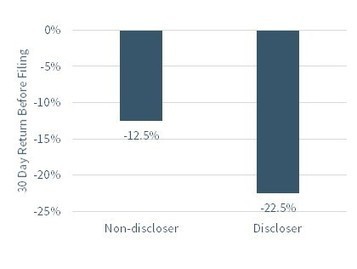
We recently published a paper on SSRN (“The Spread of COVID-19 Disclosure”) that examines disclosure practices across all U.S. public companies during the initial spread of COVID-19. Investors rely on corporate disclosure to make informed decisions about the value of companies they invest in. Corporate disclosure includes not only financial statement information that quantifies earnings, cash flows, and changes in the value of assets, but also supplemental information to explain, qualify, or forecast future performance and risks. While the Securities and Exchange Commission requires minimum standards of information in filings, it allows flexibility to go beyond these minimums within the filing and through alternative public channels (such as press releases, earnings conference calls, and industry conferences). Shareholders value transparency because it improves their ability to price securities, and over time, shareholders’ demand for transparency has led to a steady increase in the amount of information that companies voluntarily disclose beyond regulatory requirements. For a variety of reasons, however, a company might prefer to release less information to the public. A company in a competitive industry or developing a new product might not want to divulge proprietary information that will disadvantage it relative to peers. Alternatively, it might lack foresight about future performance and, out of a desire to avoid legal liability for making inaccurate statements, prefer to disclose less information or use less precision when making statements.
The COVID-19 pandemic is requiring companies to focus on survivability—whether they have the financial, human, and other resources to make it through this period of intense disruption. This is also a time, however, for companies to consider the value of their existing sustainability strategies. Companies with robust sustainability programs are more likely to perform well during a downturn. And five key elements of a fully developed sustainability program—a defined corporate purpose, a clear view of what is material (and what is not), an awareness of broader societal challenges, a robust level of engagement and transparency with stakeholders, and a collaborative culture—should improve a company’s ability to prosper in the long run. Rather than setting aside their sustainability strategies, companies should view the current crisis as an opportunity to reevaluate and strengthen their sustainability programs. Almost a decade ago, The Conference Board released a report outlining the business case for sustainability. The report highlighted that “awareness has increased among leaders that durable business models cannot be solely based on the maximization of financial performance, and that shareholder value is feeble if the company fails to recognize a broader nexus of stakeholder interests—including those of employees, customers and suppliers, regulators, and the local communities where the company operates.”
At the same time as Tesla is paying CEO Elon Musk to insure its board, a shareholder adviser is telling investors they should kick him out. In a filing with the Securities and Exchange Commission on Tuesday, the electric-vehicle company said it entered into a 90-day "indemnification agreement" with Musk on June 24. "The Indemnification Agreement provides that Mr. Musk will provide, from his personal funds, directors' and officers' indemnity coverage to Tesla during the Bridge Term in the event such coverage is not indemnifiable by Tesla, up to a total of $100 million. In return, Tesla will pay Mr. Musk a onetime fee of $972,361," the filing said. The company announced in an update to its annual report in April that Musk was personally insuring the board against lawsuits because it had been unable to find a reasonable quote from an insurance company. Separately on Tuesday, the London-based investment-advisory firm PIRC published a report urging Tesla shareholders to boot Elon Musk out of his job as CEO, as first reported by The Guardian. Specifically, PIRC homed in on Musk's $55.8 billion bonus package, the first tranche of which was unlocked for Musk in late May, saying it exposed the company to the risk of lawsuits. Musk's compensation package is complex, and he qualifies for the full $55.8 billion stock-option package only if Tesla hits certain financial milestones over the next decade.
On June 11, the Delaware Court of Chancery issued important guidance [1] to boards of directors of Delaware corporations and their controlling stockholders seeking to utilize the dual protections of MFW [2]—a special committee and a majority of the minority vote—to insulate themselves from fiduciary liability in connection with various corporate transactions. [...] Thus, while the court’s decision confirms that the dual protections of MFW can be effective to protect against fiduciary liability claims, boards of directors and controlling stockholders who wish to maximize the effectiveness of those protections must be sure to avoid these and other pitfalls. [...] The court disagreed with the defendants, holding that the plaintiffs’ complaint alleged facts that make it reasonably conceivable that the defendants failed to comply with MFW, making entire fairness the operative standard of review. [...] At a high level, to satisfy MFW, a controller must structure a transaction so that the controller-proposed transaction acquires the stockholder-protective characteristics of a third party, arm’s length transaction. More specifically, to obtain MFW cleansing, the transaction must meet the following six requirements:
(A) The controller conditions the procession of the transaction on the approval of both a special committee and a majority of the minority stockholders.
(B) The special committee is disinterested and independent.
(C) The special committee is empowered to freely select its own advisers and to say no definitively to the proposed transaction.
(D) The special committee meets its duty of care in negotiating a fair price.
(E) The vote of the minority is informed.
(F) There is no coercion of the minority.
More than a decade after the first Green Bond issuance, the original model of Use-of-Proceeds deals, where proceeds are spent on specifically identified projects, appears insufficient to meet international sustainability targets. The market has seen a number of new structures in the past year alone—from sustainability-linked bonds dedicated to general corporate purposes to transition bonds. As the market grows and continues to innovate, the question is: how can one ensure transparency and trust and what lessons can be drawn from the Green Bond Principles’ success story? The International Capital Market Association’s (ICMA) Green, Social and Sustainability Bond Principles ensure the allocation of bonds’ proceeds exclusively to green or social business activities. This allocation tenet launched and supported the rise of a credible and trusted sustainable bond market. But the pace at which the real economy needs to shift must accelerate. This pushes the sustainable debt capital market to move toward financing transition and progress, instead of focusing only on existing green and social projects.
The measures proposed on April 28, 2020, by the Autorité des marchés financiers (French Financial Market Authority) [1] in response to an environment of increasing shareholder activism have been generally welcomed by the financial markets of Paris. They have been judged by most operators to be appropriate and balanced, although they supplement a legal system that already contains suitable provisions for managing activism and that the far-reaching impact of some of them may not yet have been fully assessed. It is, moreover, doubtful that the activist community fully shares this sentiment. [...] On conclusion of its various analyses, the AMF has expressed a rather consensual and self-proclaimed measured position. As it has stated, “it is not an issue of preventing activism but of defining its limits and having the means for controlling excess.” Clearly annoyed, certain loud anti-activist voices quickly made themselves heard across the Atlantic in criticism of the balanced approach adopted by the French regulator, inviting it to reconsider its conclusions by taking into account certain economic studies suggesting that activism does not create value but simply transfers value to short-term speculators. [2]
What is the common denominator between a Chinese company listed in the United States and an Emirati company listed in the United Kingdom? Both are foreign issuers currently embroiled in massive governance scandals, the details of which are creating fascinating corporate dramas, spilling all over front pages of financial media. Both companies are presently in the process of being delisted, following a whistleblower campaign initiated by Muddy Watters, an American investment research firm, as it announced its short positions. The parallels between Luckin Coffee, a Chinese company listed on NASDAQ, and NMC Health, an Emirati company listed on the London Stock Exchange are, indeed, remarkable. Both were founded by reputed, established entrepreneurs, backed by prominent sovereign and private investors and creditors, and held leading positions in their respective industries. Fast-forward to today, both are subject to investigations of flagrant fraud: in the case of Luckin Coffee, of $310 million of fictitious sales, and in the case of NMC of over $4 billion of undisclosed debt.
COVID-19 has had and will continue to have impacts on virtually every corporation in Canada and globally. Such a disrupting chain of events, combined with freshly enacted changes to corporate legislation for federally incorporated corporations, may raise questions on the scope of directors’ fiduciary duty. If the recent legislative amendments have provided certain clarifications on a director’s fiduciary duty towards the corporation, they have had limited opportunities to be tested. The public health crisis may set the stage for such a test. As discussed below, in discharging their fiduciary duty, directors will need to consider different factors. To benefit from the protection of the business judgement rule doctrine, directors should formulate and follow a sound protocol. Under the Canada Business Corporations Act (the CBCA), directors of a corporation have a “fiduciary duty” towards the corporation according to which they must “act honestly and in good faith with a view to the best interests of the corporation.” [1] In cases of alleged breach of such duty, courts apply the “business judgement rule,” which commands great deference to directors, to the extent directors followed a reasonable process in decision-making.
In the three decades after World War II, workers and stockholders shared equitably in the nation’s growing wealth. But, during the last several decades, this fair gainsharing has diminished as the power of the stock market, in the form of institutional investors, has grown, and the comparative voice and leverage of workers has declined. As a result of these and other factors, a much greater share of the gains from increased corporate profitability and productivity has gone to stockholders and top management, on the one hand, and much less to employees, on the other. Contributing to this divide has been a push to tie top management pay to total stockholder return and to create incentives for management to deliver returns to stockholders, even if that requires decreasing the share that the workers primarily responsible for corporate success get. The resulting economic insecurity and inequality have caused demands for serious change in corporate governance to give greater weight to the interests of workers. This state of affairs has led to calls to reform our corporate governance system’s power dynamic to give workers more voice. And business leaders have acknowledged that an economic system that does not work for everyone is unsustainable, most prominently through the Business Roundtable’s revised statement on corporate purpose making clear that employee well-being and fair compensation are central issues for corporate management.
|
In recent years, publicly traded companies in the United States have faced increasing pressure to improve diversity on their corporate boards. Influenced by state legislation as well as the efforts of institutional investors and other diversity advocates, companies are recruiting more female directors than ever before. Approximately 45 percent of the directors added to the boards of companies in the Russell 3000 during the 2019 proxy season were women, up from 12 percent in 2008. The percentage of new directors who are minorities is also increasing, although at a significantly slower rate, with approximately 15 percent of the directors added to the boards of Russell 3000 companies during the 2019 proxy season belonging to a racial or ethnic minority group. One of the central arguments cited for improving the diversity of demographic characteristics such as gender, race, and ethnicity on corporate boards is that such diversity is necessary to ensure that boards are able to perform their obligations effectively in today’s competitive business landscape.
Vibrant and well-functioning U.S. capital markets create jobs, bolster investment, promote innovation, and enhance retirement savings. Capital markets function best when regulations allow for the efficient allocation of capital while protecting investors. In this report, we evaluate major trends and developments in U.S. capital markets and assess whether existing regulations are continuing to serve U.S. companies and investors. We then set forth regulatory reforms to further enhance the performance of U.S. capital markets.
The report consists of four chapters: (1) The Rise of Dual Class Shares: Regulations and Implications, (2) Short-termism, Shareholder Activism and Stock Buybacks; (3) The Rise of Index Investing: Price Efficiency and Financial Stability; and (4) An Analysis of Investment Stewardship: Mutual Funds and ETFs. An executive summary of each chapter appears below.
Montréal (Canada), le 9 juillet 2020 – L’Office d’investissement des régimes de pensions du secteur public (Investissements PSP) a clos son exercice financier du 31 mars 2020 avec un rendement net annualisé sur cinq ans de 5,8 % et un rendement net annualisé sur dix ans de 8,5 % sur ses placements. Durant la même période, Investissements PSP a généré des gains de placement cumulatifs nets de 32,9 milliards de dollars de plus que ceux prévus dans l’objectif de rendement au cours des dix derniers exercices. Le rendement net du portefeuille global sur un an se chiffrait à -0,6 %, reflétant le grave recul sur les marchés boursiers attribuable à la pandémie mondiale de COVID-19 au cours des semaines qui ont précédé la fin de l’exercice du 31 mars, 2020. Ce résultat était néanmoins supérieur au rendement sur un an de ‑2,2 % du portefeuille de référence[1].
For the past several months, the business community has been focused on navigating the economic turmoil brought on by the COVID-19 pandemic. While many companies have experienced salary reductions, staff layoffs and furloughs, and corporate restructurings, there have been developments in the executive compensation arena that have gone largely unnoticed. One such development is a proposed reform that would lead to an acceleration of the taxation of certain forms of executive compensation. On February 27, 2020, Senators Bernie Sanders of Vermont and Chris Van Hollen of Maryland introduced the “CEO and Worker Pension Fairness Act” in the U.S. Senate. [1] The proposed legislation was a response by Senators Sanders and Van Hollen to a recent report from the Government Accountability Office (GAO) commissioned by Senator Sanders: “Private Pensions: IRS and DOL Should Strengthen Oversight of Executive Retirement Plans.” [2] [...] The concept of taxing individual executives at the time of vesting without the receipt of the income would negatively impact the current executive compensation environment. Although some critics may believe that executives are overpaid and under-taxed, the notion of taxing an executive when they have yet to receive their deferred funds or stock option gains is atypical. Taxation at the time of vesting would require a major overhaul of the Tax Code, and such tax concepts as constructive receipt, risk of forfeiture, and other elements of the Tax Code would need to be rewritten.
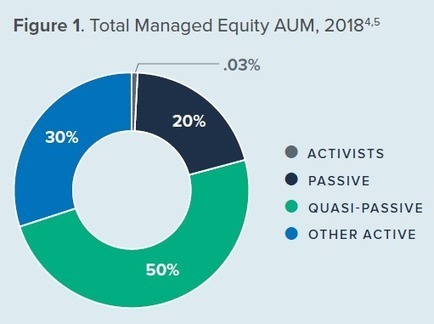
The prevailing wisdom is that activist investors can drive corporate short-term behavior themselves. The prevailing wisdom is wrong. At just 0.3% of total global equity assets under management (AUM) in 2018, activists depend on the support of long-term investors for their influence. Without clarity on long-term shareholders’ views, companies perceive short-term pressure coming from their investors, and assume the activists speak for the entirety of the shareholder register. Having a strong investor/corporate dialogue well before an activist campaign arises is the way to encourage companies to proactively improve the drivers of long-term value creation—such as bolstering their governance, honing strategies for growth, and engaging with long-term investors. Strong long-term performance is the best way to limit opportunity for an activist campaign. Indeed, rather than being a spectator, long-term investors have a significant role to play alongside companies to counteract short-term activist behaviors. It is well within the power of these long-term investors to either amplify or dampen the short-term impact of activism, serving as essential players of the activism ‘game.’
(1) Despite their relatively small AUM, activists are an important and growing influence on companies’ short- or long-term behavior globally. [...]
(2) Many activists choose to emphasize the short term at the expense of the long term, perhaps as a result of their event-driven orientation and comparatively higher discount rates. [...]
(3) Investors and companies can mitigate the short-term impact of activism by preparing for and responding to activist campaigns in ways that emphasize long-term value.
There is compelling evidence that both concentration and profitability in oligopolistic industries have increased over the past two decades. Over roughly the same time period, the concentration of shareholding in the hands of the largest institutional investors has dramatically increased, with an increase in the degree to which investors (such as Vanguard, State Street and BlackRock) own large equity stakes in competing portfolio companies. A number of authors—focusing initially on airlines and commercial banking—have argued that the growth in this “common ownership” has caused the increase in oligopoly profits. They have followed this with a variety of policy responses. We start with the core puzzle. The “Structure-Conduct-Performance paradigm”—which asserts a connection between concentration and profits—has long been a staple of antitrust policy. Yet, compelling empirical support for this connection has historically been sparse, for reasons well discussed in the Industrial Organization literature. Interestingly, according to the empirical evidence, something changed around 2000. Since then, the evidence for a link between concentration and profitability has become quite strong. As a result, an adequate theory must explain two things. First, why is there a correlation between concentration and profitability? Second, why has there been a strong(er) correlation post 2000 than pre-2000? The “common ownership” literature asserts that the increase in common ownership by the largest institutional investors since 2000 is what caused oligopolies to become more profitable. We review the evidence for this claim and find it lacking.
[...] Discussions among corporate governance industry groups to identify agreed-upon “best practices” for VoSMs (Virtual-only Shareholders Meeting) have already started and will become more formalized later this year. Based on the set of 2020 annual meetings observed by Soundboard Governance, the following is a list of “The Best Practices”—the most advanced and shareholder-friendly features a company may consider for a future VoSM.
(A) Provide prominent, “plain English” instructions in the proxy materials on what a shareholder needs to do to attend, vote, and ask questions.
(B) Give shareholders the ability to ask questions in advance of the meeting.
(C) Make it easy and give as much time as possible for a shareholder to obtain in advance whatever separate control number, legal proxy, or other information they might need to enter the meeting.
(D) Start the meeting at a reasonable time of day for people in all continental US time zones to attend.
(E) List a help-line number, or have an online chat feature, on every page the shareholder has to go through to get into the meeting and on the main meeting page.
(F) Post the Annual Report, Proxy Statement, Rules of Order, and meeting Agenda on the main meeting page.
(G) Have a prominent link on the main meeting page for record shareholders to access the Registered Shareholder List electronically.
(H) Provide real-time video footage of board and management participants.
...
Human capital management (HCM) is one of the most significant corporate governance themes emerging in 2020, shining a spotlight on a topic that had already been a growing focus for many stakeholders. HCM sits at the intersection between investors, the workforce and consumers, it tugs at many deep-rooted social and political societal values, and it can be a polarizing issue for regulators and legislators. But as we have moved toward a talent-based economy, human capital is not only a key asset for companies, but rather, it is a “mission critical asset”. [...] As companies learned from the #MeToo movement that swept through boardrooms a few years ago, board oversight is necessary to create “tone-at-the-top.” In its 2020 stewardship priorities, BlackRock said that “[g]iven most companies identify their employees as their greatest asset, we expect boards to oversee human capital management strategies.” [2] BlackRock will hold board members accountable absent some disclosure about the board’s role in overseeing the company’s HCM efforts. [3] State Street noted that it will focus on more “immediate” ESG issues, such as employee health. [4] To create the right level of oversight, management will need to do three things: (a) provide the right information to the boardroom to enable oversight, (b) determine how best to involve boards at the right level of decision-making and (c) strategically deploy directors, individually and in the aggregate, to demonstrate the company’s genuine commitment to these issues.
The U.S. and U.K. regulatory frameworks diverge in important ways—especially concerning their fiduciary duties. Scholars have therefore found it useful to compare how the two frameworks govern both merger and acquisition (M&A) transactions and self-dealing transactions. But scholars have yet to comparatively assess U.S. and U.K. regulations for the M&A transaction that may pose the greatest risk of self-dealing: the management buyout (MBO). [...] The analysis also reveals stronger formal private enforcement of corporate law and more robust disclosure rules in the United States. But because the available empirical evidence fails to justify broad claims that corporate fiduciaries’ misconduct is more severe under either regime, the analysis identifies U.K. law-related measures that may serve similar functions to formal enforcement and mandatory disclosure in constraining misconduct by corporate fiduciaries. These include informal enforcement by the U.K. Takeover Panel, stronger shareholder rights, and potentially greater monitoring by institutional investors.
This Thursday, June 25, 2020, the Saïd Business School at the University of Oxford will hold a debate titled Stakeholder versus Shareholder Capitalism: the Great Debate. The debate will be held between Harvard Law School Professor Lucian Bebchuk and Oxford University Professor Colin Mayer. In the tradition of Oxford debates, the audience watching it will be asked to vote on the question being debated: Whether corporate leaders should serve the interests of all stakeholders or just shareholders. The event will be publicly broadcast live at 9am EST, and information about how to watch the debate is available on the Oxford University website here. Lucian Bebchuk is the James Barr Ames Professor of Law, Economics, and Finance and Director of the Program on Corporate Governance at Harvard Law School. His recent article with Roberto Tallarita, The Illusory Promise of Stakeholder Governance, challenges the “stakeholderism” view under which corporate leaders should give independent weight to the interests of all stakeholders. The article conducts a conceptual, economic, and empirical analysis of stakeholderism and its expected consequences. It conclude that stakeholderism should be rejected, including by those who care deeply about the welfare of stakeholders.
As Winston Churchill said, “Now this is not the end. It is not even the beginning of the end. But it is, perhaps, the end of the beginning.” We are seeing some faint signs of progress in the struggle to contain the pandemic. But the risk of resurgence is real, and if the virus does prove to be seasonal, the effect will probably be muted. It is likely never more important than now for boards of directors and executive management teams to tackle the right questions and jointly guide their organizations toward the next normal. Recently, we spoke with a group of leading nonexecutive chairs and directors at companies around the world who serve on the McKinsey Resilience Advisory Council, a group of external advisers that acts as a sounding board and inspiration for our latest thinking on risk and resilience. They generously shared the personal insights and experiences gained from their organizations’ efforts to manage through the crisis and resume work. The 15 themes that emerged offer a guide to boards and executive teams everywhere. Together, they can debate these issues and set an effective context for the difficult decisions now coming up as companies plan their return to full activity. [...] It is the board’s responsibility to coach and advise its management team, especially when the terrain is trickier than usual. However, boards should not mistake the need for vigorous debate with the need for consensus. More than ever, a bias to action is essential, which will frequently mean getting comfortable with disagreement. Apart from all the operational focus needed for the return to work, it is even more important that boards and management teams take a step back to reflect upon these 15 core themes. In summary:
(A) Take the time to recognize how the people who (directly or indirectly) depend on the company feel.
(B) Have aspirations about the post-COVID world, but build the resilience to make them a reality.
(C) Strengthen your capability to engage and work with regulators and the government.
(D) Watch out for non-COVID risks, and make sure to carve out time to dedicate to familiar risks that have never gone away.
(E) Find out what went wrong, and answer the uncomfortable truths that investigation uncovers.
The monitoring role of independent directors on corporate boards has long been a topic of interest in the corporate governance literature. Stock-exchange rules establishing directors’ independence are typically based on transaction-based financial ties, and most empirical research classifies independent directors according to this limited assessment. However, independent directors may have other ties to top executives that interfere with their exercise of independent judgment in carrying out director responsibilities. In our forthcoming paper in the Review of Financial Studies, Paying by Donating: Corporate Donations Affiliated with Independent Directors, we investigate a new determinant of director independence: material relationships between independent directors and top executives via corporate charitable contributions to tax-exempt organizations affiliated with independent directors (affiliated donations). Corporate donations help fulfill directors’ fundraising obligations at their affiliated charities, creating a potential conflict of interest that increases directors’ disutility in carrying out monitoring responsibilities. Because corporate charitable contributions are rarely disclosed in companies’ filings with the Securities and Exchange Commission (SEC), they have been largely overlooked in corporate governance research until very recently.
|