Your new post is loading...
A recent report from AgileCraft highlights which jobs, education levels, and salaries are at risk of robot takeover.
Via TechinBiz

|
Rescooped by
Antonios Bouris
from Amazing Science
July 16, 2018 4:42 AM
|
Sometimes, a genetic tweak can make a really big difference in an animal’s appearance. That’s what likely happened when the predecessors of modern snakes lost their legs, a process that started some 150 million years ago, two separate groups of scientists have discovered. Although the teams took very different approaches to solve the mystery of how those limbs vanished, both came up with similar results: Mutations in DNA located near a gene key to limb formation keep that gene from ever turning on, they reported recently.
Via Dr. Stefan Gruenwald
Elon Musk has sent a team of engineers to help rescue the group of 12 children and their coach trapped in a cave in Thailand.
Via TechinBiz
For better or worse, a new technology is making its way from consumers' homes into America's classrooms: voice-controlled "smart speaker" systems from companies such as Amazon and Google.
The internet-enabled devices listen to what users say, send audio recordings to the cloud, translate that information into commands, and respond accordingly—providing users with a personal digital voice assistant such as Amazon's Alexa, which teachers are now using to help with everything from setting a classroom timer to leading a group of 3rd graders through a spelling test.
Groups such as the American Civil Liberties Union are raising alarms about privacy.
"Should students be required to submit themselves to always-on voice-tracking and other third-party surveillance in order to get an education?" asked ACLU staff technologist Daniel Kahn Gillmor in an interview.
Still, the early K-12 adopters of smart speakers and digital voice assistants are generally enthusiastic.
Via John Evans, Dennis Swender
|
|
Rescooped by
Antonios Bouris
from Amazing Science
July 6, 2018 1:49 AM
|
Researchers working on Search for Extraterrestrial Intelligence (SETI) efforts hunt for the same thing that their predecessors sought for decades—a sign that life arose, as Carl Sagan would say, on another humdrum planet around another humdrum star and rose up into something technologically advanced. It could happen any day. A strange radio signal. A weird, brief flash in the night sky. A curiously behaving star with no natural explanation. It could be anything, so SETI researchers are casting a wide net, tracking down as many promising leads as they can. But one thing they’ve started to realize is that if a civilization from another world follows a similar path to our own, then we may be dealing with a whole different form of brainpower. Not a little green person, Vulcan, or strange organism we aren’t yet fathoming, but an artificial intelligence.
Via Dr. Stefan Gruenwald
|
|
Rescooped by
Antonios Bouris
from Amazing Science
July 6, 2018 12:01 AM
|
New techniques are providing unprecedented views into human development — and raising ethical questions.
Via Dr. Stefan Gruenwald
|
|
Rescooped by
Antonios Bouris
from Amazing Science
June 29, 2018 7:37 AM
|
For toddlers, playing with toys is not all fun-and-games—it’s an important way for them to learn how the world works. Using a similar methodology, researchers from UC Berkeley have developed a robot that, like a child, learns from scratch and experiments with objects to figure out how to best move them around. And by doing so, this robot is essentially able to see into its own future. A robotic learning system developed by researchers at Berkeley’s Department of Electrical Engineering and Computer Sciences visualizes the consequences of its future actions to discover ways of moving objects through time and space. Called Vestri, and using technology called visual foresight, the system can manipulate objects it’s never encountered before, and even avoid objects that might be in the way.
Via Dr. Stefan Gruenwald
Robots can Build Entire Cities almost for Free
Robots provide free labor that can be used to construct meaningful places for us to live.
Via TechinBiz
|
|
Rescooped by
Antonios Bouris
from Amazing Science
June 25, 2018 10:42 AM
|
As a chameleon shifts its color from turquoise to pink to orange to green, nature's design principles are at play. Complex nano-mechanics are quietly and effortlessly working to camouflage the lizard's skin to match its environment. Inspired by nature, a Northwestern University team has developed a novel nanolaser that changes colors using the same mechanism as chameleons. The work could open the door for advances in flexible optical displays in smartphones and televisions, wearable photonic devices and ultra-sensitive sensors that measure strain.
Via Dr. Stefan Gruenwald
Flying Cars and the Future of TransportationThe flying car has long been part of science fiction. It may be closer to science fact than ever before.
Via TechinBiz
Hint: It has something to do with a little thing called Brexit.
Via TechinBiz
TechCrunch is a leading technology media property, dedicated to obsessively profiling startups, reviewing new Internet products, and breaking tech news.
Via TechinBiz
Retail 2020 | 5 Technologies that will change the way you Shop
Retail shopping will change more in the next 10 years than it has in the last 1000 years. These are 5 pieces of technology that will change the way you shop.
Via TechinBiz
|
Needle-Less Alternative to Stitches
DermaClip is a needle-less alternative to conventional stitches or surgical staples. The adhesive clips are placed around a wound so doctors can pull it closed without any pain. They are most effective to use in emergency situations or by those without medical tr
Via TechinBiz
With the implementation of Amadeus Extended Airline System Environment (EASE™), airports will gain cost savings and enhanced operational flexibility. Application virtualization will give airline staff full functionality of passenger processing systems from any desktop.
Via TechinBiz
Artificial Intelligence isn’t only limited to powerful supercomputers and big devices; it is also becoming a part and parcel of smartphones and wearable devices and equipment. Edge computing is emerging as the next big area in AI.
Via TechinBiz
|
|
Scooped by
Antonios Bouris
July 13, 2018 4:09 AM
|
A giant telescope buried in the Antarctic ice, "ghost particles" travelling near the speed of light and a violent supermassive black hole. What more could you want?
|
|
Rescooped by
Antonios Bouris
from Amazing Science
July 6, 2018 12:02 AM
|
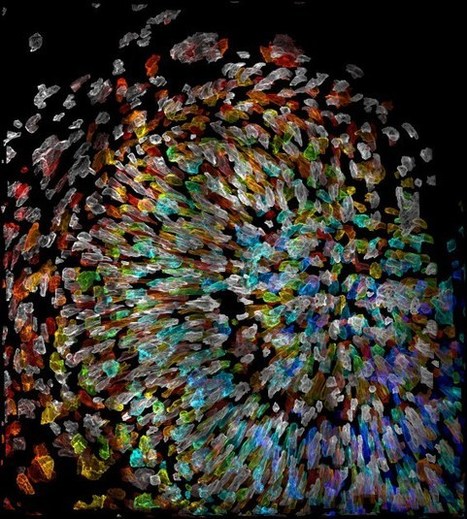
More than 350 years ago, the English natural philosopher Robert Hooke looked through a microscope at a thin slice of cork and discovered that it was made of small, box-like compartments, which he named “cells.” From that moment on, Hooke and countless inquisitive minds after him strove for a better view of these fundamental building blocks of life. And now, the window into the cellular world has become a lot clearer. In a new study in the April 20, 2018 issue of Science, researchers from Howard Hughes Medical Institute’s (HHMI) Janelia Research Campus, Harvard Medical School, and collaborating institutions report the development of a microscope capable of capturing, in unprecedented detail, 3-D images and videos of cells inside living organisms. Adapting a technique used by astronomers to study distant stars, the research team, led by Nobel laureate and Janelia group leader Eric Betzig, showcased the new technology by generating a series of stunning movies: cancer cells crawling through blood vessels, spinal nerve cells wiring up into circuits, immune cells cruising through a zebrafish’s inner ear, and much more. The resolution of the microscope is stunning and so powerful it can even capture subcellular details such as the dynamics of miniscule bubbles known as vesicles, which transport molecular cargo through to the cell. “This is the miracle of being able to see what we have never been able to see before. It’s simply incredible,” said study co-author Tomas Kirchhausen, HMS professor of cell biology, and the Springer Family Chair of pediatrics and a senior investigator at Boston Children’s Hospital.
Via Dr. Stefan Gruenwald
|
|
Rescooped by
Antonios Bouris
from Amazing Science
July 5, 2018 11:17 PM
|
- CRISPR-Cas9 shows promise for correcting genetic defects in a reliable manner
- Using the gene-editing system to 'fix' embryos has caused ethical controversy and it is unclear whether or not it is safe
- New research from Weill Cornell University suggests that DNA in sperm could be fixed with CRISPR using a brief but powerful electrical shock
Scientists may be able fix faulty DNA in a father's sperm before it has even fertilized an egg, according to new research presented this week. CRISPR gene-editing technology has shown promise for snipping out bad DNA and replacing it in embryos, but as their cells multiply, the fixed DNA may make it into some cells and not others. Changing the genetic makeup of sperm cells would solve that problem but, so far, scientists have struggled to find a way to gene-edit them without killing them. But scientists at Weill Cornell Medicine in New York think they may have found a way: by delivering an electrical pulse to the sperm, breaking its outer shell and allowing them to deliver CRISPR to the cell.
Via Dr. Stefan Gruenwald
|
|
Rescooped by
Antonios Bouris
from Amazing Science
June 29, 2018 7:17 AM
|
AI will help bring novel therapies to market at lightning speeds, at much lower cost, and with no requirement for massive infrastructure and investments. What if we could generate novel molecules to target any disease, overnight, ready for clinical trials? Imagine leveraging machine learning to accomplish with 50 people what the pharmaceutical industry can barely do with an army of 5,000. What they’re doing is extraordinary, and it’s an excellent lens through which to view converging exponential technologies.
Via Dr. Stefan Gruenwald
|
|
Scooped by
Antonios Bouris
June 25, 2018 10:46 AM
|
Can't find what you're looking for on Google? Here are 31 advanced search tips for conducting better Google searches so you can get to your results faster.
|
|
Rescooped by
Antonios Bouris
from Amazing Science
June 22, 2018 5:33 AM
|
Artificial intelligence is giving scientists new hope for studying the habitability of planets, in a study from astronomers Chris Lam and David Kipping. Their work looks at so-called ‘Tatooines’, and uses machine learning techniques to calculate how likely such planets are to survive into stable orbits. The study is published in the journal Monthly Notices of the Royal Astronomical Society. Circumbinary planets are those planets that orbit two stars instead of just one, much like the fictional planet Tatooine in the Star Wars franchise. Tens of these planets have so far been discovered, but working out whether they may be habitable or not can be difficult.
Via Dr. Stefan Gruenwald
Amputees often experience the sensation of a "phantom limb"—a feeling that a missing body part is still there.
Via TechinBiz
AI and The Future of WorkingHow will AI transform our world as the technology develops?
Via TechinBiz
|
|
Rescooped by
Antonios Bouris
from Amazing Science
June 15, 2018 4:17 AM
|
A soon-to-be-published study supports the development of arbovirus vaccines targeting mosquito salivary proteins rather than the viruses present in their saliva. Arbovirus infections represent 17% of all communicable diseases in humans, causing one billion cases and one million deaths annually. An arbovirus is a virus that is transmitted by insects to a vertebrate host, mainly mammals. The most common vectors of the arbovirus are mosquitos, ticks, and sandflies. The most prevalent mosquito-borne viruses are dengue, yellow fever, West Nile, Zika, and chikungunya. These viruses have been responsible for emerging and re-emerging outbreaks and epidemics in the last years, thus representing a huge global health burden. Among all vector-borne viruses, Dengue is the most clinically significant arbovirus, infecting 390 million people each year with nearly 100 million symptomatic infections.
Via Dr. Stefan Gruenwald
|