Your new post is loading...

|
Rescooped by
Antonios Bouris
from Amazing Science
June 8, 2018 8:03 AM
|
The Curiosity rover found seasonally changing methane in Mars’ atmosphere and more signs of organic molecules in an ancient lake bed. To Martian methane, there is a season. NASA’s Curiosity rover has found evidence that methane in Mars’ thin atmosphere varies during the year. Higher concentrations appear in late summer and early autumn in the northern hemisphere and lower concentrations in the winter and spring, researchers report in the June 8, 2018 Science. What’s more, Curiosity also spotted organic molecules previously unseen on Mars preserved in mudstone, some of the same researchers report in another study in the same issue of Science. Although neither methane nor organics alone are signs of life, the implications for astrobiology are “potentially huge,” says planetary scientist Michael Mumma of NASA’s Goddard Space Flight Center in Greenbelt, Md., who was not involved in the studies.
Via Dr. Stefan Gruenwald
The Construction Robots are Coming
Via TechinBiz
As a major player in the cloud infrastructure market, Microsoft is keen on figuring out better ways to store and power its machinery. To that end, it's now deployed a data center on the seafloor off the Orkney Islands in Scotland.
Via TechinBiz
Future Technologies - Documentary 2018 HD
Via TechinBiz
|
|
Scooped by
Antonios Bouris
May 27, 2018 12:49 AM
|
Swedish artist Peder Norrby has created a fun new app that illustrates the capabilities of the TrueDepth camera system used on Apple’s iPhone X.
|
|
Rescooped by
Antonios Bouris
from Amazing Science
May 25, 2018 7:12 AM
|
NASA's Transiting Exoplanet Survey Satellite (TESS), led by MIT, successfully completed a lunar flyby on May 17, and the science team snapped a 2-second test exposure using one of the four TESS cameras. The image reveals more than 200,000 stars. NASA’s next planet hunter, the Transiting Exoplanet Survey Satellite (TESS), is one step closer to searching for new worlds after successfully completing a lunar flyby on May 17. The spacecraft passed about 5,000 miles from the moon, which provided a gravity assist that helped TESS sail toward its final working orbit.
Via Dr. Stefan Gruenwald
|
|
Scooped by
Antonios Bouris
May 25, 2018 3:26 AM
|
In a wide-ranging interview, Apple’s Jony Ive has talked about the origins of the Apple Watch and its priorities.
|
|
Scooped by
Antonios Bouris
May 20, 2018 2:09 AM
|
Developed with Vodafone, Garvan’s DreamLab app uses your phone’s processing power to speed up cancer research whenever you’re not using it.
Google Duplex: A.I. Assistant Calls Local Businesses to Make Appointments
Via TechinBiz
|
|
Rescooped by
Antonios Bouris
from Amazing Science
May 18, 2018 6:01 AM
|
Dueling neural networks. Artificial embryos. AI in the cloud. Welcome to our annual list of the 10 technology advances we think will shape the way we work and live now and for years to come. Every year since 2001 the people at Technology Review have picked what they call the 10 Breakthrough Technologies. People often ask, what exactly is meant by “breakthrough”? It’s a reasonable question—some of the picks haven’t yet reached widespread use, while others may be on the cusp of becoming commercially available. What Technology Review is really looking for is a technology, or perhaps even a collection of technologies, that will have a profound effect on our lives.
Via Dr. Stefan Gruenwald
|
|
Rescooped by
Antonios Bouris
from Amazing Science
May 11, 2018 7:09 AM
|
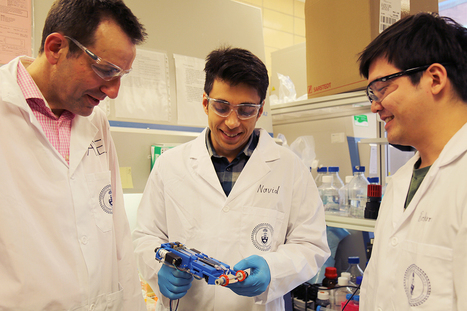
University of Toronto researchers have developed a handheld 3D skin printer that deposits even layers of skin tissue to cover and heal deep wounds. The team believes it to be the first device that forms tissue in situ, depositing and setting in place, within two minutes or less. The research, led by PhD student Navid Hakimi under the supervision of Associate Professor Axel Guenther of the Faculty of Applied Science & Engineering, and in collaboration with Dr. Marc Jeschke, director of the Ross Tilley Burn Centre at Sunnybrook Hospital and professor of immunology at the Faculty of Medicine, was recently published in the journal Lab on a Chip. For patients with deep skin wounds, all three skin layers – the epidermis, dermis and hypodermis – may be heavily damaged. The current preferred treatment is called split-thickness skin grafting, where healthy donor skin is grafted onto the surface epidermis and part of the underlying dermis. Split-thickness grafting on large wounds requires enough healthy donor skin to traverse all three layers, and sufficient graft skin is rarely available. This leaves a portion of the wounded area “ungrafted” or uncovered, leading to poor healing outcomes.
Via Dr. Stefan Gruenwald
|
|
Rescooped by
Antonios Bouris
from Amazing Science
May 11, 2018 7:05 AM
|
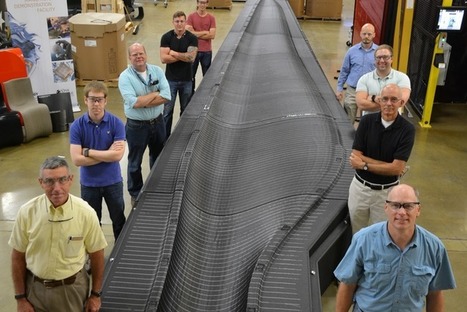
In collaboration with Oak Ridge National Laboratory's Manufacturing Demonstration Facility Team and turbine blade manufacturer TPI Composites, Sandia National Laboratories 3D printed a massive mold to produce wind turbine blades. Sandia researchers have been working on wind turbines for the better part of 40 years; it’s part of the lab's effort to make the renewable energy more affordable. However, building wind turbine prototypes takes a lot of time and effort, and each requires custom molds that take up to 16 months to complete before the blade can be developed and tested. Through the use of 3D printing, the team was able to cut mold development time by more than 80 percent, going from 16 months of development time down to 3 months. The work cut out more than a year of labor. The 13-meter blade mold is relatively small compared to other blades currently on the market and under development — for example, GE's Haliade-X blades will be 107 meters long. However, by cutting design and development time and cost, engineers could take greater risks during the prototype phase that could potentially accelerate innovation in the market.
Via Alan Charky, Dr. Stefan Gruenwald
The Top 10 Most Promising Medical Technologies
Via TechinBiz
|
|
|
Rescooped by
Antonios Bouris
from Amazing Science
June 8, 2018 8:02 AM
|
Building a mirror for any giant telescope is no simple feat. The sheer size of the glass, the nanometer precision of its curves, its carefully calculated optics, and the adaptive software required to run it make this a task of herculean proportions. But the recent castings of the 15-metric ton, off-axis mirrors for the Giant Magellan Telescope (GMT) forced engineers to push the design and manufacturing process beyond all previous limits.
Via Dr. Stefan Gruenwald
|
|
Scooped by
Antonios Bouris
June 8, 2018 4:11 AM
|
Plagiarism is a common (and often misunderstood) problem that is often the result of a lack of knowledge and skills. Our mission is to support the education community with a comprehensive set of resources to help students write with integrity.
Samsung Future Technology that will Blow Your Mind - The World in 2020
Via TechinBiz
|
|
Scooped by
Antonios Bouris
June 1, 2018 7:01 AM
|
In a cashless society, even street performers need to accept contactless payments. In what it claims is a world’s first, London is launching a new scheme to outfit buskers with card and phone readers made by iZettle. They’ll accept fixed tips with just a tap.
|
|
Rescooped by
Antonios Bouris
from Amazing Science
May 25, 2018 7:14 AM
|
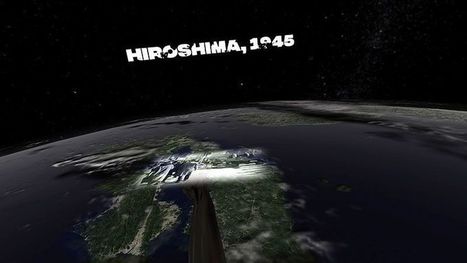
On August 6, 1945, Shigeru Orimen traveled from his rural home near Itsukaichi-cho to Hiroshima, where he was one of nearly 27,000 students working to prepare the city for impending U.S. airstrikes. For lunch that day, he had brought soybeans, sautéed potatoes and strips of daikon. When the atomic bomb fell on Hiroshima at 8:16 a.m., Shigeru was among the nearly 7,200 students who perished. Three days later, his mother Shigeko would identify his body using his lunch box; the food inside was transformed into coal, but the outside remained intact.
Via LilyGiraud, Dr. Stefan Gruenwald
|
|
Scooped by
Antonios Bouris
May 25, 2018 3:32 AM
|
There’s a saying out there that entrepreneurs aren’t made, they’re born. I don’t believe that. I think being an entrepreneur is something anyone can learn how to do. But you need to have a core set of abilities and the right mindset first.
|
|
Scooped by
Antonios Bouris
May 25, 2018 2:54 AM
|
The emergence of edible powders, gels, sugars and doughs has brought the culinary world into 3-D printing’s creative sphere.
|
|
Scooped by
Antonios Bouris
May 18, 2018 6:08 AM
|
What kind of knowledge, skills and personality traits are common in successful entrepreneurs? This question was originally answered on Quora by Euwyn Poon.
TED Talks can offer all kinds of information on a variety of topics. Check out these four videos for small business inspiration.
Via TechinBiz
|
|
Rescooped by
Antonios Bouris
from Amazing Science
May 18, 2018 5:56 AM
|
Scientists have isolated the gene responsible for temperature-controlled sex determination in turtles. Red-eared slider turtles, a common household pet, develop into male or female embryos according to their egg incubation temperature. This little understood process is also at work in the eggs of crocodiles, alligators and some lizards. Researchers are now one step closer to solving a mystery which has persisted for over 50 years.
Via Dr. Stefan Gruenwald
|
|
Rescooped by
Antonios Bouris
from Amazing Science
May 11, 2018 7:06 AM
|
The US and European space agencies are edging towards a joint mission to bring back rock and soil samples from Mars. NASA and ESA have signed a letter of intent that could lead to the first "round trip" to another planet. The move was announced as a meeting in Berlin, Germany, discussed the science goals and feasibility of a Mars Sample Return (MSR) mission. The venture would allow scientists to answer key questions about Martian history. Those questions include whether the Red Planet once hosted life. Scientists at the Mars meeting said that there was only so much they could learn from Martian meteorites and from the various rovers and static landers sent to the Red Planet. The next step had to be a mission that would retrieve samples from the Martian surface, blast them into space in a capsule and land them safely on Earth.
Via Dr. Catherine Russell, Dr. Stefan Gruenwald
Scientists look to songbirds to solve human speech disorder
Via TechinBiz
|