Your new post is loading...

|
Scooped by
Gilbert C FAURE
February 27, 3:53 AM
|
🌹 ✨ International Day of Women and Girls in Science ✨ 🌹
February 11, 2026
✨ Let’s celebrate scientific women from yesterday, today, and tomorrow! ✨
☀️ On this meaningful day, we are proud to highlight the outstanding work of 3 women scientists from Liquid Biopsy LCCRH Lab - Laboratoire Cellules Circulantes Rares Humaines – CHU de Montpellier, whose dedication and excellence are helping advance translational oncology research.
📰 Their study has just been published in the highly regarded Journal of Experimental & Clinical Cancer Research (IF= 12.8), which trusted us with the publication of:
“Reconstructing the Metastatic Journey: Functional Circulating Tumor Cells and Disseminated Tumor Cells-based Models for Translational Oncology.”
🕊️ This achievement reflects their scientific rigor, commitment, and passion for better understanding metastasis to ultimately improve patient care.
📖 The article is open access — feel free to read and share it!
🌺 Today, and 🌺 every day, let’s continue to support, empower, and inspire women and girls in science.
Recherche et innovation – CHU de Montpellier, Anne FERRER-VILLENEUVE, Renan Targhetta, Pôle Biologie Pathologie du CHU de Montpellier, Laurence LACHAUD
Liquid Biopsy LCCRH Lab - Laboratoire Cellules Circulantes Rares Humaines, Sanglier caroline, Laure Cayrefourcq
Mauro Castelli
MedVallée Montpellier, Quinzaine Franco-Allemande d'Occitanie
Association Des étoiles dans la mer, vaincre le glioblastome, Laetitia Levère
European Liquid Biopsy Society, PANCAID, GUIDE.MRD
OncoDaily Aurélia Brégnac
ACADEMIE NATIONALE DE MEDECINE DE FRANCE
|
|
Scooped by
Gilbert C FAURE
February 20, 3:35 AM
|
We have built something that I believe our field urgently needs and that I would like to share: www.liquidbiopsyinfo.com.
When I talk to oncologists about liquid biopsy, the same question keeps coming up:
Where do I find a clear overview of the clinical evidence for my specific clinical scenario?
The honest answer, until now, has been: there is no single place. The data is
scattered. The field moves too fast. And the gap between what the science shows and what reaches daily clinical practice is growing.
www.liquidbiopsyinfo.com is a free, structured resource covering liquid biopsy evidence across 20+ cancer types from MRD detection to molecular profiling. It helps to decide where measuring MRD makes sense and what findings mean.
Built by LIQOMICS, a team that has worked on ctDNA diagnostics for years.
We are transparent about our approach: we use AI to keep pace with the volume of new publications, and we know that this requires expert oversight to meet the standards clinicians and patients deserve. That is why this is an open invitation.
If you work in oncology, liquid biopsy, or clinical research and you think this kind of resource matters I would genuinely value your perspective.
www.liquidbiopsyinfo.com
#LiquidBiopsy #PrecisionMedicine #Oncology #ctDNA #CancerResearch
#LIQOMICS
|
|
Scooped by
Gilbert C FAURE
February 12, 3:29 AM
|
🩸 ❓🩸 Do you want to learn more about the history of circulating tumor cell (CTC) lines and xenograft models, developed over the past 2️⃣2️⃣ years from CTCs isolated directly from cancer patients — and their biological insights, clinical relevance, and translational applications?
✨ This new review is for you !!!! GOOD READING !!!!
❤️ Proud to highlight the outstanding work of these women scientists from the Liquid Biopsy LCCRH Lab - Laboratoire Cellules Circulantes Rares Humaines (CHU de Montpellier), whose dedication and scientific excellence continue to advance translational oncology research.
📰 Our study has just been published in the excellent Journal of Experimental & Clinical Cancer Research (IF 12.8) :
✨ “Reconstructing the Metastatic Journey: Functional Circulating Tumor Cells and Disseminated Tumor Cells-based Models for Translational Oncology.” ✨
🕊️ A comprehensive overview of how functional CTC/DTC models help us better understand metastasis biology and move closer to improving patient care.
📖 The article is open access — feel free to read and share it!
Recherche et innovation – CHU de Montpellier, Renan Targhetta, Pôle Biologie Pathologie du CHU de Montpellier
Liquid Biopsy LCCRH Lab - Laboratoire Cellules Circulantes Rares Humaines, Sanglier caroline, Laure Cayrefourcq
Mauro Castelli
MedVallée Montpellier, Quinzaine Franco-Allemande d'Occitanie
Fondation ARC pour la recherche sur le cancer
European Liquid Biopsy Society, PANCAID, GUIDE.MRD
OncoDaily Aurélia Brégnac
ACADEMIE NATIONALE DE MEDECINE DE FRANCE
#LiquidBiopsy #CTCs #CancerResearch #TranslationalOncology #Metastasis #WomenInScience #OpenScience
|
|
Scooped by
Gilbert C FAURE
December 22, 2025 6:48 AM
|
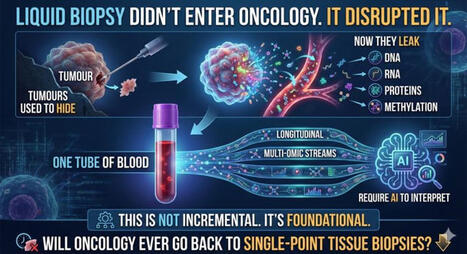
Liquid biopsy didn’t enter oncology.
It redefined it.
Tumours used to hide behind tissue.
Now they broadcast.
DNA.
RNA.
Proteins.
Methylation.
Clonal evolution, in motion.
One tube of blood now delivers
longitudinal, multi-omic intelligence
across diagnosis, treatment, resistance, and relapse.
This is not a better biopsy.
This is a new operating system for oncology.
When disease becomes continuous data,
AI isn’t a nice-to-have, it’s the only way to listen.
So let’s be honest:
Will oncology ever go back to single-timepoint tissue biopsies? 👇
Or have we already crossed the point of no return?
Pic: Gemini
|
|
Scooped by
Gilbert C FAURE
June 4, 2025 1:31 PM
|
Out now! --> Cancer in a drop: Advances in liquid biopsy in 2024
An overview of all liquid biopsy studies published in 2024, done by the Young Committee of the International Society of Liquid Biopsy
https://lnkd.in/e-wgkYK8
Roberto Borea Eleonora Nicolò Letizia Pontolillo Diego de Miguel Perez Erick Saldanha Pasquale Pisapia Angelo Dipasquale Ana Ortega Franco Konstantinos Venetis Nadia Ghazali Christian Rolfo, MD, PhD, MBA,Dr.hc Umberto Malapelle Yüksel ÜRÜN Natasha Leighl Massimo Cristofanilli, MD, FACP Mª JOSE SERRANO Eloisa Jantus Nicola Fusco
|
|
Scooped by
Gilbert C FAURE
April 16, 2025 3:54 AM
|
❤️ Hot off the press!
💫 Super excited to share our latest review just published in Nature Portfolio.
Liquid biopsies🩸, indicating the sampling of body fluids rather than solid-tissue biopsies, have the potential to revolutionize cancer care through personalized, noninvasive disease detection and monitoring.
Circulating tumour DNA (#ctDNA) 🧬 and circulating tumour cells (#CTCs) are promising blood-based biomarkers in bladder cancer. Results from several studies have shown the clinical potential of ctDNA and CTCs in #bladder #cancer for prognostication, treatment-response monitoring, and early detection of minimal residual disease (#MRD) and disease recurrence.
Following successful clinical trial evaluation, assessment of ctDNA and CTCs holds the potential to transform the therapeutic pathway for patients with bladder cancer — potentially in combination with the analysis of urinary tumour DNA — through tailored treatment guidance and optimized disease surveillance.
👏👏👏 Sia Viborg Lindskrog, Trine Strandgaard, Iver Nordentoft, Matthew Galsky, Tom Powles, Mads Agerbæk, Jørgen Bjerggaard Jensen, Catherine Alix-Panabières & Lars Dyrskjøt
🤩 Good reading !
CHU de Montpellier, Recherche et innovation – CHU de Montpellier, Renan Targhetta, Samir JABER
Liquid Biopsy LCCRH Lab - Laboratoire Cellules Circulantes Rares Humaines 🩸
Aarhus University
European Liquid Biopsy Society (ELBS)
PANCAID, GUIDE.MRD
OncoDaily | 11 comments on LinkedIn
|
|
Scooped by
Gilbert C FAURE
November 2, 2024 6:35 AM
|
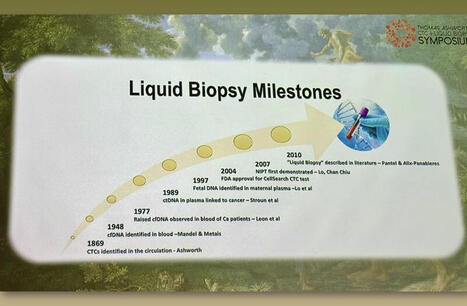
🩸Liquid Biopsy Milestones since 1869 ...
✨Wonderful experience at the University of Technology Sydney (UTS) in #Australia.
CHU de Montpellier
Recherche et…
|
|
Scooped by
Gilbert C FAURE
February 2, 2024 8:18 AM
|
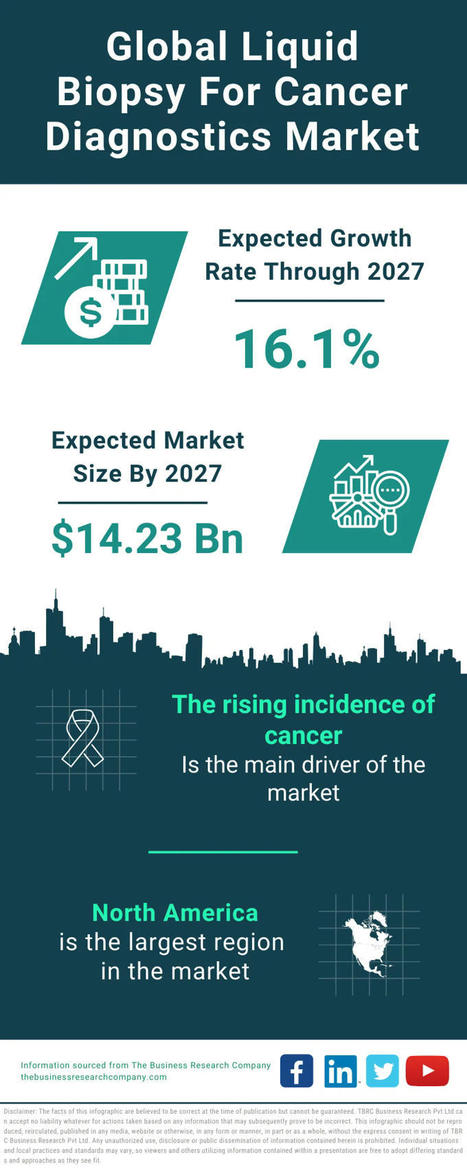
Global liquid biopsy for cancer diagnostics market size is expected to reach $16.42 Bn by 2028 at a rate of 15.7%, segmented as by type, product, services...
|
|
Scooped by
Gilbert C FAURE
April 11, 2023 4:34 AM
|
Over the last decade, liquid biopsy has gained much attention as a powerful tool in personalized medicine since it enables monitoring cancer evolution and follow-up of cancer patients in real time. Through minimally invasive procedures, liquid biopsy provides important information through the analysis of circulating tumour cells (CTCs) and circulating tumour-derived material, such as circulating tumour DNA (ctDNA), circulating miRNAs (cfmiRNAs) and extracellular vehicles (EVs). CTC analysis has already had an important impact on the prognosis, detection of minimal residual disease (MRD), treatment selection and monitoring of cancer patients. Numerous clinical trials nowadays include a liquid biopsy arm. CTC analysis is now an exponentially expanding field in almost all types of solid cancers. Functional studies, mainly based on CTC-derived cell-lines and CTC-derived explants (CDx), provide important insights into the metastatic process. The purpose of this review is to summarize the latest findings on the clinical significance of CTCs for the management of cancer patients, covering the last four years. This review focuses on providing a comprehensive overview of CTC analysis in breast, prostate and non-small-cell lung cancer. The unique potential of CTC single-cell analysis for understanding metastasis biology, and the importance of quality control and standardization of methodologies used in this field, is also discussed.
|
|
Scooped by
Gilbert C FAURE
August 9, 2022 1:52 PM
|
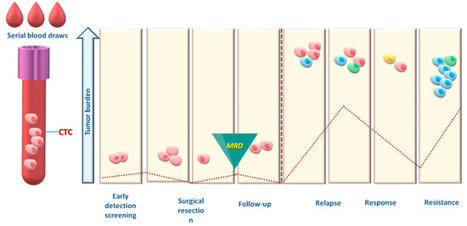
Over the past decade, various liquid biopsy techniques have emerged as viable alternatives to the analysis of traditional tissue biopsy samples. Such surrogate ‘biopsies’ offer numerous advantages, including the relative ease of obtaining serial samples and overcoming the issues of interpreting one or more small tissue samples that might not reflect the entire tumour burden. To date, the majority of research in the area of liquid biopsies has focused on blood-based biomarkers, predominantly using plasma-derived circulating tumour DNA (ctDNA). However, ctDNA can also be obtained from various non-blood sources and these might offer unique advantages over plasma ctDNA. In this Review, we discuss advances in the analysis of ctDNA from non-blood sources, focusing on urine, cerebrospinal fluid, and pleural or peritoneal fluid, but also consider other sources of ctDNA. We discuss how these alternative sources can have a distinct yet complementary role to that of blood ctDNA analysis and consider various technical aspects of non-blood ctDNA assay development. We also reflect on the settings in which non-blood ctDNA can offer distinct advantages over plasma ctDNA and explore some of the challenges associated with translating these alternative assays from academia into clinical use. Advances in circulating tumour DNA (ctDNA) detection and analysis are beginning to be implemented in clinical practice. Nonetheless, much of this development has thus far focused on plasma ctDNA. Theoretically, all bodily fluids, including urine, cerebrospinal fluid, saliva, pleural fluid and others, can also contain measurable ctDNA and can provide several advantages over the reliance on plasma ctDNA. In this Review, Tivey et al. describe the potential roles of ctDNA obtained from non-plasma sources in optimizing the outcomes of patients with cancer.
|
|
Scooped by
Gilbert C FAURE
August 15, 2021 5:44 AM
|
Click on the article title to read more.
|
|
Scooped by
Gilbert C FAURE
April 3, 2021 11:53 AM
|
|
|
Scooped by
Gilbert C FAURE
October 16, 2020 2:23 PM
|
As we continue to better our understanding of cancer biology, one thing remains a game changer for cancer care: the ability to detect cancer in a liquid biopsy.Just a few years ago, the idea of hav...
|
|
|
Scooped by
Gilbert C FAURE
February 25, 5:48 AM
|
Prostate cancer is characterized by multifocality, inter- and intra-patient tumour heterogeneity, and differences in risk of progression to metastatic disease, castration resistance and lethality, which can make prognosis challenging. Consequently, sampling methods that provide accurate insight into disease phenotype to facilitate risk-stratification of patients are crucial. The variable biology of prostate cancer seems to be recapitulated in the phenotypic heterogeneity of circulating tumour cells (CTCs). CTC sampling offers a liquid biopsy method to achieve minimally invasive longitudinal sampling for disease monitoring. CTC analysis has also offered a crucial insight into aggressive phenotypes, disease metastasis and treatment response, particularly in clinical trials. The clinical use of CTC count for prognosis in advanced prostate cancer has been approved by the FDA, but is not routinely used clinically, as these cells are technically challenging to isolate and analyse. However, methodological advances continue to improve CTC enrichment and profiling. Understanding the clinical utility of CTCs and future innovations is crucial to incorporating CTCs into the clinical management of prostate cancer. Circulating tumour cells (CTCs) offer a minimally invasive biopsy strategy for prostate cancer monitoring. This Review discusses the use of CTCs at all stages of prostate cancer development and treatment, from CTC isolation and enrichment strategies to the prognostic and clinical utility of these cells in prostate cancer.
|
|
Scooped by
Gilbert C FAURE
February 12, 12:44 PM
|
European Liquid Biopsy Society (ELBS)
|
|
Scooped by
Gilbert C FAURE
December 29, 2025 11:17 AM
|
We’re excited to share our latest paper exploring the tumor–immune interface in circulation through liquid biopsy: “Caught in the Act: Tumor–Immune Interactions in Circulation of Patients with Immune Marker–Positive Circulating Tumor Cells”
Circulating tumor cells (CTCs) and large extracellular vesicles (LEVs) are key components of liquid biopsy, offering minimally invasive insight into tumor biology. A particularly intriguing subset, immune marker–positive CTCs (im.CTCs), has been described clinically, yet their biological origin has remained unclear.
In this study, using high-resolution immunofluorescence microscopy and proteomic profiling of patient blood samples, we show direct physical interactions between white blood cells and both im.CTCs and im.LEVs, observed exclusively in patients with im.CTCs.
Together, these results support the hypothesis for in vivo membrane transfer as a mechanism of immune marker acquisition by CTCs and LEVs, with important implications for tumor–immune biology and the clinical interpretation of immune-positive CTCs in liquid biopsy.
Read the full paper here: https://lnkd.in/gGy66mZJ
#LiquidBiopsy #CirculatingTumorCells #CancerResearch #TranslationalScience
|
|
Scooped by
Gilbert C FAURE
December 19, 2025 11:32 AM
|
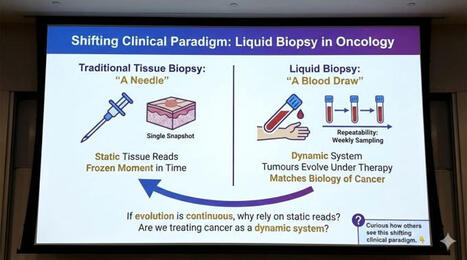
A needle vs a blood draw.
Oncology chose sides.
Repeatability beats a single snapshot.
Tumours evolve under therapy.
Blood can be sampled weekly.
Liquid biopsy isn’t just less invasive, it matches the biology of cancer.
If evolution is continuous, why are we still relying on static tissue reads?
Are we finally treating cancer as a dynamic system, not a frozen moment in time?
👇 Curious how others see this shifting clinical paradigm.
Pic: Gemini
#liquidbiopsy #cancer #oncology
|
|
Scooped by
Gilbert C FAURE
May 28, 2025 3:35 AM
|
Fostering the Implementation of Liquid Biopsy in Clinical Practice: European Liquid Biopsy Society (ELBS) 2024 Meeting Report by Klaus Pantel et al.
Journal of Experimental & Clinical Cancer Research Catherine Alix-Panabières
https://lnkd.in/dag4Z7Vb
#Cancer #CancerResearch #LiquidBiopsy #Medicine #Health #Oncology #ELBS2024 #OncoDaily
|
|
Scooped by
Gilbert C FAURE
December 13, 2024 4:03 AM
|
|
|
Scooped by
Gilbert C FAURE
February 22, 2024 4:21 AM
|
|
|
Scooped by
Gilbert C FAURE
November 14, 2023 5:46 AM
|
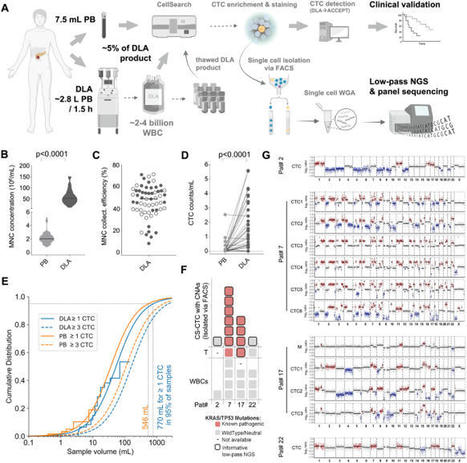
The limited sensitivity of circulating tumor cell (CTC) detection in pancreatic adenocarcinoma (PDAC) stems from their extremely low concentration in the whole circulating blood, necessitating enhanced detection methodologies. This study sought to amplify assay-sensitivity by employing diagnostic leukapheresis (DLA) to screen large blood volumes. Sixty patients were subjected to DLA, with a median processed blood volume of ~ 2.8 L and approximately 5% of the resulting DLA-product analyzed using CellSearch (CS). Notably, DLA significantly increased CS-CTC detection to 44% in M0-patients and 74% in M1-patients, yielding a 60-fold increase in CS-CTC enumeration. DLA also provided sufficient CS-CTCs for genomic profiling, thereby delivering additional genomic information compared to tissue biopsy samples. DLA CS-CTCs exhibited a pronounced negative prognostic impact on overall survival (OS), evidenced by a reduction in OS from 28.6 to 8.5 months (univariate: p = 0.002; multivariable: p = 0.043). Additionally, a marked enhancement in sensitivity was achieved (by around 3-4-times) compared to peripheral blood (PB) samples, with positive predictive values for OS being preserved at around 90%. Prognostic relevance of CS-CTCs in PDAC was further validated in PB-samples from 228 PDAC patients, consolidating the established association between CTC-presence and reduced OS (8.5 vs. 19.0 months, p < 0.001). In conclusion, DLA-derived CS-CTCs may serve as a viable tool for identifying high-risk PDAC-patients and aiding the optimization of multimodal treatment strategies. Moreover, DLA enables comprehensive diagnostic profiling by providing ample CTC material, reinforcing its utility as a reliable liquid-biopsy approach. This high-volume liquid-biopsy strategy presents a potential pathway for enhancing clinical management in this malignancy.
|
|
Scooped by
Gilbert C FAURE
September 25, 2022 4:17 AM
|
📚 Atlas of Liquid Biopsy Circulating Tumor Cells and Other Rare Cells in Cancer Patients’ Blood. Chapter 1, page 2. Ludmilla Thomé Domingos…
|
|
Scooped by
Gilbert C FAURE
September 27, 2021 3:26 AM
|
The liquid biopsy (LB) concept was introduced for circulating tumor cells (CTCs) 10 years ago (1) and rapidly extended to ctDNA (2) and other tumor-derived prod
|
|
Scooped by
Gilbert C FAURE
July 5, 2021 11:26 AM
|
Cancer remains one of the most challenging diseases, as many patients show limited
therapeutic response to treatment. Liquid biopsy is a minimally invasive method that
has the advantage of providing real-time disease information with the least damage
to cancer patients.
|
|
Scooped by
Gilbert C FAURE
November 20, 2020 3:00 AM
|
Epic Sciences, Inc. today announced it has entered into an exclusive license and collaboration agreement with Dr. Peter Kuhn and the USC Michelson Center for Convergent Bioscience. Dr. Kuhn is a founding member of the USC Michelson Center and leads USC’s Convergent Science Institute in Cancer (CSI-Cancer). The collaboration will improve Epic’s platform and enable more precise characterization of rare circulating tumor cells (CTCs), which Epic is developing into liquid-biopsy diagnostics used for characterizing a patient’s cancer to guide treatment decisions.
|