Your new post is loading...

|
Scooped by
Roland Schegg
Today, 9:34 AM
|
Hoteliers are feeling the pressure to transform their businesses as technology evolves, according to Amadeus’ “Travel Dreams 2026” report.
The shift comes as travelers’ reliance on artificial intelligence (AI) is increasing. Travelers said AI was useful for planning (42%), inspiration (36%), booking (32%) and during travel (35%).
“Hoteliers are this year focused on becoming more efficient, digital and guest-centric, with rising costs, digital transformation and hyper-personalization cited as the main challenges,” Amadeus said in the report.
“They are investing heavily in artificial intelligence (AI) for revenue intelligence, forecasting and automation, while being careful to preserve the human touch in guest services.”
|
|
Scooped by
Roland Schegg
Today, 7:03 AM
|
Expedia Group released The AI Trust Gap report, revealing a growing disconnect between how travelers use AI chatbots and agents and where they book. While AI is quickly becoming a go-to tool for trip planning and inspiration, travelers still overwhelmingly rely on trusted travel brands for booking and support.
Travelers don't have a technology problem with AI. They have a trust problem.
Share
The Expedia Group survey, which interviewed more than 5,700 adults across the U.S., U.K., and India, highlights a defining shift in travel: AI is reshaping discovery, but trust — not technology — is the deciding factor in where travelers transact.
Travelers embrace AI for discovery and planning
Expedia Group research shows that travelers are open to using AI chatbots and agents to help with planning a trip:
53% are comfortable letting AI suggest travel options
42% use or would use AI to monitor prices
40% use AI to help build itineraries
Nearly half (48%) say AI saves them time and helps them discover places they wouldn’t have found otherwise
|
|
Scooped by
Roland Schegg
Today, 12:39 AM
|
Anthropic a créé une IA capable, selon ses dires, de lancer des cyberattaques massives. Le secteur de la finance, notamment, est sur le qui-vive. Tous les acteurs du numérique tentent de se préparer
|
|
Scooped by
Roland Schegg
April 14, 4:42 AM
|
The rise of generative AI is changing how travelers begin their journey, with a growing number starting without a specific destination in mind. Instead of searching for places and dates, users increasingly describe moods, motivations, or personal preferences, allowing AI tools to suggest tailored travel ideas. This shift reflects a broader move from transactional search to exploratory discovery, particularly among younger travelers. As adoption of conversational AI accelerates, destinationless search is becoming a defining trend in how travel demand is shaped.
Key takeaways
Destinationless search emerges: More travelers now begin trip planning without a fixed destination, relying on AI to guide discovery based on intent and preferences.
Intent replaces location as a starting point: Queries increasingly reflect emotions, needs, or identities rather than specific places or dates.
|
|
Scooped by
Roland Schegg
April 13, 12:24 PM
|
The travel industry is entering a new phase of disruption as major technology companies develop competing AI systems for travel planning and booking. Amazon, Meta, and Google are building distinct ecosystems with different architectures, data sources, and commercial models. These systems do not interoperate, meaning travel companies cannot rely on a single integration for visibility across platforms. As a result, fragmentation is emerging as the next major distribution challenge for the industry.
Key takeaways
Fragmented AI ecosystems: Amazon, Meta, and Google are developing separate AI-driven travel environments, each with its own logic, partners, and user experience, limiting cross-platform visibility.
Platform-specific visibility: Travel brands integrated into one ecosystem (e.g., Google) may not appear in others (e.g., Alexa or Meta), forcing companies to manage multiple distribution strategies.
|
|
Scooped by
Roland Schegg
April 13, 12:22 PM
|
"Booking.com has confirmed a data breach in which unauthorized parties accessed certain customer booking details. The company stated that financial information was not compromised, but personal data such as names, contact details, and reservation information may have been exposed. After detecting suspicious activity, Booking.com took steps to contain the issue, reset reservation PINs, and notify affected customers. The incident reflects a broader pattern of increasing cybercrime and fraud attempts targeting online travel platforms.
Key takeaways
Scope of exposed data: Hackers accessed booking-related information including names, email addresses, phone numbers, addresses, and reservation details, but not financial data.
Unclear scale of impact: Booking.com has not disclosed how many customers were affected, leaving uncertainty about the full extent of the breach."
|
|
Scooped by
Roland Schegg
April 12, 4:47 AM
|
Travel companies are staring down a trust gap on the road to artificial intelligence (AI)-powered booking that is both technical and behavioral.
Following OpenAI’s recent relocation of its Instant Checkout, Walmart reported its Instant Checkout conversions in ChatGPT were three times worse than on its own website. The result indicates consumer reluctance to adapt to a new commerce structure, emphasizing a potential barrier to AI booking.
To enable agentic booking in the future, AI, travel and payments companies must close a gap that is as much about the plumbing of payments as it is about the psychology of the purchase.
“Trust doesn't transfer automatically through a new interface,” Matthew Mamet, a fractional chief product officer and chief growth officer wrote on LinkedIn. “You have to earn it in the new context, which takes time and usually means worse numbers before better ones.”
The takeaway isn’t that agentic commerce is dead, Mamet wrote. But it’s not going to become a standard method of transaction overnight either.
|
|
Scooped by
Roland Schegg
April 12, 2:09 AM
|
Chinese online travel agencies are leveraging a decade of domestic technological innovation to expand aggressively into global markets. By integrating artificial intelligence across their platforms, these companies are enhancing personalization, operational efficiency, and customer engagement. Their experience in China’s highly competitive and mobile-first environment is now becoming a strategic advantage abroad. As a result, global travel distribution is entering a new phase where Chinese players are increasingly influential.
Key takeaways
AI as a competitive advantage: Chinese OTAs are embedding AI across search, pricing, and customer service, enabling faster and more personalized user experiences.
Domestic scale as a testing ground: Intense competition and large user bases in China have allowed these companies to refine technologies before deploying them internationally.
|
|
Scooped by
Roland Schegg
April 12, 1:42 AM
|
For years, travel executives have called their decision-making "data-driven." Artificial intelligence (AI) is about to reveal how much of it was actually instinct-led, dressed up with dashboards.
AI won't just automate tasks. It will surface insights that challenge assumptions, expose where intuition has been substituted for evidence and enable a level of operational intelligence that will make us wonder how we ever managed without it.
Yet nearly one third (32%) of travel companies are not using agentic AI at all, according to Phocuswright research.
On the multi-day travel front, brands are still trying to figure out where AI fits. Executives see impressive demos of agentic platforms, while frontline teams still wrestle with quoting, rooming lists and supplier emails.
The following phased model for AI adoption reflects how tour and cruise operators actually work. The brands who want to lead, not follow, will need to think differently about how AI-first applications are built from the ground up.
|
|
Scooped by
Roland Schegg
April 1, 10:52 AM
|
The conversation about Google and agentic travel keeps returning to the same question: when agentic hotel booking goes live inside AI Mode, who wins and who loses?
It is a fair question. But it is also a narrow one.
The booking moment is one point in a journey that begins weeks before arrival and ends weeks after checkout — when the experience gets processed, rated, remembered, and eventually shapes the next booking decision. Google's infrastructure touches every one of those stages. The question worth asking is what happens when Gemini becomes the interface that ties them together.
|
|
Scooped by
Roland Schegg
March 31, 8:23 AM
|
"Chatbots, Self-Check-in, automatisierte Bewertungen - wenn Hotels über KI reden, geht es fast immer um die Operative. Dabei liegt der größte Hebel woanders: im Finanzmanagement. Laut einer aktuellen Studie von Prof. Roland Schegg (HES-SO Valais-Wallis, 2025), aufbereitet von ÖHV und WKÖ, bewerten österreichische Hoteliers den Einfluss von KI auf ihren Betrieb mit 7,3 von 10 Punkten – deutlich über dem europäischen Schnitt von 6,1. Rund 40 Prozent der heimischen Betriebe setzen bereits KI ein. Doch wo genau? Beim Chatbot an der Rezeption, beim automatisierten Check-in, bei der Beantwortung von Google-Bewertungen. Alles sinnvoll. Nur: Der operative Alltag ist nicht der Bereich, in dem die meisten Betriebe wirtschaftlich unter Druck stehen.Der blinde Fleck heißt FinanzplanungSteigende Energiekosten, volatile Personalkosten, Kreditrückzahlungen in der Nebensaison – die Themen, die Hoteliers wirklich beschäftigen, liegen selten an der Rezeption. Sie liegen in der Frage: Weiß ich, wo mein Betrieb finanziell steht? Nicht im Jahresabschluss, der drei Monate zu spät kommt. Sondern jetzt."
|
|
Scooped by
Roland Schegg
March 30, 3:06 PM
|
Il y a une différence fondamentale entre utiliser un outil d’intelligence artificielle et intégrer l’IA dans son infrastructure de travail. Google a choisi la deuxième voie, et les implications pour les professionnels du tourisme québécois sont considérables.
Là où ChatGPT se positionne comme une plateforme distincte que l’on consulte, l’intelligence artificielle de Google s’est tissée à l’intérieur des outils que vous utilisez déjà chaque jour au sein de Google Workspace.
|
|
Scooped by
Roland Schegg
March 30, 9:38 AM
|
As artificial intelligence (AI) becomes embedded across customer service platforms and in day-to-day travel search activity, travel brands should be aware of biases creeping in.
A session at ITB Berlin earlier this month focused on how the direct answers and recommendations generated by AI bring their share of ethical challenges, potential regulatory issues and bias.
"The key question is how we can ensure AI enhances equity, fairness and meaningful guest experiences, rather than becoming a barrier to them," said Professor Fevzi Okumus of the school of hospitality and tourism management at the University of South Carolina.
Okumus said AI systems can disadvantage certain groups across many areas including recruitment, service recommendations and visibility of businesses.
|
|
|
Scooped by
Roland Schegg
Today, 7:10 AM
|
Travel companies are increasingly adopting a hybrid service model that combines AI-powered agents with human support to deliver both efficiency and empathy. Executives from Navan and Expedia Group highlight that while AI can handle a growing share of customer interactions, it cannot fully replace the value of human connection. Instead, the industry is moving toward orchestrating both elements to create faster, more responsive, and more personalized service experiences. This shift reflects a broader recognition that technology enhances service delivery, but trust and reassurance still depend on human interaction.
Key takeaways
Hybrid service model: Travel companies are intentionally combining AI automation with human agents to balance efficiency with personalized support.
AI as the first line of service: AI agents increasingly handle routine inquiries, itinerary changes, and disruptions, reducing response times and operational costs.
|
|
Scooped by
Roland Schegg
Today, 6:51 AM
|
Expedia Group’s latest research highlights a growing disconnect in the travel journey that directly impacts hotels. While guests are increasingly using AI tools to explore destinations, compare options, and shape their trips, they still turn to trusted brands and platforms to complete their bookings. This shift is fragmenting the path to purchase, with discovery moving into AI-driven environments while transactions remain anchored in established channels. For hotels, this creates both a visibility challenge and an opportunity to rethink how they engage travelers across the funnel.
Key takeaways
AI is reshaping the discovery phase: Travelers are increasingly using AI to explore destinations, build itineraries, and generate ideas, shifting early-stage demand away from traditional search channels.
Booking still happens in trusted ecosystems: Most guests prefer to complete hotel bookings through established brands such as OTAs or direct hotel channels rather than through AI interfaces.
|
|
Scooped by
Roland Schegg
April 14, 9:41 AM
|
Traditional channels continue to dominate trip planning over artificial intelligence (AI) platforms according to research from Expedia Group.
In its AI Trust Gap study, the company said it is still a small percentage of consumers, 8%, who rely on AI chatbots and agents when planning a trip compared with 59% who use search engines.
Recent research from Phocuswright on U.S. travelers highlighted a growing reliance on AI. It revealed that 39% are using AI to research and plan travel. It also found that search engines are losing ground, dropping from 51% in late 2024 to 36% in the second half of 2025.
|
|
Scooped by
Roland Schegg
April 13, 12:26 PM
|
Guest communication is shifting rapidly toward messaging platforms, and hotels need to respond accordingly. Today’s travelers expect fast, conversational, and mobile-first interactions, often preferring WhatsApp over traditional channels like email or phone. This shift is not just about service—it directly impacts conversion, upselling, and guest satisfaction. For hoteliers, WhatsApp is evolving into a strategic touchpoint across the entire guest journey.
Key takeaways
Guest expectations are changing: Travelers increasingly expect hotels to be available on WhatsApp, making it a baseline communication channel rather than a differentiator.
A new conversion channel: WhatsApp is not just for service; it can influence booking decisions, handle inquiries, and drive direct reservations.
|
|
Scooped by
Roland Schegg
April 13, 12:23 PM
|
Travel scams are becoming more sophisticated, targeting travelers across the entire journey — from booking hotels to contacting airlines and managing loyalty accounts. The New York Times highlights how misleading websites, fake customer service numbers, and hacked airline accounts can lead to significant financial losses and disrupted travel plans. These issues are often driven by intermediaries that mimic trusted brands or exploit moments of stress and urgency. As digital travel ecosystems grow more complex, travelers must become more vigilant in how they search, book, and manage their trips.
Key takeaways
Deceptive booking sites: Some online travel agencies mimic official hotel websites, leading travelers to unknowingly book through intermediaries that add hidden fees, upgrades, or restrictive conditions.
Search engine manipulation: Paid search results often place third-party booking sites above official hotel websites, increasing the risk of users clicking on misleading links.
|
|
Scooped by
Roland Schegg
April 13, 11:37 AM
|
"IMG has released the results of its 6th annual Travel Outlook Survey that gathered 1,000+ responses from IMG customers about their 2026 travel plans. Travel planning support: advisors and AI Findings reveal travelers are relying on expert guidance from both human and digital sources. - 41% of respondents use a travel advisor or agent for at least some of their trips
- 33% of respondents say they are likely to use AI tools (ChatGPT, Gemini, Copilot, Claude, etc.) to help plan travel in 2026
Among those likely to use AI, travelers expect to rely on it for: - Recommendations – 75% of respondents
- Itinerary planning – 70% of respondents
- Discovery and ideas – 69% of respondents
- Comparisons – 55% of respondents
- Booking – 13% of respondents"
|
|
Scooped by
Roland Schegg
April 12, 3:20 AM
|
The travel industry is shifting from isolated AI tools toward a model where artificial intelligence acts as an orchestration layer across complex systems. Rather than relying on a single, all-purpose model, companies are increasingly deploying multiple specialized AI agents that handle distinct tasks and coordinate them across booking, distribution, and servicing workflows. This approach reflects the reality of travel’s highly interconnected ecosystem, where accuracy, reliability, and collaboration between systems are critical. As AI adoption scales, orchestration is becoming the defining factor that separates experimental deployments from operational impact.
Key takeaways
AI as an orchestration layer: The most effective AI strategies in travel focus on coordinating multiple specialized agents across systems, rather than relying on a single model to handle all tasks.
Specialized agents improve reliability: Smaller, task-specific AI agents (e.g., search, booking, disruption handling) tend to produce more accurate and consistent results than broad, general-purpose models.
|
|
Scooped by
Roland Schegg
April 12, 2:04 AM
|
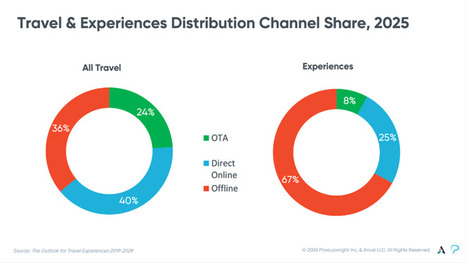
A couple of weeks ago Arival and Phocuswright published Outlook for Travel Experiences 2019–2029. As always, the headline number got the attention: $271 billion in gross bookings in 2025, heading toward $340 billion plus by 2029. And as always, the takeaway seems straightforward: big market, fast growth, low online penetration, huge opportunity. That is all true. But it is also where the conversation often goes off track.
The first chart presents two of the most commonly cited data points:
Online channels account for just a third of all experiences bookings versus nearly two-thirds for travel overall.
OTAs represent only 8% of experiences gross bookings, compared with roughly 24% across all travel.
The usual conclusion is that experiences is simply “behind” and therefore full of upside. That may be partly true. But it also misses a more important question: how much of this market is actually serviceable by online travel distribution in the first place?
|
|
Scooped by
Roland Schegg
April 12, 1:22 AM
|
The latest shifts in Google’s travel search experience aren’t just another UI test; they’re a signal flare for where distribution power is heading next. If you’re a hotel owner, operator, or marketer, it’s time to pay very close attention.
Over the past several months, Google has been testing changes to hotel search results in Europe under pressure from the Digital Markets Act (DMA). On the surface, these adjustments are about ensuring fair competition and giving third-party intermediaries (OTAs, metasearch, DMCs) more visibility. But in practice, what we’re seeing is something much more consequential: a reshuffling of who controls demand at the point of discovery.
The familiar Google Hotel Ads ecosystem (where suppliers could compete in a relatively structured marketplace) is being diluted and replaced by more prominent listings of intermediaries and less direct pathways to hotel-owned channels.
As I’ve said before, this isn’t about fairness. It’s about unintended consequences.
|
|
Scooped by
Roland Schegg
April 1, 2:06 AM
|
Brand USA, Visit California, Discover Puerto Rico... j'ai épluché ce qu'ils font avec Mindtrip et ce que ça nous apprend : stratégie, data, POI, visibilité
|
|
Scooped by
Roland Schegg
March 31, 2:21 AM
|
Artificial intelligence is transforming how travelers discover and choose hotels, shifting search from a manual comparison process to an intelligent, guided experience. Instead of browsing multiple websites, travelers increasingly rely on AI to interpret their intent, filter options, and recommend the most relevant stays. This evolution reduces friction in the booking journey but also changes who controls visibility and demand. For hoteliers, the implication is clear: success will depend less on ranking in traditional search and more on being understood, structured, and surfaced by AI systems.
Key takeaways
Discovery is moving beyond traditional search: AI assistants increasingly shape which hotels travelers see and consider, reducing the role of classic keyword-based search rankings.
Visibility depends on structured and accessible data: Hotels that provide rich, well-organized content—rates, availability, amenities, policies—are more likely to be surfaced accurately by AI systems.
|
|
Scooped by
Roland Schegg
March 30, 3:05 PM
|
Après une année 2024 marquée par une forte progression de la haine en ligne (+16 % par rapport à 2023), l’année 2025 confirme l’installation durable du phénomène. C’est ce que révèle la deuxième édition de l’Observatoire de la haine et de la toxicité en ligne publiée par Bodyguard, spécialiste de la modération sur les réseaux sociaux.
Basée sur l’analyse de plus de 14,3 milliards de commentaires publiés entre le 1er janvier et le 1er décembre 2025 (contre 3,8 milliards en 2024), cette étude met en lumière une polarisation accrue des discours haineux, souvent liée à une actualité géopolitique et sportive particulièrement intense. Le périmètre de l’étude a par ailleurs été élargi avec l’intégration de deux nouvelles plateformes : TikTok et Discord, en plus de YouTube, Instagram, X, Twitch, Facebook et LinkedIn.
|


 Scoop.it!