Your new post is loading...
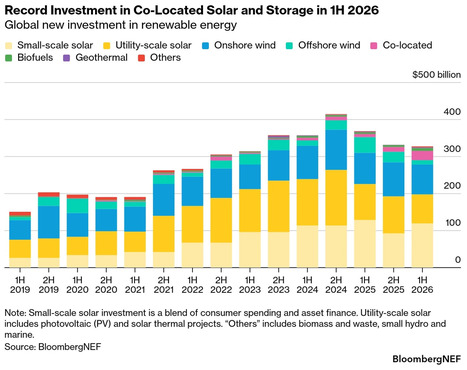
Renewable energy investment in the first half of 2026 reached $327.5 billion, on par with the preceding six-month level but down 21% from its peak in the second half of 2024. The numbers show that the broader growth story for renewables remains intact despite policy changes in key markets like the US and China. China accounted for a mere quarter of global investment in 1H 2026, sliding from over half of global investment in 2022, as developers adjusted revenue expectations following last year’s power market reforms. The US was the second-largest market in 1H 2026, investment was up 54% year-on-year as project developers pushed to hit deadlines for claiming tax credits and to support unprecedented load growth from data centers. Solar investment rose 41% year-on-year to a record $45.8 billion, while wind investment more than doubled to $13.8 billion. European onshore wind nvestment reached $92.3 billion in 1H 2026, down 27% from the same period last year.
Después de un cuarto de siglo apoyado casi por completo en los combustibles fósiles, que cubrieron cerca del 80% de la generación eléctrica del país entre 2000 y 2024, México podría estar a las puertas de una transformación energética acelerada. El detonante es un cambio regulatorio: en junio se adjudicaron 7.410 megavatios de proyectos solares y eólicos entre casi 38.000 MW propuestos por inversores, señal del apetito que despierta el sector. La mayor parte, unos 6.700 MW, corresponde a fotovoltaica, y el resto a energía eólica. La novedad clave es que todos los proyectos deberán incorporar baterías equivalentes a, al menos, el 30% de su capacidad, con una autonomía mínima de tres horas.
Según un informe de Alvarez & Marsal, España ha perdido relevancia dentro del mercado europeo de transacciones, pasando de representar históricamente alrededor del 15% de la actividad renovable a apenas el 6% de las operaciones durante el último trimestre de 2025. Tras una década marcada por la rápida incorporación de nueva capacidad eólica y fotovoltaica, los inversores están desplazando su interés hacia activos que permitan integrar esa electricidad en el sistema, como el almacenamiento con baterías, las redes de transporte y distribución y las infraestructuras capaces de aportar flexibilidad. El cambio responde a un escenario de mayor incertidumbre sobre los precios, una creciente congestión de la red y unos retornos más ajustados que han provocado un fuerte descenso de la actividad corporativa en el sector.
El Consejo de Ministros ha aprobado, a propuesta del Ministerio para la Transición Ecológica y el Reto Demográfico (MITECO), un Acuerdo por el que se declaran “instalaciones energéticas estratégicas” los proyectos de generación renovable y de almacenamiento energético adjudicatarios de los procedimientos para la concesión de capacidad de acceso en los nudos de transición justa, regulados a partir de la disposición adicional vigésima segunda de la Ley 24/2013, del sector eléctrico. La declaración otorga a estos proyectos la consideración de “proyectos energéticos preferentes”, lo que supone una atención prioritaria por parte de las Administraciones intervinientes.
The trade truce between the European Union and the United States holds for now despite Washington's rollout of new Section 301 tariffs ranging from 10% to 12.5% on 60 trading partners, including the EU. Brussels has decided against immediate retaliation because the new rates do not breach the 15% ceiling established under the bilateral joint statement. Although European officials firmly reject the U.S. allegations regarding weak forced labor enforcement as unfounded, the European Commission is prioritizing commercial stability and protecting the existing agreement over rekindling a full-scale trade war.
El Pleno del Congreso ha convalidado este jueves el Real Decreto-ley 18/2026, de 29 de junio, por el que se adoptan determinadas medidas en el marco del Plan Integral de Respuesta a la Crisis en Oriente Medio. De acuerdo con la exposición de motivos, este real decreto-ley mantiene “de manera transitoria” algunas de las medidas del Real Decreto-ley 7/2026, de 20 de marzo, por el que se aprueba el Plan Integral de Respuesta a la Crisis en Oriente Medio, “articulando su retirada progresiva conforme se consolide la estabilización de los mercados energéticos y disminuyan los riesgos asociados a la actual coyuntura geopolítica”, que se hará “de forma escalonada” hasta su desaparición a finales de septiembre de 2026. La norma se estructura en cinco capítulos, ocho disposiciones adicionales, dos transitorias, una derogatoria y cinco disposiciones finales. El capítulo I contempla medidas en materia energética, que tienen por objeto “continuar con el despliegue renovable” y “agilizar la urgente reducción de la exposición a la volatilidad de los combustibles fósiles tanto en términos de precio como de abastecimiento”, mediante la electrificación de la demanda, sustituyendo el uso de combustibles fósiles por electricidad en los distintos usos energéticos para reducir la dependencia. Las medidas se destinan, entre otros ámbitos, a las infraestructuras de recarga para vehículos eléctricos, las redes de distribución y el almacenamiento de las energías renovables. Además de rebajas fiscales, el RD incluye la eliminación definitiva del Impuesto sobre el Valor de la Producción Eléctrica, del 7%.
The IEA’s latest Electricity Mid-Year Update forecasts that global electricity demand will grow by 3.6% in 2026 and by a further 3.8% in 2027 – up from 3% growth in 2025. Global electricity consumption is projected to reach 30,700 terawatt-hours (TWh) in 2027, compared with 28,600 TWh in 2025. The disruptions to liquified natural gas (LNG) flows through the Strait of Hormuz have tested electricity markets around the world, driving natural gas prices in Asia and Europe to their highest levels since the 2022-23 energy crisis and prompting emergency measures to curb energy use in some regions. Power systems have for the most part weathered the impacts of the crisis so far, with additional LNG supplies – particularly from North America – helping to ease market tightness. Nevertheless, spikes in gas prices have prompted fuel switching from natural gas to coal in several Asian and European countries. At the same time, rising power generation from renewable sources has contributed to the diversification of electricity supplies in many countries, supporting energy security and helping cushion the impacts of the shock. Renewables are on track to become the world’s largest source of electricity generation in 2026, overtaking coal after reaching near parity in 2025. Renewable generation is set to grow by more than 8% in 2026, and it is poised to increase its share of global electricity generation from 33% in 2025 to 37% by 2027.
The nineteenth edition of the Levelized Cost of Energy+ report finds that renewables remain the lowest-cost new-build generation despite rising cost pressures, as they remain the most cost-competitive form of new-build generation on an unsubsidized basis and will account for the majority of near-term capacity additions. Unprecedented demand reinforces the need for a diverse generation fleet and a thoughtful acceleration of permitting and approval processes, especially since rising power demand and intensifying reliability considerations are compounding the pressures already confronting the industry, from pipeline capacity constraints to rising and inflationary cost pressures. Additionally, the analysis notes the increasing competitiveness of existing generation, given that the relative economics of existing generation have improved as rising new-build costs across all technologies, together with execution challenges tied to supply chains, inflation, tariffs, permitting and macroeconomic uncertainty, have made replacement capacity more expensive and difficult to deliver. Finally, storage costs are rising, reversing recent declines, as the effect of tariffs on lithium-ion battery imports has materialized and accelerated battery supply chain diversification, though battery energy storage remains an important resource to address higher levels of intermittent generation in a speed-to-power era where demand is outpacing supply and costs are climbing across every technology.
Wood Mackenzie has published analysis warning that accelerating declines in global fertility rates present a material risk to long-term energy demand projections, with a UN low-birth-rate scenario placing peak global population at 8.9 billion in 2053, followed by a contraction to 7.0 billion by 2100. The global fertility rate fell to 2.2 births per woman in 2025, perilously close to the 2.1 replacement ratio needed to keep the population stable, according to new analysis from Wood Mackenzie that identifies demographic decline as a structural risk for long-term energy demand. The research finds that plummeting fertility rates could materially reshape energy and commodity demand to 2060 and beyond. The trend joins the war in Iran as a risk factor that strategic planners must now weigh. Wood Mackenzie forecasts global primary energy consumption will increase by 8% from current levels, peaking at 717 exajoules (EJ) in 2035 before declining to 672 EJ by 2060. Electricity consumption is projected to double to 71 petawatt-hours over the same period.
According to the Renewable Energy Statistics 2026 released by the International Renewable Energy Agency, global renewable electricity generation grew by 9.8% in 2024 to reach 9,836 TWh, significantly outpacing the 1.4% growth rate of non-renewable sources and accounting for 31.7% of all electricity generated worldwide. This expansion was driven by the dominance of solar and wind power, with Asia leading absolute production at 4,589 TWh (a 14.3% increase), followed by Europe at 1,758 TWh (a 7.2% increase driven by solar and hydropower), North America at 1,535 TWh (a 5.8% increase), South America at 1,047 TWh (a 2.9% increase), and Eurasia at 411 TWh (an 11.9% increase), while the Middle East recorded the fastest percentage growth rate at 17.3%. Despite this historic progress and a revised peak of 693 GW of new renewable capacity installed globally in 2025, the agency warns that clean energy deployment must accelerate further to increase its global generation share to 78% by 2035 to meet international climate and energy transition targets.
The Statistical Review of World Energy Report, published by the Energy Institute and Ember, shows that total energy supply (TES) exceeded 600EJ in 2025, a rise of 1.7% over 2024, continuing the long-term upward trend in energy demand. Renewables were the largest source of TES growth for the first time outside of a recession, with solar power accounting for 71% of this increase. Fossil fuels continued to expand in absolute terms and retained their dominant position, accounting for 86% of TES. All sources of energy supply, globally, saw increases in 2025. Electricity is growing in prominence in the energy system, with electricity demand continuing to grow faster than TES, rising 3% year-on-year. Solar achieved 30% growth in 2025 and its share of total power generation reached 8.7% – surpassing wind (8.4%) for the first time and almost equalling nuclear’s share of 8.8%. Behind solar, wind power was the second largest source of renewables growth in 2025, increasing by 8.2% year-on-year.
Renewable Power Generation Costs in 2025, released by the International Renewable Energy Agency (IRENA), estimates that more than 90% of the utility-scale renewable capacity added in 2025 was cheaper than the lowest-cost new fossil alternative. The cost advantage of renewables over fossil fuels continued to widen. In 2025, Solar PV remained at its 2024 level of USD 44 per megawatt hour (MWh), while wind continued to improve, with onshore wind falling by 4% to USD 33/MWh and offshore wind by 3% to USD 78/MWh.
According to the report, "Federal friction: permitting risk across the US utility-scale renewables pipeline," a Department of Interior (DOI) memorandum issued on July 15, 2025 centralized federal review across nearly all wind and solar projects, introducing a multi-step approval process that extends permitting timelines and increases scrutiny for any project involving a federal agency. The analysis indicates that solar has the largest absolute exposure, with 30% of its pipeline at risk of additional review. Wind, however, has the highest proportional exposure, with 62% of its pipeline affected (excluding the ongoing FAA halt). Energy storage is also significantly impacted, as more than one-quarter of planned capacity faces heightened permitting scrutiny. Following the implementation of the DOI permitting rules, 32% of the early-stage project pipeline is now subject to additional federal review.
|
Germany’s energy transition is progressing, but lacks the momentum needed to meet the country’s 2030 renewables targets, according to the German Institute for Economic Research’s (DIW) latest Energy Transition Monitor, which covers the first half of 2026. The targets are mandated by the country’s flagship Renewable Energy Act (EEG) which aims for renewables to make up 80 percent of electricity consumption by 2030, and includes specific goals for installed solar and wind power capacity. By mid-2026, Germany had installed just under 126 gigawatts (GW) of solar PV capacity, or 58 percent of the 2030 target of 215 GW, the report showed. Onshore wind capacity stood at 70 GW, or 61 percent of the 115 GW target. Solar is expanding faster than wind, but neither technology is being built out quickly enough to reach 2030 targets, DIW said.
The final FER X Decree entered into force on August 7, 2026, introducing Italy’s long-term support framework for renewable energy technologies with generation costs close to market competitiveness. The regime covers solar photovoltaic (PV), onshore wind, hydropower, and sewage-gas projects until December 31, 2030, supporting up to 37.15 GW of capacity: 27.15 GW through indicative auction volumes and up to 10 GW through direct access for plants up to 1 MW.
Wood Mackenzie's mid-year review finds most striking how contained the damage to metals and mining has been. The clearest evidence sits in aluminium. At the height of the conflict, the disruption was expected to generate a supply deficit of between 2.5 and 3 million tonnes. The revised expectation is approximately 900,000 tonnes. Approximately 32% of global direct reduced iron production was also affected, though this remains a small share of overall global steel output. The indirect effects are proving harder to contain. The conflict has disrupted half of global sulphur supply, and China’s restrictions on sulphuric acid shipments have compounded the pressure on copper and nickel production. Copper is expected to be in surplus this year, with trade imbalances driven by tariff-related US inflows continuing to support higher prices. Global steel demand is faltering. Lithium has continued through the disruption largely unscathed, backed by existing oversupply and offtake concentrated in China.
El Gobierno Central ha aprobado un Real Decreto por el que se regulan los planes de inversión de las redes de transporte y distribución de energía eléctrica, con el objetivo de acelerar la electrificación de la economía y aumentar la capacidad de conexión de nueva demanda industrial, residencial y de transporte electrificado. La norma autoriza una inversión adicional de 17.900 millones de euros hasta 2030 en redes eléctricas, con el fin de reforzar las infraestructuras necesarias para la conexión de nueva vivienda, industria y transporte electrificado, así como para mejorar la seguridad del sistema, la protección de la avifauna y la resiliencia frente a fenómenos naturales adversos. Considerando también las inversiones permanentes ya permitidas con cargo al sistema eléctrico, el desembolso total en redes eléctricas podría superar los 35.000 millones de euros hasta final de la década. En concreto, se prevé una senda creciente de inversiones adicionales de 10.200 millones de euros adicionales en redes de distribución, distribuidos entre 2027 y 2030 y 7.700 millones de euros adicionales en redes de transporte, en función de la planificación que finalmente apruebe el Gobierno. En el caso de la distribución, las inversiones adicionales deberán destinarse a categorías concretas, entre ellas: - Conexión de demandas industriales, residenciales y de descarbonización del transporte.
- Actuaciones de control de tensión, telemando, telecontrol, observabilidad y ciberseguridad.
- Inversiones anticipatorias en zonas sin redes o con redes saturadas.
- Adaptación de líneas a la normativa de protección de la avifauna.
- Actuaciones de resiliencia climática frente a fenómenos naturales adversos.
Asimismo, la norma establece nuevos criterios de transparencia y control sobre los planes de inversión de las empresas distribuidoras.
The Trump administration has imposed new tariffs ranging from 10% to 12.5% on imports from 60 trading partners—including China and the European Union—citing a lack of rigorous enforcement regarding forced labor prohibitions. The measure took effect immediately after a temporary 10% global tariff, which had been in place for 150 days, expired. The move represents the White House's latest attempt to restore President Donald Trump's tariff structure after the U.S. Supreme Court struck down earlier emergency "reciprocal" tariffs in February. By invoking Section 301 of the Trade Act of 1974, the administration aims to establish a legally defensible tariff baseline covering roughly 99.4% of U.S. imports to better withstand potential court challenges. The new duties apply to countries including the UK, Canada, Mexico, India, Argentina, and Japan, while carving out exemptions for key sectors such as oil, gas, fertilizer, select agricultural products, and critical minerals.
El Gobierno ha puesto en marcha un nuevo instrumento para acelerar el despliegue de las energías renovables en España con mayores garantías de integración social, territorial y ambiental. El Ministerio para la Transición Ecológica y el Reto Demográfico ha iniciado la tramitación de un real decreto que permitirá conceder de forma directa una subvención de 200.000 euros a la Asociación Española de Normalización (UNE) para desarrollar las normas técnicas que darán forma al futuro estándar de excelencia aplicable a los proyectos de energías renovables y al sello de excelencia para la producción de biometano.
IEA analysis identifies widening range of vulnerabilities, though policy action – including on rare earths – shows progress is possible. The 2026 edition of the IEA’s annual Global Critical Minerals Outlook, out today, presents the latest data and analysis on supply, demand, investment and more for key energy minerals, including copper, lithium, nickel, cobalt, graphite and rare earth elements. It also examines market trends for a broader range of strategic minerals that play vital roles across the energy, high-tech, aerospace and advanced manufacturing industries. The report finds that after declining in recent years, the prices of critical minerals rebounded in 2025 and early 2026 as supply conditions tightened – a trend that has been amplified by a raft of new export restrictions from leading suppliers. Price volatility and geopolitical tensions have weighed on investment, which fell by 9% in 2025, ending several consecutive years of growth.
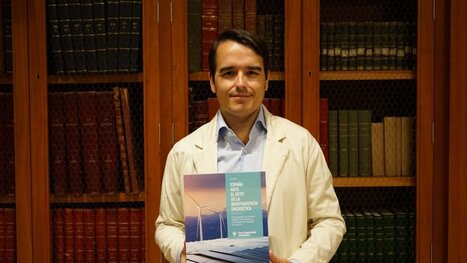
España ha construido en dos décadas uno de los sistemas eléctricos más limpios de Europa. En 2025 las energías renovables cubrieron el 55,5 por ciento de la generación eléctrica y 3 de cada 4 kilovatios hora se produjeron sin emisiones de dióxido de carbono. Estos resultados conviven, no obstante, con el hecho de que nuestro país sigue importando cerca del 68 por ciento de la energía primaria que consume. Además, nuestro sistema eléctrico está mal conectado con el resto del continente y la maraña administrativa que deben atravesar los nuevos proyectos de inversión en el campo energético lastra significativamente nuestro desempeño presente y futuro. La tesis del informe del Foro Regulación Inteligente es que el objetivo de transición ecológica o descarbonización solamente resulta socialmente sostenible y económicamente viable cuando se asienta sobre energía abundante, asequible y segura. Reducir emisiones es una meta legítima, pero un paradigma que no garantice un suministro firme con precios competitivos terminará por perder el apoyo de los ciudadanos a raíz del elevado coste que impondrá a los hogares, las industrias y los negocios del país. La seguridad de suministro y la competitividad no son obstáculos para la transición, son las condiciones que la hacen posible. Este diagnóstico se apoya en datos oficiales. La dependencia exterior alcanzó el 68,4 por ciento en 2024, con el petróleo y el gas representando el 97 por ciento de las importaciones energéticas. El gas llega de forma concentrada desde Argelia, que en 2025 aportó el 34,6 por ciento del total, seguida de Estados Unidos, que ha duplicado sus ventas hasta el 30 por ciento
La Comisión Europea ha presentado el Plan de Acción para la Electrificación (Electrification Action Plan), en el marco de su estrategia para reforzar la competitividad industrial, acelerar la descarbonización y reducir la dependencia energética exterior de la Unión Europea. La Comisión parte de la premisa de que, aunque alrededor del 70% de la electricidad de la UE procede ya de fuentes limpias y autóctonas, la electrificación de la demanda energética permanece estancada en torno al 23% desde hace una década. En este contexto, la Comisión propone evaluar un objetivo indicativo de electrificación del 46% en 2040, como parte del futuro paquete de la Unión de la Energía posterior a 2030. Entre los principales elementos del Plan, destacan: (1) Reducción de la brecha de costes entre electricidad y combustibles fósiles, con medidas sobre peajes de red, fiscalidad energética, despliegue de contadores inteligentes, almacenamiento y flexibilidad. La Comisión plantea como referencia que, en 2030, la ratio electricidad/gas se sitúe como máximo en 2,5 para hogares y 2 para la industria. (2) Impulso a la electrificación industrial, incluyendo bombas de calor industriales, calderas eléctricas, almacenamiento térmico, reutilización de calor residual y soluciones de flexibilidad. La Comisión prevé desarrollar hojas de ruta sectoriales de electrificación y estudiar mecanismos europeos para agrupar demanda eléctrica industrial y facilitar el acceso a electricidad baja en carbono. (3) Refuerzo de redes, almacenamiento e infraestructuras, con un objetivo de alcanzar 200 GW de capacidad de almacenamiento en 2030, la revisión de códigos de red, el impulso de soluciones vehicle-to-grid y el despliegue de infraestructura de recarga para vehículos pesados eléctricos. (4) Electrificación de edificios y transporte, mediante medidas de apoyo a bombas de calor, movilidad eléctrica, esquemas de leasing social, fiscalidad favorable y nuevos instrumentos para reducir los costes iniciales de estas tecnologías. (5) Actualización de la estrategia europea del hidrógeno, con el objetivo de garantizar soluciones complementarias de descarbonización para aquellos procesos industriales en los que la electrificación directa no sea viable o coste-eficiente.
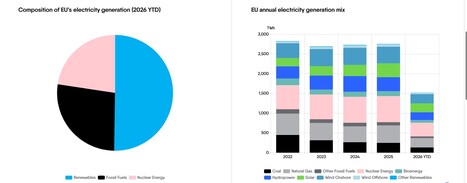
A mid-year analysis from Eurelectric’s revamped electricity data platform shows that record clean power generation helped shield Europe from a sharp gas-price shock in early 2026. However, higher prices outside solar hours exposed the urgent need for more storage, grids and other flexible low-carbon capacity. Following the outbreak of the US–Iran war, Title Transfer Facility (TTF) gas prices rose by 60% between February and March. Yet, over the same period, the EU average day-ahead electricity price fell by 9%, thanks to seasonal factors such as lower demand and stronger spring renewable output. This contrast shows that the gas shock did not dictate power prices in the way it would have in a more fossil-fuel-dependent system. Strong clean power generation, particularly solar, helped limit the pass-through of higher gas costs to electricity consumers.
El MITECO ha iniciado el trámite de audiencia pública, de un Proyecto de Real Decreto que incorpora nuevas medidas destinadas a acelerar la integración de energías renovables, fomentar el autoconsumo y el almacenamiento energético, así como agilizar los procedimientos de acceso, conexión y autorización en el sector energético. Entre las principales novedades destaca la creación de procedimientos específicos para la adjudicación de capacidad de acceso a la red eléctrica orientados, por un lado, a la repotenciación de instalaciones renovables, especialmente parques eólicos, y, por otro, al desarrollo de proyectos de autoconsumo en la industria manufacturera. Asimismo, la propuesta contempla medidas para impulsar el almacenamiento energético, permitiendo a las centrales hidroeléctricas reversibles incorporar mejoras tecnológicas y habilitando a las centrales solares termoeléctricas para ampliar su campo solar e integrar sistemas de almacenamiento térmico. Adicionalmente, el texto incluye actuaciones dirigidas a incrementar la capacidad y resiliencia de las redes eléctricas, mediante la simplificación de determinados trámites administrativos y la incorporación de sistemas de capacidad dinámica de líneas (DLR), que permiten optimizar el uso de la infraestructura existente. Por último, se introducen nuevas obligaciones de información en las facturas de gas natural, que deberán incluir datos sobre el origen del gas suministrado y el porcentaje de gas renovable, además de facilitar la comparación de ofertas a través del comparador de la CNMC. Los interesados podrán remitir comentarios y alegaciones al proyecto normativo hasta el 13 de julio de 2026.
El Gobierno central ha aprobado un paquete de medidas energéticas urgentes que reduce el IVA de la electricidad, el gas y la biomasa al 10%, baja el Impuesto Especial sobre la Electricidad al 0,5% y reactiva la suspensión progresiva del impuesto a la producción eléctrica. Asimismo, introduce reformas regulatorias para agilizar los permisos de conexión, facilitar la repotenciación de las líneas de transporte y permitir la integración de almacenamiento en red. Por último, se autorizan 200 millones de euros del Fondo Nacional de Eficiencia Energética para la climatización de centros educativos públicos.
|