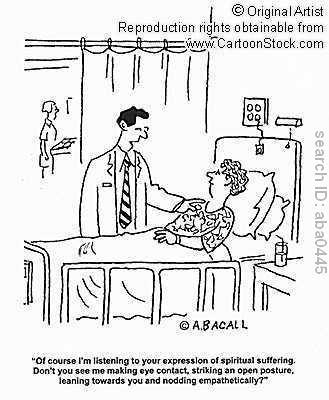
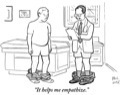
Doctors appointments could be less distressing if doctors expressed more empathy toward patients and their relatives, according to physicians in an editorial in this week's Canadian Medical Association Journal.
"Empathy is the best way to acknowledge what the patient is going through," said Buckman, an oncology professor at the University of Toronto. "Doctors are often thrown in awkward and emotional situations, especially when they have to deliver bad news to the patients. They can help resolve that awkwardness by showing empathy."
If you do manage to accurately empathise with someone, then this will become clear to that person in due course - they will come to sense that you have an understanding of them. If that person is to trust you to help them, if they are to let their pride down, and reveal their fears and desires, they will have to believe that you are likely to understand these and relate to them on an intuitive level. If they sense that you will not understand them as a person, their guard will remain up - the risks of opening up will seem to outweigh the potential benefits of doing so.
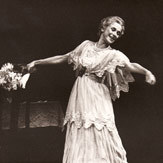
The most important role of her stage career was that of Vivian Bearing in Margaret Edson’s glorious play Wit. In 2000, after performing the play (in a third production) at Houston’s Alley Theater, Megan, at the request of the directors of University of Texas/Houston Health Science Center, began to develop a course that proposed applying various skills from the profession of theater to the practice of medicine.
And so “Becoming An Empathic Physician” was born. The course is about ways of looking beyond the patient’s condition to see the person inside, and about knowing how important that is for the patient’s recovery. It is about finding a balance that allows the caregiver to engage with the patient without becoming personally lost. And it is about becoming aware of being aware, in healthcare as in the larger world.
Many doctors find it hard to provide the compassion that their patients deserve.
I wondered: How do I show him compassion?
Many say our health-care system lacks compassion. I too at times feel that pills and surgeries, CT scans and radiation therapies, biopsies and blood tests have become a priority in medicine and that compassion — the “touchy-feely” part of medicine — has become an afterthought in patient care.
Most physicians are empathetic by nature and are drawn to medicine because they want to “make a difference.”
But the rigors of training and practice often cause us to disconnect from our compassionate selves.
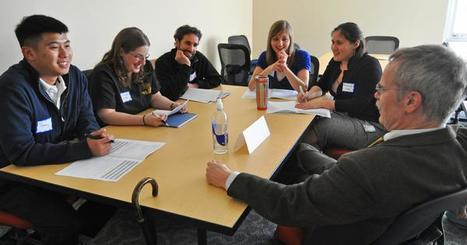
01 Welcoming Remarks - Gordon Irving M.D. 02 Empathy: Concepts & Significance in Medicine - James P. Robinson MD, PhD 03 Generating Compassion - David Elaimy 04 Perfectionism: The Disconnect - David Hanscom M.D. 05 Connecting with Your "Authentic Self" - Raz Ingrasci 06 An Introduction to BALINT Groups - Paul Costello M.D. 07 "Stop Trying to Cure Me and Start Listening" David Tauben M.D. 08 Empathy and Emotions Matter: A Psychophysiologic Approach to Chronic Pain and Related Syndromes Howard Schubiner M.D. 09 Afternoon Workshop: Connecting with Your "Authentic Self" - Raz Ingrasci
Last week, I started reading "Living the Spiritual Principles of Health and Well-Being" by Drs. John-Roger and Paul Kaye soon to be released with book signings in Europe.
In the book, one of the causes attributed to disease is fear. Its cure is empathy. What if there were no real source of fear, although the feeling of fear is real enough? Your mind and emotions create the feeling of fear through imagining, for example, the worst possible outcome. You may be drawn to news items which focus on negative scenarios. News agencies make their profit through our attraction to drama and what a friend calls "awful-ization." It is your thoughts about a situation that produce feelings of fear.
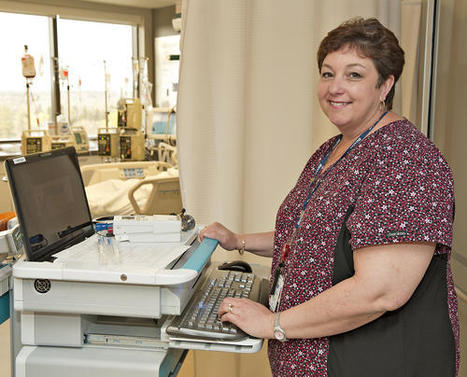
"I think compassion is a big part of nursing in all departments," said Sharlene Davies, a registered nurse in the CCU. "But it tends to be very important in the CCU because we are dealing with families at the worst possible time.
"Most of these patients come in with sudden onset of acute illness and families are taken aback by how sick their family members are without warning. Having a lot of compassion is extremely important."
Doctors taught empathy techniques by theater professors show improved bedside manner, according to a pilot study by a Virginia Commonwealth University research team. The findings may help in the development of medical curriculum for clinical empathy training.
Creating a good patient experience is the focus and mandate of the Chief Experience Officer at the Cleveland Clinic, one of the world's top-rated medical facilities.
Patch Adams, M.D., author and founder of the Gesundheit! Institute, addressed the Transform 2010 Symposium sponsored by the Mayo Clinic Center for Innovation. [talks about the importance of compassion]
Whether you are a nurse or caregiver, compassion fatigue or burnout is real. Finding ways to minimize the burnout is important if you are going to continue in that role.
Having been a nurse for over 20 years, I have experienced burnout or compassion fatigue several times during this journey. Wikipedia describes the follow symptoms of compassion fatigue: "Sufferers can exhibit several symptoms including hopelessness, a decrease in experiences of pleasure, constant stress and anxiety, and a pervasive negative attitude. This can have detrimental effects on individuals, both professionally and personally, including a decrease in productivity, the inability to focus, and the development of new feelings of incompetency and self doubt."
Medical Student Salmaan tells his personal story on how compassion was his drive to get into healthcare, shares what happened to him as a medical student Next he unveils the Compassion for Care Charter and what this joined initiative of the IFMSA and the Radboud REshape & Innovation Center is about.
Empathy is commonly regarded as an essential attribute for doctors and there is a conviction that empathy must be taught to medical students. Yet it is not clear exactly what empathy is, from a philosophical or sociological point of view, or whether it can be taught. The meaning, role and relevance of empathy in medical education have tended to be unquestioningly assumed; there is a need to examine and contextualise these assumptions. This paper opens up that debate, arguing that ‘empathy’, as it is commonly understood, is neither necessary nor sufficient to guarantee good medical or ethical practice....
The authors argue that good communication with patients is necessary for good practice and that a very thin version of ‘empathy’ is necessary to achieve that good communication. But this thin version of ‘empathy’ differs from thicker conceptions of empathy as conceived in moral philosophy, sociology or psychology.
The present study aimed at exploring empathic abilities in alcoholism, and notably the hypothesis of a differential deficit between emotional and cognitive empathy.
Conclusions: At the theoretical level, this first observation of a specific deficit for emotional empathy in alcoholism, combined with the exact inverse pattern observed in other psychiatric populations, leads to a double-dissociation, which supports the notion that emotional and cognitive empathy are 2 distinct abilities. At the clinical level, this deficit calls for considering emotional empathy rehabilitation as a crucial concern in psychotherapy.
"The more that you understand about that patient as a person, the better care you can give them."..
"My hope is that it will increase empathy among the students," he said. "That they understand what it's like to live with a chronic health condition or disability, rather than see these patients as a condition and in terms of textbook stuff. It's going to be good for the patient, and good for the health- care professional, to understand how to confer in order to make things better for a patient with complex needs."
We have discussed the term empathy several times. The most clarifying definition of empathy is based on viewing it as a process. This process of empathy consists of the following stages.
- The patient expresses feelings by way of verbal and non-verbal communication. Patients are not always aware of these expressions....
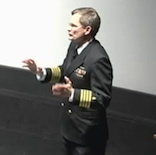
At the recent TEDx Pentagon event, CAPT William Todd, a U.S. Navy pediatric orthopedic surgeon, explains why the need for efficiency often diminishes the value of human touch, and why it is ever so important for physicians to preserve the special bond between doctor and patient.
Some cold medicines will shave a day off your suffering from the common cold, but they often produce unpleasant side effects. A new study shows, for the first time, that the doctor's empathy may be an even better way to speed recovery.
People recover from the common cold faster if they believe their doctor shows greater compassion toward their illness, according to a University of Wisconsin School of Medicine and Public Health study, published in the July issue of Family Medicine.
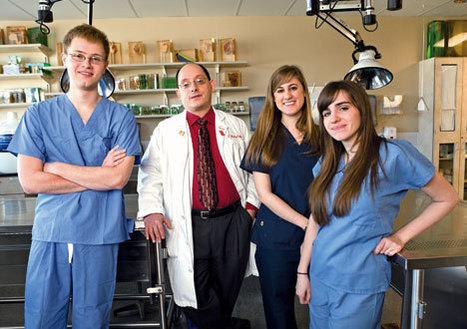
How students relate to the cadavers they dissect has changed. Some say teaching empathy begins in the anatomy lab.
That all-too-intimate encounter with a cadaver is bound to affect many medical students emotionally, experts say. The questions are how to deal with those feelings, and how the approach to anatomy can help or hinder medical students' ability to empathize with patients...
"This helps teach things that are difficult to teach in academia," Talarico said. "It's hard to teach professionalism; it's hard to teach respect; it's hard to teach empathy. But our relationships with the donors and the donors' families do that, with the core principle that the student's first patient is the cadaver."
Teaching empathy to med students througth the arts. Dr. Gelo is the behavioral science coordinator for the Family Medicine residency program and the recipient of funding to establish a curriculum around religion, spirituality and medicine.
Like the rest of the world, I held my breath when I heard there would be a special announcement by President Obama, especially before we knew it regarded...
We certainly have empathy for the families who lost loved ones in those planes and in the World Trade Center. I don't intend to diminish the horrors of their losses in any way. But that's not the empathy I'm talking about here. I'm talking about the empathy we can show for someone who has been handed a horrible diagnosis.
How about you? How did drum up the empathy you needed for a loved one or friend?
Medical students and other health care students, join a revolution in loving.
Here is an invitation to medical students, nursing students, and all other health care students in the world to explore compassion (tender, loving, fun care) and its delivery from September, 2010 to September 2011. The plan is to gather data so that we can collectively then create an embedded course in all the years of medical school in order to graduate compassionate beloved physicians.
Can compassion (tender, loving, fun care) become a central interest and action in your life and at all times?
The practice of medicine is the practice of compassion in the deep engagement with people and their families. One can never promise to cure; one can promise to care 100%. The compassion is equally given to self and coworkers
Shawna Bellew, a first-year medical student at the UCF College of Medicine, is the national winner in the American Medical Association’s (AMA) Humanities Initiative, which focuses on expressing empathy through art and poetry.
To get content containing either thought or leadership enter:
To get content containing both thought and leadership enter:
To get content containing the expression thought leadership enter:
You can enter several keywords and you can refine them whenever you want. Our suggestion engine uses more signals but entering a few keywords here will rapidly give you great content to curate.


 Your new post is loading...