The pressures of national academic standards have pushed character education out of the classroom.
In the recently released Unselfie: Why Empathetic Kids Succeed in Our All-About-Me World, Michelle Borba claims narcissism is on the rise, especially in the Western world, as more teens concur with the statement: “I am an extraordinary person.” If empathy is crucial to developing a moral identity, then this trend should be troubling to parents and educators who hope that students foster the ability to see the world through others’s eyes.
My own observations support the data. I’m frequently unnerved by the behaviors I see in classrooms and hallways every day, from physical and verbal bullying, to stereotyping, to students leaving trash strewn all over the outdoor cafeteria courtyard.
The empathy-based curriculum has been established at our school for several years now, and we have recently received international recognition for this work.
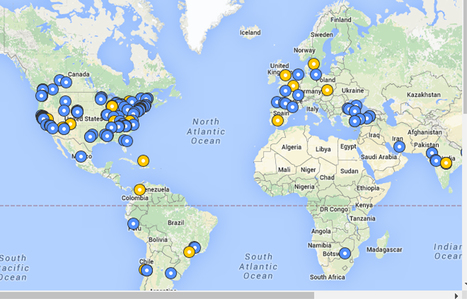
In 2014, Francis Street CBS was selected to become an Ashoka “changemaker” school — one of only five in Ireland. With more than 200 schools in Europe, Africa and the US, Ashoka schools form a global network of peer institutions that share a commitment to fostering empathy, creativity, teamwork and leadership among their students.
Sharing insights and ideas with like-minded educators convinced me that the commitment to teaching empathy is a truly global one, and I feel hopeful and inspired for the future of our students.
Design thinking is a powerful way for today’s students to learn, and it’s being implemented by educators all around the world. This site is a directory of schools and programs that use design thinking in the curriculum for K12 students.
Bullying is awful, but a Finnish program is teaching bystanders to empathize and intervene.
"In the game, students can practice how to be nice to someone and what kind of nice things you can say to someone who would like to be included in the group or is new in the school," said Alanen.
By asking the kids what they would do in certain situations and giving feedback and advice about it, the program can help teach the students to be more empathetic and supportive of bullying victims. And the data shows that the program works too.
Juvonen's analysis found that KiVa reduced the odds of a given student being bullied by about one-third to one-half.
New research at Stanford University encouraged middle school teachers to take on an “empathetic mindset” when students were being disciplined. The study found that the number of pupils who were suspended across the academic year halved, from 9.6% to 4.8%....
A crucial part of teaching young people is to create positive relationships with students, said Okonofua and Walton, particularly students who are struggling. But some school environments have “zero-tolerance” policies concerning student behavior. In turn, this exposes some teachers to a “default punitive mindset.”
“It is heartbreaking,” Walton said. “Teachers are caught between two models, a punitive model that says you have to punish kids to get them to behave and an older model that goes to the heart of the profession, which says that teaching is all about building strong relationships with children, especially when they struggle.”
Empathy may be one of the most important social skills we learn as humans.
Without it, not only do we fail to understand how our actions affect others, but we also lack the imagination and creativity needed to design tools and communicate our ideas beyond our own communities of like-minded people. Indeed, without some degree of empathy, we may not be able to communicate at all.
And yet, empathy also happens to be one of the most difficult skills to teach, rife as it is with complexity and emotion.
Our students are often prompted in ways that guide them to empathize with both hypothetical and real “users.” HS Mathematics Teachers Duane Wacha and Amy Harbaugh’s geometry course took a look at ASIJ, as it is designed now.
Their goal was to redesign the entire campus in a way they feel more empathetically represents the student users’ needs. They created 3D models in SketchUp and used paper schematics to draft a new view of the school grounds. In the process Duane and Amy’s geometry students came to appreciate the complexity in considering the needs of all who share our campus. They also came to appreciate the value in creating for others.
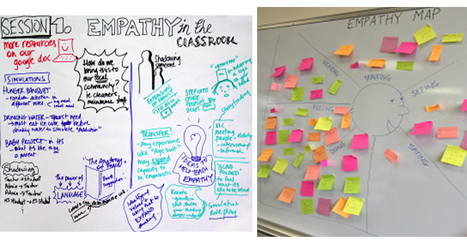
Empathy was a topic of interest at the start of school In-House Teacher Conference held on August 18 and 19. Eighteen other teachers joined Duane in a collaborative session that explored empathy in the classroom—discussing strategies and skills teachers can use to support students in shifting their point of view and understanding the diverse perspectives of others.
It’s the way you learned to be step-by-step—to collect data, analyze it and come up with a conclusion, like you did in science class. It is really useful, and I hope people keep doing it. It's very important.
Design thinking is more experimental
and less step-by-step.
It's fuzzier.
It's intuitive.
It's empathic.
We often say that it’s integrative thinking, where you put together ideas from different sources—it’s synthesis. This is a way of thinking that is not quite so linear, but you can build confidence in it if you do it over and over again....
- But the basic premise of design thinking revolves around empathy, being understanding of what other people want, and how the world is put together from a social and emotional point of view...
- They can make something that is not project-based a little bit project-based by bringing in our focus on empathy for other people for instance, or making it real in some way. If you have no choice but to do the curriculum that is outlined, you have to figure out a way to get some of these concepts—empathy, prototyping, synthesis—included...
In 2012, researchers at McGill University in Montreal found a direct connection between empathy and learning capacity. It is part of social and emotional learning (SEL) as it helps the students to manage emotions, establish relationships and solve life problems.
It is an underlying foundation for student-teacher interaction that enables to know and connect with each other. This help the students to get rid of stress that affects their learning, brain development, memory power, reasoning ability and self control.
Positive relationships can be developed with the help of empathy skills. It enables the students to listen to others, understand & learn verbal and non verbal cues and appreciate the differences in others. Empathy stands as a main factor in developing leadership skills in students as a leader is expected to understand the thoughts and feelings of other people, expose their care towards them and value them as this will build trust by the followers on the leaders.
There is increasing concern about rising discipline citations in K–12 schooling and a lack of means to reduce them. Predominant theories characterize this problem as the result of punitive discipline policies (e.g., zero-tolerance policies), teachers’ lack of interpersonal skills, or students’ lack of self-control or social–emotional skills. By contrast, the present research examined teachers’ mindsets about discipline.
A brief intervention aimed at encouraging an empathic mindset about discipline halved student suspension rates over an academic year. This intervention, an online exercise, can be delivered at near-zero marginal cost to large samples of teachers and students.
These findings could mark a paradigm shift in society’s understanding of the origins of and remedies for discipline problems.
Have you ever felt dehumanized by a system or organization? What does it mean to treat each other like “real people”? In this talk, Karen Warner explores the impact of organizational empathy.
Drawing upon a background in the social sector and her own family’s story, Karen challenges us to design and lead organizations that put human empathy front and center.
Four Ingredients that Move Students from Apathy to Empathy:
1. Margin.. A number of neuro-scientific experiments have been conducted, where brains were scanned to study how empathy emerges. Neuroscientists, like Dr. Thomas Lewis of UCSF, remind us that empathy is taken from two roots:
Em – to be within Pathos – to feel or suffer with
2. Exposure...3. Hardship...4. Models...
Question:
How can you model more clearly the virtue of empathy each day?
How can you find time to tell stories of those who’ve embodied empathy?
A one-time intervention to help teachers and students empathize with each other halved the number of suspensions at five diverse California middle schools, and helped students who had previously been suspended feel more connected at school,according to Stanford University research published in April in the Proceedings of the National Academy of Sciences.
Building Empathy Based on the teacher study, Okonofua and his colleagues developed a professional-development workshop for teachers in five middle schools in three districts. Math teachers—chosen because math is a core subject and one associated with a high risk of stereotype threat for black and Latino students—took part in one 45-minute, in-person workshop and one 25-minute, online exercise on ways to resolve misbehavior in class.
Teachers were randomly assigned to either a control group or a training focused on how stress and insecurities that children develop during adolescence can make them detach or act out in school.
...they worked through exercises about empathetic rather than punitive ways to respond to rule breaking.
Find a quiet place where you can talk without interruption or distraction. Invite a conversation, following these steps. You don’t need to cover every step, but the more you do cover, the more effective this practice is likely to be.
Paraphrase. Once the other person has finished expressing a thought, pause and paraphrase or mirror back what he or she said to make sure you understand and to show that you are paying attention. Helpful ways to paraphrase include “What I hear you saying is…” “It sounds like…” and “If I understand you right….” Be careful to avoid parroting, which can sound phony.
Ask open questions. An open question is a question that you could not possibly know the answer to. Examples of open questions include: “What did you learn from that experience? How did that shape your opinion?” Open questions move the speaker into a new way of thinking. When appropriate, ask questions to encourage the other person to elaborate on his or her thoughts and feelings.
As mass shootings capture the national spotlight with more frequency, some experts are pushing for a radical solution: teaching empathy in schools. An elementary school in Richmond, Calif., is using one program to teach social emotional learning to its students. Photo/Video: Jake Nicol/The Wall Street Journal
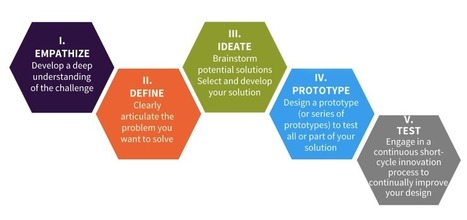
EMPATHIZING Over the past several months, I started with empathizing as I set out on the exciting path to build Educate78’s School Design Lab. Our audacious vision is for the lab to support school design teams in creating high quality, innovative new schools.
In launching this work, I am thoroughly relishing my first round of empathizing. In a relatively short amount of time, I had the opportunity to: watch and listen, engage, and observe from an incredible cast of courageous educators and innovators taking on the task of transforming our schools.
Teaching kids facts and analytical thinking skills isn’t enough, she said, adding that she hopes to use her new platform to promote service-learning — which involves community service activities, teaching kids to use their education for good and showing the importance of being empathetic.
“We spend a lot of time teaching kids to be self-sufficient and high achievers, and I think we really need to spend some time also teaching them: OK, now what do you do with that? What does it mean? You have this knowledge and information, how can you use it to improve the human condition?” Hayes said. “I think we need to nurture empathy from a very early age.
High school students are taking ownership of the mental health of the teenagers in their building. About 2,000 ninth grade students hear presentations each year on positive mental health and suicide prevention, thanks to the efforts of dozens of upperclassmen peer counselors.
The suicide prevention trainings began among the peer counselors at Fort Collins High School a few years ago, after a student died by suicide, then spread to the other high schools as the students trained each other on what to say.
And they had a similar reaction this year, after hearing about two middle schoolers who took their own lives in the fall. The group started developing a training for middle school students around self-confidence that they'll pilot for the first time at eighth grade transition night on April 18.
Various studies show that the more empathy a child displays, the less likely they are to engage in bullying, online and in real life. Empathic children and adolescents are more likely to engage in positive social behaviors, like sharing or helping others.
They’re also less likely to be antisocial and exhibit uncontrolled aggressive behaviors. That’s a big reason why educators have been devoting more attention to empathy in recent years, integrating it more deeply into schools and curricula. And as Golestan illustrates, some of these efforts are focusing on early childhood education.
Indeed, research suggests the sooner we learn to empathize, the better off we are in the long run. People exposed to empathy earlier in life have greater and longer-lasting emotional benefits than those exposed to it later, or not at all. One recent study suggests that children who are taught social and emotional skills (as opposed to purely cognitive skills) in preschool and kindergarten have better social skills and fewer behavior problems in both kindergarten and first grade, compared with kids who don’t experience that holistic classroom setting.
Does the sight of someone in pain or distress do little to move you? If so, you may share something in common with a bully.
Research into what makes a bully tick shows many have low levels of empathy and can be described as "morally disengaged".
There was no set profile for a bully, said Dr Jaimee Stuart of the Victoria University school of psychology, but there were "some really common characteristics" which could usually be identified by how a child interacted with other children.
"Particularly if there's a lack of empathy and a lack of care for other people's feelings, those are quite key indicators." '
"When you learn empathy you learn to be able to put yourself in another person's shoes, so it really broadens your outlook on seeing other people for who they are and appreciating their gifts."
Carey Wilkinson Lee is an instructor with Roots of Empathy and says one of the interesting parts of the program is learning to understand your temperament in comparison to someone else.
"It's a fantastic part of the Roots of Empathy program because we are all born with certain temperaments and to realize which temperament you are born with- it's not all good or bad, or right or wrong, we're all fantastic."
Wilkinson Lee feels that when children accept their own traits they develop less mental health issues as they grow.
Students participating in service-learning classes experience many benefits, including cognitive development, personal growth, and civic engagement. Student development of empathy is an understudied area, especially with respect to how students develop empathy through interactions in their service-learning placements.?
This article describes a project designed to pilot teaching tools (e.g., self-assessment, reflective writing) related to empathy development in 12 undergraduate students. This study examined changes in level of student empathy across the semester, critical incidents linked to such changes, factors that enhanced or challenged empathy development, and student metacognition related to empathy. Findings suggest that certain experiences, such as observing the emotional experiences of others or being given more responsibility at a community site, might prompt changes in level of empathy for service-learning students.
Strategies for integrating findings from this pilot project into other service-learning courses and future directions for empathy research are also described.
Six East Antrim primary schools have taken part in a unique scheme aimed at reducing levels of aggression amongst schoolchildren.
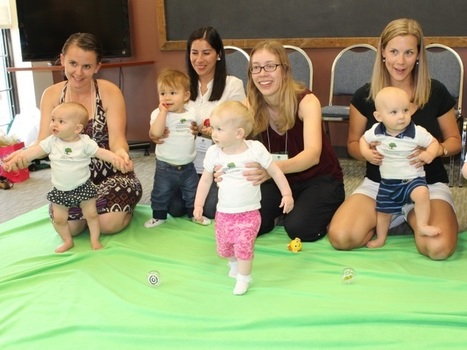
The innovative Roots of Empathy programme involves bringing a baby and parent into a classroom once a month throughout the school year, giving youngsters the opportunity to track the infant’s milestones.
To get content containing either thought or leadership enter:
To get content containing both thought and leadership enter:
To get content containing the expression thought leadership enter:
You can enter several keywords and you can refine them whenever you want. Our suggestion engine uses more signals but entering a few keywords here will rapidly give you great content to curate.


 Your new post is loading...