


Campus technology leaders say “game” isn’t the four-letter word it once was in the Ivory Tower, thanks to a new crop of instructors willing to make games a centerpiece of their course curriculum.
Via Kim Flintoff

 Your new post is loading...
 Scoop.it! Campus technology leaders say “game” isn’t the four-letter word it once was in the Ivory Tower, thanks to a new crop of instructors willing to make games a centerpiece of their course curriculum. Via Kim Flintoff 
No comment yet.
Sign up to comment
Scoop.it!

Discover how giving students more responsibility in shaping their own curriculum can lead to more active participation. Via Kim Flintoff
Scoop.it!

Codecademy is the easiest way to learn how to code. It's interactive, fun, and you can do it with your friends.
From the NY Times, 9/14/11
"That’s how he and Mr. Bubinski got the idea of creating a way to help newbies to computer science learn coding skills painlessly and quickly — with easy lessons on the Web and built-in rewards to keep them motivated. The idea led to Codecademy, an online tool designed to give computer science newbies a crash course in the basics.
"Codecademy was introduced less than a month ago, and since then, more than 550,000 people have used the site, completing more than six million exercises. Mr. Sims said most users do more than just peruse the site; they spend time working their way through the exercises." Via Jim Lerman, Kim Flintoff
Scoop.it!
Our vision is to enable students and academics to realise their potential through the creation of connected learning communities. A connected learning community attempts to satisfy the diverse needs of everyone involved in education, from university administrators, to research and teaching faculties, to the ultimate beneficiaries – the students. Via Kim Flintoff
Scoop.it!

Education blogs, on any and every topic, abound online. Unfortunately, educators are probably the last people who have the time to go out and search for them. Which blogs review good free resources? Via Kim Flintoff
Scoop.it!

Yesterday, I wrote a short post about Kwiqpoll. After that post was published I got a few requests for suggestions about other web-based polling/ survey tools. Here are eleven other ways you can conduct polls and surveys online. Via Kim Flintoff
Scoop.it!

From the website "With Projeqt, your presentations never remain static. Pull in live tweets or blog feeds, insert an interactive map, add audio notes or stream videos. Let your presentations be as dynamic as you are."
Projeqt is an alternative to PowerPoint, Keynote, and Prezi. I like it better than all 3 because it lives on the web and is device agnostic. Basically, it's a cool way to tell digital stories that overcomes some of the linear limitations of PP and KN, while not making viewers dizzy like Prezi can. Built in HTML5, so it's future friendly.
It's simple to use and can integrate all types of media easily, while incorporating layering of presentations (stacks) and the ability to pull in live feeds including live tweets or blog posts.
Honored as one of the the best Web Services and Applications by the 2011 Webbys and as an Interactive Awards Finalist at SXSW 2012. Do check it out. -JL
Via Jim Lerman, Kim Flintoff
Scoop.it!
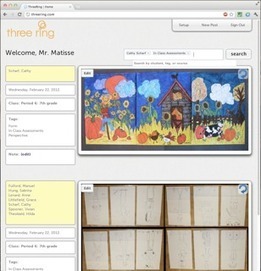
Born out of Startup Weekend EDU in Washington DC last fall, ThreeRing has been hard at work over the past few months transforming its initial idea and prototype into a working application and a brand new startup. Earlier this month, ThreeRing launched its open beta with two apps -- one for Android (link) and one for iPhone (link) -- available in their respective mobile app stores. Via Mark Smithers, Kim Flintoff
Scoop.it!

From
arxiv

In growing numbers, scholars are integrating social media tools like blogs, Twitter, and Mendeley into their professional communications. The online, public nature of these tools exposes and reifies scholarly processes once hidden and ephemeral. Metrics based on this activities could inform broader, faster measures of impact, complementing traditional citation metrics. This study explores the properties of these social media-based metrics or "altmetrics," sampling 24,331 articles published by the Public Library of Science. We find that that different indicators vary greatly in activity. Around 5% of sampled articles are cited in Wikipedia, while close to 80% have been included in at least one Mendeley library. There is, however, an encouraging diversity; a quarter of articles have nonzero data from five or more different sources. Correlation and factor analysis suggest citation and altmetrics indicators track related but distinct impacts, with neither able to describe the complete picture of scholarly use alone. There are moderate correlations between Mendeley and Web of Science citation, but many altmetric indicators seem to measure impact mostly orthogonal to citation. Articles cluster in ways that suggest five different impact “flavors,” capturing impacts of different types on different audiences; for instance, some articles may be heavily read and saved by scholars but seldom cited. Together, these findings encourage more research into altmetrics as complements to traditional citation measures. Via Martin Weller, Kim Flintoff
Scoop.it!

From
vimeo
eLearning / Teaching and Learning - Northern Illinois University
Here are all Faculty Development's videos on Vimeo. You can see both the videos this user has uploaded, as well as any other users' videos they appear in. Choose "Uploaded" to see the videos this user has uploaded to Vimeo. Choose "Other Credits" to see the videos that Faculty Development is credited in by other users. We recommend using the sort bar which allows you to view these videos in different orders or formats. If you are looking for a particular video, use the "search these videos" link. Via Kim Flintoff
Scoop.it!

Atlanta — Higher education’s spin on the Silicon Valley garage. That was the vision laid out in September, when the Georgia Institute of Technology announced a new lab for disruptive ideas, the Center for 21st Century Universities. During a visit to Atlanta last week, I checked in to see how things were going, sitting down with Richard A. DeMillo, the center’s director and Georgia Tech’s former dean of computing, and Paul M.A. Baker, the center’s associate director. We talked about challenges and opportunities facing colleges at a time of economic pain and technological change—among them the chance that many universities might follow Borders Bookstores into oblivion. Via Mark Smithers, Kim Flintoff
|
Scoop.it!
Marcio Oliveira could see the benefits of his kinesiology course’s flipped learning approach with every new hand that popped up in the first minute of every class, as students peppered him with questions. Via Kim Flintoff
Scoop.it!

RT @AnneOsterrieder: Six Ways to Use Social Media in Education | Center for Instructional Technology - http://t.co/Q6Um0LpH... Via Kim Flintoff
Scoop.it!

Give students and staff the creative tools and technologies they need to create, inspire, and learn anywhere and anytime. Via Kim Flintoff
Scoop.it!

The decision had been made, student information had been transferred, and faculty had been trained to use the Moodle learning management system hosted by Moodlerooms. Via Kim Flintoff
Scoop.it!

Responsive Open Learning Environments (ROLE) is a European collaborative project with 16 internationally renowned research groups from 6 EU countries and China. Via Kim Flintoff
Scoop.it!

As an online student, you are at the intersection of academia and technology. This is an exciting and dynamic place to be as educators across disciplines explore new ways to engage in scholarly pursuits and enhance learning ... Via Martin Weller, Kim Flintoff
Scoop.it!

It’s Open Education Week this week, apparently (whatever that means), although as Amber writes in her piece openedspace: “most of the definitions [of open education] are really about op... Via Kim Flintoff
Scoop.it!

Edmodo hopes to make the move from "app" to "platform," with the opening today of its API to third-party Web developers. At launch, Edmodo boasts some 35 partners who have already developed apps for the new platform -- these include Mathalicious, Late Nite Labs, Desmos, BrainNook, Aviary and (30) others. Using the Edmodo API, these companies can now connect their own apps to the Edmodo social network, meaning that they can tap into Edmodo's badge functionality, feeds, assignments, grade book and so on. These apps are integrated with Edmodo, in terms of single sign-on, analytics, and -- and this is key for both Edmodo users and app developers -- roles (that is, who's a teacher, who's a student, what grade is the student, who's a parent, who's a principal and so on). Via Mark Smithers, Kim Flintoff
Scoop.it!

A while back here on e-Literate, Phil wrote a post called Farewell to the Enterprise LMS, Greetings to the Learning Platform. In it, he wrote, In my opinion, when we look back on market changes, 2011 will stand out as the year when the LMS market passed the point of no return and changed forever. What we are now seeing are some real signs of what the future market will look like, and the actual definition of the market is changing. We are going from an enterprise LMS market to a learning platform market. What I mean by ‘enterprise LMS’ is the legacy model of the LMS as a smaller, academically-facing version of the ERP. This model was based on monolithic, full-featured software systems that could be hosted on-site or by a managed hosting provider. A ‘learning platform’, by contrast, does not contain all the features in itself and is based on cloud computing – multi-tenant, software as a service (SaaS). There tends to be a pendulum swings in technology. In the old days, there were dumb terminals, with all the business logic residing on the mainframe. Then came the PC revolution, pushing functionality out to the edges of the network. Next came the internet, driving functionality back to the server. And now we have apps. Similarly, in educational technology, we started with a few tools, moved to an all-in-one, all-you-can-eat LMS model, and now are moving back toward more specialized systems. And one of the questions platform developers and teachers a like are asking is how much functionality do you really need? Is it just WordPress? Is it WordPress plus Google Docs? Is it WordPress, Google Docs, and grade book? Is it a simple LMS with only a handful of tools and an app store? There are lots of different models.
Via Mark Smithers, Kim Flintoff

Alberto Rivera's curator insight,
June 11, 2022 11:10 PM
This article is an overview and review of the LMS GoodSemester =. I’m frankly not sure what to think about GoodSemester. Their product model is so different from the conventional LMS business that there are no clear precedents for how well it might work, even in principle. It’s uncharted territory. And I have trouble connecting the dots for some aspects of their product strategy.
Scoop.it!

From
vgalt
Why Video Games Sustain Engagement: A Cage Match between Social Learning Theories: Why Video Games Sustain Engagement: A Cage Match between Social Learning Theories Brock Dubbels The Center for Cognitive Sciences Department of Curriculum & Instruction... Via Kim Flintoff
|






