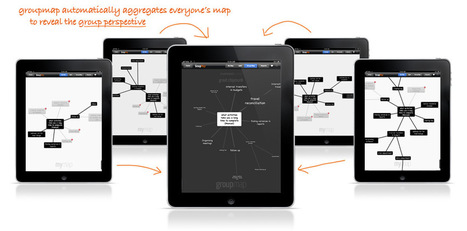
Real time, collaborative brainstorming with a twist. GroupMap shows you what the group is thinking by combining the views and ideas of individual participants. It provides valuable insight for leading a group, collective learning and effective decision making. Solve a problem, learn together or discover common ground...quickly and effectively.
Bacon's RebellionOnline Learning on a Roll: Picture a Steamroller that Accelerates like a FerrariBacon's RebellionShe signed up for a free, online course with Coursera, the online teaching enterprise that recently forged an agreement with the...
The three panelists agree that, in and of themselves, computers aren’t the answer to education. As avid Facebook users know, technology can be disruptive in all the wrong ways.
“I would never use the word replace in public,” added Thrun, before uttering his parting words to the audience of tech entrepreneurs and investors.”We need high-quality education for the fraction of the cost and to give anyone a chance to learn throughout their lifetime.”
Online Teacher of the Year shares tips on student engagement, virtual collaboration
As online learning reaches more students in districts across the country, some educators struggle with how they can become successful virtual teachers—but tips from the 2011 National Online Teacher of the Year might help.
M.L. Bettino is a sort of open-source technology hipster. He was into open source way before it was mainstream.
Higher education’s slow but steady shift toward open-source learning management system (LMS) software, administrative systems, and campus content repositories hasn’t come as a surprise to Bettino, former dean of academic affairs at Cerritos College, a community college in Los Angeles County.
The range of technologies available to support teaching and learning in higher education continues to grow exponentially. There is a growing expectation for educators to be well informed and familiar with the many suitable technologies and systems that are available to be used for delivering courses online, and to complement classroom (face-to-face) education. Detailed evidence of the perceptions and applications of the use of e-technologies is needed to inform not only teaching practice, but also policy development. These e-technologies need to be matched to pedagogical styles in order for online teaching and learning to be successful. Based on 33 semi-structured interviews, this paper presents a study of staff experiences of e-technologies, using Chickering and Gamson's 'Seven Principles of Good Practice' to provide educators with information about the most appropriate e-technology to support their pedagogical aims.
KF: iJET is a web-based journal that adheres to an open access policy. Registration is required to access the articles but it is free - you can register as both Author and Reader in the same process.
In the sixth installment of their monthly column, blended learning experts Michael B. Horn and Heather Staker outline what teachers need to know about blended learning training resources, and where they can go to get them.
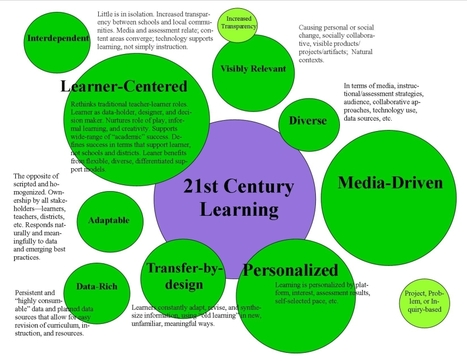
What does it mean when you say 21st century learning? This post lists nine characteristics of 21st century learning and provides a rationale. What makes this notable is "the absence of technology. There is very little about iPads, social media, 1:10 laptops, or other tech-implementation. In that way, it is closer to the 'classic' approach to 'good learning' than it is the full-on digital fare we often explore."
The nine characteristics are in the diagram above and listed below:
David Stanley and Karen Glaister implemented an ePortfolio for students to use as an electronic repository of evidence toward meeting University Graduate Attributes and in particular the Australian Nursing and Midwifery Council (ANMC) Competencies.
Kathryn Greenhill talks about her approach to connecting with her online students by creating personalised introductions and delivering general course inform...
Colleen united internal and external students through the shared experience of recorded presentations. Recorded presentation furthermore improved students' presentation skills.
Liz Frehner, Karen Glaister and Alan Tulloch implemented "Video Critique" a video annotation tool that provides students the opportunity to record a clinical practice skill, upload it, then carry out peer and self-reflections on playback.
Ashley Aitken, from the School of Information Systems used Google Docs with his students to facilitate more cooperation, collaboration and engagement. Students reported that developing shared lecture summaries was a useful revision activity.
Paper presented at EFQUEL by Anne Villems (University of Tartu), Lehti Pilt (University of Tartu), Toomas Plank (University of Tartu), Merle Varendi (The Estonian Information Technology College), Eneli Sutt (The Estonian Information Technology Foundation), Marit Dremljuga-Telk (The Estonian Information Technology Foundation)
Open innovation has received ample attention in the business management and policy literature, but not so much in the educational context. There are many models how open innovation is working for companies. But what about open innovation within the universities (and other higher education organisations) themselves? As an organisation, they too need successful innovation schemes to survive in a contemporary world. Universities, having two main processes: research and education, have to innovate both.
Most disappointing to me in this projection is the long timeframe likely required to see substantial change. Fifteen years is an entire generation of students! It is difficult to accept the idea that change will take that long while we are failing so many students. But there is no silver bullet for fixing our K-12 system. At Imagine K12, we are trying to compress the timeframe by investing in early stage ed tech companies and helping them launch.
Most exciting to me in this revolution is the movement away from the factory model of education and towards something more individually customized to each student and more cost efficient. Technology helps make this possible. We will fail fewer students because they will be more engaged, and we will lose fewer teachers to frustration. And that is an investment worth making.
Sensing the excitement from online education tools like edX, Google has just unveiled a (very beta) version of its own course building software. If you’ve ever wanted to run your own online courses, this might be worth your time.
Google’s new Course Builder software comes on the heels of a massively popular online Google class ‘Power Searching With Google‘ hosted by Google’s Director of Research, Peter Norvig.
Blended learning, in which students experience a mix of face-to-face and online instruction, is catching on in K-12 schools—and advocates of this approach say that, when done well, it combines the best features of both types of learning.
With the generous support of Blackboard, we’ve compiled this list of stories from our archives, along with other relevant materials, to help you learn more about blended learning and how to make it successful.
This interdisciplinary journal aims to focus on the exchange of relevant trends and research results as well as the presentation of practical experiences gained while developing and testing elements of technology enhanced learning. So it aims to bridge the gape between pure academic research journals and more practical publications. So it covers the full range from research, application development to experience reports and product descriptions.
iJET is an Open Access Journal. Readers don't have to pay any fee. Only registration is necessary.
The technologies that can have the best impact on education are evolving quickly from year to year, and the pace seems to be quickening.
"Naturally, as author of EmergingEdTech, I’m always keeping an eye out for education and instructional technologies that are emerging from the seemingly endless array of tools and concepts that are out there – which applications and ideas are rising to the fore and best positioned to enhance engagement and impact learning? This year I’ve also been working with constituents at The College of Westchester to develop a Strategic Technology Plan for the next 3 years, so it’s never been more important for me to be aware of those impactful education technologies and concepts that are on the horizon or are already in use and pulling ahead of the pack."
Woopid provides thousands of video tutorials for all computer questions, including Windows Vista, Mac OS X Leopard, Microsoft Office, iLife, cool gadgets and more.
Woopid is a video tutorial website which aims to empower people by giving them access to thousands of free and practical video tutorials, allowing them to learn about their computer and other gadgets. Every video is made with the knowledge that both a beginner or an advanced user may be watching, and through our unique "Take a Step Back", "Moving Forward" system, we're able to ensure all levels of computer and gadget users aren't confused about what they're watching. Learn some new tricks, make better presentations, network your computer and more.
Joan Wardrop empowers students to explore ideas of identity and place through the use of mixed media blogging. The learning experience took students on a journey and allowed them to cross disciplinary boundaries.
Cathy Cupitt (Faculty of Humanities, Curtin University) provided students with the opportunity to use podcasting technologies to record their reflections.
Louise Deshon (Faculty of Medical Imaging, Curtin University) implements a variety of educational technologies to motivate students and foster life long learning.
To get content containing either thought or leadership enter:
To get content containing both thought and leadership enter:
To get content containing the expression thought leadership enter:
You can enter several keywords and you can refine them whenever you want. Our suggestion engine uses more signals but entering a few keywords here will rapidly give you great content to curate.


 Your new post is loading...