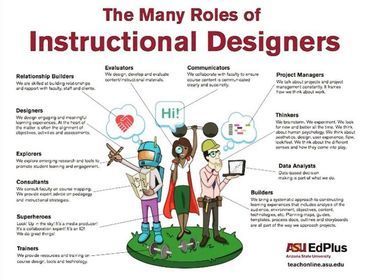
There is widespread interest in employing designers who focus on learning, performance and education technology in many industries at a global level. In Australia, learning designers are in demand in Education, Corporate Training, Finance, Charity, Non-Government Sectors, and also in Start-Ups and Entrepreneurial arenas. This demand is despite the fact that the role of the Learning Designer is incredibly varied, contextually-based, and also unclear to many employers – and students! This suggests that there is currently an opportunity for learning designers and academics who deliver learning design content to define what it means to be a learning designer. This paper presents an Australian case study which uses design-based research methods in a pre-production mode to identify the key principles that informed the development of a course of study (what others may refer to as a program). How those principles were operationalised within the course design and more are discussed in an effort to reposition understandings of knowledge, skills and abilities for this field.
In 2021, we see a lot of buzz around making video content for all kinds of purposes and monetization. Of course, in this tech age video content is easy to make. A decent video can be produced with almost any camera or mobile device. So, we see videos everywhere. Any platform has a huge volume of videos because people do appreciate it much more now compared to audio or just text.
In the webinar hosted by Contact North | Contact Nord's Research Associate Dr. Ron Owston, participants learn how to use OBS Studio with Zoom to create engaging learning experiences for students.
Needed Now 2021 provides insights into learning and teaching that you won’t find anywhere else this year, in a convenient series of online webinars brought to you by Sally Kift, Campus Morning Mail, and Twig Marketing.
Each day during conference week we will bring information-intensive webinars facilitated by expert communicators, drawing insights from a panel of experts from across the higher education sector.
Help-seeking is an essential self-regulatory and metacognitive skill. In the online learning environment, much of the learning is self-directed and there are generally less opportunities to receive help in real time. The uses of email and discussion boards are the most common method of seeking help in these environments. The current study explored students’ perceptions of the use of live chat technology for online academic help-seeking within higher education, with a focus on comparing online and blended learners’ perspectives. Participants were 246 students who were studying psychology online (n = 91) or in blended learning (n = 155) environments. The live chat technology was well received by both groups, especially for its ability to provide instant, real-time, and convenient help. Live chat was particularly well received by online learners, who were more satisfied, felt more cared about by the teaching team, and would be more likely to recommend it to others than blended learners. Further, online learners reported that live chat gave them better access to staff, and felt that this feature was a good approximation for more traditional face-to-face conversations. As an online, synchronous, private help-seeking tool between student and teacher, these findings provide a strong endorsement for the use of live chat in higher education, particularly for online learners.
The Guerra Scale Of Interactivity was developed by Tim Guerra and Dan Dan Heffernan in March 2004. It outlines the range of electronic content, and user experience, in relation to online learning.
A bit dated now tech wise, but the last three paragraphs sum it up nicely.
Tight funding and COVID-related limits on face-to-face contact have forced academics to find other ways to expose students to the real-life work they are preparing them for.
Four weeks into her role as Pro Vice-Chancellor (Education and Digital), Professor Maryanne Dever has amassed an impressive daily step count as she traverses the ANU campus. While this approach may have prompted a rethink of her daily shoe selection, it is consistent with her desire to imagine her portfolio as a roving one, characterised by collaboration and a desire to listen and learn from staff and students.
Why might maths students' performance suffer from relying on videos? A new study suggests we might be conditioned to watch video in a way that hinders the sort of thinking needed in maths.
Last week I led a webinar for Contact North, a nonprofit corporation funded by the government of Ontario, that was meant as an update to last year’s session on the LMS. For this update I took a broader look at learning platforms in general, and how the LMS might have to share center stage moving forward, as the changes driven by Pandemic lockdowns have changed adoption patterns in a significant way. Whether you love it or hate it (or are somewhere in between), video platforms are likely here to stay and not just a sideshow. To best understand the changes, the core argument of the webinar is that you need to look at user adoption – the human and social issues involved – even more than the technology roadmaps of the platforms. This is a topic I’ve mentioned in several panel discussions and notes to our EdTech Market Analysis subscribers, but I build out the argument more fully in this webinar.
Communication between students and teachers was one of the first identified gaps at the start of the pandemic. I guess with a handful of online courses this is an issue that is often noted. For many districts and higher ed institutions, it took a global pandemic for schools to try their best in shifting the classroom effectively into a virtual space. Institutions had to work rapidly at the beginning of covid to be able to offer engaging virtual classrooms to students.
To get content containing either thought or leadership enter:
To get content containing both thought and leadership enter:
To get content containing the expression thought leadership enter:
You can enter several keywords and you can refine them whenever you want. Our suggestion engine uses more signals but entering a few keywords here will rapidly give you great content to curate.


 Your new post is loading...
 Scoop.it!