An Ohio English teacher decided to test whether iPads were a worthwhile investment for his school district.


|
Scooped by
EDTECH@UTRGV
onto Educational Technology News September 10, 2011 6:43 PM
|
 Scoop.it!
An Ohio English teacher decided to test whether iPads were a worthwhile investment for his school district.

 Your new post is loading...
 Your new post is loading...
Your new post is loading...
Scoop.it!
|
|
|
Scooped by
EDTECH@UTRGV
October 23, 12:24 PM
|
Scoop.it!

Educational AI should be evaluated not only by what it can do, but by what it is designed not to do for the student.
"Assisted performance and learning are not the same thing, and design determines whether a tool supports one while undermining the other."
|
|
Scooped by
EDTECH@UTRGV
October 23, 12:06 PM
|
Scoop.it!

Twelve hundred agents invented a language, a government, and cryptography — and none of it was in the benchmark
"For the whole of human history, the only things on this planet that formed conventions, assigned authority, and coordinated strangers at scale were us. That was the arrangement Harari was describing, and it held without exception until very recently. It doesn’t hold now. Whatever else the next twenty years bring, the students in front of us will spend their working lives among non-human systems that build orders of their own, quickly, and mostly out of sight. Nothing in the curriculum was designed for that, because until this year it was science fiction."
|
|
Scooped by
EDTECH@UTRGV
October 22, 12:00 PM
|
Scoop.it!

AI is quickly changing. These tips from university librarians can help people keep pace with the shifts as they approach their research.
"[M]ost AI tools focus on sources such as websites, internet forums and other online content that is freely available and written in English. Consider what expert knowledge might be missing from AI datasets and seek out those viewpoints when needed."
|
|
Scooped by
EDTECH@UTRGV
October 22, 10:34 AM
|
Scoop.it!


Some of tech's most powerful leaders are treating AI like it's alive. It could have profound consequences for our world and your own personal safety.
"Some of tech's most powerful leaders are treating AI like it could have feelings. It could have profound consequences for our world and your own personal safety."
|
|
Scooped by
EDTECH@UTRGV
October 22, 10:18 AM
|
Scoop.it!

"For the past several years, colleges and universities have pondered how artificial intelligence will transform higher education. We're approaching the question backward.
Academia has spent much of the AI era defining itself against the technology when we should be claiming a far more urgent role: showing society how to live with it."
"Campuses can explore questions technology companies cannot answer for us: When does AI supercharge human learning, and when does it short-circuit it? Which tasks should we gladly hand over to machines, and which forms of intellectual and artistic struggle are worth preserving?"
|
|
Scooped by
EDTECH@UTRGV
October 21, 10:16 AM
|
Scoop.it!

Google is expanding access to AI-generated STEM simulations, Deep Review document checking and Earth AI research tools. ETIH covers the pilots, access arrangements and research findings in this edtech news story.
"Teachers can apply to test curriculum-specific STEM interactives, while researchers gain wider access to tools for checking technical documents and analyzing geographic data"
|
|
Scooped by
EDTECH@UTRGV
October 21, 10:09 AM
|
Scoop.it!

Peter Cappelli, Wharton professor of management, explains how AI is changing jobs, automating tasks, and reshaping the workplace.…Read More
"The conversation explores AI agents, workplace management, programmers, organizational change, data management, and why some of AI’s most valuable applications may involve work that companies simply could not afford to do before."
|
|
Scooped by
EDTECH@UTRGV
October 20, 10:06 AM
|
Scoop.it!
"The evolution of digital accessibility has given us principles, standards, and tools to identify and remove barriers embedded within digital experiences. But as technology moves towards increasingly dynamic, personalized, and intelligent experiences, can the inclusion of accessibility remain static as it always were till recent? — or more than ever today, do we need to rethink how the term accessibility adapts alongside the people and contexts it is designed for?”
"In systems facilitated by intelligent accessibility infrastructure, content can change based on user behavior. Interfaces can adapt to different screen sizes and respond to diverse user goals and tasks."
|
|
Scooped by
EDTECH@UTRGV
October 20, 10:01 AM
|
Scoop.it!
"Agents used to wait for a prompt because everyone thought that AI was only chat. Now they triage inboxes, update records, and send messages while we’re in another meeting. That’s the whole point of them, and it’s also where the trouble starts."
"Agents now act before we ask and reach past what we authorized. A person in the loop isn’t enough if nobody owns the outcome. Here’s what to consider when designing for it."
|
|
Scooped by
EDTECH@UTRGV
October 20, 9:56 AM
|
Scoop.it!
"uturism was an early 20th-century avant-garde artistic and social movement that originated in Italy, celebrating the speed, machinery, technology, and dynamic energy of modern life while violently rejecting traditional art and history. It launched on February 20, 1909, when Italian poet Filippo Tommaso Marinetti published the Manifesto of Futurism on the front page of the Paris newspaper Le Figaro. The core goal was to liberate Italy from the heavy weight of its classical past, glorifying industrial cities, automobiles, and airplanes over museums and libraries. The movement’s alignment with Italian Fascism led to its decline."
"The promise of artificial intelligence (AI) has been around since WWII but in the last decade the technology gradually caught up with expectations. Virtual environments, generative AI, and autonomous systems are blurring boundaries between physical, digital, and imagined spaces."
|
|
Scooped by
EDTECH@UTRGV
October 19, 11:10 AM
|
Scoop.it!

Geoffrey Hinton, known as the “Godfather of AI” due to his pioneering work in the field, has a new, bold idea to regulate AI systems.
"Hinton’s call for greater oversight arrives as AI industry insiders raise alarms about the technology they are helping build."
|
|
Scooped by
EDTECH@UTRGV
October 19, 11:08 AM
|
Scoop.it!

According to the McKinsey Global Institute, the importance of people skills will likely be emphasized by generative AI.
"Emerging research suggests that the skills the future job market will demand most are skills that technology cannot replace or replicate: people skills."
|
|
Scooped by
EDTECH@UTRGV
October 23, 12:27 PM
|
Scoop.it!

The implementation of AI should not preclude universities from imparting skills that last a lifetime, including the ability to think critically, defend a conclusion and recognize when it is time to learn something new.
"Industries will change, technology will change and jobs will change. What can endure is the ability to think critically, exercise judgment, recognize gaps in one’s knowledge and determine how to close them."
|
|
Scooped by
EDTECH@UTRGV
October 23, 12:21 PM
|
Scoop.it!

As students increasingly turn to AI for learning, understanding its limitations is critical to ensuring it supports learning.
"A student relying on AI throughout a course encounters a distinct set of failures at each stage of learning: hallucinations when gathering information, sycophancy when testing their understanding, over-automation that replaces rather than supports genuine learning during assignments, and feedback that overlooks the misconceptions, reasoning, and growth opportunities that a human instructor would recognize."
|
|
Scooped by
EDTECH@UTRGV
October 23, 12:03 PM
|
Scoop.it!

We examine the purpose of modern schooling and why the traditional model of passive, highly regulated consumption and only base regurgitation is becoming obsolete.
"AI in education is forcing us to rethink what and how students actually need to learn when machines possess advanced knowledge."
|
|
Scooped by
EDTECH@UTRGV
October 22, 11:56 AM
|
Scoop.it!

What we’re learning—and still need to discover—about AI for networking.
"Users often stumble into moments of emotional support in the course of using AI for tasks. When that AI-generated support resonates, it draws users in."
|
|
Scooped by
EDTECH@UTRGV
October 22, 10:22 AM
|
Scoop.it!

The edtech world loves a disruption narrative, and it is easy to assume that artificial intelligence in the classroom was born alongside ChatGPT in late 2022.
"If we want to successfully integrate generative tools into our schools, we need to look at what 50 years of evidence actually tells us about learning with computers."
|
|
Scooped by
EDTECH@UTRGV
October 21, 10:17 AM
|
Scoop.it!

OpenAI’s AI Skills Jams drew more than 1,600 US educators. Feedback from 802 participants found 92% left with reusable tools, while 29% wanted more hands-on time. ETIH’s edtech news coverage examines classroom examples and the limits of the findings.
"Feedback from 802 participants found 92% left with something they could use again, while 29% wanted additional hands-on time"
|
|
Scooped by
EDTECH@UTRGV
October 21, 10:11 AM
|
Scoop.it!

Writing is inherently linked to critical thinking, but these five strategies can help solidify that link.
"Proving what you know is never fun, but discovering and saying something new can be both fun and rewarding educationally. Additionally, with the rise of AI writing, originality is an even more important criterion in student work."
|
|
Scooped by
EDTECH@UTRGV
October 21, 10:07 AM
|
Scoop.it!
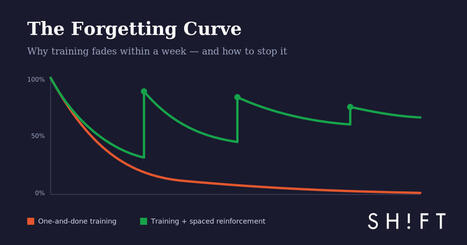
Employees forget most of what they learn within days. The forgetting curve explains why — and how spaced reinforcement makes corporate training actually stick.
"Learning delivered once, then never revisited, follows the red line down. And no amount of polish on the original session changes that trajectory. A beautifully produced course that is never reinforced forgets just as fast as a boring one."
|
|
Scooped by
EDTECH@UTRGV
October 20, 10:02 AM
|
Scoop.it!
"AI is not making us less intelligent. It is reducing the amount of intelligence we practise. The real problem is that we can slowly forget how to do things we no longer have to do. AI skill atrophy and cognitive offloading go hand in hand, and in this article we look at what happens when we outsource the thinking, judgement, and struggle that made those skills ours in the first place."
"The hidden cost of outsourcing our thinking and judgment to AI."
|
|
Scooped by
EDTECH@UTRGV
October 20, 9:59 AM
|
Scoop.it!
"Underneath the numbers, the nature of work is changing yet again, and this time it’s turning everyone into a manager instead of a maker of widgets. That makes this a story about human in the loop and who keeps the agency. A person who can’t read what an agent did is still in the loop on paper, while the agent makes the calls."
"Agents at Anthropic now log six hours for every human hour, and reading their output would eat half a week. The job is to create judgement systems for what deserves attention."
|
|
Scooped by
EDTECH@UTRGV
October 19, 11:12 AM
|
Scoop.it!
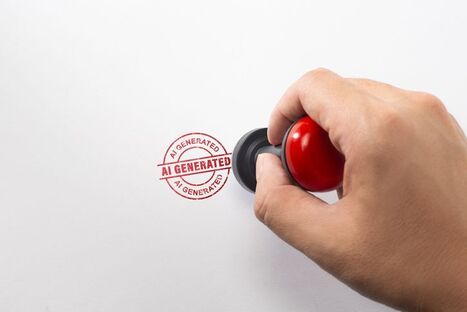
A new European Union ruling is forcing giant AI companies to start using AI watermarks. This could have positive implications for AI detection efforts by teachers.
"Some critics of AI watermarking worry that since it won’t be perfect, it will lead society to a false sense of security and could potentially make it more likely to fall for AI-generated content"
|
|
Scooped by
EDTECH@UTRGV
October 19, 11:09 AM
|
Scoop.it!
"As the world increasingly recognizes the need for safer and more secure AI, U.S. colleges and universities are trying to meet a growing demand for AI security education that prepares future workers to safeguard businesses’ and governments’ powerful AI systems.
AI cybersecurity education programs, from undergraduate and graduate classes to professional certificates, are sprouting up all over the country, as experts warn that young people need to understand how to manage AI risks as they enter a workforce teeming with algorithms, models and agents. The recent autonomous-hacking incidents involving frontier AI models have further underscored the need for cybersecurity education."
"Student interest in AI safety is growing rapidly, and schools are rushing to prepare for new career paths."
|
|
Scooped by
EDTECH@UTRGV
October 19, 11:06 AM
|
Scoop.it!

"As you start the school year, have you thought about what is missing, or more precisely, who might be missing? Are you aware that technologies, even so-called advanced ones, especially instructional materials provided through web-based applications and programs, do not always meet standards and guidelines for accessibility for all students? By accessibility, we mean that students should be able to access, use, and learn with those web-based programs and applications with relatively the same ease as their peers."
"[S]tudents with various disabilities, exceptionalities, and/or challenges do not find web-based instructional materials accessible."