Educational technology developers at Imagine Learning have released an expanded version of Bookster, the company’s free interactive storybook app for kids.
Via Dr. Susan Bainbridge


|
Rescooped by
EDTECH@UTRGV
from The 21st Century
onto Educational Technology News September 8, 2011 10:58 AM
|
 Scoop.it!
Educational technology developers at Imagine Learning have released an expanded version of Bookster, the company’s free interactive storybook app for kids.

 Your new post is loading...
 Your new post is loading...
Your new post is loading...
Scoop.it!
|
|
|
Scooped by
EDTECH@UTRGV
August 26, 11:31 AM
|
Scoop.it!

About half of Americans say they're more concerned than excited about AI, and young adults' concern is rising.
"Across age groups, about half or more say they’re more concerned than excited about AI. Excitement, in turn, has dropped off since 2021 among all age groups."
|
|
Scooped by
EDTECH@UTRGV
August 26, 11:25 AM
|
Scoop.it!

Speaker Coach, the AI-powered presentation tool built into PowerPoint, is not fun to use, but it could help me get better at giving presentations.
"As you speak, the program gives on-screen guidance by default, though you can turn off this feature. It will provide feedback such as telling you to speak more slowly, avoiding “ahs” and “ehs,” and offering encouragement that you are doing great and should keep it up."
|
|
Scooped by
EDTECH@UTRGV
August 26, 11:21 AM
|
Scoop.it!

"Ridley Scott’s Blade Runner turned out to be a design document. Most people remember it for the rain, the neon, and whether Deckard is a replicant.
The reality: the film kept getting the texture of artificial intelligence right while everyone around it argued about flying cars and Pan Am.
It imagined machines that remember, machines that judge, and the people who have to tell them apart, all lifted from Philip K. Dick’s 1968 novel Do Androids Dream of Electric Sheep?"
"A 1982 film and its 2017 sequel predicted the design problems we are still failing to solve, from synthetic memory to the interfaces we now argue about daily."
|
|
Scooped by
EDTECH@UTRGV
August 25, 8:47 AM
|
Scoop.it!

The latest AI tutoring research points to a stubbornly human problem — getting students to engage. “Access was nearly universal but engagement was thin,” a new study found.
"[R]esearch on AI in education is nascent, but an early theme is that students often won’t use it for learning. 'When given AI tutors, many students do not engage'”
|
|
Scooped by
EDTECH@UTRGV
August 25, 8:39 AM
|
Scoop.it!

Helping multilingual students spot deepfakes in the age of AI will help them better assess authenticity of online content.
"[I]f we use visuals as a bridge to understanding, we must also teach students to question their source, context, and credibility."
|
|
Scooped by
EDTECH@UTRGV
August 25, 8:34 AM
|
Scoop.it!
"For a few years now, the UX research field has been arguing with itself over whether AI is coming to replace us or whether AI can’t do “real” research and we need to hold the line. Is AI coming to replace us? Should we use AI to automate research? Can AI conduct “real” research? Research is about asking questions. However, we can ask better questions about AI in UXR."
"We don’t need to ask whether AI can do research. It’s already doing it, and it’s doing it in your org right now, whether or not a researcher is involved. So the real question is: when everyone can do research, who keeps it honest?"
|
|
Scooped by
EDTECH@UTRGV
August 21, 2:19 PM
|
Scoop.it!

What research reveals about the absence of training, policy, and institutional support
"Teachers with higher self-efficacy perceived more benefits, fewer concerns, and reported more trust."
|
|
Scooped by
EDTECH@UTRGV
August 21, 2:14 PM
|
Scoop.it!

The letter emphasizes outcomes and evidence but stops short of issuing federal regulations.
"Responsible design is the floor. Not only do we need to know if the tool works, but if it works; why does it work, for whom does it work, and under what conditions.”
|
|
Scooped by
EDTECH@UTRGV
August 21, 2:09 PM
|
Scoop.it!

A new Wharton study shows that people feel more positively about ethical advice from AI once they see how good it can be.
"Most people would not prefer to take ethical advice from a computer, but a new Wharton study shows how attitudes change when users see how good AI guidance can be."
|
|
Scooped by
EDTECH@UTRGV
August 20, 10:01 AM
|
Scoop.it!

Plunging assessment scores show reading skills are vanishing, with an instructor complaining his pupils can't understand basic assignments.
“There is a measurable, generational collapse in sustained reading and writing, and the academy is responding to it with improvisation and exhaustion rather than the structural overhaul it requires.”
|
|
Scooped by
EDTECH@UTRGV
August 20, 9:52 AM
|
Scoop.it!

Adam Fein, Vice President of Academic Innovation and Strategic Partnerships at 2U, explores how online education is becoming central to university strategy and why institutional alignment and the right partnerships matter.
"As online learning takes on a bigger role, the success of an institution’s portfolio depends on more than the strength of any individual program. It requires a perspective shift, in which online strategy becomes inseparable from institutional strategy."
|
|
Scooped by
EDTECH@UTRGV
August 20, 9:45 AM
|
Scoop.it!
"We built it to sound sure of everything. The best thing it can learn to say is “I’m not sure.”
"[W]hat you actually get from Claude or ChatGPT is a play-by-play that tells you nothing. “Analyzing your request” or “Working on it.” Cool. You never see the one thing that matters, how it got from your question to its answer."
|
|
Scooped by
EDTECH@UTRGV
August 26, 11:33 AM
|
Scoop.it!

What does teaching without AI look like? Explore human-centered strategies that make learning more personal, meaningful, and lasting in the AI era.
"Teaching without AI can’t, for example, mean ignoring these developments and pretending like we live in the past. No, we all have a responsibility to know what AI is and what it might be doing to the world—and, in particular, to our students."
|
|
Scooped by
EDTECH@UTRGV
August 26, 11:29 AM
|
Scoop.it!
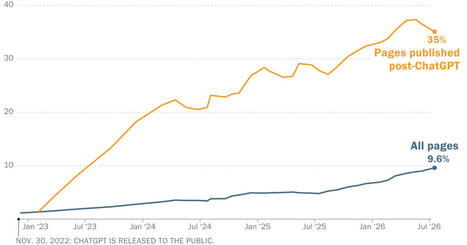
In a random sample of 10,000 webpages collected in July 2026, one-in-ten show signs of being written or substantially edited by AI.
"In the July 2026 snapshot, signs of AI authorship can be found in over one-third of pages published after ChatGPT was released."
|
|
Scooped by
EDTECH@UTRGV
August 26, 11:23 AM
|
Scoop.it!
"AI cheating has already gone from asking a chatbot to write an essay to using tools that can make that AI-written work look human. We’ve previously talked about AI tools designed to help students cheat and the growing problem of AI detectors struggling to keep up, as well as how commonly students are already using AI for homework. Now the technology isn’t merely helping students do the work. In some cases, it can effectively be the student."
"The technology has moved from helping with homework to effectively impersonating students inside virtual classrooms."
|
|
Scooped by
EDTECH@UTRGV
August 25, 8:55 AM
|
Scoop.it!

Kevin Ramsey says the glasses can read menus to him and help him track walking routes.
"UK courts recently banned people using the glasses inside their buildings and a number of restaurants and theatres have done the same. Ramsey is concerned more places might ban them which could negatively affect visually impaired people using them."
|
|
Scooped by
EDTECH@UTRGV
August 25, 8:44 AM
|
Scoop.it!

Most teachers recognize the scene: a room full of students copying down slides word-for-word or neatly filing away handouts under the assumption that having the record means having the knowledge.
"When participants recorded words knowing they could look at their notes during a recall test, their initial encoding became exceptionally superficial...Knowing a backup existed did not merely reduce study effort; it actively undercut retention."
|
|
Scooped by
EDTECH@UTRGV
August 25, 8:37 AM
|
Scoop.it!

Before restricting screens, schools should ask what students will lose, including access to books, translation, accessibility features, and more.
"At a time when many students are struggling to read, schools should increase access to high-interest books, not limit ways students find and read them...Digital books do not replace paper, but expand access, choice, privacy, and independence."
|
|
Scooped by
EDTECH@UTRGV
August 25, 8:32 AM
|
Scoop.it!
"Artificial Intelligence (AI) has the potential to address some of the biggest challenges in education today, innovate teaching and learning practices, and ultimately accelerate the progress towards SDG 4. However, these rapid technological developments inevitably bring multiple risks and challenges, which have so far outpaced policy debates and regulatory frameworks."
"This publication offers guidance for policy-makers on how best to leverage the opportunities and address the risks, presented by the growing connection between AI and education."
|
|
Scooped by
EDTECH@UTRGV
August 21, 2:16 PM
|
Scoop.it!
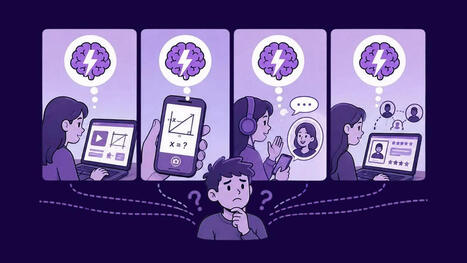
As the catch-all term “AI tutoring” captures the public imagination, it’s time to define and measure what actually meets the bar for a “tutor.”
"Homework helpers (and off-the-shelf LLMs) are designed to resolve the task a user brings in real time: to get to an answer. Great tutors don’t provide answers."
|
|
Scooped by
EDTECH@UTRGV
August 21, 2:12 PM
|
Scoop.it!

The best AI-powered tutors guide students towards genuine learning
"While students may welcome the ability to quickly get answers without much work, educators and education leaders have been deeply uneasy about the potential effects of AI on learning."
|
|
Scooped by
EDTECH@UTRGV
August 21, 2:08 PM
|
Scoop.it!
"The film feared a superintelligence that would rise up and rule us, but the generative AI we built asks for our trust instead — and mostly gets it."
"The Matrix feared a machine that would wake up, decide we were the problem, and seize control. Generative AI did the opposite. It asked politely — a summarizer here, a copilot there — and we said yes, one convenient task at a time. No war, no red pill. The takeover, if that is the word, came by invitation."
|
|
Scooped by
EDTECH@UTRGV
August 20, 9:54 AM
|
Scoop.it!

Instead of banning the technology, schools have a unique opportunity to promote digital citizenship and authentic student engagement.
"It has become a concerning cycle in education: When any new technology becomes prevalent in our kids’ world — from TV to video games, and computers to the rise of AI — policymakers’ first instinct is to ban the technology rather than attempt to understand it."
|
|
Scooped by
EDTECH@UTRGV
August 20, 9:49 AM
|
Scoop.it!

The cyberattack that rocked Canvas offered a lesson for higher ed: Institutions must move faster to stay ahead of emerging threats.
"Experts at Instructure recognized earlier this year that conventional security practices were being challenged by AI-powered threats,...The company’s renewed defenses remained unfinished when the attack occurred."
|
|
Scooped by
EDTECH@UTRGV
August 20, 9:43 AM
|
Scoop.it!
"Why making the human behind the machine visible changes what we call morally right, and what that does to the alignment of AI with human values"
"Who do we blame when an AI makes a wrong prediction or a harmful decision? The obvious suspects are the machine itself, or the company that built it. Recent experimental research evidence points in a new direction."