
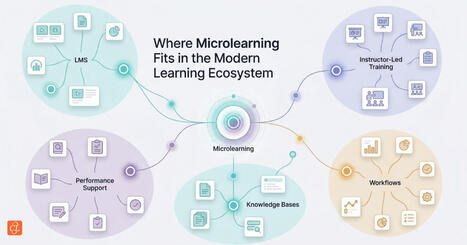
Discover how microlearning fits into blended learning, mobile learning, social learning, analytics, flow-of-work learning, and content conversion.


|
Scooped by
EDTECH@UTRGV
onto Educational Technology News October 7, 2:06 PM
|
 Scoop.it!
Discover how microlearning fits into blended learning, mobile learning, social learning, analytics, flow-of-work learning, and content conversion.

 Your new post is loading...
 Your new post is loading...
Your new post is loading...
Scoop.it!
|
|
|
Scooped by
EDTECH@UTRGV
October 8, 2:32 PM
|
Scoop.it!

Some people are abandoning office jobs for teaching, health care and the trades. But the new paths can come with trade-offs
"As AI threatens to upend the white-collar job market, some young workers and recent graduates...are reconsidering their career paths."
|
|
Scooped by
EDTECH@UTRGV
October 8, 2:13 PM
|
Scoop.it!
"To adapt, faculty must be able to quickly update their curriculum without 'multi-committee, year-long review processes'"
|
|
Scooped by
EDTECH@UTRGV
October 7, 2:06 PM
|
Scoop.it!
Discover how microlearning fits into blended learning, mobile learning, social learning, analytics, flow-of-work learning, and content conversion.
"To understand microlearning strategically, it helps to stop treating it as a separate training category and start seeing it as a layer within the wider learning architecture."
|
|
Scooped by
EDTECH@UTRGV
October 7, 1:57 PM
|
Scoop.it!

"We’re standing at the edge of another historic shift. Just as the internet redefined business in the 90s and smartphones transformed the workplace in the 2000s, artificial intelligence (AI) is now reshaping how we work—and who does the work. According to the latest Microsoft Work Trend Index (WTI), this transformation marks the emergence of the Frontier Firm: organizations built around human-agent teams, digital labor, and AI-powered workflows."
"Eighty-two percent of leaders say this is the time to rethink strategy with AI as the driving force, but most organizations aren’t ready."
|
|
Scooped by
EDTECH@UTRGV
October 7, 1:51 PM
|
Scoop.it!

Video game designers spend an enormous amount of time studying what keeps people engaged when something becomes difficult. They have become very good at helping people persist. Schools should pay attention.
"Visible progress and meaningful choice increase motivation: Students benefit when they can see their growth, demonstrate learning in different ways, and have ownership over how they meet clear academic expectations."
|
|
Scooped by
EDTECH@UTRGV
October 6, 1:47 PM
|
Scoop.it!

Microsoft has published a draft code of conduct that lays out how its homegrown AI models should behave, with human control taking priority over model capability, autonomy, and even task completion.
"Microsoft's Humanist AI Code prioritizes human control, safety and oversight over autonomy."
|
|
Scooped by
EDTECH@UTRGV
October 6, 1:42 PM
|
Scoop.it!

The question shouldn't be how much screen time should students have, but what they are doing, what are they learning, and is technology helping?
"That's the conversation schools should be having about technology more broadly. Don't start with the tool or the number of minutes. Start with the learning and decide what tools are best to achieve the desired outcomes."
|
|
Scooped by
EDTECH@UTRGV
October 5, 1:36 PM
|
Scoop.it!

People remember the moment they had to decide. Four rules for building scenarios that teach — and a 30-second mini scenario you can try inside the post.
"That is why scenarios work: instead of telling learners what to do, you put them inside a situation and let them choose. Done well, a scenario turns dry content into something people feel — and what people feel, they keep."
|
|
Scooped by
EDTECH@UTRGV
October 5, 1:30 PM
|
Scoop.it!

As AI features flood K-12 curricula, educators are left to filter proven quality from marketing hype.
"The blurred lines between AI-enabled course materials and materials without AI can affect classrooms...The worst-case scenario...is that quality assurance at adoption no longer guarantees quality at instruction.”
|
|
Scooped by
EDTECH@UTRGV
October 5, 1:23 PM
|
Scoop.it!

"In this episode of This Week with EdSurge, two former educators join to discuss EdReport's recent brief and explain why it is so important to verify the efficacy of digital instructional tools."
"EdReports, an independent nonprofit that reviews K-12 curriculum, recently went looking for the evidence behind those claims. What it found raises hard questions for any district leader weighing an edtech purchase this fall."
|
|
Scooped by
EDTECH@UTRGV
October 2, 1:21 PM
|
Scoop.it!

There is growing concern that AI can blunt memory and reasoning. But science shows ways to keep the brain sharp.
"Some studies suggest that AI tools can help people to learn if, rather than supplying ready-baked answers, they give feedback or tasks that encourages students to think and problem-solve. 'It’s about how we structure the task'”
|
|
Scooped by
EDTECH@UTRGV
October 2, 1:14 PM
|
Scoop.it!
"Faced with quadratic equations, Richard Scott couldn’t resist the temptation.
The Pennsylvania eighth-grader knew that the Google search box on his school laptop was essentially an AI chatbot that would helpfully spit out answers. He started popping algebra questions into the search bar to quickly finish off his daily schoolwork.
By the end of the school year, Scott’s grades were tanking."
"The risks of cognitive and emotional dependence, along with falling test scores, are fueling a backlash"
|
|
Scooped by
EDTECH@UTRGV
October 8, 2:48 PM
|
Scoop.it!
"The scale of unauthorized or previously unknown actions by AI agents keeps getting bigger by the day. More than 100 organizations have now received a metaphorical knock on the door from OpenAI after it discovered their AI agents have in some way tampered with their systems, while other AI labs are finding the same uncomfortable discoveries.
It’s caused many in the field to call for better, more robust accident investigators, with the ultimate aim of stopping such actions happening in the first place by understanding how they’ve happened at all. But any investigations are pointless if the AI can’t be tracked. And it’s increasingly difficult to do so."
"New research finds that popular AI agents can alter or delete their own activity logs, making it much harder to figure out what happened when something goes wrong."
|
|
Scooped by
EDTECH@UTRGV
October 8, 2:15 PM
|
Scoop.it!
"The rise of artificial intelligence (AI) has pushed higher education to a crossroads, and a paradigm shift is required. Universities who expect to lead in this new AI-shaped landscape must reimagine higher education as a hyper-personalized journey for students, enabled by AI, interactive data, predictive analytics, and adaptive technologies from end to end."
"The essence of leadership in the era of AI is to be proactive, not wait for disruption to come our way."
|
|
Scooped by
EDTECH@UTRGV
October 8, 2:10 PM
|
Scoop.it!
"Artificial intelligence (AI) is rapidly transforming higher education, creating new opportunities to enhance student experiences, improve operational efficiency, and support data-driven decision-making. As institutions explore AI-powered applications for learning, research, enrollment, and campus operations, many IT leaders are facing an important question: Is campus infrastructure ready to support AI reliably, securely, and at scale?"
"Many institutions are discovering that AI adoption requires more than new software tools. New workloads often demand increased computing capacity, greater power availability, and more advanced cooling strategies."
|
|
Scooped by
EDTECH@UTRGV
October 7, 2:00 PM
|
Scoop.it!

Learn how to review AI-assisted training for source accuracy, realistic practice, media quality, learner usability, and workplace application.
"AI can compare drafts, flag inconsistencies, and suggest areas that deserve investigation. It cannot provide conclusive verification. Important claims, procedures, and conditions should be checked against authoritative sources by a qualified person."
|
|
Scooped by
EDTECH@UTRGV
October 7, 1:52 PM
|
Scoop.it!

AI is changing which human capabilities matter most at work, yet employees are reporting that some of those same capabilities are being eroded, according to a new study from IBM.
"More than half of employees surveyed — 52% — said their assigned tasks changed during the past year as AI reshaped day-to-day responsibilities."
|
|
Scooped by
EDTECH@UTRGV
October 6, 1:49 PM
|
Scoop.it!

Artificial intelligence is saving scientists significant amounts of time, but researchers are giving some of those gains back by checking the technology's work, according to a new study involving Google, Google DeepMind, and MIT.
"Scientists reported nearly seven weekly hours saved with AI, largely reinvested in research. Nearly half of time-saving scientists spent over 25% of those gains verifying AI outputs."
|
|
Scooped by
EDTECH@UTRGV
October 6, 1:44 PM
|
Scoop.it!

As schools become more dependent on digital platforms for instruction, grading, student services, and family communication, resilience depends not only on preventing attacks, but on how quickly leaders can restore trusted data, recover essential services, and keep disruptions from cascading across the school community.
"Recovery plans must be simple, tested, and institution-wide: Schools should identify critical services in advance, practice recovery under realistic conditions, and treat cyber resilience as a leadership and governance responsibility, not just an IT issue."
|
|
Scooped by
EDTECH@UTRGV
October 6, 1:39 PM
|
Scoop.it!

Gamified learning has become another target in the conversation about screens in schools. The concern is understandable.
"A 2023 meta-analysis of 41 studies, representing 49 samples and more than 5,000 participants, found a significant positive effect on learning outcomes. Results varied by the learners, subject, design, duration, and learning environment. That is not evidence that gamification fails. It shows that design and implementation matter."
|
|
Scooped by
EDTECH@UTRGV
October 5, 1:34 PM
|
Scoop.it!

Understand your audience’s behavior and create learning opportunities that improve performance. The data tells the story; the AI dashboard tells the saga.
"The data tells the story. The AI dashboard tells your organization's saga: where it comes from, what it is learning, and how far it can go."
|
|
Scooped by
EDTECH@UTRGV
October 5, 1:26 PM
|
Scoop.it!

Tired of compliance-driven workshops, one teacher took to TikTok to turn literacy research into actionable classroom strategies.
"Unlikely as it may seem, online platforms like Spotify, Substack and TikTok are becoming vibrant spaces for meaningful, bite-sized PD."
|
|
Scooped by
EDTECH@UTRGV
October 2, 1:22 PM
|
Scoop.it!

Discover how AI-powered, hands-on cybersecurity education uses AI tools, vulnerability scanning, and microlearning to build students’ critical thinking and practical skills.
"The question was not whether to allow AI, but how to design learning around it so that critical thinking remained non-negotiable.”
|
|
Scooped by
EDTECH@UTRGV
October 2, 1:16 PM
|
Scoop.it!

With school phone bans of various sorts now underway in 41 states and counting, debates on classroom screen time have shifted focus to the devices ostensibly being used for educational purposes: Chromebooks, iPads, and the like. In response to all the tech backlash, state policymakers are taking swift action, some of which is warranted, but much of which bears signs of legislative haste.
"[A]rbitrarily limiting the quantity of screen time does absolutely nothing for the quality of the screen time."
|
|
Scooped by
EDTECH@UTRGV
October 1, 9:20 AM
|
Scoop.it!

We need innovations to reinvent schooling around a positive mindset--and eliminate the breeding ground for cheating oneself out of learning.
"Cheating isn’t the problem holding schools back. It’s a solution students use to make progress in an education system built around a zero-sum mindset designed to sort students rather than develop every child’s full potential."









"To understand microlearning strategically, it helps to stop treating it as a separate training category and start seeing it as a layer within the wider learning architecture."