
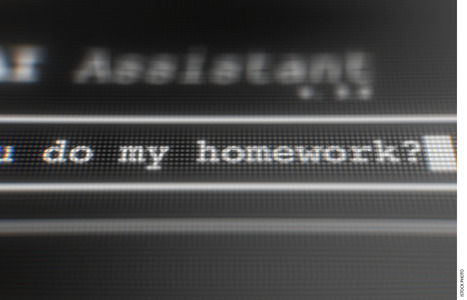
Teenagers are willingly automating cognition and learning less. Adults seem unwilling to stop them.


|
Scooped by
EDTECH@UTRGV
onto Educational Technology News September 24, 8:30 AM
|
 Scoop.it!
Teenagers are willingly automating cognition and learning less. Adults seem unwilling to stop them.

 Your new post is loading...
 Your new post is loading...
Your new post is loading...
Scoop.it!
|
|
|
Scooped by
EDTECH@UTRGV
Today, 8:25 AM
|
Scoop.it!
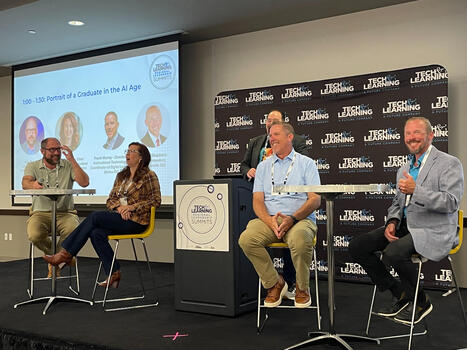
"What does a "Portrait of a Graduate" look like in the age of AI? As the future workplace grows increasingly unpredictable, district leaders must rethink how they equip students for success."
"Berger: A skill now becoming more important is human judgement. And just the ability to think critically.
McCalla: Critical thinking plus accountability. If we’re making decisions about AI, are we thinking critically about it down the road, and the impact that will have."
|
|
Scooped by
EDTECH@UTRGV
Today, 8:19 AM
|
Scoop.it!

People remember the moment they had to decide. Four rules for building scenarios that teach — and a 30-second mini scenario you can try inside the post.
"People forget bullet points. They remember the time they had to decide. That is why scenarios work: instead of telling learners what to do, you put them inside a situation and let them choose. Done well, a scenario turns dry content into something people feel — and what people feel, they keep."
|
|
Scooped by
EDTECH@UTRGV
September 24, 8:40 AM
|
Scoop.it!

AI use in early years education has risen sharply, with educators reporting time savings alongside concerns about accuracy, safeguarding, data protection and training.
"[T]he most popular use of AI was drafting communications to parents and carers, followed by research topics and writing policies or risk assessments. Respondents also use it to help write nativity plays, update the school website, and rewrite job adverts."
|
|
Scooped by
EDTECH@UTRGV
September 24, 8:35 AM
|
Scoop.it!
"Every educator in higher education is grappling with AI right now. But the challenge lands differently in fully asynchronous online environments.
In a face-to-face course, a faculty member develops a running read on each student across the semester. They have heard students speak, watched them work through ideas in discussion, observed the moments where understanding arrived and the moments where it did not. When a submitted paper does not sound like the student who stumbled through an explanation two weeks ago, the discrepancy is recognizable. The faculty member has a reference point outside the artifact itself."
"But when AI can produce all of them, written artifacts can no longer serve reliably as evidence of student understanding. That is the specific challenge online educators face"
|
|
Scooped by
EDTECH@UTRGV
September 24, 8:30 AM
|
Scoop.it!
Teenagers are willingly automating cognition and learning less. Adults seem unwilling to stop them.
"[W]hen it comes to measuring the student-learning outcomes of various ed-tech programs, the results often only apply to the 5 percent of students who 'used the program as intended. The other 95 percent see minimal gains, if any.'”
|
|
Scooped by
EDTECH@UTRGV
September 23, 11:16 AM
|
Scoop.it!

AI is changing which human capabilities matter most at work, yet employees are reporting that some of those same capabilities are being eroded, according to a new IBM study.
"Critical thinking, judgment and the ability to evaluate AI output sit at the center of that tension."
|
|
Scooped by
EDTECH@UTRGV
September 23, 11:11 AM
|
Scoop.it!

Transform your career with an Instructional Design certificate and master the skills needed for today’s evolving workplace learning.
Check out the online, accelerated, project-based Online Instructional Designer Certificate program from UTRGV. https://www.utrgv.edu/accelerated/programs/online-instructional-designer-certificate-program/index.htm
|
|
Scooped by
EDTECH@UTRGV
September 23, 11:07 AM
|
Scoop.it!

Discover small, practical strategies for building a positive classroom climate, strengthening social presence, and creating connection and community in online classes.
"One of the challenges that online instructors face is creating a sense of connectedness in which students feel present, “seen,” heard, and part of the learning community."
|
|
Scooped by
EDTECH@UTRGV
September 22, 10:53 AM
|
Scoop.it!

Public concerns are growing over artificial intelligence use in schools as districts call for more resources to successfully and safely implement the tech.
"The pause on AI tools comes amid public concerns over the technology’s ability to safeguard student data and well-being as well as questions about whether AI can actually improve learning outcomes."
|
|
Scooped by
EDTECH@UTRGV
September 22, 10:45 AM
|
Scoop.it!
"A transcription product ships. On a short clip, the result comes back in two seconds. A week later, the same user records a longer passage and waits six seconds, which is exactly how long a passage that size takes. They assume it is broken.
That story is not mine. It came from Bilal Skiani, who builds a transcription product called Genie 007 and shared it in the comments of an earlier piece of mine on waiting in AI interfaces. Nothing about the system changed between the two runs. What changed was the user’s reference point. The two-second run set the promise, and the six-second run broke it."
"Users forgive a slow answer. What breaks trust is an AI product that is fast one day, slow the next, and never says why."
|
|
Scooped by
EDTECH@UTRGV
September 22, 10:24 AM
|
Scoop.it!

"Ruth Colvin Clark is a specialist in instructional design and technical training who focuses on bridging academic research and practitioner application in instructional methods. She holds a doctorate in the field and is president of Clark Training & Consulting. I reviewed her third edition of Evidence-Based Training Methods: A Guide for Training Professionals.
Here’s the latest research on a few trending instructional methods and evidence-based tips you can implement into your program design."
"One of the greatest takeaways from Clark’s findings is that research often validates simpler design, interface, and animations as more effective learning tools."
|
|
Scooped by
EDTECH@UTRGV
September 21, 1:15 PM
|
Scoop.it!

Why we say “I Love EdTech”
For us, it starts with our graduates and the EdTech community we’ve built together. We love seeing what our graduates accomplish, learning from their experiences, and staying connected as they take their work in new directions.
We also love the work itself: designing learning experiences, solving problems, trying new ideas, and helping people do something they couldn’t do before.
That’s why we adopted “I Love EdTech.”
It doesn’t mean every new app, platform, or AI tool deserves a standing ovation. Loving this field means asking tough questions, too. What do learners need? Does this technology help? Is there a simpler way?
The people in this community bring the judgment, curiosity, and imagination that turn technology into something useful. That’s true in classrooms, universities, workplaces, and everywhere else learning happens.
Our heart-shaped mascot, Eddie, gives us a way to show that connection—to our graduates, to each other, and to the work we care about.
And we’d love to see that heart become something the whole EdTech community shares.
The Jeep people have their ducks. Let’s make the heart our thing.
Put one on your desk, your laptop, or your next presentation. Give one to a colleague. Adopt it, make it your own, and help it become the mascot for the EdTech community. ❤️
Jeep people have their ducks. Let’s make the heart our thing. Put one on your desk, laptop, or next presentation. Let's make it the EdTech community’s mascot. ❤️
|
|
Scooped by
EDTECH@UTRGV
Today, 8:26 AM
|
Scoop.it!

Here are five ways to open up your assignments and make student thinking, creativity, and judgment matter more in the age of AI.
"An AI policy cannot fix an assignment that no longer asks students to do meaningful thinking."
|
|
Scooped by
EDTECH@UTRGV
Today, 8:22 AM
|
Scoop.it!

As hiring falls across 20 top college majors, new LinkedIn data shows which degrees work best for versatility, with liberal arts such as English in the lead.
"Liberal arts majors, such as English, are among the most versatile, with many graduates working outside their fields of study."
|
|
Scooped by
EDTECH@UTRGV
September 24, 8:44 AM
|
Scoop.it!

One school even offers pupils a semiconductor qualification to help them get into the industry.
"I think in all industrial change of the past, there have been some jobs created, some jobs lost."
|
|
Scooped by
EDTECH@UTRGV
September 24, 8:37 AM
|
Scoop.it!

Relying too much on AI will hurt both individuals and organizations in the long run, warns Wharton’s Cornelia Walther.
"Agency decay is the gradual erosion of a person’s ability and willingness to observe carefully, think independently, choose deliberately, and act responsibly. It does not arise because AI is inherently harmful. It arises when convenience becomes the default setting for cognition."
|
|
Scooped by
EDTECH@UTRGV
September 24, 8:32 AM
|
Scoop.it!
"Industries desire employees who can navigate complex, technology-driven environments with agility and foresight. As educators, it is essential to anticipate and prepare students so that they may flourish in their lives and careers."
"Institutions that focus solely on knowledge transmission risk undermining student outcomes over time, as such approaches primarily exercise memory, recall, and associative thinking skills."
|
|
Scooped by
EDTECH@UTRGV
September 23, 11:18 AM
|
Scoop.it!

AI literacy should include the energy and resources behind AI, helping students decide when its benefits justify its environmental costs.
"[G]enerative AI carries environmental consequences that include increased electricity demand, associated carbon emissions, and increased water consumption to cool computing hardware (Zewe, 2025)."
|
|
Scooped by
EDTECH@UTRGV
September 23, 11:15 AM
|
Scoop.it!

As regulations and risks increase, these directories of artificial intelligence components help boost confidence.
"[A]n AIBOM is a 'repository or inventory'...that can be read by your machines, by your systems, and it comprises components including your data sets, your prompts, your models, your specific configurations, version history, pipelines and third-party dependencies.”
|
|
Scooped by
EDTECH@UTRGV
September 23, 11:08 AM
|
Scoop.it!
"For centuries, higher education institutions have occupied a uniquely stable position in society. While technologies, from printing presses to the internet, have continually reshaped how colleges and universities operate, academic structures have remained remarkably resistant to transformation. Professors teach, evaluate, mentor, and certify; students study and progress through academic terms; credentials are awarded through processes deeply embedded in tradition. Today, agentic artificial intelligence (AI) is challenging that stability. In just a few years, AI has evolved from a novelty into a ubiquitous partner in writing, coding, designing, analyzing, simulating, and, increasingly, teaching."
"The Agentic Professor is a construct that helps colleges and universities explore how AI agents providing scalable, long-term personalized instruction could reshape teaching, assessment, and ultimately the role of faculty."
|
|
Scooped by
EDTECH@UTRGV
September 22, 10:59 AM
|
Scoop.it!

Looking ahead, higher education institutions face a pivotal moment with AI.
"As institutions explore AI-powered applications for learning, research, enrollment, and campus operations, many IT leaders are facing an important question: Is campus infrastructure ready to support AI reliably, securely, and at scale?"
|
|
Scooped by
EDTECH@UTRGV
September 22, 10:50 AM
|
Scoop.it!

Conversations with students can provide educators with valuable information in regard to AI use in schools
"When schools make decisions about artificial intelligence, the conversation is usually led by adults...but I believe there is another important voice that is often included only after the decisions have been made, and that is the students who are already using AI."
|
|
Scooped by
EDTECH@UTRGV
September 22, 10:36 AM
|
Scoop.it!
"By Monday, Jenna will remember almost nothing from the compliance course she’s about to pass.
It’s Friday morning, and Jenna must complete the course by end of day. She opens the course between two meetings. The first screen greets her with 240 words lifted straight from a policy document and a narrator who reads every one of them aloud. By the third screen, she mutes the audio. By the fifth, she scrolls ahead, hunting for the quiz."
"Everyone knows a bad course when they see one. But few of us can articulate what makes it bad. When I looked across a year of teardowns, however, the same three problems kept surfacing."
|
|
Scooped by
EDTECH@UTRGV
September 22, 10:22 AM
|
Scoop.it!
"A resume is designed to compress a career. That is its strength and its limitation. A resume can show where someone worked, what they were responsible for, and any notable performance results they can summarize in a few lines. It cannot easily show the decisions, constraints, collaboration, and judgment behind those lines.
When a resume is the only link an employer receives, that evidence is often missing precisely when it would be most useful."
"This is not an argument for replacing the resume with a portfolio. A resume should remain the structured record. But there is a practical opportunity to connect a few important claims to evidence that helps another person understand the work."
|
|
Scooped by
EDTECH@UTRGV
September 21, 11:46 AM
|
Scoop.it!

AI can seem highly capable in some settings and unreliable in others, depending on the tools, context, permissions, and oversight surrounding it.
"Understanding why the same technology can appear inept in one setting and highly capable in another can help schools use it more effectively while managing its risks."









"[W]hen it comes to measuring the student-learning outcomes of various ed-tech programs, the results often only apply to the 5 percent of students who 'used the program as intended. The other 95 percent see minimal gains, if any.'”