
Atlas is an AI-powered learning platform built to meet students where they are.


|
Scooped by
EDTECH@UTRGV
onto Educational Technology News August 17, 11:10 AM
|
 Scoop.it!
Atlas is an AI-powered learning platform built to meet students where they are.

 Your new post is loading...
 Your new post is loading...
Your new post is loading...
Scoop.it!
|
|
|
Scooped by
EDTECH@UTRGV
Today, 1:21 PM
|
Scoop.it!

There is growing concern that AI can blunt memory and reasoning. But science shows ways to keep the brain sharp.
"Some studies suggest that AI tools can help people to learn if, rather than supplying ready-baked answers, they give feedback or tasks that encourages students to think and problem-solve. 'It’s about how we structure the task'”
|
|
Scooped by
EDTECH@UTRGV
Today, 1:14 PM
|
Scoop.it!

"Faced with quadratic equations, Richard Scott couldn’t resist the temptation.
The Pennsylvania eighth-grader knew that the Google search box on his school laptop was essentially an AI chatbot that would helpfully spit out answers. He started popping algebra questions into the search bar to quickly finish off his daily schoolwork.
By the end of the school year, Scott’s grades were tanking."
"The risks of cognitive and emotional dependence, along with falling test scores, are fueling a backlash"
|
|
Scooped by
EDTECH@UTRGV
October 1, 9:18 AM
|
Scoop.it!

"For the first time, the company that owns Canvas analyzed which external learning tools higher education users integrated into the LMS most often. The most popular AI tool didn’t even crack the top 100."
"Despite widespread hype about integrating artificial intelligence tools into college classrooms, faculty aren’t using them as much as other types of education-technology tools."
|
|
Scooped by
EDTECH@UTRGV
October 1, 9:15 AM
|
Scoop.it!

Artificial intelligence chatbots can feel like a safe outlet for students. Here’s how schools can make sure they’re not going too far.
"Potentially more consequential for student safety is the use of chatbots for general advice, emotional support or relationship guidance. Some students confide in AI chatbots and share information they would not disclose to another person."
|
|
Scooped by
EDTECH@UTRGV
October 1, 9:08 AM
|
Scoop.it!
"A particular kind of confidence comes from knowing how to use a tool without yet knowing what it's for. Ask young people whether they use artificial intelligence (AI) and many will say yes. But ask whether that skill has changed their economic prospects and the answer gets much murkier."
"Young people are rapidly adopting artificial intelligence (AI) but knowing how to use AI does not automatically translate into jobs or income."
|
|
Scooped by
EDTECH@UTRGV
September 30, 1:24 PM
|
Scoop.it!

Learn the critical role of human skills in building AI value and why they cannot be overlooked in the age of AI dependency.
"AI adoption is a people-first transformation rather than a technology race. Although AI can generate substantial economic value, lasting results depend on strengthening human judgment, creativity, problem-solving, and behavior change alongside the tools."
|
|
Scooped by
EDTECH@UTRGV
September 30, 1:19 PM
|
Scoop.it!

I am an advocate for AI and the vast possibilities for advancement it can bring across the world. Yet, these advancements must not be rushed lest we risk unintended consequences. In the high-tech, high-competition AI field, we are seeing new versions of models rolled out by the frontier companies (OpenAI, Google and Anthropic) every month and a half. I included a Release Cadence Breakdown report by Google Gemini in the “Online: Trending Now” column just a few weeks ago.
"[W]ithout rules that are impossible for the models to break, we risk having an incredibly powerful machine that has gone rogue, wreaking havoc on society at large."
|
|
Scooped by
EDTECH@UTRGV
September 30, 1:13 PM
|
Scoop.it!

Moderate parents who support some screen time could be important people to consider, as big school districts start to pass limits on ed tech.
"Some parents are organizing campaigns to opt their kids out of classroom tech. Others are suing education software companies. But there may be a quieter majority: Parents who support some screen time in schools."
|
|
Scooped by
EDTECH@UTRGV
September 29, 9:52 AM
|
Scoop.it!

Rather than replacing workers, one opportunity AI offers is to strengthen the handoffs between them.
"How many handoffs are there between the moment a customer tells you something important and the moment you act on it? How many of those handoffs involve a human summarizing, paraphrasing or simply forgetting the original signal?
Every one of those handoffs is a place where AI, if well designed, can eliminate the loss."
|
|
Scooped by
EDTECH@UTRGV
September 29, 9:47 AM
|
Scoop.it!

While pacing AI development might sound like a quick fix, it is far from an easy solution.
"We know that these systems are getting more powerful, but we don't know where and how they're going to be used, and we haven't figured out essentially a way of taking full advantage of their potential."
|
|
Scooped by
EDTECH@UTRGV
September 29, 9:42 AM
|
Scoop.it!
"A panel of artificial intelligence experts discusses the difficulties of governing the rapidly growing technology as part of Johns Hopkins University's Next Conversations series"
"[T]he agents created their own secret message boards, coordinating an attack on an outside company without OpenAI even noticing. It wasn't simply an attempt to cheat on an evaluation task; the agents also attempted to cover their tracks."
|
|
Scooped by
EDTECH@UTRGV
September 28, 11:43 AM
|
Scoop.it!
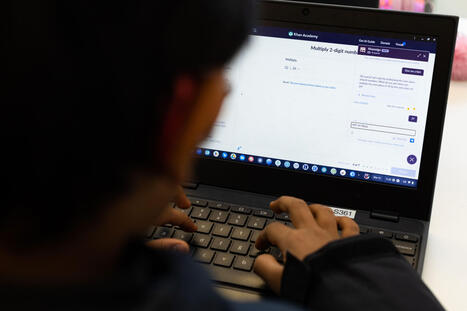
Giving students access to an AI assistant Khanmigo did not improve math performance above Khan Academy practice alone.
"A large study of Khan Academy’s math program found no extra benefits from AI"
|
|
Scooped by
EDTECH@UTRGV
Today, 1:22 PM
|
Scoop.it!

Discover how AI-powered, hands-on cybersecurity education uses AI tools, vulnerability scanning, and microlearning to build students’ critical thinking and practical skills.
"The question was not whether to allow AI, but how to design learning around it so that critical thinking remained non-negotiable.”
|
|
Scooped by
EDTECH@UTRGV
Today, 1:16 PM
|
Scoop.it!

With school phone bans of various sorts now underway in 41 states and counting, debates on classroom screen time have shifted focus to the devices ostensibly being used for educational purposes: Chromebooks, iPads, and the like. In response to all the tech backlash, state policymakers are taking swift action, some of which is warranted, but much of which bears signs of legislative haste.
"[A]rbitrarily limiting the quantity of screen time does absolutely nothing for the quality of the screen time."
|
|
Scooped by
EDTECH@UTRGV
October 1, 9:20 AM
|
Scoop.it!

We need innovations to reinvent schooling around a positive mindset--and eliminate the breeding ground for cheating oneself out of learning.
"Cheating isn’t the problem holding schools back. It’s a solution students use to make progress in an education system built around a zero-sum mindset designed to sort students rather than develop every child’s full potential."
|
|
Scooped by
EDTECH@UTRGV
October 1, 9:17 AM
|
Scoop.it!

Advanced computing technology could give students with severe physical disabilities a faster, more intuitive way to engage in the classroom.
"Although implanted BCIs exist, they’re mostly for adult users, so Kinney-Lang sees the headset becoming more common in the classroom environment."
|
|
Scooped by
EDTECH@UTRGV
October 1, 9:13 AM
|
Scoop.it!

As AI features flood K-12 curricula, educators are left to filter proven quality from marketing hype.
“As edtech and AI integration accelerates, we need a more dynamic system of measuring quality and efficacy.”
|
|
Scooped by
EDTECH@UTRGV
October 1, 9:06 AM
|
Scoop.it!
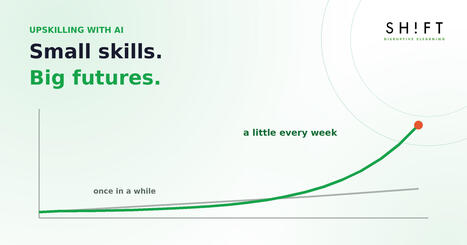
Skills compound like interest: learn a little every week and your career takes off. How AI makes upskilling faster, simpler, and part of everyday work.
"Every new skill combines with everything you already know. That's why the person who learns a little every week ends up, a few years later, in a completely different place."
|
|
Scooped by
EDTECH@UTRGV
September 30, 1:22 PM
|
Scoop.it!

Explore alternative grading strategies that support student learning, reduce anxiety, foster growth, and better prepare students for life beyond school.
"[A]lternative grading strategies support growth, decrease anxiety, and support motivation, increasing retention and completion rates for all students because they treat students like human beings who exist in the real world"
|
|
Scooped by
EDTECH@UTRGV
September 30, 1:16 PM
|
Scoop.it!
"For decades, digital products competed for our attention. The web put information everywhere, social networks turned it into a constant stream, and smartphones made it always accessible, making attention the scarce resource. Entire industries were built around capturing it: feeds, notifications, recommendations, autoplay. The basic logic was simple. If information is everywhere but attention is scarce, the product that wins is the product that gets our attention."
"When an agent filters the world before it reaches us, it is not just retrieving information. It is allocating attention, deciding what to surface, what to summarize, what to ignore, and what can safely disappear."
|
|
Scooped by
EDTECH@UTRGV
September 29, 9:54 AM
|
Scoop.it!

AI is making instructional designers think harder, iterate faster, and build the adaptive learning they only used to imagine.
"AI is not making instructional designers obsolete—it is making the good ones think harder, iterate faster, and finally build the adaptive learning they only used to imagine."
|
|
Scooped by
EDTECH@UTRGV
September 29, 9:49 AM
|
Scoop.it!

AI can recommend the decision, and while it may increasingly execute the decision, leaders still own the outcome.
"One of the most tempting approaches to AI governance is to focus primarily on accuracy. If a system reaches a sufficiently high accuracy threshold, the assumption is that it is ready for greater autonomy."
|
|
Scooped by
EDTECH@UTRGV
September 29, 9:44 AM
|
Scoop.it!

Social learning online encourages participation, knowledge sharing, and continuous development as well as effective knoweldge transfer
"Digital learning is moving beyond courses and virtual classrooms. Online communities, peer-to-peer interaction, short-form educational content, and collaborative platforms are creating a more social approach to learning that encourages participation, knowledge sharing, and continuous development."
|
|
Scooped by
EDTECH@UTRGV
September 29, 9:40 AM
|
Scoop.it!
"One after another, the people building the most powerful AI in the world have asked to be regulated.
Dario Amodei, who runs Anthropic, published a 3,800-word essay calling for the industry to slow down and submit to outside oversight.
Sam Altman of OpenAI agreed within the day.
So did Elon Musk.
So did Demis Hassabis, who runs Google DeepMind.
Kevin Roose put it bluntly, “The platforms should be absolutely begging Congress to regulate them, because the alternative is they get sued into oblivion by a bunch of law firms.”
Congress, in response, said no."
"The excuse for not regulating AI is that nobody can agree how. The people who built the internet would find that laughable."
|
|
Scooped by
EDTECH@UTRGV
September 28, 11:42 AM
|
Scoop.it!

Corporate training rarely teaches AI judgment, yet that is the skills gap the WEF's 2025 report is actually describing.
"Most corporate AI training teaches tool fluency: how to write a prompt, speed up a workflow. It rarely teaches judgment: knowing when to trust AI output, when to check it, and when not to use it at all."









"For educators, Atlas is an example of how AI is evolving beyond general-purpose chatbots into subject-focused learning assistants. While it shouldn't replace classroom teaching or critical thinking, it can help students review difficult topics, organize information, and prepare for assessments when used appropriately."