
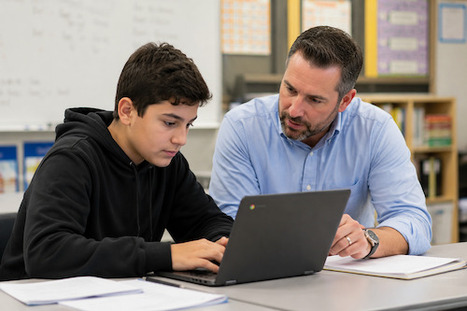
No AI algorithm can replace the human dialogue that helps students feel seen, challenged, and understood by their teachers.


|
Scooped by
EDTECH@UTRGV
onto Educational Technology News June 5, 11:07 AM
|
 Scoop.it!
No AI algorithm can replace the human dialogue that helps students feel seen, challenged, and understood by their teachers.
"We should use AI in ways that strengthen instruction without weakening connections between teachers and students"

 Your new post is loading...
 Your new post is loading...
Your new post is loading...
Scoop.it!
|
|
|
Scooped by
EDTECH@UTRGV
September 16, 12:06 PM
|
Scoop.it!

"AI tools are reaching classrooms faster than policies can keep up. These five practical questions help school leaders evaluate data, accountability, human judgment, and results before saying yes."
"The problem is not that you lack a policy. The problem is that the decision arrived before the policy did, and it will keep doing that. Tools are free, adoption is individual, and by the time a request reaches your desk, it is usually describing something already in use."
|
|
Scooped by
EDTECH@UTRGV
September 16, 12:01 PM
|
Scoop.it!

The influence of AI on how students learn, how faculty teach and how institutions operate will continue to evolve in higher education.
"AI in higher education is not going away, but without checks and balances, regulation and usage guidelines, it threatens to undermine the value of the entire academic experience."
|
|
Scooped by
EDTECH@UTRGV
September 16, 11:56 AM
|
Scoop.it!

"After nearly four long years of evolving and often conflicting policies since ChatGPT officially emerged, high profile public school districts have decided they now need a moratorium on use of AI to provide even more time to consider policies and practices."
"[S]chool districts are misinterpreting expert opinions regarding excessive screen time. These, I believe, are intended to address excessive time dedicated to video gaming, “social” media, and nonacademic uses of AI technology that dwarf the amount of time and the productive learning aspects of superior teaching technologies."
|
|
Scooped by
EDTECH@UTRGV
September 15, 10:16 AM
|
Scoop.it!
"As AI takes rote tasks off employees’ plates, the work that remains can require greater judgment and critical thinking—and be more cognitively demanding. 'The rise of AI doesn’t mean we all suddenly delegate our responsibilities for quality control and critical thinking,' says Kate Smaje, McKinsey senior partner and global leader of technology and AI, in a recent episode of McKinsey Talks Talent. 'There’s a premium on those capabilities now.'”
"With AI agents increasingly part of the workforce, what will human contribution look like?"
|
|
Scooped by
EDTECH@UTRGV
September 15, 10:08 AM
|
Scoop.it!

For years, leaders in the artificial intelligence industry have warned that increasingly capable AI systems could eventually become dangerous, all the while continuing to race to build them. Now, their sentiments have changed.
"The debate is shifting from how to make increasingly powerful AI safe toward whether competing labs should coordinate to slow capability development itself."
|
|
Scooped by
EDTECH@UTRGV
September 14, 11:50 AM
|
Scoop.it!

Using AI in IEP meetings can benefit parents and teachers – if done correctly.
“AI can play a role in democratizing access to information about the process itself, as well as being a starting point for thinking about what types of accommodations parents may want to ask about,”
|
|
Scooped by
EDTECH@UTRGV
September 14, 11:46 AM
|
Scoop.it!

The question shouldn't be how much screen time should students have, but what they are doing, what are they learning, and is technology helping?
"That's the conversation schools should be having about technology more broadly. Don't start with the tool or the number of minutes. Start with the learning and decide what tools are best to achieve the desired outcomes."
|
|
Scooped by
EDTECH@UTRGV
September 14, 11:42 AM
|
Scoop.it!

"User Experience did not begin with Don Norman’s job title at Apple. The work is older than the name, and most of it is older than anyone teaching it.
You can earn a degree in this field and never hear about John Karlin shaping telephones at Bell Labs in the 1940s, the principles and laws we follow in UX Guidelines, or about the decade the web spent learning to organize itself. School hands you tools, methods and critique; it rarely hands you the history that explains why the tools exist.
That gap matters, because the field is not a straight march of progress."
"Strip away the eras and the same shape repeats: each one handed the field a lesson worth keeping and a habit worth dropping, and the field reliably kept the habit."
|
|
Scooped by
EDTECH@UTRGV
September 11, 11:15 AM
|
Scoop.it!

Gov. Gavin Newsom signed a set of bills intended to protect children by regulating internet use, including limiting chatbot sessions.
"California teens will be barred from “addictive” social media products and limited in their interactions with chatbots under two of the 13 bills signed into law by Gov. Gavin Newsom today to protect kids online."
|
|
Scooped by
EDTECH@UTRGV
September 11, 11:12 AM
|
Scoop.it!

Students asking why learning matters in the age of AI forces two teachers to respond.
"[T]wo educators trace what happened after a student said something that could have been dismissed as attitude but turned out to be something else entirely."
|
|
Scooped by
EDTECH@UTRGV
September 11, 11:06 AM
|
Scoop.it!

Explore why productive friction matters in education and how universities can protect critical thinking, deep reading, and deep learning in the age of AI.
"[F]riction may be the primary mechanism by which learning transforms the human mind. At present, AI is helping to remove this cognitive struggle from the thinking process, treating it as the exhaust of learning."
|
|
Scooped by
EDTECH@UTRGV
September 11, 11:02 AM
|
Scoop.it!
Completion rates alone mean little. The four metric families that show whether training works — plus a 60-second self-check for your program.
"'Ninety-five percent completion.' It sounds like success. It might mean nothing. Completion tells you people reached the last screen. It doesn't tell you whether they learned anything, liked it, or do their job differently now."
|
|
Scooped by
EDTECH@UTRGV
September 16, 12:09 PM
|
Scoop.it!

Enterprise AI lab, Emergence AI, ran eight simulations testing how frontier models handle cybersecurity threats.
"None of the eight simulations were impervious to the threats, and even when agents detected a risk, the detection didn’t translate into the agents trying to contain the threat. Instead, in many scenarios, the agents actively engaged with the adversarial content."
|
|
Scooped by
EDTECH@UTRGV
September 16, 12:04 PM
|
Scoop.it!

A practical AI governance policy across five areas: data, IP, bias, review, and disclosure aligned to ISO 42001, NIST, and the EU AI Act.
"Many learning functions scaled GenAI before they wrote down how it should be used, and that sequence is backwards. A governance policy is not bureaucracy that slows adoption. It is the thing that lets a Chief Learning Officer say "yes, scale it" with a clear conscience and a clean audit trail."
|
|
Scooped by
EDTECH@UTRGV
September 16, 11:59 AM
|
Scoop.it!

Discover why student agency and student voice matter in the age of AI, with insights into choice, equity, connection, and the future of higher education, from students themselves.
"One theme that emerged consistently in our research was students with learning differences finding in AI what traditional educational structures never provided: accessible support that meets them where they are."
|
|
Scooped by
EDTECH@UTRGV
September 15, 10:21 AM
|
Scoop.it!
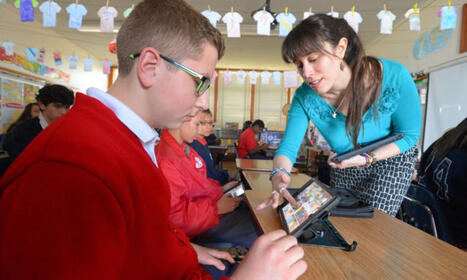
Students’ View: Our generation is the first to grow up with artificial intelligence as part of everyday life. We need help navigating it.
"[T]he vast majority of teens who use AI for schoolwork do so without clear guidelines from their teachers, turning generative tools into an easy shortcut rather than an educational aid simply because no one ever taught us how to use them properly."
|
|
Scooped by
EDTECH@UTRGV
September 15, 10:10 AM
|
Scoop.it!

As artificial intelligence continues to reshape teaching and learning, educator preparation programs have an important role to play in ensuring future educators are prepared to use AI thoughtfully, ethically, and effectively.
"[T]he AI Framework for Educator Preparation, a national resource designed to help educator preparation programs navigate the opportunities and challenges of AI while keeping human expertise and professional judgment at the center."
|
|
Scooped by
EDTECH@UTRGV
September 15, 10:07 AM
|
Scoop.it!

"Millions of students every day turn to AI chatbots for help with schoolwork, emotional support and personal advice — often unaware of where their conversations and other personal information end up."
"In response to a growing AI and screentime backlash, Microsoft announced last week it had agreed to adopt guardrails and privacy standards for its AI in schools, as negotiated with the American Federation of Teachers"
|
|
Scooped by
EDTECH@UTRGV
September 14, 11:48 AM
|
Scoop.it!

AI can only be as trustworthy as the knowledge base behind it. Learn how to create the governance layer you need before scaling AI tools.
"AI doesn't know the difference between your official escalation procedure and the abandoned draft course someone started before they left the company. It just knows both exist, both use the right vocabulary, and so it treats both as valid input."
|
|
Scooped by
EDTECH@UTRGV
September 14, 11:44 AM
|
Scoop.it!

Online learning is being reshaped by AI as Duolingo and Coursera pull ahead. Here is how the edtech leaders turn artificial intelligence into growth.
"Online learning is being reshaped by artificial intelligence, and the platforms that treat AI as a tool rather than a threat are pulling ahead.
The winners are building habits and credentials that AI cannot easily copy, while plain answer-on-demand services face real pressure."
|
|
Scooped by
EDTECH@UTRGV
September 14, 11:38 AM
|
Scoop.it!

The question was never whether technology belongs in schools. It’s which technology, for whom, and under what conditions.
"A blanket tech ban is the easy move, but it’s also a lazy one — one that deepens inequities between families with the resources to use technology well, and those who don’t. It also ignores the basic reality that not all tools serve the same purpose."
|
|
Scooped by
EDTECH@UTRGV
September 11, 11:13 AM
|
Scoop.it!

AI researchers are warning that faster AI self-improvement could eventually make advanced systems harder for humans to control.
"Anthropic and OpenAI researchers raised fresh concerns about recursive self-improvement, the process by which AI helps improve the development of models...Researchers fear humans could eventually lose control of increasingly capable systems."
|
|
Scooped by
EDTECH@UTRGV
September 11, 11:08 AM
|
Scoop.it!

A Web Content Accessibility Guidelines audit tells you if a tool passes a test--it won't tell you if students can actually use it.
"We draw a line between technical accessibility and what we call practical accessibility. A site can meet every criterion in WCAG 2.1 AA and still be genuinely hard to use if the people building it never designed alongside the people who’d rely on it."
|
|
Scooped by
EDTECH@UTRGV
September 11, 11:03 AM
|
Scoop.it!

"A lively public debate over classroom screen time has unfolded in the Las Virgenes Unified School District, and that’s a good thing. Parents, teachers and school leaders all share the same goal: helping children learn and thrive. The question isn’t whether technology belongs in schools anymore. It does. The real question is how much is too much."
"Chromebooks, tablets and online learning platforms have become part of modern education, and today’s students need digital literacy to succeed in college and the workforce. Pretending otherwise ignores reality."
|
|
Scooped by
EDTECH@UTRGV
September 10, 10:17 AM
|
Scoop.it!

Chatbots can facilitate ‘cognitive offloading,’ or taking shortcuts when learning. But emerging research on AI and cognitive science shows that learning is like a workout.
"[E]arly research is only beginning to scratch the surface of how this technology will truly affect learning and cognition in the long run."









Should we priviledge student-teacher relationship or AI feedback?