

The conversation on most campuses has become consumed with detection: How do we catch students using AI when they shouldn't? The impulse to protect academic integrity is legitimate, but the detection-first approach has a fatal flaw.


|
Scooped by
EDTECH@UTRGV
onto Educational Technology News June 1, 11:16 AM
|
 Scoop.it!
The conversation on most campuses has become consumed with detection: How do we catch students using AI when they shouldn't? The impulse to protect academic integrity is legitimate, but the detection-first approach has a fatal flaw.


 Your new post is loading...
 Your new post is loading...
Your new post is loading...
Scoop.it!
|
|
|
Scooped by
EDTECH@UTRGV
June 2, 10:27 AM
|
Scoop.it!


It’s graduation season, and people entering the workforce now can turn the 2026 hiring slowdown into a career launchpad using practical skills — and some surprising suggestions.
"While many organizations are attempting to leverage AI to assist in areas such as security operations centers (SOCs), which can affect entry-level roles, industry insiders continue to see a need for a workforce that is knowledgeable about what these technologies can do, how they fit into the broader business strategy, and how to deploy them effectively to increase security while reducing risk.”
|
|
Scooped by
EDTECH@UTRGV
June 2, 10:21 AM
|
Scoop.it!

Where the AFT's new 10-point plan gets it right, where it falls short, and why “devices down” is not the path to meaningful learning.
"The 10-point plan’s name, “Devices Down, Eyes Up, Hands-On,” may sound appealing, especially to adults exhausted by distraction, low-quality screen use, and Big Tech overreach. The problem is that it aims at the wrong target. Devices are not the enemy of active learning. Passive, drill-and-kill learning is."
|
|
Scooped by
EDTECH@UTRGV
June 2, 10:15 AM
|
Scoop.it!

Students and academics are on different planets in terms of AI use, creating a culture of distrust and secrecy. Dina Kamel offers three ways to close the gap
"62 per cent of students felt their lecturers viewed them with automatic suspicion, and 57 per cent reported hiding their AI use even when they believed it was legitimate. This highlights a failure of mutual transparency: students declare AI use but faculty rarely do the same. The result is a classroom of silent distrust – the opposite of the open culture we claim to foster."
|
|
Scooped by
EDTECH@UTRGV
June 1, 11:16 AM
|
Scoop.it!
The conversation on most campuses has become consumed with detection: How do we catch students using AI when they shouldn't? The impulse to protect academic integrity is legitimate, but the detection-first approach has a fatal flaw.
"AI detection is the wrong focus...Effective AI policies distinguish types of AI use, clarify disclosure and prohibited use, and hold students responsible for showing their own understanding."
|
|
Scooped by
EDTECH@UTRGV
June 1, 11:11 AM
|
Scoop.it!

Technical skills are changing rapidly. A college education teaches students something more durable.
"[A] degree from a competitive college with a high graduation rate cultivates the ultimate asset in a rapidly changing economy: the ability to think critically. This includes being able to understand AI"
|
|
Scooped by
EDTECH@UTRGV
June 1, 11:07 AM
|
Scoop.it!

Schools can implement systems and policies that allow for access to student devices while limiting their use during instructional time.
"The question is not simply whether phones should be allowed or banned. It is how schools can create policies that support both priorities without forcing a tradeoff."
|
|
Scooped by
EDTECH@UTRGV
June 1, 11:01 AM
|
Scoop.it!

"The booing kicked off before Gloria Caulfield could finish her sentence. At the University of Central Florida's College of Arts and Humanities graduation on May 8th, real estate exec Caulfield told the graduating class that "the rise of artificial intelligence is the next industrial revolution." One student yelled, "AI sucks", and the crowd erupted."
"[A]t the heart of the problem, the people most affected by AI in learning are telling us that they are deeply conflicted about the technology."
|
|
Scooped by
EDTECH@UTRGV
May 29, 11:14 AM
|
Scoop.it!

"A recent ransomware attack on Instructure's Canvas LMS has raised concerns across the higher education community about cybersecurity, data privacy, third-party risk, and institutional preparedness."
"Instead of a coordinated pause, institutions are making local decisions based on their own risk tolerance and operational needs"
|
|
Scooped by
EDTECH@UTRGV
May 29, 11:03 AM
|
Scoop.it!

The 2026 EDUCAUSE Horizon Report should be read as a leadership document, not just a technology report, for higher education leaders.
"[H]igher education is being reshaped by pressures surrounding value, trust, AI, financial instability, sustainability, data protection, accessibility, and policy change."
|
|
Scooped by
EDTECH@UTRGV
May 29, 10:54 AM
|
Scoop.it!

"Since the release of ChatGPT, in 2022, colleges and universities have been engaged in an experiment to discover whether artificially intelligent chatbots and the liberal-arts tradition can coexist. Notwithstanding a few exceptions, by now the answer is clear: They cannot. AI-enabled cheating is pretty much everywhere. As a May New York magazine essay put it, 'students at large state schools, the Ivies, liberal-arts schools in New England, universities abroad, professional schools, and community colleges are relying on AI to ease their way through every facet of their education.'”
"[W]hen an educational institution as a whole produces large amounts of AI-generated scholarship, it fails to create new ideas and add to the storehouse of human wisdom."
|
|
Scooped by
EDTECH@UTRGV
May 28, 11:38 AM
|
Scoop.it!

"Demis Hassabis just told Sequoia Capital he expects AGI by 2030. He has the strictest definition in the field. The timelines from every major lab are moving up, not back. Schools should be paying attention — because the ground under their value proposition is shifting the way it shifted when we left the farms."
"Hassabis estimates that if AGI does arrive in 2030, 'the economic transformation will be 10 times larger and 10 times faster than the Industrial Revolution.'”
|
|
Scooped by
EDTECH@UTRGV
May 28, 11:31 AM
|
Scoop.it!

Vibe coding can feel instant, but it is not simply pressing a button and getting a finished app.
"Instead of writing every line of code yourself, you describe what you want created and the AI generates the code for you. The “vibe” part comes from the idea that you may not actually know exactly how the code is working."
|
|
Scooped by
EDTECH@UTRGV
June 2, 10:30 AM
|
Scoop.it!

Credentialing programs in artificial intelligence are multiplying fast, but educators and researchers say their value depends on workplace relevance, hands-on learning opportunities and measurable career outcomes.
"An AI credential can signal two things employers are looking for,...In the immediate term, it shows technical AI skills, and in the long term, it shows a willingness to upskill and continue learning, which...will be important as technology evolves."
|
|
Scooped by
EDTECH@UTRGV
June 2, 10:23 AM
|
Scoop.it!

Districts that creates the right language, the structure, and competence statements around AI will get a return on whatever platform it picks
"American districts trying to land a shared AI structure are spending too much time on tooling and too little on the question that actually drives teacher uptake."
|
|
Scooped by
EDTECH@UTRGV
June 2, 10:18 AM
|
Scoop.it!

A five-stage framework, enhanced by GenAI, can help educators create more interactive, inclusive and responsive online learning experiences that boost student engagement and learning online
"We developed the “5E” framework (engage, explore, explain, elaborate and evaluate) to structure our online sessions around five learning stages."
|
|
Scooped by
EDTECH@UTRGV
June 1, 11:17 AM
|
Scoop.it!

At its recent I/O developer conference, Google presented artificial intelligence agents not as a distant research project, but as a product strategy spanning Search, personal assistants, productivity software, developer tools, and smart glasses.
"AI agents are moving from experimental tools into mainstream products as Google builds Gemini deeper into Search, apps, developer tools, and wearable devices."
|
|
Scooped by
EDTECH@UTRGV
June 1, 11:14 AM
|
Scoop.it!

When it comes to screen time and distractions, school-issued devices and personal smartphones aren’t the same conversation. Here’s how to make sure your district is having the right one.
"Not all devices are the same, and not all screen time is created equal. The debate that’s dominating headlines is largely about personal smartphones... But when that conversation starts bleeding into school-issued instructional technology, we have crossed into different territory."
|
|
Scooped by
EDTECH@UTRGV
June 1, 11:09 AM
|
Scoop.it!

Most AI literacy initiatives training build awareness, but organizations need employees who can use their judgment in AI use.
"Traditional learning programs are optimized for recall. Performance is different. Performance requires people to diagnose situations, adapt to changing conditions, weigh tradeoffs, and act despite uncertainty."
|
|
Scooped by
EDTECH@UTRGV
June 1, 11:06 AM
|
Scoop.it!

Health sciences professor Humberto López Castillo urges students to use AI to help with science research, but never to lose sight of the human element.
"University of Central Florida professor Humberto López Castillo was recently looking at a student project when he saw that it cited a paper by Castillo himself. There was, however, a problem with this citation: Castillo couldn’t remember ever writing this paper or conducting the research it referenced."
|
|
Scooped by
EDTECH@UTRGV
June 1, 10:59 AM
|
Scoop.it!

The primary source of institutional AI proficiency must be universities themselves, not the technology companies who offer training for their platforms. Without that agency, we risk surrendering educational practice to commercial interests, write Amy Allen and David Hicks
"Those shaping how future educators are learning to use artificial intelligence are often not teachers or scholars but the technology companies building the tools."
|
|
Scooped by
EDTECH@UTRGV
May 29, 11:08 AM
|
Scoop.it!

Iowa State University has announced a new effort aimed at ensuring its use of AI is ethical and trustworthy.
“Our strengths across the humanities, social sciences, mathematics, and natural sciences allow us to examine AI through the lenses of ethics, communication, policy, human behavior, and scientific rigor simultaneously. By bringing these disciplines together, we can help ensure that AI systems are not only innovative, but transparent, accountable, and worthy of public trust.”
|
|
Scooped by
EDTECH@UTRGV
May 29, 10:59 AM
|
Scoop.it!
"If you designed for the web in 1999, you remember the feeling while the Hamster Dance video was playing in the background.
Pages were handmade — for a lot of us, the WYSIWYG editor was Notepad — the conventions were improvised, the JavaScript was rough, and some of the most popular things online were gloriously, defiantly pointless, like the Hamster Dance."
"Design for where the puck is going. Build for the capability you’ll plausibly have in two or three model generations, and make the parts most likely to change the easiest parts to replace."
|
|
Scooped by
EDTECH@UTRGV
May 28, 11:41 AM
|
Scoop.it!

"Most AI literacy curricula begin and end with the same lesson: here’s how to use ChatGPT responsibly. Learn to prompt. Check your sources. Don’t plagiarize.
That’s not AI literacy. That’s a typing tutorial for 2023."
"The world students are entering — the world that’s arriving right now — requires something far more comprehensive. The chatbot is just the opening act. What follows is an AI environment that will reshape how young people think, feel, relate, work, and build their identities."
|
|
Scooped by
EDTECH@UTRGV
May 28, 11:34 AM
|
Scoop.it!
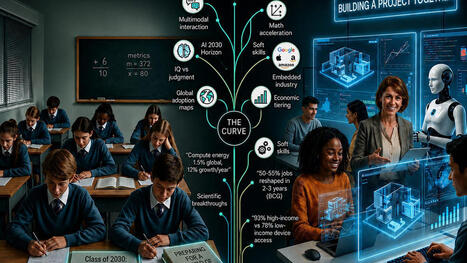
"As the school year ends for many, I see twelve emerging trends in AI that will both create profound change and risk intelligence deprivation unless we chart a new course.
AI is becoming conversational, multimodal, agentic, and increasingly embodied/physical. It will not just help students write papers. It will help companies replace tasks and alter workflows; governments redesign services; scientists solve the world’s biggest problems; militaries accelerate decision-making; and agentic robots act in the world as a form of embodied cognition.
But this future will not arrive evenly."
"The old school model prepared students for a world where human intelligence was scarce and schools and resources sorted access to opportunity. The next world will be different. Intelligence will be ambient, conversational, tiered, embodied, and, maybe, unevenly distributed."









"AI detection is the wrong focus...Effective AI policies distinguish types of AI use, clarify disclosure and prohibited use, and hold students responsible for showing their own understanding."