

AI may make it easier to manipulate athletic performance, but students often underestimate how easily it can be exposed


|
Scooped by
EDTECH@UTRGV
onto Educational Technology News May 18, 12:56 PM
|
 Scoop.it!
AI may make it easier to manipulate athletic performance, but students often underestimate how easily it can be exposed

 Your new post is loading...
 Your new post is loading...
Your new post is loading...
Scoop.it!
|
|
|
Scooped by
EDTECH@UTRGV
July 3, 4:06 PM
|
Scoop.it!


"Dr. Jared Cooney Horvath’s recent testimony before the U.S. Senate Committee on Commerce, Science, and Transportation warning about the rapid expansion of EdTech and the explosion of student screen time should spark an important national conversation about learning, cognition, and the future of education."
"Every environment trains the brain for something. The issue is not whether children use technology. The issue is whether that technology strengthens the capacities human beings most need to learn, adapt, create and thrive."
|
|
Scooped by
EDTECH@UTRGV
July 3, 3:28 PM
|
Scoop.it!

"Across the ADDIE framework, AI supports ideation, drafting, summarization, and pattern recognition, while instructional designers remain responsible for pedagogical alignment, accessibility, ethical review, and learner-centered decision-making."
"When viewed through the ADDIE framework, AI supports different types of work at each stage of the design process."
|
|
Scooped by
EDTECH@UTRGV
July 3, 3:08 PM
|
Scoop.it!

AI-generated deepfakes are being used to cyberbully students and target staff. Learn how K–12 districts can detect synthetic media, update policies and protect their communities.
"Existing policies that don’t cover synthetic media will need updating.
'They need to call out specifically synthetic media of real people. Whether that’s used for harm or not, kids really shouldn’t be making fake pictures of others'"
|
|
Scooped by
EDTECH@UTRGV
July 2, 3:22 PM
|
Scoop.it!

A bilingual educator examines how alignment with AI emerges not from better prompting but from deliberate boundary-setting and sustained correction over time—building on the practitioner lens first developed in Holding the Line.
"Once you’ve interacted with enough AI tools, the voice starts to sound the same, no matter the platform."
|
|
Scooped by
EDTECH@UTRGV
July 1, 3:58 PM
|
Scoop.it!
The pace of development and proliferation of artificial intelligence tools — generative, agentic, physical — can be hard to follow, but IT leaders must do their best to stay apprised of potential innovations and risks.
“In 2026, technology leaders will be focused on equipping and empowering people across their institutions to realize the net benefits of technology, AI and data."
|
|
Scooped by
EDTECH@UTRGV
July 1, 3:19 PM
|
Scoop.it!

Drawing on experience across higher education in the UK and Malaysia, two academics argue that the real AI divide in universities is not about access to tools but about institutional readiness — and why it is an urgent equity issue policymakers can no longer afford to ignore.
"[T]he trajectory of AI in education has long pointed towards personalised, competency-based learning, yet realising that potential equitably remains an unresolved challenge"
|
|
Scooped by
EDTECH@UTRGV
June 30, 3:55 PM
|
Scoop.it!

Experienced learning engineers, researchers, and industry leaders shared eight top tips for landing your first ed tech role.
"[A]n understanding of the human side of the equation – specifically, identifying where technology supports learning and where it creates friction – is often a missing skillset that is prized by ed tech developers and employers."
|
|
Scooped by
EDTECH@UTRGV
June 30, 3:16 PM
|
Scoop.it!

‘It’s not looking good’: The unemployment rate for recent grads is the highest in five years, but AI is not primarily to blame — at least not yet
"Labor experts say AI hasn’t cannibalized much entry-level or white-collar work just yet, even as the technology injects more uncertainty into an already tight market."
|
|
Scooped by
EDTECH@UTRGV
June 29, 3:52 PM
|
Scoop.it!

AI moves into law, mathematics, and the arts as the public turns on the data centers, and Washington moves to claim its share.
"[A]s intelligent machines take on more of the legal, creative, mathematical, and financial work we once trained people for, what should we actually be teaching now?"
|
|
Scooped by
EDTECH@UTRGV
June 29, 3:13 PM
|
Scoop.it!

Two educators are reckoning with who is really in charge: technology or the teacher.
"[T]he information gleaned from social media is already shaping how future teachers think, so the more productive move is to help them engage with it critically rather than dismiss or ignore it."
|
|
Scooped by
EDTECH@UTRGV
June 26, 3:39 PM
|
Scoop.it!

Learn how teaching AI literacy helps students use AI as a writing assistant rather than a substitute, improving revision, critical thinking, and ethical AI use.
"[I]f students were taught how to use AI more deliberately and critically, could it strengthen their writing rather than replace it?"
|
|
Scooped by
EDTECH@UTRGV
June 26, 3:26 PM
|
Scoop.it!
Reading Anthropic's new reports on the 'AI exponential' and recursive self-improvement alongside recent scholarship on tech oligarchy, this piece asks a simple question: is AI being built to serve people, or to serve its own acceleration?
"Since the dawn of personal computing, a technology's worth has been measured by whether it becomes helpful, intuitive, and meaningful for everyone — across every economy, culture, and belief. As AI begins to build itself, that measure matters more than ever."
|
|
Scooped by
EDTECH@UTRGV
July 3, 4:10 PM
|
Scoop.it!

"Since at least the 1960s, the connection between education and economic outcomes has been the subject of substantial research—both theoretical and empirical. Economists have long demonstrated that higher levels of education are associated with increased productivity, higher earnings and stronger economic growth."
"For decades, education has been shaped by the demands of the knowledge economy, where access to information and mastery of content were primary goals. But that model is no longer sufficient. What increasingly matters is not just what students know, but how effectively they can learn new information, integrate ideas across contexts, solve unfamiliar problems and adapt to changing demands."
|
|
Scooped by
EDTECH@UTRGV
July 3, 3:47 PM
|
Scoop.it!

Every day, another op-ed lands in my feed: AI is destroying education.
"We built an education system around information retrieval, and then we ranked children by who could retrieve the most, fastest. That’s the game. And then — recently, conveniently, right about when the machines got good at the game — we started insisting that what we really value, above all else, is critical thinking."
|
|
Scooped by
EDTECH@UTRGV
July 3, 3:26 PM
|
Scoop.it!
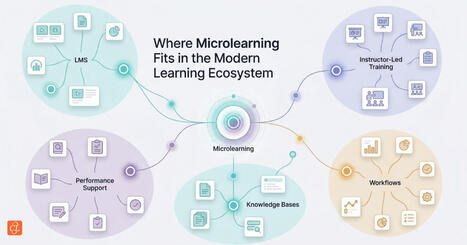
Discover how microlearning fits into blended learning, mobile learning, social learning, analytics, flow-of-work learning, and content conversion.
"Microlearning is often introduced as a format improvement, but its bigger value appears at the systems level."
|
|
Scooped by
EDTECH@UTRGV
July 2, 3:42 PM
|
Scoop.it!

Experts warn AI can clone voices from short clips as UK law struggles to protect people.
"The law comes close, but it doesn't fully protect your voice, your face or your identity"
|
|
Scooped by
EDTECH@UTRGV
July 2, 3:06 PM
|
Scoop.it!
"It’s 2026, a Tuesday morning. A user — let’s call her Maya — asks her AI agent: “Find me a sustainable sneaker brand that ships to Berlin within three days.”
Five years ago, Maya would have typed that into Google, clicked three links, skimmed two blogs, and maybe opened an incognito tab for price comparison.
Today? She doesn’t leave the chat window. Her AI agent instantly reads hundreds of sites, ranks them, and returns one clean answer."
"Your website just got ghosted by an AI agent and why accessibility is your new best friend."
|
|
Scooped by
EDTECH@UTRGV
July 1, 3:40 PM
|
Scoop.it!

Some tech leaders have a vision for a world where you spend a lot less time looking at your phone. Is it the solution to screen time, or just a new dystopia?
"For the past 60 years or so, screens have been the predominant way we have interacted with computers. Now it's possible they could fade further into the background."
|
|
Scooped by
EDTECH@UTRGV
July 1, 3:04 PM
|
Scoop.it!
"Every few weeks, another business leader recites the doomsday line: AI will replace all workers. Their confidence is proportional to the capex. A company that just committed tens of billions to data centers has strong incentives to sound sure, and the memo goes out accordingly. They boast about leaner teams and a future where most of the work runs itself. However, the reality looks different."
"AI is putting the future of UX designers in jeopardy, unless they are willing to become builders, makers, and system thinkers."
|
|
Scooped by
EDTECH@UTRGV
June 30, 3:35 PM
|
Scoop.it!
"Understanding the evolving nature of professional identity is a good lens through which to explore how faculty navigate their roles as academics. Both academic and teacher identities are shaped by various influences, including discipline-related socialization and personal experiences."
"In the evolving higher education landscape, a faculty member’s teaching presence is deeply connected to teacher identity."
|
|
Scooped by
EDTECH@UTRGV
June 30, 3:02 PM
|
Scoop.it!

Researchers say a lack of reliable information on artificial intelligence use on campus could lead to misguided policies.
"Students may be overestimating how many of their peers are using AI because it is such a visible part of campus life. They hear people talking about ChatGPT. They see AI tools open on laptop screens. That can start to feel like the norm."
|
|
Scooped by
EDTECH@UTRGV
June 29, 3:33 PM
|
Scoop.it!

Some students with disabilities rely on assistive technology to learn, and they worry it could be swept up in the movement to get screens out of schools.
"Much of the pivot away from screens in schools has come from parents who are concerned screen use is getting in the way of their children’s learning"
|
|
Scooped by
EDTECH@UTRGV
June 29, 2:59 PM
|
Scoop.it!

Why story-driven training sticks — and how to build it fast in SHIFT Meteora AI Studio or deliver it through the LMS you already use.
"[A]sk someone about a story that moved them, even one they heard years ago, and the details come back instantly: the character, the moment of tension, what they would have done differently."
|
|
Scooped by
EDTECH@UTRGV
June 26, 3:33 PM
|
Scoop.it!

AI voiceovers are reshaping corporate training. Discover how L&D leaders can use AI in eLearning effectively and ethically.
"For instructional text, which is typically clear, structured, and professional — the quality gap between AI and studio talent has narrowed considerably."
|
|
Scooped by
EDTECH@UTRGV
June 26, 2:58 PM
|
Scoop.it!

"or years, Learning and Development focused on a single goal: delivering knowledge. Courses were built, content was deployed, and completion rates were tracked. Yet one persistent challenge remained: learning did not reliably translate into on-the-job performance."
"AI coaching agents are emerging as a key part of the answer: moving development from scheduled events into continuous, real-time performance support."





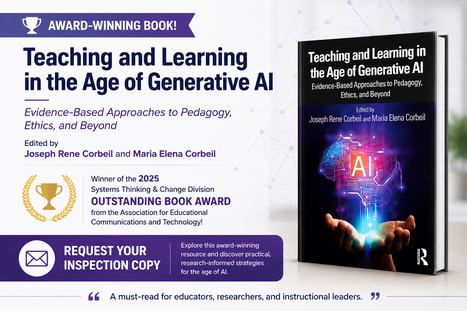




"A recent Sports Illustrated article described how some high school football players are using artificial intelligence to fabricate highlight plays in recruiting videos. Generative tools can now insert touchdowns, tackles, or explosive runs that never actually occurred, creating a misleading picture of an athlete’s performance."