
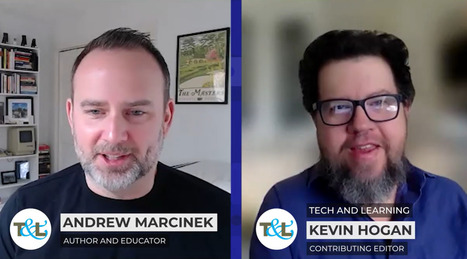
Conversations with Kevin Hogan: Author and educator Andrew Marcinek argues that the Meta lawsuit is the inevitable outcome of 20 years of algorithmic manipulation — and that schools have a narrow window to get AI right before history repeats itself.


|
Scooped by
EDTECH@UTRGV
onto Educational Technology News Today, 2:43 PM
|
 Scoop.it!
Conversations with Kevin Hogan: Author and educator Andrew Marcinek argues that the Meta lawsuit is the inevitable outcome of 20 years of algorithmic manipulation — and that schools have a narrow window to get AI right before history repeats itself.

 Your new post is loading...
 Your new post is loading...
Your new post is loading...
Scoop.it!
|
|
|
Scooped by
EDTECH@UTRGV
Today, 2:50 PM
|
Scoop.it!


As AI use becomes common in the workforce, institutions of higher education must train students to be fluent in the technology, so they can evolve with it.
"Competency means knowing how to operate the tools. Frankly, our students can gain competency quickly through a weekend workshop, YouTube videos or simple trial and error. Fluency, on the other hand, means understanding what the tools can and cannot do. It requires recognizing the assumptions baked into systems trained on imperfect data, asking who benefits and who bears the costs when AI is deployed in a hiring process, a courtroom or a healthcare setting."
|
|
Scooped by
EDTECH@UTRGV
Today, 2:45 PM
|
Scoop.it!

AI is already in the classroom--will we give it a place that makes sense for teaching and learning as the technology evolves?
"Teachers are responding in real time, trying to protect their classrooms, their expectations, and their students. But over time, that flexibility creates inconsistency. Students are left to figure out what is acceptable, what is not, and when the rules apply."
|
|
Scooped by
EDTECH@UTRGV
Today, 2:41 PM
|
Scoop.it!

How AI leadership and enterprise AI strategy are transforming the future of work, and how Stanford GSB Executive Education prepares leaders to adapt.
"Organizations should approach...as an ongoing capability that requires refinement. With technological changes, adaptability will matter more than technical knowledge of any single tool."
|
|
Scooped by
EDTECH@UTRGV
Today, 2:34 PM
|
Scoop.it!
"We have spent decades cataloguing the ways the human mind trips itself up. Confirmation bias. The Dunning-Kruger effect. Anchoring. The list currently stands at over 180 documented cognitive biases, each a small, predictable glitch in our otherwise remarkable thinking apparatus. Most were identified long before a large language model could hold a conversation, draft a legal brief, or talk someone through a difficult evening."
"What happens when technology starts reshaping the minds using it? Meet the new class of cognitive biases AI is creating."
|
|
Scooped by
EDTECH@UTRGV
Today, 2:30 PM
|
Scoop.it!
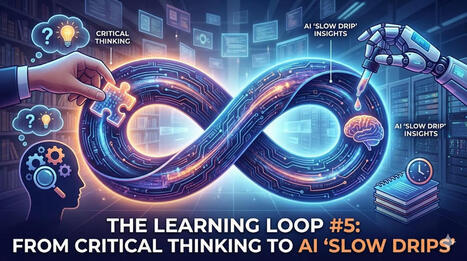
"As AI tools become ubiquitous, the “human” competitive advantage shifts to metacognition and critical inquiry. In this issue, we dive into why “thinking about our thinking” is the ultimate learning power-up and test whether AI can actually handle high-stakes academic writing. You will find frameworks for a “slow drip” of personal insights, a five-minute strategy for mastering new tools, and a refresher on the SIFT method to keep your digital literacy sharp."
"Instead of just checking if an answer is right, ask students: 'What specific strategy helped you reach this conclusion, and would you use it again?'”
|
|
Scooped by
EDTECH@UTRGV
May 4, 12:48 PM
|
Scoop.it!

"Artificial intelligence has rapidly shifted the instructional landscape. Tools that can generate explanations, draft essays, and summarize complex topics are now readily available to students. This accessibility has led some to question whether deep instructor content knowledge still holds the same importance. The answer is an unequivocal yes."
"Strong instruction in an AI-rich classroom depends on strong content knowledge"
|
|
Scooped by
EDTECH@UTRGV
May 4, 12:44 PM
|
Scoop.it!

"A pointed warning about the future of work and education took centre stage as the Mona School of Business and Management (MSBM), UWI, Mona brought together leaders from academia and industry to confront a pressing question: is the Caribbean truly ready for the age of artificial intelligence?"
"AI is going to change everything – how we work, how we learn, how we interact. It won’t replace human talent, but those who understand AI will have a clear advantage. Our responsibility is to ensure every graduate is AI fluent, regardless of discipline.”
|
|
Scooped by
EDTECH@UTRGV
May 4, 12:36 PM
|
Scoop.it!
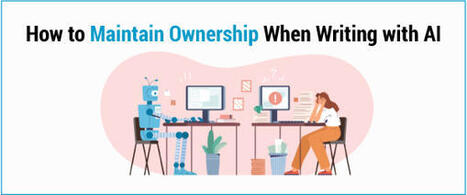
"We take the ability to write for granted. It is actually quite a complex non-linear activity driven by our goals and purpose. To understand this process and how AI can support it while you maintain ownership, it’s helpful to understand the cognitive activities of writing.
Several cognitive models explain the writing process, and the core of most models is based on Flower and Hayes’ cognitive activities of writing (1981). The model identifies the mental operations that underlie writing as distinct activities: planning, translation (text production), and reviewing."
|
|
Scooped by
EDTECH@UTRGV
May 4, 12:33 PM
|
Scoop.it!

"For years, progress in artificial intelligence has been defined by scale. Bigger models, more data, longer context windows. But a quieter shift is now underway, and it’s one that may prove even more transformative. Instead of building a single, ever-larger model, researchers are beginning to focus on how multiple AI systems can work together. This emerging paradigm is known as agent swarms. And it signals a move away from isolated intelligence toward collaborative intelligence, where coordination, communication, and adaptation matter just as much as raw capability."
"Agent swarms aren’t just multiple models running in parallel. The defining feature is interaction. Each agent operates with partial information, contributes to a shared goal, and adjusts its behavior based on others."
|
|
Scooped by
EDTECH@UTRGV
April 30, 12:58 PM
|
Scoop.it!

Google offers various AI-powered programs, training, and tools to help advance your skills. Develop AI skills and view available resources.
"Explore foundational concepts in artificial intelligence. Learn how AI works and how to effectively use it in your daily work."
|
|
Scooped by
EDTECH@UTRGV
April 30, 12:55 PM
|
Scoop.it!
"AI-powered technologies are increasingly being developed for educational purposes to contribute to students' academic performance and overall better learning outcomes. This exploratory review uses the PRISMA approach to describe how the effectiveness of AI-driven technologies is being measured, as well as the roles attributed to teachers, and the theoretical and practical contributions derived from the interventions."
"Findings from 48 articles highlighted that learning outcomes were more aligned with the optimization of AI systems, mostly nested in a computer science perspective, and did not consider teachers in an active role in the research. Most studies proved to be atheoretical and practical contributions were limited to enhancing the design of the AI system."
|
|
Scooped by
EDTECH@UTRGV
April 30, 12:49 PM
|
Scoop.it!
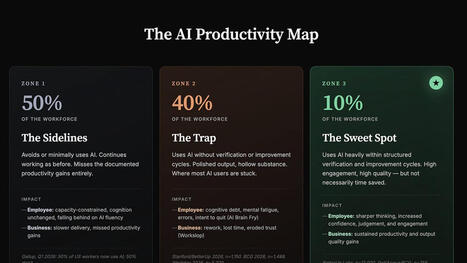
Why your AI tools aren't delivering the ROI you were promised — and what to do about it
"[I]n some organisations, AI is driving unprecedented increases in productivity and with it employee growth and satisfaction. In others, AI is cited as the primary cause of reduced productivity and with it growing employee 'brain drain', frustration and attrition."
|
|
Scooped by
EDTECH@UTRGV
Today, 2:53 PM
|
Scoop.it!
"Human-in-the-loop (HITL) has emerged as the default answer to concerns about AI trust, safety and governance. The logic is that when AI systems make decisions that affect people, a human should be involved."
"In safety-critical environments, insisting that humans be in every real-time loop does not make systems safer. Designing for reliability does."
|
|
Scooped by
EDTECH@UTRGV
Today, 2:47 PM
|
Scoop.it!

AI replaces information overload with tunnel vision, creating faster decisions but hidden risks. Organizations must build AI literacy.
"AI doesn't just filter information. It narrows it. Like blinders on a horse, it blocks out the periphery and presents a single, coherent path forward."
|
|
Scooped by
EDTECH@UTRGV
Today, 2:43 PM
|
Scoop.it!
Conversations with Kevin Hogan: Author and educator Andrew Marcinek argues that the Meta lawsuit is the inevitable outcome of 20 years of algorithmic manipulation — and that schools have a narrow window to get AI right before history repeats itself.
"Schools that treat AI primarily as a cheating threat, Marcinek contends, are asking the wrong question — and risking the same institutional failure that defined the social media era."
|
|
Scooped by
EDTECH@UTRGV
Today, 2:37 PM
|
Scoop.it!
"When students and educators think of asynchronous courses, they envision something akin to a correspondence course, lacking an available professor with disengaged students struggling to understand assignments in isolation, all within a disconnected learning environment. This type of course structure has the potential to leave students with high levels of stress and anxiety, feelings of apathy, and an overabundance of reading materials, without the requisite expertise to guide them through the learning process. However, in a high-functioning, engaging, and rigorous asynchronous learning environment, the instructor’s presence and engagement with students is not only prevalent, but they can create a learning experience which students enjoy and want replicated."
"In a well-designed, dynamic asynchronous learning environment, the instructor's presence and interaction with students are not only evident but also contribute to a learning experience that students enjoy and wish to replicate"
|
|
Scooped by
EDTECH@UTRGV
Today, 2:33 PM
|
Scoop.it!

So excited to generate these with AI in response...they were a great test of ChatGPT: All of this was made in response to a need from members so they could share the good word.
TCEA is an amazing professional organization for technology educators and EdTech professionals in general.
|
|
Scooped by
EDTECH@UTRGV
May 4, 12:50 PM
|
Scoop.it!

Whether students vote with a ballot or with their feet, the outcome of the vote sometimes has unintended consequences. Voting offers limited information, and that’s true whether voting with your ballot or with your feet. When you chose Smith over Jones, was it because of a policy position, a party identity, personal familiarity, or because you liked their name better? And if it was based on a policy position—most votes aren’t, at least directly—did you understand the nuances behind the policy?
"Conflicting desires play out beyond electoral politics. I’m seeing it in the push-pull of students wanting a more robust on-campus college experience while simultaneously crowding into online classes. The desire for a robust on-campus experience conflicts with the desire for a convenient schedule."
|
|
Scooped by
EDTECH@UTRGV
May 4, 12:47 PM
|
Scoop.it!
"Artificial intelligence is rapidly progressing and poised to reshape the workforce in the near future. The higher education sector is in a unique position, as both an employer of millions of workers and a system that prepares students for the labor force.
At the annual ASU+GSV Summit last week, four college leaders talked to Higher Ed Dive to weigh in on two questions: What about AI’s use in higher education are you most excited for? And what has you most concerned?"
"[P]eople have to be thoughtful about deploying AI. Think of it as an amplifier. The largest amplification capacity for any human being is an AI agent."
|
|
Scooped by
EDTECH@UTRGV
May 4, 12:41 PM
|
Scoop.it!
"With critical thinking skills on the line I built a real-time AI collaborator, Thia — with vision and voice capabilities to keep early ideas raw, the loop tight, and the thinking mine."
"AI is making light work of building, but there are some spaces in the design process where I believe deep thinking is sacred, where I didn’t want AI to encroach upon."
|
|
Scooped by
EDTECH@UTRGV
May 4, 12:35 PM
|
Scoop.it!

"What will today’s leaders wish they’d learned about AI five years earlier? The answer: that AI is no longer a fringe IT project but a core strategic imperative, and that many basic lessons about data, talent, and governance need to be front-and-center. AI adoption has already accelerated faster than many executives expected, creating a “regret gap” between early movers and late adopters. In fact, 88% of companies report regular AI use, yet many still struggle to integrate it into daily operations."
"Five years from now, successful leaders will look back wishing they had treated AI as a business priority sooner – not as a passing tech fad."
|
|
Scooped by
EDTECH@UTRGV
April 30, 12:59 PM
|
Scoop.it!

Researchers looked at more than 150,000 prompts from more than 4,400 K-12 teachers interacting with AI. Here's what they found.
"Teachers, the research suggests, are generally using the tool to help them build curriculum content and as a sounding board, all with an eye toward better helping students."
|
|
Scooped by
EDTECH@UTRGV
April 30, 12:57 PM
|
Scoop.it!

Experts say going back to school for a graduate degree is one way to hedge against a rapidly changing labor market.
"Typically, enrollment in graduate school increases during recessions as workers seek to advance or to move to another industry with better career prospects or pay. Today, more people in a survey said they plan to go back to school within a year, even though the economy is doing well."
|
|
Scooped by
EDTECH@UTRGV
April 30, 12:52 PM
|
Scoop.it!
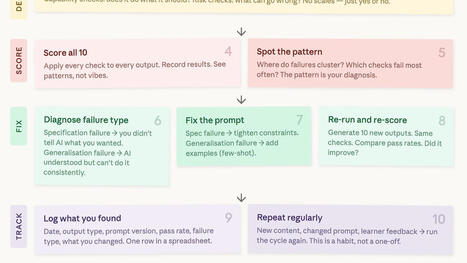
"If (like ~90% of us) you’re using AI to generate learning content — quiz questions, scenarios, feedback, objectives, anything — you’ve already stopped being a creator in the traditional sense. You’re not the person writing the quiz question anymore: you’re the person deciding whether the quiz question is good enough to put in front of a learner.
That’s not a small change: it’s a fundamental redefinition of what it means to be an L&D professional."
"The emerging consensus is that the bottleneck isn’t AI capability — it’s AI quality assurance. And this problem is heading straight for L&D."
|
|
Scooped by
EDTECH@UTRGV
April 29, 1:01 PM
|
Scoop.it!

"Driven by a bottom-up partnership between the Faculty Center for Teaching and Learning and the Division of Digital Learning, the University of Central Florida established an evolving campus infrastructure of policies, training, and a national conference to guide the ethical and effective integration of generative artificial intelligence into teaching and learning."
"The bottom-up approach used by the DDL and FCTL to kick-start the development of resources and programming on AI use in teaching and learning has evolved into a strong foundation of faculty support for this rapidly advancing technology."








"Schools that treat AI primarily as a cheating threat, Marcinek contends, are asking the wrong question — and risking the same institutional failure that defined the social media era."