 Your new post is loading...

|
Scooped by
EDTECH@UTRGV
February 11, 5:29 PM
|
Looking for a Textbook on Generative AI in Education?
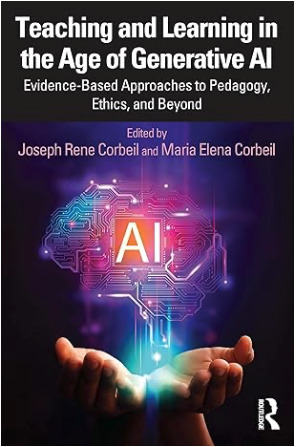
Teaching and Learning in the Age of Generative AI: Evidence-Based Approaches to Pedagogy, Ethics, and Beyond Edited by Joseph Rene Corbeil & Maria Elena Corbeil (2025) 🏆 Winner of the 2025 Systems Thinking & Change Division Outstanding Book Award from the Association for Educational Communications and Technology! If you are designing a course that addresses generative AI in education, this award-winning volume provides a research-driven, classroom-ready foundation. Rather than offering hype or fear, this book helps educators:
- Ground AI integration in learning theory and research
- Address academic integrity with thoughtful, practical strategies
- Redesign assessment for an AI-enabled world
- Explore ethics, bias, privacy, and institutional responsibility
- Leverage AI to enhance critical thinking and digital literacy
Bookended by historical and forward-looking analyses of AI in education, the chapters move beyond surface-level discussions to provide evidence-based approaches for real classrooms—K–12, higher education, and professional learning environments.
This text is ideal for:
- Undergraduate and graduate teacher education programs
- Curriculum & Instruction courses
- Educational Technology programs
- Higher education faculty development
- School technology coordinators and talent development professionals
Adopting a GenAI textbook for an upcoming semester? We invite you to request an inspection copy and explore how this resource can support your students in navigating AI with skill, ethics, and informed judgment.
Request your inspection copy today.
|
|
Scooped by
EDTECH@UTRGV
April 1, 1:59 PM
|
"AI agents are starting to look less like chatbots and more like services. They can coordinate tasks, call tools and make changes in production systems without a human reviewing every step. For large enterprises, that autonomy is both an opportunity and a risk. The question is no longer whether an AI system can generate a good answer. It is whether you can govern what the system does."
|
|
Scooped by
EDTECH@UTRGV
April 1, 1:55 PM
|
In a new series, we will test the limits of the latest AI technology by pitting it against human experts.
|
|
Scooped by
EDTECH@UTRGV
April 1, 1:46 PM
|
In his book and Senate testimony, a neuroscientist offers a three-pronged case against screens and edtech in schools.
|
|
Scooped by
EDTECH@UTRGV
April 1, 1:40 PM
|
What are you doing to ensure that the degree and certificate candidates at your institution are prepared to thrive in the new environment that is emerging in this year and next? Technologists, economists and visionaries are warning us that in the next three to 18 months, we are going to experience rapid and pervasive disruption of our professional lives, workplace models and distribution of income. Professional positions requiring college degrees will be lost, remade into highly productive, cost-efficient, hybrid human-AI models where human contributions and compensation will collectively shrink and evaporate.
|
|
Scooped by
EDTECH@UTRGV
March 31, 1:35 PM
|
"[T]he emergence of AI has produced a bonfire of hot takes about what it all means for education. Three and a half years on from the November 2022 unveiling of ChatGPT, let’s try to sort through a handful of them."
|
|
Scooped by
EDTECH@UTRGV
March 31, 1:30 PM
|
The new AI agent aims to save faculty time on “low-value tasks,” but stops short of fully automating grading. But some experts worry that the rise of agentic AI could lead to a dead classroom, where computers teach other computers. Weeks after an outside agentic artificial intelligence tool called Einstein caused an uproar over its ability to complete entire courses in the learning management system Canvas, Canvas has unveiled an agentic AI tool of its own. But instead of helping students cheat—or automating instruction—its creators say it’s designed to enhance teaching and learning.
|
|
Scooped by
EDTECH@UTRGV
March 31, 1:18 PM
|
Delve into what beginners actually want to know about Artificial Intelligence and how to design an AI course that works for them.
|
|
Scooped by
EDTECH@UTRGV
March 31, 1:13 PM
|
Canvas will introduce its first AI agent directly into the LMS later this year, arriving in a chaotic landscape where few institutions have considered how agentic AI will impact faculty teaching and student learning.
|
|
Scooped by
EDTECH@UTRGV
March 30, 1:56 PM
|
Edtech innovation can come from teachers who remove learning guardrails and show students the joy and excitement in trying something new.
|
|
Scooped by
EDTECH@UTRGV
March 30, 1:53 PM
|
One New York City education leader has seen an uptick in AI use across emails, grant applications, newsletters, and education-related projects, but just like in the classroom, there are appropriate and inappropriate times to use AI.
|
|
Scooped by
EDTECH@UTRGV
March 30, 1:47 PM
|
Learn about the results of a survey by the Digital Education Council in collaboration with Tec de Monterrey's IFE about AI in education.
|
|
Scooped by
EDTECH@UTRGV
March 30, 1:44 PM
|
"Today’s leadership mandate requires more than long-term strategy. In a recent interview with McKinsey’s Eric Kutcher, IBM CEO Arvind Krishna had advice for fellow leaders: “You’ve got to be willing to ‘do’: As opposed to getting disrupted by somebody else, disrupt yourself while you still have the cash flow and clients who value your capabilities.”
|
|
|
Scooped by
EDTECH@UTRGV
April 1, 2:03 PM
|
"The rise of generative AI in higher education is reshaping how feedback is delivered, but meaningful learning could be undermined if its use is not carefully guided by principles of care, trust and connection, according to new research led by the University of Surrey. Published in Assessment & Evaluation in Higher Education, the paper explores how generative AI technologies, including chatbots such as ChatGPT, are transforming feedback for students—highlighting both the opportunities and risks of AI in education."
|
|
Scooped by
EDTECH@UTRGV
April 1, 1:58 PM
|
"Artificial intelligence (AI) is quickly moving beyond chatbots and copilots. A new generation of AI agents is beginning to perform real actions. These agents can access APIs, move money, retrieve data, write code, interact with customers and even coordinate other agents. That shift raises a simple but critical question: Who is watching what the agent actually does?"
|
|
Scooped by
EDTECH@UTRGV
April 1, 1:54 PM
|
Explore the concept of a learning mindset and its importance for organizations in today's fast-paced, AI-driven world.
|
|
Scooped by
EDTECH@UTRGV
April 1, 1:43 PM
|
Conversations with Kevin Hogan—Pineville ISD technology coordinator Kenzo Vanhaesebroeck explains why vague-on-purpose policy, a grading scale for AI use, and teacher-to-teacher modeling are the best defenses a small district has against an overnight technological revolution
|
|
Scooped by
EDTECH@UTRGV
April 1, 1:37 PM
|
"AI didn’t teach designers to code. It gave them back the decisions that were always theirs."
|
|
Scooped by
EDTECH@UTRGV
March 31, 1:32 PM
|
AI has arrived as a powerful, pervasive reality, bringing with it a whirlwind of innovation, new tools, and pressing questions. Here are five practical steps to help your institution navigate this rapidly evolving landscape and accelerate its path to real transformation.
|
|
Scooped by
EDTECH@UTRGV
March 31, 1:20 PM
|
"Over the past several years, schools have been urged to respond to the rapid emergence of generative AI tools such as ChatGPT with limited information and a lot of hype and horror stories. Some have framed the technology as potentially transformative for teaching and learning, while others claim the opposite. Yet in many classrooms, adoption has been slower and more selective than the surrounding hype might suggest."
|
|
Scooped by
EDTECH@UTRGV
March 31, 1:14 PM
|
Relying entirely on a vendor’s AI means adopting their hidden assumptions, which is why teams should build their own intelligence layers.
|
|
Scooped by
EDTECH@UTRGV
March 30, 1:58 PM
|
"A little over a decade ago, schools were swept into what many described as a movement to prepare students for the future of work. That work was coding — “Hello, world!” Districts introduced new courses, nonprofits expanded access to computer science education and a growing ecosystem of programs promised to teach students the skills needed to enter the tech workforce. For many, it felt like a necessary correction to a rapidly digitizing world. But over time, a more complicated picture emerged."
|
|
Scooped by
EDTECH@UTRGV
March 30, 1:55 PM
|
Colleges’ rush toward artificial intelligence is outpacing oversight, policy, and academic safeguards--that's the danger of AI.
|
|
Scooped by
EDTECH@UTRGV
March 30, 1:51 PM
|
"Artificial intelligence has moved decisively from research corridors into the core of undergraduate education across the United States, forcing universities to redraw academic priorities with unusual speed."
|
|
Scooped by
EDTECH@UTRGV
March 30, 1:45 PM
|
University of Phoenix College of Doctoral Studies scholars Patricia Akojie, Ph.D., Marlene Blake, Ph.D., and Louise Underdahl, Ph.D. have published new research exploring how generative artificial intelligence tools (GenAI) are being used in academic environments. Their article, “Academic Applications of Generative Artificial Intelligence Tools: A Scoping Review,” appears in the peer-reviewed International Journal of Digital Society.
|
|
Scooped by
EDTECH@UTRGV
March 30, 1:40 PM
|
"The importance of fostering a sense of connection in higher education, particularly in virtual environments, is well-documented in educational research [1]. Meaningful connections—with peers, instructors, and within this context, course material—are central to student engagement and success, particularly in online learning contexts, where physical presence and face-to-face interaction are absent. Scholars have noted that the absence of these traditional forms of engagement necessitates intentional instructional strategies to support students' sense of belonging and active participation in the learning process [2]."
|


























"For designers who’ve spent years watching their craft get approximated on the other side of a handoff, that’s a meaningful change. The gate was never locked. We just needed tools that made it obvious."