
Learn about the results of a survey by the Digital Education Council in collaboration with Tec de Monterrey's IFE about AI in education.
Get Started for FREE
Sign up with Facebook Sign up with X
I don't have a Facebook or a X account


|
Scooped by
EDTECH@UTRGV
onto Educational Technology News March 30, 1:47 PM
|
 Scoop.it!
Learn about the results of a survey by the Digital Education Council in collaboration with Tec de Monterrey's IFE about AI in education.

 Your new post is loading...
 Your new post is loading...
Your new post is loading...
Scoop.it!
|
|
|
Scooped by
EDTECH@UTRGV
March 30, 1:56 PM
|
Scoop.it!

Edtech innovation can come from teachers who remove learning guardrails and show students the joy and excitement in trying something new.
"[I]n districts’ rush to innovate, we often allow technology and convenience to replace the curiosity and joy in learning."
|
|
Scooped by
EDTECH@UTRGV
March 30, 1:53 PM
|
Scoop.it!

One New York City education leader has seen an uptick in AI use across emails, grant applications, newsletters, and education-related projects, but just like in the classroom, there are appropriate and inappropriate times to use AI.
"In the AI era, it has become a cliché that AI shouldn’t be used to outsource thinking, but...some educators may need a reminder of that."
|
|
Scooped by
EDTECH@UTRGV
March 30, 1:47 PM
|
Scoop.it!
Learn about the results of a survey by the Digital Education Council in collaboration with Tec de Monterrey's IFE about AI in education.
"[T]eaching practice is evolving in the age of AI: 48% of teachers believe that task redesign is necessary to ensure their effectiveness and preserve learning outcomes."
|
|
Scooped by
EDTECH@UTRGV
March 30, 1:44 PM
|
Scoop.it!
"Today’s leadership mandate requires more than long-term strategy. In a recent interview with McKinsey’s Eric Kutcher, IBM CEO Arvind Krishna had advice for fellow leaders: “You’ve got to be willing to ‘do’: As opposed to getting disrupted by somebody else, disrupt yourself while you still have the cash flow and clients who value your capabilities.”
"[T]he goal of AI transformation isn’t automation layered onto old workflows—but redesign from the ground up."
|
|
Scooped by
EDTECH@UTRGV
March 30, 1:38 PM
|
Scoop.it!
"Focusing on polish and production speed over pedagogy creates a fundamental problem across the industry: Most e-learning authoring tools emphasize digital interactions and visual templates, while providing minimal guidance on pedagogical principles [1]. As a result, users can inadvertently equate an engaging interactive brochure with an effective learning product."
"[T]he current way in which the industry is integrating generative AI into e-learning authoring tools represents a missed opportunity. Current AI implementations focus almost exclusively on course content generation: quizzes and images from text, text-to-speech voice generation, language translations, and accessibility features. Nearly all tools emphasize speed rather than pedagogical soundness."
|
|
Scooped by
EDTECH@UTRGV
March 27, 11:24 AM
|
Scoop.it!


Attending the UTRGV Grad Fair? Learn what questions to ask program representatives so you can better understand program expectations, student support, and career outcomes before applying to graduate school.
Ready to grow your career? A master’s degree in Educational Technology can open doors far beyond the traditional classroom.
|
|
Scooped by
EDTECH@UTRGV
March 27, 10:59 AM
|
Scoop.it!

Despite the widespread enthusiasm for OpenClaw's AI agents, the tech comes with some enormous and hard-to-overlook security concerns.
"According to a recent investigation by cybersecurity firm Gen Threat Labs, more than 18,000 OpenClaw instances are already exposed to internet attacks, and almost 15 percent of them contain malicious instructions."
|
|
Scooped by
EDTECH@UTRGV
March 27, 10:52 AM
|
Scoop.it!

Learn practical strategies to increase student engagement in online courses, including interactive techniques for teaching quantitative methods and coding.
"‘Social Presence’ is focused on how an instructor engages with participants in their learning environment. A key tenet of this element is ensuring that participants can bring their real selves to the conversations and interactions that happen in the learning environment."
|
|
Scooped by
EDTECH@UTRGV
March 27, 10:43 AM
|
Scoop.it!

Google DeepMind proposes a cognitive framework to evaluate AGI and launches a Kaggle hackathon to build capability benchmarks
"[A] new paper, “Measuring Progress Toward AGI: A Cognitive Taxonomy,”...presents a scientific foundation for understanding the cognitive capabilities of AI systems."
|
|
Scooped by
EDTECH@UTRGV
March 26, 12:01 PM
|
Scoop.it!

Can AI truly reason? Discover how the CareerNet initiative uses expert labels to improve autonomous decision-making and bridge the gap in machine logic.
"Although agentic AI mimics aspects of human decision-making, the type of reasoning used by these systems differs from how reasoning is typically defined in psychology."
|
|
Scooped by
EDTECH@UTRGV
March 26, 11:48 AM
|
Scoop.it!

"The screen-time debate is no longer confined to parenting advice. As states introduce legislation limiting devices in schools, and pediatric researchersrethink how digital environments affect development, educators are confronting a difficult question: when does technology support learning, and when does it undermine it?"
"In education, conversations about technology traditionally have focused on the digital divide and ensuring equitable access to devices and internet connectivity. That conversation is shifting."
|
|
Scooped by
EDTECH@UTRGV
March 26, 11:42 AM
|
Scoop.it!

Students are clearly embracing AI as a learning tool, but they’re also conflicted about what it means for their own learning.
"Students most often reported using AI to get better explanations of assignments (38 percent), brainstorm ideas (35 percent), look up facts (33 percent) and draft or revise writing (33 percent). The survey found that older students were more likely than younger students to use AI for these purposes, with the exception of fact-checking."
|
|
Scooped by
EDTECH@UTRGV
March 30, 1:58 PM
|
Scoop.it!

"A little over a decade ago, schools were swept into what many described as a movement to prepare students for the future of work. That work was coding — “Hello, world!”
Districts introduced new courses, nonprofits expanded access to computer science education and a growing ecosystem of programs promised to teach students the skills needed to enter the tech workforce. For many, it felt like a necessary correction to a rapidly digitizing world. But over time, a more complicated picture emerged."
"The “learn to code” movement raised an important question that still lingers today: Which skills actually endure when technologies change?"
|
|
Scooped by
EDTECH@UTRGV
March 30, 1:55 PM
|
Scoop.it!

Colleges’ rush toward artificial intelligence is outpacing oversight, policy, and academic safeguards--that's the danger of AI.
"[T]he current higher education story is not simply about innovation. It is about whether institutions will allow the logic of platform adoption to outrun the educational values they claim to defend."
|
|
Scooped by
EDTECH@UTRGV
March 30, 1:51 PM
|
Scoop.it!

"Artificial intelligence has moved decisively from research corridors into the core of undergraduate education across the United States, forcing universities to redraw academic priorities with unusual speed."
"The growing popularity of AI degrees is not just about the emergence of a new subject. It actually signifies a change of the very basics of higher education."
|
|
Scooped by
EDTECH@UTRGV
March 30, 1:45 PM
|
Scoop.it!

University of Phoenix College of Doctoral Studies scholars Patricia Akojie, Ph.D., Marlene Blake, Ph.D., and Louise Underdahl, Ph.D. have published new research exploring how generative artificial intelligence tools (GenAI) are being used in academic environments. Their article, “Academic Applications of Generative Artificial Intelligence Tools: A Scoping Review,” appears in the peer-reviewed International Journal of Digital Society.
"Institutions may need clearer policies and guidance to support responsible AI adoption in research and teaching."
|
|
Scooped by
EDTECH@UTRGV
March 30, 1:40 PM
|
Scoop.it!
"The importance of fostering a sense of connection in higher education, particularly in virtual environments, is well-documented in educational research [1]. Meaningful connections—with peers, instructors, and within this context, course material—are central to student engagement and success, particularly in online learning contexts, where physical presence and face-to-face interaction are absent. Scholars have noted that the absence of these traditional forms of engagement necessitates intentional instructional strategies to support students' sense of belonging and active participation in the learning process [2]."
"By fostering intentional interaction and engagement, scaffolding empowers educators to address the diverse needs of online learners and create pathways for achieving academic and personal goals."
|
|
Scooped by
EDTECH@UTRGV
March 30, 1:35 PM
|
Scoop.it!

"Florida’s public university leaders are consulting in-house and private-sector artificial intelligence experts to help formulate the state system’s approach to the technology...
The state is compiling a report about recommended AI use across the system in the “near-term,” governor Ed Haddock said. Haddock chairs the newly formed Task Force on Artificial Intelligence and Cybersecurity."
“Suddenly, AI seems to be everywhere in our lives and in our work. Our job is to prepare students for this reality, even as it evolves,”
|
|
Scooped by
EDTECH@UTRGV
March 27, 11:02 AM
|
Scoop.it!

Students are consulting artificial intelligence tools for their college searches, finding it useful for tracking down programs they might be interested in, flagging schools they hadn’t thought of and tracking deadlines.
"Students take AI suggestions seriously. About a third said they discovered a school they hadn’t considered previously, and 18 percent said they removed a school from consideration due to AI results."
|
|
Scooped by
EDTECH@UTRGV
March 27, 10:54 AM
|
Scoop.it!

Researchers at Tufts University have released the "first-of-its-kind data-driven framework," dubbed the American AI Jobs Risk Index.
"As fears over an AI-driven jobs apocalypse continue to grow, researchers are trying to get a better sense of which occupations will be most — and least — affected."
|
|
Scooped by
EDTECH@UTRGV
March 27, 10:45 AM
|
Scoop.it!

Learn how Google's NAI framework uses AI to make technology more adaptive, inclusive and helpful for everyone.
"Disability communities are using the Natively Adaptive Interfaces (NAI) framework to build AI that adapts to everyone, with support from Google.org."
|
|
Scooped by
EDTECH@UTRGV
March 27, 10:41 AM
|
Scoop.it!
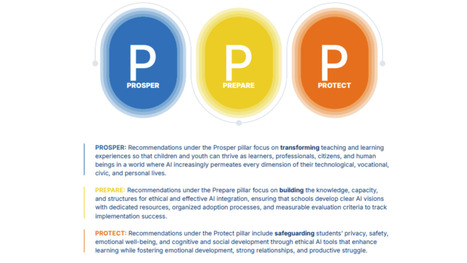
"Earlier this year, we released the Brookings Global Taskforce on AI and Education report, A New Direction for Students in an AI World: Prosper, Prepare, Protect. Our key finding was striking: while AI offers clear benefits—expanded access, time savings, personalization, and new forms of assessment—its potential risks to cognitive and socioemotional development, trust, safety, dependence, and equity currently overshadow these benefits."
"Ensuring student safety in an AI-driven world requires strong policy and accountability."
|
|
Scooped by
EDTECH@UTRGV
March 26, 11:52 AM
|
Scoop.it!

A study of more than 70 AI models, such as ChatGPT, shows that answers are similar even when prompted to be creative or brainstorm.
"Outwitting the AI hive mind requires some post-modern creativity."
|
|
Scooped by
EDTECH@UTRGV
March 26, 11:44 AM
|
Scoop.it!

The goal of AI in higher education should be clear: Use technology to reinforce the learning moment, not replace it.
"[T]he goal of academic AI should be clear: Use technology to reinforce the learning moment, not replace it."
|
|
Scooped by
EDTECH@UTRGV
March 26, 11:37 AM
|
Scoop.it!

Two years into his English literature degree at the University of Pittsburgh, sophomore Luke Johnson has noticed something in his liberal arts courses: Students in his classes have gone quiet.
“We’ve had this assumption that learning can happen in these very autonomous, individualistic ways,...But maybe that’s not how learning happens, maybe learning happens in the community?”







"[T]eaching practice is evolving in the age of AI: 48% of teachers believe that task redesign is necessary to ensure their effectiveness and preserve learning outcomes."