
New regulations around screen time and AI could push edtech companies towards better outcomes—if they can demonstrate real educational value
Get Started for FREE
Sign up with Facebook Sign up with X
I don't have a Facebook or a X account


|
Scooped by
EDTECH@UTRGV
onto Educational Technology News February 10, 10:54 AM
|
 Scoop.it!
New regulations around screen time and AI could push edtech companies towards better outcomes—if they can demonstrate real educational value

 Your new post is loading...
 Your new post is loading...
Your new post is loading...
Scoop.it!
Watch this video to learn more about the fully online, accelerated, project-based Master of Education in Educational Technology at the University of Texas Rio Grande Valley. For more information, visit: https://www.utrgv.edu/edtech/index.htm
EDTECH@UTRGV's insight:
This 30-hour accelerated program designed to prepare persons in K-12, higher education, corporate, and military settings to develop the skills and knowledge necessary for the classrooms and boardrooms of tomorrow. Students in this program have the opportunity to earn one or more graduate certificates in E-Learning, Technology Leadership, and Online Instructional Design.

Katlego Mofokeng's curator insight,
May 19, 2025 3:46 PM
Using technology in education proves affective in helping students/ learners accelerate their learning progress.

Elena Galeote's comment,
December 29, 2025 6:51 AM
Desde mi punto de vista, el Master of Education in Education Technology responde de manera acertada a las necesidades actuales del ámbito educativo, donde la integración pedagógica de la tecnología es cada vez más importante. El enfoque basado en proyectos potencia un aprendizaje significativo, ya que permite a los maestros diseñar y aplicar recursos digitales directamente en sus contextos escolares. Además, el formato online y acelerado facilita la actualización profesional continua, lo que considero clave para mejorar la práctica docente y promover una educación más creativa y eficaz.
Scoop.it!

New book argues it’s not the tools we use but the values we hold that make the difference in education
EDTECH@UTRGV's insight:
Key takeaway from the book: "Education is not a matter of tools; it is a matter of values."
Scoop.it!
From
medium

"Lately I’ve spent a lot of time thinking about how AI is affecting my high school English students. For now, at least, I seemed to have developed a system to keep most AI usage at bay. Last week I finished reading and scoring 100 junior essays analyzing Arthur Miller’s The Crucible. Of the 100, I identified only three papers that were AI-written. Is it possible that there were more and I just missed them?"
EDTECH@UTRGV's insight:
"Layering in multiple strategies reduces student dependency on AI"
Scoop.it!

How this year’s BETT UK suggested a cultural shift toward accountability and impact-focused governance in EdTech
EDTECH@UTRGV's insight:
"EdTech 1.0 largely sidestepped issues like data integrity, participant protection, or conflict-of-interest management. EdTech 2.0 requires understanding how tools actually function in real contexts, and supplementing experimental and quasi-experimental studies with deep qualitative research in classrooms and homes."
Scoop.it!

As more legislation sweeps the nation limiting children’s phone usage in schools, a new report shows not all laws are created equal.
EDTECH@UTRGV's insight:
"Only two states in the nation received “A” marks, with most states lacking explicit rules"
Scoop.it!

Gain practical HyFlex teaching strategies that support in-person and remote students through accessible course design, active learning, and inclusive practices.
EDTECH@UTRGV's insight:
"HyFlex may never be seamless, but small, consistent choices made it far more equitable and rewarding. Designing with accessibility in mind benefited every student, not just those with specific needs."
Scoop.it!

Between coursework, jobs, family responsibilities, and extracurriculars, many students struggle to keep up with the required reading and course-related review and studying. New artificial intelligence tools are beginning to ease that challenge.
EDTECH@UTRGV's insight:
"One bot, known as the 'syllabot,' reduces the time faculty spend answering common syllabus-related questions about course policies, grading, and course expectations."
Scoop.it!
From
uxdesign
"AI assistants don’t have to communicate in paragraphs. They can communicate through interfaces."
EDTECH@UTRGV's insight:
"AI assistants and agents are only going to keep increasing. The question isn’t whether your product will have one, it’s whether the experience will be differentiated or commoditized."
Scoop.it!

An assessment flowchart can help guide educators through the delicate balance of whether or not to allow GenAI in their assignment design. Here’s how it works
EDTECH@UTRGV's insight:
"[T]he AI Assessment Flowchart: a practical, self-evaluation tool that helps educators evaluate the validity of their individual assignments. Rather than prescribing a single 'correct' method, the flowchart guides educators through a series of reflective questions and decision points, helping them consider different aspects of their individual assignment design."
Scoop.it!

Explore how frontier AI—reasoning models, agentic systems, and multimodal tools—can support deeper learning and instruction for schools.
EDTECH@UTRGV's insight:
"Increased autonomy also introduces new risks. Each additional decision point creates opportunities for error: choosing the wrong tool, misinterpreting an instruction, or failing to complete a chain of actions. These failures can undermine trust or misalign support with learning goals."
Scoop.it!

Under-resourced schools are less likely to support teachers in implementing AI technology to best serve learning.
EDTECH@UTRGV's insight:
"How teachers end up using, or not using, AI to support their teaching – and their students’ learning – may be the most crucial determinant of whether AI’s use in schools narrows or widens existing equity gaps."
Scoop.it!
From
uxdesign
"Throughout my career in software testing, I’ve noticed dilemmas that affect the overall team’s dynamics and product outcomes. Believe it or not, these are the patterns that are quite common for every development team I worked with. These very patterns easily block the team’s goal, e.g. to develop an amazing cutting-edge product that could help humanity... As a result, this amazing product exists only in the requirements or in the dreams of the product owner. The team builds something else instead."
EDTECH@UTRGV's insight:
"Before a team starts building a quality assurance system for a product, it is smart to brainstorm on how quality assurance should function. It is important to define how the quality will be measured"
Scoop.it!

When a thirteen-year-old boy swims four kilometres through open ocean to save his family, it raises an educational question: what exactly do our assessments believe they are measuring?
EDTECH@UTRGV's insight:
"Education faces a choice. Systems can continue to equate task compliance with capacity in the world, or they can be redesigned around a richer understanding of human development."
|
Scoop.it!

A position-based approach notes that what we learn and how we learn it vary by role, experience level, environment, and context.
EDTECH@UTRGV's insight:
"By mapping learning to those workflows, we are able to create microlearning that is intuitive and of immediate value."
Scoop.it!

As of December 2025, there are over 66 million articles across all languages on Wikipedia. Around 7 million articles are in English.
EDTECH@UTRGV's insight:
"Wikipedia is one of the top sources mentioned in Google search results and is used to train large language models that power many artificial intelligence technologies."
Scoop.it!
New regulations around screen time and AI could push edtech companies towards better outcomes—if they can demonstrate real educational value
EDTECH@UTRGV's insight:
"[I]f edtech is lumped in with all social media, AI, and consumer tech, we are in for a bumpy ride in 2026"
Scoop.it!

How will AI change learning and instruction? How can we best prepare students for the AI World?
EDTECH@UTRGV's insight:
Jensen Huang: "'reading a room well is arguably more important than an SAT score.' That’s not a soft-skills platitude from a motivational speaker. That’s the CEO of the most valuable company on Earth telling us that the entire measurement infrastructure of American education may be optimizing for the wrong thing."
Scoop.it!

When educators design learning intentionally, AI becomes another tool students learn to use
EDTECH@UTRGV's insight:
"Responsible use of AI in schools does not begin with tools. It begins with clarity."
Scoop.it!

"Assessment is fast becoming a central focus in the higher education debate as we move into an era of generative AI, but too often institutions are responding through compliance and risk-management actions rather than fundamental pedagogical reform. Tightened regulations, expanded scrutiny and mechanistic controls may reassure quality assurance systems, but they run the risk of diluting genuine transformation and placing unsustainable pressure on staff and students alike."
EDTECH@UTRGV's insight:
"If reform is driven through compliance, we will miss opportunities to align assessments with the learning needs of a graduate entering the gen-AI era."
Scoop.it!

"Artificial intelligence (AI) is no longer just a buzzword in the world of technology; it’s rapidly becoming a core part of how American universities and schools educate, support, and prepare students for the future. In early 2026, three major developments in the U.S. education landscape have highlighted a growing trend: institutions are moving swiftly to define, regulate, and expand the role of AI in both higher education and K-12 classrooms."
EDTECH@UTRGV's insight:
"While universities are racing to expand and refine their AI offerings, K-12 education is also grappling with how best to integrate these powerful tools."
Scoop.it!
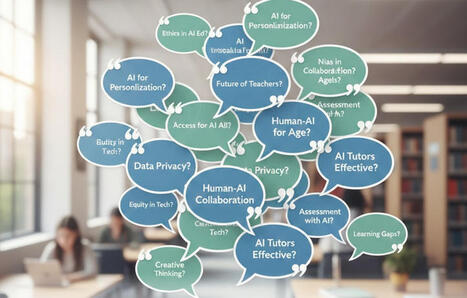
"Artificial Intelligence has entered the world of education like an explosion, leaving us reeling in its wake. Everyone has questions: how could AI reshape education? What risks does it create? These questions are natural, coming as they do from our common experiences. But what if they’re the wrong questions to ask? What if we should be questioning what we’re doing in education at all?"
EDTECH@UTRGV's insight:
"[F]ailing good answers to any of our questions, we just keep moving on, doing what we’ve always done. We need better questions than we have been asking to this point."
Scoop.it!

"AI helpers can now rummage through multiple documents"
EDTECH@UTRGV's insight:
"Microsoft has made OneDrive agents generally available, allowing users to query multiple documents simultaneously through Copilot instead of just one at a time."
Scoop.it!

Leading thinkers in the field are seeking a more nuanced understanding of how best to use AI to shape the future of education.
EDTECH@UTRGV's insight:
"Educators are starting to realize that AI isn’t going away anytime soon – and that it’s better to teach their students how to use it, rather than leave them to their own devices."
Scoop.it!
When I make presentations about AI, I am most often asked, “What can I do now to ensure that AI doesn’t take my job?” And, that’s a challenge to answer. We do not know just how, and how quickly, AI will roll out. However, a Gallup Poll released last week showed nearly one-quarter of American workers use AI at least a few times each week. We know that Agentic AI is different from Generative AI. Generative AI is the transactional, commonly chatbot mounted, question and answer form that we saw first in ChatGPT by OpenAI a couple of years ago. That remains a powerful tool.
EDTECH@UTRGV's insight:
"Instead of being a ‘task machine,’ you should aim to be an ‘operator’ who uses AI as leverage to manage systems and drive real-world business goals"
Scoop.it!
From
uxdesign
"You likely know, or at the very least know of, a designer who just gets it. I’m talking about the designer who solves complex problems with elegant, user-centred, buildable solutions without breaking a sweat. Or maybe that designer who turns everything they touch into something genuinely beautiful. Or even the one who gets up on a stage and says what we’re all thinking more clearly and eloquently than we can. Maybe all three. Love or irrationally hate them, there they are, making the things that you struggle with daily look easy. You look skyward and wonder, 'what is it they have that I don’t?'”
EDTECH@UTRGV's insight:
"In a world where anyone can make anything– what matters is your ability to choose and curate what you make.”
Scoop.it!
From
youtu
UTRGV offers a top-ranked, affordable online Master’s in Educational Technology. This accelerated program prepares students for high-demand roles like instructional design and AI curriculum specialist. Graduates gain a competitive advantage across diverse industries. Learn more here: http://utrgv.edu/edtech
EDTECH@UTRGV's insight:
The EdTech, E-Learning, and AI industries are booming! Get future ready by earning a master's degree in Educational Technology to get ready to design the future of learning.
|








"[I]f edtech is lumped in with all social media, AI, and consumer tech, we are in for a bumpy ride in 2026"