"Most AI search systems do not fail in obvious ways. There are no outages, error rate spikes or alerts that warn that something went wrong. Instead, relevance quietly erodes. Users initially adapt by reformulating queries and scrolling further, but eventually some abandon search altogether. By the time leadership starts seeing a measurable business impact, the system might have been underperforming for months."
EDTECH@UTRGV's insight:
"This silent degradation is one of the most underestimated risks in AI search, often a result of the team’s definition of success."
The latest news related to the meaningful and effective implementation of educational technology and e-learning in K-12, higher education, corporate and government sectors.
Watch this video to learn more about the fully online, accelerated, project-based Master of Education in Educational Technology at the University of Texas Rio Grande Valley. For more information, visit: https://www.utrgv.edu/edtech/index.htm
EDTECH@UTRGV's insight:
This 30-hour accelerated program designed to prepare persons in K-12, higher education, corporate, and military settings to develop the skills and knowledge necessary for the classrooms and boardrooms of tomorrow. Students in this program have the opportunity to earn one or more graduate certificates in E-Learning, Technology Leadership, and Online Instructional Design.
Desde mi punto de vista, el Master of Education in Education Technology responde de manera acertada a las necesidades actuales del ámbito educativo, donde la integración pedagógica de la tecnología es cada vez más importante. El enfoque basado en proyectos potencia un aprendizaje significativo, ya que permite a los maestros diseñar y aplicar recursos digitales directamente en sus contextos escolares. Además, el formato online y acelerado facilita la actualización profesional continua, lo que considero clave para mejorar la práctica docente y promover una educación más creativa y eficaz.
"Most AI search systems do not fail in obvious ways. There are no outages, error rate spikes or alerts that warn that something went wrong. Instead, relevance quietly erodes. Users initially adapt by reformulating queries and scrolling further, but eventually some abandon search altogether. By the time leadership starts seeing a measurable business impact, the system might have been underperforming for months."
EDTECH@UTRGV's insight:
"This silent degradation is one of the most underestimated risks in AI search, often a result of the team’s definition of success."
"Colleges and universities have begun formalizing the chief AI officer role as they respond to the growing impact of generative artificial intelligence on teaching, research, and operations. Reflections from early incumbents point to five lessons about how AI leadership in higher education is taking shape."
"Here’s a guide on using app settings and tools to minimize the amount of AI content you see."
EDTECH@UTRGV's insight:
"If you want fewer cartoonish videos of dead celebrities, creepy or absurd images or fake bands playing synthetic tunes, a few platforms have rolled out settings and features to help minimize AI-generated content."
While the pediatric group previously recommended two hours or less of screen time a day, a decade later, the American Academy of Pediatrics is gettin
EDTECH@UTRGV's insight:
"One of the biggest shifts from 2016 to 2026: no set screen time limit. In contrast, 10 years ago, the AAP suggested limiting children to two hours of screen time a day."
A new analysis shows AI in the classroom is most often used to promote reasoning, analysis, and evaluation rather than answer-getting.
EDTECH@UTRGV's insight:
"Rather than replacing student thinking, when teachers design and guide AI experiences, the technology is most often used to deepen critical thinking and strengthen instruction"
"This advice is why designers are quietly losing strategic influence. We optimized AI interfaces for confidence. Organizations learned that confidence replaces judgment."
EDTECH@UTRGV's insight:
"22% designers now use AI to create first drafts of interfaces. 33% use it to generate design assets. The time from concept to visible prototype collapsed from days to minutes."
By aligning learning design with how adults actually learn best—through choice, creation, and real-world use—this approach delivers both engagement and performance impact.
EDTECH@UTRGV's insight:
"One model gaining traction is a hybrid learning framework that combines the practicality of “Make & Take” workshops with microlearning, learner autonomy, and real-time coaching."
The ethics of AI isn't just about red tape and box-ticking... We need to look at what AI adoption means toward building inclusive cultures, toward challenging our biases, toward creation of the conditions for a fair, equitable education for all learners.
EDTECH@UTRGV's insight:
"Along with producing data, AI embeds values, assumptions, and worldviews in every content brief. Human writers can see and correct these biases, but AI’s subtle distortions may escape detection"
What is Diagnostic Teaching? Diagnostic teaching is a step-by-step, intentional process for pinpointing exactly why a student is struggling.
EDTECH@UTRGV's insight:
"The big idea behind Diagnostic Teaching is to illuminate and remove barriers to student understanding. When students have problems, you need to be able to systematically identify and fix them."
We speak with Jenay Robert, senior researcher at Educause, about goals for generative AI in higher education, action steps for integrating AI effectively, and upcoming AI research.
EDTECH@UTRGV's insight:
Rhea Kelly and Jenay Robert discuss the 2025 Horizon Action Plan, highlight the shift from AI policy and outline concrete actions higher education institutions can take to build generative AI literacy over the next decade.
Artificial intelligence preparedness, classroom modernization, cybersecurity and esports will be front and center at TCEA 2026, running from Jan. 30-Feb. 4.
EDTECH@UTRGV's insight:
The UTRGV Educational Technology faculty be at the conference. Drop by Booth 1966 to learn more about this award winning program!
UTRGV offers a top-ranked, affordable online Master’s in Educational Technology. This accelerated program prepares students for high-demand roles like instructional design and AI curriculum specialist. Graduates gain a competitive advantage across diverse industries. Learn more here: http://utrgv.edu/edtech
EDTECH@UTRGV's insight:
The EdTech, E-Learning, and AI industries are booming! Get future ready by earning a master's degree in Educational Technology to get ready to design the future of learning.
"Generative AI (GenAI) has made explicit knowledge nearly free. The research, the synthesis, the frameworks—all commoditized. An LLM can produce a cloud migration strategy, draft a technical architecture document or summarize the latest thinking on microservices in seconds. At the same time, technology leadership has never felt harder. What remains scarce is wisdom—the kind forged through implementation, failure and recovery."
EDTECH@UTRGV's insight:
"When leaders manage dashboards rather than systems, entropy accumulates in the structural seams of the software, invisible to anyone who cannot read the code. This raises the question: how do leaders maintain technical depth whilst scaling their responsibilities?"
"The implications of AI for data governance and security don’t often grab the headlines, but the work of incorporating this technology into institutional culture is vital, complex, and illuminating."
EDTECH@UTRGV's insight:
"Bringing AI into real, regulated institutional data environments is not just a technology project; it’s a test of our entire data governance and security philosophy."
"When researchers ask students to test educational technology products, a consistent pattern emerges: Tools that impress adults in demos often fall flat with the students who actually use them."
EDTECH@UTRGV's insight:
"When you center student voice, you learn things about an edtech tool that adults simply can't see."
Institutions should embed an AI use framework into syllabi, program handbooks, IRB protocols, and dissertation templates.
EDTECH@UTRGV's insight:
"[O]ne of the most pressing academic questions remains unresolved: When should the use of AI be cited as a source, and when is it simply a tool that needs no more acknowledgement than spell-check?"
AI models should ensure every instructor, student, and creator has a viable economic access path--ads are a roadblock.
EDTECH@UTRGV's insight:
"We’re stuck in a digital conundrum: how do we keep the AI platforms of the future solvent without locking the classroom door on those who can’t afford the cover charge?"
Explore how AI and cognitive load theory can improve student learning by reducing overload, supporting schema building, and optimizing instructional design.
EDTECH@UTRGV's insight:
"When students are inundated with information, they risk experiencing cognitive overload—a state where the brain is unable to effectively process information, hindering understanding and retention."
"The failure of AI to increase productivity isn’t just cherry-picked anecdote or idle speculation. According to Microsoft’s own study, only 25% of AI initiatives achieved expected returns over the past three years. Computer scientist Gary Marcus has been writing about the hype and misplaced hope around large language models (LLMs) for just as long. But the problem here is not that AI can’t do great stuff; it’s that organizations are not yet thinking in a human-first way about technology."
EDTECH@UTRGV's insight:
"It’s the humans who bring the complexity, culture, and chaos."
"Effective use of microlearning can lead to real behavior change on the job. But figuring out how to successfully build it can be tricky. To help you dive into this important topic, we’ve asked our Micro- & Workflow Learning Online Conference speakers to share their top tips"
EDTECH@UTRGV's insight:
"[M]icrolearning, doesn’t always need to take place while at work, or in the flow of work. Look where people spend their time during breaks, in transit, or other places where they are idle, and catch them there."
This article outlines a strategic roadmap for L&D professionals to navigate the rise of artificial intelligence by proactively adapting their skills and pivoting into adjacent, integrated, or specialized AI roles to ensure long-term career resilience.
EDTECH@UTRGV's insight:
"The central question facing every practitioner has shifted: it is no longer if AI will impact your job, but how you will strategically respond."
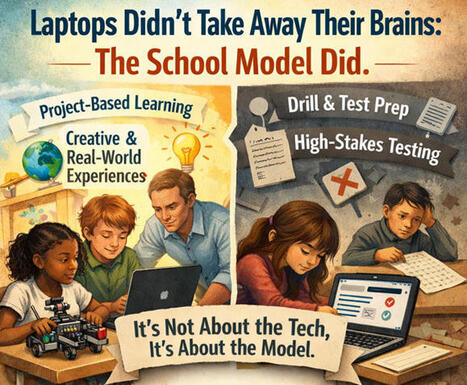
"Neuroscientist Jared Cooney Horvath's new book and article argue that when we gave students laptops, student performance declined, so the tech broke their brains. That story skips the real culprits:
high-stakes standardized testing that reshaped public schooling, and
inequitable access to effective models of learning, not to devices."
EDTECH@UTRGV's insight:
"Students in well-resourced schools are more likely to experience project-based, passion-driven models where technology is used for real-world work. Students in under-resourced and segregated schools are more likely to sit in “drill and kill” environments, whether the drill is on paper or on a screen."
The digital learning landscape is entering a new phase defined by rapid advances in artificial intelligence, rising expectations for the student experience, and increasing pressure to demonstrate quality and accountability in online education.
EDTECH@UTRGV's insight:
"Artificial intelligence is expected to renew institutional focus on instructional design, as AI-generated content increases the need for structured, pedagogy-informed course design aligned with accessibility, inclusion, and quality standards."
Learn about AI-enhanced learning design and how it balances efficiency with creativity for a better educational experience.
EDTECH@UTRGV's insight:
"AI can support eLearning, but only humans provide the creativity, judgment, and accountability needed for quality learning. Effective Instructional Design depends on humans guiding and refining AI, not the other way around."
To get content containing either thought or leadership enter:
To get content containing both thought and leadership enter:
To get content containing the expression thought leadership enter:
You can enter several keywords and you can refine them whenever you want. Our suggestion engine uses more signals but entering a few keywords here will rapidly give you great content to curate.




 Your new post is loading...






















"This silent degradation is one of the most underestimated risks in AI search, often a result of the team’s definition of success."