

All AIs are not the same. Each of them has subtle differences in the way they respond to prompts, the way they handle context, and how they format output


|
Scooped by
EDTECH@UTRGV
onto Educational Technology News March 5, 2024 9:47 AM
|
 Scoop.it!
All AIs are not the same. Each of them has subtle differences in the way they respond to prompts, the way they handle context, and how they format output

 Your new post is loading...
Scoop.it!
|
|
|
Scooped by
EDTECH@UTRGV
Today, 9:59 AM
|
Scoop.it!

AI marking has been around a long time. But it’s not the tech causing outcry – it’s what happens now that it’s readily available.
"There’s a doomsday scenario where uni students hand in work generated by artificial intelligence (AI), which is then marked by AI and university assessment no longer involves any humans at all."
|
|
Scooped by
EDTECH@UTRGV
Today, 9:56 AM
|
Scoop.it!

With AI now making it more difficult for employers to gage a potential employee’s skills, institutions must design curricula around proof of readiness.
"AI can now draft a polished résumé, cover letter and interview answer in minutes. That’s made it harder for employers to tell who can actually do the job, so they’re looking for something harder to fake: evidence that someone can contribute and grow."
|
|
Scooped by
EDTECH@UTRGV
Today, 9:50 AM
|
Scoop.it!

"AI was supposed to make work easier, but for the people who use it most, it just became a different kind of work, and a whole lot of exhaustion."
"The people embracing AI the right way, learning the tools, wiring them into everything, getting genuinely good, are the ones getting buried, because being good at this now means being the one who holds it all together."
|
|
Scooped by
EDTECH@UTRGV
November 11, 1:28 PM
|
Scoop.it!

"Microsoft has announced Classroom and changes to Microsoft 365 Education, including Office 365 A1 retirement, new student licenses and storage changes at eligible renewals from 2028."
"Microsoft Classroom will give K–12 schools and universities a separate environment for teaching and learning, with experiences tailored to elementary, secondary and university students."
|
|
Scooped by
EDTECH@UTRGV
November 11, 1:21 PM
|
Scoop.it!

Hanover Research surveyed nearly 300 parents and teachers to determine how schools are using artificial intelligence and where they can improve.
"[W]hile AI use is increasingly common in schools, there are major gaps in guidance, appropriate use and training."
|
|
Scooped by
EDTECH@UTRGV
November 10, 9:47 AM
|
Scoop.it!

Instead of banning AI and schools prescribing how students must learn, let's empower students to decide when technology helps, when it doesn't, and how they learn best. We're Asking the Wrong Questions About AI As schools respond to AI, I'm seeing a familiar pattern.
"Why are we asking students to complete work that AI can easily do, particularly when they see little value in doing it themselves?"
|
|
Scooped by
EDTECH@UTRGV
November 10, 9:39 AM
|
Scoop.it!

Inside Higher Ed breaks down some of the latest developments regarding AI and ed tech on campus. While many universities have announced more artificial intelligence–focused initiatives this fall, one is creating a space designed to help college students develop their own ideas and express them in an authentic voice with—and without—the use of the technology.
"At the same time that faculty are trying to keep original thought at the center of students’ written work, students also want to ensure that faculty aren’t relying too much on AI."
|
|
Scooped by
EDTECH@UTRGV
November 10, 9:32 AM
|
Scoop.it!
"I was a skeptic. Let the record show, I too, was against it.
When Ted Chiang wrote in The New Yorker that AI isn’t going to make art, I felt vindicated. I forwarded it. To people who had not asked (as I often do).
His point was that art is the sum of thousands of small choices, and a machine that makes most of them for you has removed the art. I summarized this at dinners as “it’s a vending machine with ambitions,” which got a laugh and some confused looks."
"Every new medium gets called cheating by the people who are good at the old one."
|
|
Scooped by
EDTECH@UTRGV
November 9, 12:43 PM
|
Scoop.it!
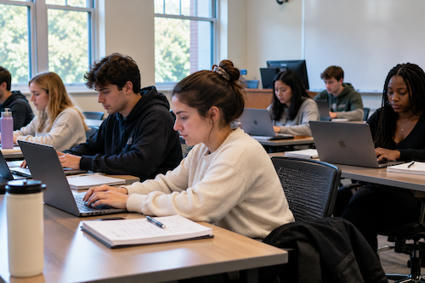
In the AI learning era, course design must go beyond teaching students where to click or assuming that a polished product equals competence.
"Because generative AI can present inaccurate information confidently, AI literacy requires students to identify credible sources, compare evidence, inspect outputs, and exercise independent judgment rather than accept results as authoritative."
|
|
Scooped by
EDTECH@UTRGV
November 9, 12:29 PM
|
Scoop.it!

Discover practical strategies for redesigning assignments in the AI era, strengthening student learning, promoting academic integrity, and keeping teaching human-centered.
"[I]nstead of asking how we stop students from using AI, I started asking a different question: what would we have to design so that the learning itself could not be outsourced? That reframe became the Studio."
|
|
Scooped by
EDTECH@UTRGV
November 9, 12:25 PM
|
Scoop.it!

Grainger Engineering faculty are helping define the future of engineering education, setting new standards for AI fluency and responsibility through curricular innovation, human-centered teaching, and a commitment to ensuring AI strengthens learning without compromising rigor.
"AI may change how engineers work, but it cannot replace what they know, understand, or remain accountable for."
|
|
Scooped by
EDTECH@UTRGV
November 9, 12:22 PM
|
Scoop.it!

Agentic AI can make marking more efficient – but what are we losing in the process? Find out why human judgement is still key
"[L]arge language models such as ChatGPT and Gemini can be deployed as on-demand marking assistants at a negligible cost per submission. The efficiency gains are real, but so are the complications."
|
|
Scooped by
EDTECH@UTRGV
Today, 10:01 AM
|
Scoop.it!

"A new study has revealed the differences between students and lecturers when it comes to AI use, implying that academics think students are using generative AI too much, whereas students think they’re not using it that much."
"Mixed experience and knowledge of AI among university staff has made it more difficult to judge how students use the technology, offering an opportunity for improvement among academics"
|
|
Scooped by
EDTECH@UTRGV
Today, 9:58 AM
|
Scoop.it!

AI can help children learn, but teaching kindergarten is about reading a room full of small humans, minute by minute.
"Teachers are masters of doing ten things at once. We are also masters of noticing which tools need our hands and full attention, because those are the tools we can't use while children are in the room."
|
|
Scooped by
EDTECH@UTRGV
Today, 9:53 AM
|
Scoop.it!

When generative AI exposed the flaws in my traditional assignments, I redesigned student learning experiences — turning AI from a cheating tool to a “cognitive sparring partner.”
"If we spend all our energy policing every click, we are simply refusing to face the bigger truth: If AI could complete our assignments in seconds, the problem wasn’t artificial intelligence. The problem was the assignment."
|
|
Scooped by
EDTECH@UTRGV
November 11, 1:30 PM
|
Scoop.it!

As a campus leader, you probably know students are using your school's AI agents to find support at all hours. But you may be looking for more insight on the problems that today's students are turning to chatbots to solve.
"Students like chatbots and often return with more questions. The study found that students find AI agents most useful when they provide timely, and relevant guidance"
|
|
Scooped by
EDTECH@UTRGV
November 11, 1:23 PM
|
Scoop.it!

Unlock the secrets to AI strategy trust by fostering a culture of understanding and collaboration among your workforce.
"AI is dividing your workforce. Champions are pushing ahead, sceptics are pulling back, and 31% of employees in a recent study admitted to working against their organisation's AI strategy."
|
|
Scooped by
EDTECH@UTRGV
November 11, 1:20 PM
|
Scoop.it!

Unis must ensure degrees demonstrate students’ learning, rather than how well they’ve used artificial intelligence. But it’s an ongoing challenge.
"[T]he line between what is acceptable and unacceptable use of AI is not always clear to students or teachers."
|
|
Scooped by
EDTECH@UTRGV
November 10, 9:41 AM
|
Scoop.it!

AI tools may be evolving quickly, but we have a deep research base we can draw on to determine how they help meet—or undermine—any particular learning goal. Kathryn Palmer’s recent Inside Higher Ed article “The ‘Nonexistent’ Research on AI’s Benefits for Education” raises an important concern. Colleges and universities are investing heavily in generative artificial intelligence even though evidence about when, how or whether these tools improve student learning remains limited. Some studies even suggest that unguided use could undermine learning.
"AI systems are evolving faster than traditional educational research can evaluate them."

|
|
Scooped by
EDTECH@UTRGV
November 10, 9:34 AM
|
Scoop.it!

In a U.S. survey, 39 percent of students say peers' AI use motivates their own.
"Fifty percent of students say peers use AI text with little editing; only 8 percent admit doing so themselves. Researchers recommend AI guidelines for college students remain flexible to account for various disciplines."
|
|
Scooped by
EDTECH@UTRGV
November 9, 12:45 PM
|
Scoop.it!
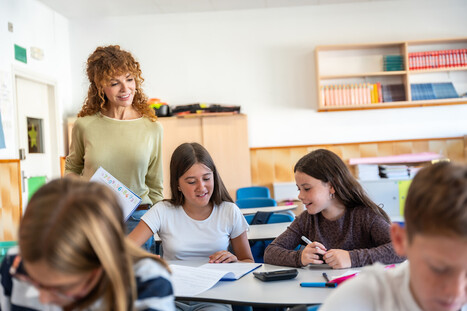
The team will study whether AI can measure a key teaching skill and provide useful feedback faster than humans.
"A team of researchers wants to know whether artificial intelligence (AI) may hold the key to faster, more useful feedback that can improve teaching and learning."
|
|
Scooped by
EDTECH@UTRGV
November 9, 12:40 PM
|
Scoop.it!

Can students show where a research theme came from, explain what AI changed, and defend what remains uncertain?
"If universities teach students to generate themes without teaching them to defend those themes, they risk confusing production with education."
|
|
Scooped by
EDTECH@UTRGV
November 9, 12:28 PM
|
Scoop.it!

This research examines the key factors associated with users’ intentions to adopt AI avatars within online learning environments. By combining the Technology Acceptance Model (TAM) and the Diffusion of Innovations (DOI) theory, a comprehensive model was proposed to assess the relationships between four primary design elements—perceived personalization, feedback quality, transparency, and interactivity—on five key constructs: observability, relative advantage, perceived usefulness, perceived ease of use, and trust, as well as users’ attitudes and willingness to adopt."
"[T]rust is closely associated with transparency and other design perceptions, as well as users’ attitudes and behavioral intentions."
|
|
Scooped by
EDTECH@UTRGV
November 9, 12:24 PM
|
Scoop.it!

In-person experiential opportunities and high-quality virtual platforms help prepare remote students for careers after graduation.
"Applied projects, collaborative assignments, presentations and opportunities for revising work after receiving feedback can give students practice with processes that occur in the workplace. With this kind of coursework, students are not just demonstrating that they intellectually know the material. They are also learning to communicate ideas, work closely with other people, receive and respond to criticism, and exercise judgment."
|
|
Scooped by
EDTECH@UTRGV
November 5, 12:33 PM
|
Scoop.it!

Google is disabling Search in schools that choose not to use its AI features. The company says it will turn Gemini, Gemini Notebook, Gemini in Classroom, and Google Search “entirely off” unless administrators turn them on.
"Students in schools that reject Google’s AI will see notices that Search isn’t available."









"Artificial intelligence has two sets of abilities: Natural Language Understanding (NLU) and Natural Language Generation (NLG).
NLU enables AI to understand human language, while NLG empowers AI to generate meaningful and coherent responses. These two sets of abilities work in tandem to enhance AI’s communication with users."