 Your new post is loading...
Looking for a Textbook on Generative AI in Education?
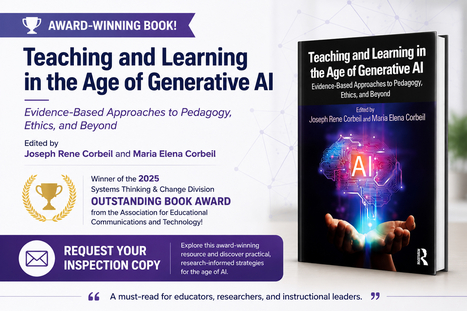
Teaching and Learning in the Age of Generative AI: Evidence-Based Approaches to Pedagogy, Ethics, and Beyond Edited by Joseph Rene Corbeil & Maria Elena Corbeil (2025) 🏆 Winner of the 2025 Systems Thinking & Change Division Outstanding Book Award from the Association for Educational Communications and Technology! If you are designing a course that addresses generative AI in education, this award-winning volume provides a research-driven, classroom-ready foundation. Rather than offering hype or fear, this book helps educators:
- Ground AI integration in learning theory and research
- Address academic integrity with thoughtful, practical strategies
- Redesign assessment for an AI-enabled world
- Explore ethics, bias, privacy, and institutional responsibility
- Leverage AI to enhance critical thinking and digital literacy
Bookended by historical and forward-looking analyses of AI in education, the chapters move beyond surface-level discussions to provide evidence-based approaches for real classrooms—K–12, higher education, and professional learning environments.
This text is ideal for:
- Undergraduate and graduate teacher education programs
- Curriculum & Instruction courses
- Educational Technology programs
- Higher education faculty development
- School technology coordinators and talent development professionals
Adopting a GenAI textbook for an upcoming semester? We invite you to request an inspection copy and explore how this resource can support your students in navigating AI with skill, ethics, and informed judgment.
Request your inspection copy today.

|
Scooped by
EDTECH@UTRGV
November 4, 10:05 AM
|
Discover how student voice, classroom dialogue, and trust can improve AI conversations, strengthen engagement, and support meaningful learning in higher education.
|
|
Scooped by
EDTECH@UTRGV
November 4, 10:01 AM
|
Two AI tutors, contrasting studies: One hinted that a little AI-powered practice might improve math skills. The other found that an AI assistant undermined college students’ engagement and hurt their grades.
|
|
Scooped by
EDTECH@UTRGV
November 4, 9:58 AM
|
"I’ve used generative models for almost four years and designed machine learning applications for seven before that, so people ask what I delegate. I approach this as an apologist, someone who makes the case for the technology in the right context."
|
|
Scooped by
EDTECH@UTRGV
November 3, 10:56 AM
|
Parents want schools to teach AI — but 4 in 10 teachers say they’ve had no training at all.
|
|
Scooped by
EDTECH@UTRGV
November 3, 10:52 AM
|
Districts need sustained support connecting AI to daily instructional decisions and support teachers in their efforts.
|
|
Scooped by
EDTECH@UTRGV
November 3, 10:47 AM
|
"I teach digital prototyping to fashion design undergraduates and master’s students at UPM’s Fashion School. My course focuses on exploring app concepts that can enrich the fashion experience. Past project ideas ranged from aesthetic affinity social communities (and dating) and live-action fashion-branded games to smart garment upcycling, VR fashion recommendations, and even a shared laundry app for roommates. In previous semesters, I asked my students to prototype in Figma and standard design software. This past term, however, we switched to an entirely AI-based toolset, including Google Stitch, Google AI Studio, and Lovable."
|
|
Scooped by
EDTECH@UTRGV
November 2, 7:39 AM
|
AI tutors won’t teach students to think until the conversation itself becomes the assessment.
|
|
Scooped by
EDTECH@UTRGV
November 2, 7:33 AM
|
Universities are embedding technical competencies and ethics into learning outcomes, faculty development and degree requirements.
|
|
Scooped by
EDTECH@UTRGV
November 2, 7:29 AM
|
Understand the importance of completion rates and how they connect learning data to people and performance effectively.
|
|
Scooped by
EDTECH@UTRGV
November 2, 7:24 AM
|
Small AI helps young people build the skills and confidence to move from the classroom into meaningful jobs. The World Bank Group is working with countries to pilot small AI tools that support teachers, personalize learning, and support students.
|
|
Scooped by
EDTECH@UTRGV
October 30, 1:03 PM
|
As generative AI has become embedded in the tools students use to search, write, create, translate, organize, and receive feedback, the boundary between "using AI" and "not using AI" has become increasingly difficult to define. More importantly, treating AI use as a binary choice does little to help students understand the different roles AI can appropriately play in learning.
|
|
Scooped by
EDTECH@UTRGV
October 30, 1:00 PM
|
"“Presence is a sense of being in a place and belonging to a group” [1]. This article is a comparative review examining the effects of social presence, as well as the importance of instructional immediacy, on student instructional success, and the necessity of considering learner gratification within traditional educational settings and emergency remote teaching (ERT) in higher education settings. Considerable research on the significance of social presence in the online learning community has been conducted, yet there is still much to learn."
|
|
|
Scooped by
EDTECH@UTRGV
November 4, 10:06 AM
|
From social media use to digital gambling, emerging concerns about student well-being are prompting colleges to rethink their approaches to technology. Technology has increasingly become central to the college experience, influencing how students learn, communicate, build relationships and navigate challenges both in and outside the classroom. But as digital platforms and artificial intelligence become more embedded in students’ daily lives, questions are emerging about how those technologies affect their mental health and overall well-being.
|
|
Scooped by
EDTECH@UTRGV
November 4, 10:03 AM
|
"Does artificial intelligence help students learn? That’s a question many teachers and parents want answered, as the new educational technology is rapidly spreading in classrooms. Normally, meta-analyses would be the right place to look, since they’re supposed to gather a scattered body of research and make sense of it by pointing to where the preponderance of evidence lies. And indeed, there are 39 of them, all reporting substantial benefits for AI in education. But it appears that the studies synthesizing that evidence are themselves unreliable — and the peer-review process failed to catch the problems."
|
|
Scooped by
EDTECH@UTRGV
November 4, 9:59 AM
|
"In September 2025, researchers at Thinking Machines Lab ran the same prompt through a language model 1,000 times. They set the temperature to zero, a setting that should, in theory, make token selection deterministic. They got 80 different completions from the same prompt, model, and settings. What’s even more interesting is that all 1,000 outputs were identical for the first 102 tokens. The differences started at token 103, when the model described where Richard Feynman was born."
|
|
Scooped by
EDTECH@UTRGV
November 3, 11:01 AM
|
"Time-strapped and distracted, students say reading for pleasure is a luxury and AI is sometimes the best teacher on campus."
|
|
Scooped by
EDTECH@UTRGV
November 3, 10:55 AM
|
Unmanned aerial system curricula help K–12 students achieve industry certifications before graduation.
|
|
Scooped by
EDTECH@UTRGV
November 3, 10:49 AM
|
"The UX job market right now is genuinely grim. Jeff Sauro, PhD and Jim Lewis, PhD found that UX job postings are down 71 percent from their 2022 peak, and research postings are down even further. They also found that one in three organizations cut UX staff in a single year, the worst reading on record, worse than the one right after the 2008 financial crisis. When companies trimmed their teams, UX roles took a bigger share of the cuts than their headcount would predict."
|
|
Scooped by
EDTECH@UTRGV
November 3, 10:45 AM
|
By Shannon Donnally Quinn, Michigan State University DOI: https://www.doi.org/10.69732/MDPP1855 I keep saying that I am somewhat of an AI skeptic, and I still have many reservations about AI use, including concerns about its environmental impact and the ways in which
|
|
Scooped by
EDTECH@UTRGV
November 2, 7:35 AM
|
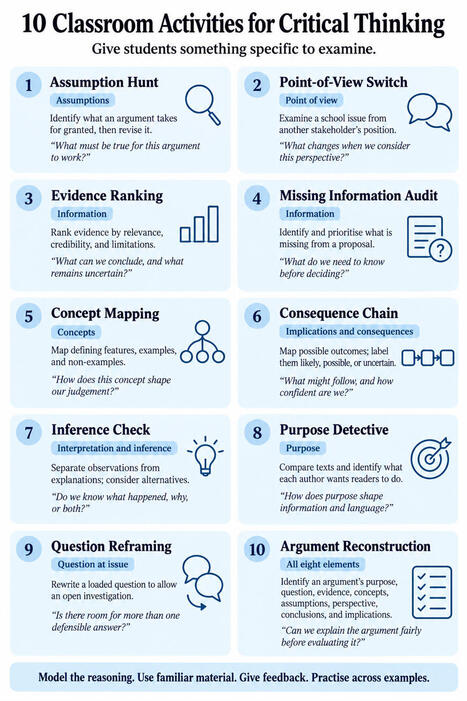
"Critical thinking becomes easier to teach when students have something specific to examine. Instead of asking them simply to “think critically,” we can ask them to identify a purpose, question an assumption, evaluate information, or explain how they reached a conclusion."
|
|
Scooped by
EDTECH@UTRGV
November 2, 7:31 AM
|
A majority of employers remain confident in higher ed, with just less than half saying college degrees will become more important as AI advances.
|
|
Scooped by
EDTECH@UTRGV
November 2, 7:26 AM
|
A new report from the Center for Digital Thriving at Harvard University found AI suspicion is fueling a lack of trust between teachers and educators. A report author shares three strategies for overcoming that.
|
|
Scooped by
EDTECH@UTRGV
October 30, 1:05 PM
|
Nearly four-in-ten U.S. adults are in an online community. These virtual third spaces can take many forms, like Facebook groups, online video games or fandom forums on Reddit.
|
|
Scooped by
EDTECH@UTRGV
October 30, 1:02 PM
|
As institutions work to set technology priorities and budgets for the year ahead, now is the time to determine what to add, what to consolidate, and where to get more from existing investments.
|
|
Scooped by
EDTECH@UTRGV
October 30, 12:57 PM
|
"Practitioners know what good output looks like and should own the final call, with operations handling the plumbing."
|






















When I need to create a quick graphic or edit a picture, I regularly turn to PowerPoint as my default image editor.