

If all required learning materials, including textbooks, were provided to all students on or before the first day of class


|
Scooped by
EDTECH@UTRGV
onto Educational Technology News September 18, 2017 12:33 PM
|
 Scoop.it!
If all required learning materials, including textbooks, were provided to all students on or before the first day of class

 Your new post is loading...
 Your new post is loading...
Your new post is loading...
Scoop.it!
|
|
|
Scooped by
EDTECH@UTRGV
Today, 11:08 AM
|
Scoop.it!


Iowa State University has announced a new effort aimed at ensuring its use of AI is ethical and trustworthy.
“Our strengths across the humanities, social sciences, mathematics, and natural sciences allow us to examine AI through the lenses of ethics, communication, policy, human behavior, and scientific rigor simultaneously. By bringing these disciplines together, we can help ensure that AI systems are not only innovative, but transparent, accountable, and worthy of public trust.”
|
|
Scooped by
EDTECH@UTRGV
Today, 10:59 AM
|
Scoop.it!
"If you designed for the web in 1999, you remember the feeling while the Hamster Dance video was playing in the background.
Pages were handmade — for a lot of us, the WYSIWYG editor was Notepad — the conventions were improvised, the JavaScript was rough, and some of the most popular things online were gloriously, defiantly pointless, like the Hamster Dance."
"Design for where the puck is going. Build for the capability you’ll plausibly have in two or three model generations, and make the parts most likely to change the easiest parts to replace."
|
|
Scooped by
EDTECH@UTRGV
May 28, 11:41 AM
|
Scoop.it!

"Most AI literacy curricula begin and end with the same lesson: here’s how to use ChatGPT responsibly. Learn to prompt. Check your sources. Don’t plagiarize.
That’s not AI literacy. That’s a typing tutorial for 2023."
"The world students are entering — the world that’s arriving right now — requires something far more comprehensive. The chatbot is just the opening act. What follows is an AI environment that will reshape how young people think, feel, relate, work, and build their identities."
|
|
Scooped by
EDTECH@UTRGV
May 28, 11:34 AM
|
Scoop.it!

"As the school year ends for many, I see twelve emerging trends in AI that will both create profound change and risk intelligence deprivation unless we chart a new course.
AI is becoming conversational, multimodal, agentic, and increasingly embodied/physical. It will not just help students write papers. It will help companies replace tasks and alter workflows; governments redesign services; scientists solve the world’s biggest problems; militaries accelerate decision-making; and agentic robots act in the world as a form of embodied cognition.
But this future will not arrive evenly."
"The old school model prepared students for a world where human intelligence was scarce and schools and resources sorted access to opportunity. The next world will be different. Intelligence will be ambient, conversational, tiered, embodied, and, maybe, unevenly distributed."
|
|
Scooped by
EDTECH@UTRGV
May 28, 11:30 AM
|
Scoop.it!

College students are increasingly worried that artificial intelligence will upend their future career plans.
"The AI effect puts immense pressure on schools to address students’ concerns about the labor market at a time when many people were already questioning higher ed’s return on investment."
|
|
Scooped by
EDTECH@UTRGV
May 28, 11:23 AM
|
Scoop.it!

AI literacy goes far beyond basic prompt writing. Learn strategies for building understanding of how AI tools work, how to use them effectively to support teaching, learning and research, where their limitations lie and the ethical implications surrounding their use
"Uneven knowledge and experience of and access to AI tools can slow progress towards AI literacy."
|
|
Scooped by
EDTECH@UTRGV
May 27, 1:01 PM
|
Scoop.it!

Without guardrails on the use of AI tools, students are left to find their own way and make their own decisions for using the technology.
"Even as students are incorporating AI tools into coursework, institutional practices for teaching AI literacy remain limited and uneven, at best."
|
|
Scooped by
EDTECH@UTRGV
May 27, 12:57 PM
|
Scoop.it!

"Much is being said about the impact of artificial intelligence in the hands of students resulting in too many A’s being granted. We are seeing colleges and universities across the country cracking down on grade inflation."
"It strikes me that the more A’s earned in a well-designed class using quality grading rubrics, the better. If viable, relevant, up-to-date learning outcomes are well assessed, then higher grades on average are commendable."
|
|
Scooped by
EDTECH@UTRGV
May 27, 12:51 PM
|
Scoop.it!
"The concept of early engagement is a necessity for online instructors in higher education to establish social connectedness with learners. The practice is based on Garrison et al.’s (1999) model for the Community of Inquiry (CoI). The CoI model suggests that the optimum online learning experience occurs when social, cognitive, and teaching presences converge [1]. However, social presence is more than simply one of three components; social presence is a foundational element. Social presence exists to establish an emotional connection."
"Implementing early engagement practices builds social presence, a critical component for developing cognitive and teaching presences"
|
|
Scooped by
EDTECH@UTRGV
May 27, 12:46 PM
|
Scoop.it!

"The 2026 State of EdTech report provides insights into the state of K-12 education through the lens of education technology leaders—professionals who play a critical role ensuring technology is safe, reliable, and effective in supporting student learning, teaching, and district operations."
"Cybersecurity continues to rank as the No. 1 priority for education technology leaders, reflecting the essential role secure digital systems play in modern education."
|
|
Scooped by
EDTECH@UTRGV
May 26, 11:00 AM
|
Scoop.it!

Purpose-built AI systems can analyze patterns in student performance, identify specific skill gaps, and connect those gaps directly to instructional recommendations. Done well, this doesn't remove the teacher from the equation. It sharpens the teacher's ability to act.
"AI-supported tools can turn data into instructional guidance: Purpose-built systems can identify patterns, surface skill gaps, and recommend next steps while keeping teachers in control."
|
|
Scooped by
EDTECH@UTRGV
May 26, 10:57 AM
|
Scoop.it!

Learning how to question and analyze are skills that must be honed and practiced. Educators must help train minds to look for flawed arguments, misuse of data, or outright lies so we can ensure that as students form their own thoughts on issues, they are grounding them in reality.
"Digital literacy is critical for K–12 students: Educators must help students question and analyze information, including flawed arguments, misused data, and false claims."
|
|
Scooped by
EDTECH@UTRGV
Today, 11:14 AM
|
Scoop.it!

"A recent ransomware attack on Instructure's Canvas LMS has raised concerns across the higher education community about cybersecurity, data privacy, third-party risk, and institutional preparedness."
"Instead of a coordinated pause, institutions are making local decisions based on their own risk tolerance and operational needs"
|
|
Scooped by
EDTECH@UTRGV
Today, 11:03 AM
|
Scoop.it!

The 2026 EDUCAUSE Horizon Report should be read as a leadership document, not just a technology report, for higher education leaders.
"[H]igher education is being reshaped by pressures surrounding value, trust, AI, financial instability, sustainability, data protection, accessibility, and policy change."
|
|
Scooped by
EDTECH@UTRGV
Today, 10:54 AM
|
Scoop.it!

"Since the release of ChatGPT, in 2022, colleges and universities have been engaged in an experiment to discover whether artificially intelligent chatbots and the liberal-arts tradition can coexist. Notwithstanding a few exceptions, by now the answer is clear: They cannot. AI-enabled cheating is pretty much everywhere. As a May New York magazine essay put it, 'students at large state schools, the Ivies, liberal-arts schools in New England, universities abroad, professional schools, and community colleges are relying on AI to ease their way through every facet of their education.'”
"[W]hen an educational institution as a whole produces large amounts of AI-generated scholarship, it fails to create new ideas and add to the storehouse of human wisdom."
|
|
Scooped by
EDTECH@UTRGV
May 28, 11:38 AM
|
Scoop.it!

"Demis Hassabis just told Sequoia Capital he expects AGI by 2030. He has the strictest definition in the field. The timelines from every major lab are moving up, not back. Schools should be paying attention — because the ground under their value proposition is shifting the way it shifted when we left the farms."
"Hassabis estimates that if AGI does arrive in 2030, 'the economic transformation will be 10 times larger and 10 times faster than the Industrial Revolution.'”
|
|
Scooped by
EDTECH@UTRGV
May 28, 11:31 AM
|
Scoop.it!

Vibe coding can feel instant, but it is not simply pressing a button and getting a finished app.
"Instead of writing every line of code yourself, you describe what you want created and the AI generates the code for you. The “vibe” part comes from the idea that you may not actually know exactly how the code is working."
|
|
Scooped by
EDTECH@UTRGV
May 28, 11:26 AM
|
Scoop.it!

Students don’t need help from their educators to keep up with AI. But what we can do is encourage them to question it more. Here’s how
"Students today aren’t intimidated by AI. If anything, they’re ahead of us in terms of how quickly they experiment with it, try things, remix them and move on. But this confidence can sometimes be misleading."
|
|
Scooped by
EDTECH@UTRGV
May 28, 11:20 AM
|
Scoop.it!

Aka, what I learned when I help to map the ~300 tasks involved in every L&D project to AI's strengths and limitations.
"Every task we mapped ran through three sequential tests. If a task failed any one test, it moved away from the delegation end of the spectrum and toward the human-only end."
|
|
Scooped by
EDTECH@UTRGV
May 27, 12:59 PM
|
Scoop.it!
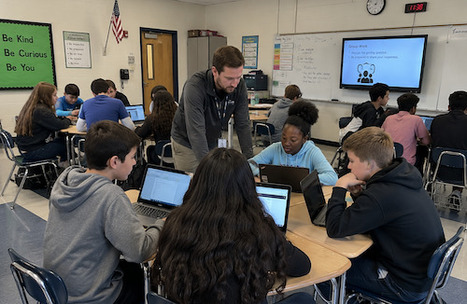
AI should never replace teachers in collaboration or expertise, but should shine a light on the insights that spark deeper conversations.
"AI is becoming more adept at eliminating the cumbersome, lower-level administrative tasks associated with compiling data and summarizing assessments, giving educators more time to focus on meaningful collaboration and develop richer conversations to better inform instruction."
|
|
Scooped by
EDTECH@UTRGV
May 27, 12:55 PM
|
Scoop.it!
"When students and educators think of asynchronous courses, they envision something akin to a correspondence course, lacking an available professor with disengaged students struggling to understand assignments in isolation, all within a disconnected learning environment. This type of course structure has the potential to leave students with high levels of stress and anxiety, feelings of apathy, and an overabundance of reading materials, without the requisite expertise to guide them through the learning process."
"One particular challenge of asynchronous learning is managing the isolation felt by students due to the lack of real-time interactions with classmates and the instructor."
|
|
Scooped by
EDTECH@UTRGV
May 27, 12:48 PM
|
Scoop.it!
This is the percentage drop in brain activity measured among participants in an MIT Media Lab study who used ChatGPT, compared to those who wrote without AI assistance. This is not a philosophical finding. It is a neurological one, recorded via EEG, from the actual brainwaves of real people while they worked.
"There is a paradox at the heart of everyday AI use, and it is worth naming clearly: the better you get at using AI, the easier it becomes to stop thinking."
|
|
Scooped by
EDTECH@UTRGV
May 27, 12:43 PM
|
Scoop.it!
"Some K-12 teachers say they are using AI on the job, but around eight in ten say they've received no formal guidance on applying the tools their work"
"AI tools are reshaping the classroom and students' critical thinking — but school leaders are lagging on giving teachers formal guidance for using the tech, a new report shows."
|
|
Scooped by
EDTECH@UTRGV
May 26, 10:59 AM
|
Scoop.it!

Cybersecurity ranks as the No. 1 priority for education technology leaders in the United States, according to the latest State of Ed Tech report from CoSN, yet insufficient cybersecurity staffing and the lack of a dedicated budget are key barriers.
"Budget constraints remain the top implementation challenge: Districts reported risks to classroom technology modernization, devices, cybersecurity, software licenses, and IT staffing after the end of emergency funding programs such as ESSER."









It already happens on online courses.