 Your new post is loading...

|
Scooped by
EDTECH@UTRGV
February 11, 5:29 PM
|
Looking for a Textbook on Generative AI in Education?
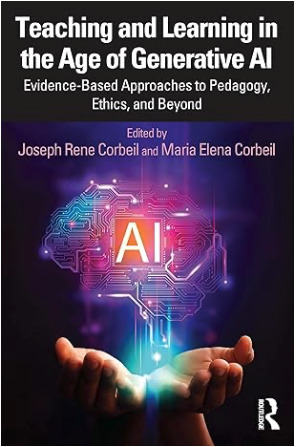
Teaching and Learning in the Age of Generative AI: Evidence-Based Approaches to Pedagogy, Ethics, and Beyond Edited by Joseph Rene Corbeil & Maria Elena Corbeil (2025) 🏆 Winner of the 2025 Systems Thinking & Change Division Outstanding Book Award from the Association for Educational Communications and Technology! If you are designing a course that addresses generative AI in education, this award-winning volume provides a research-driven, classroom-ready foundation. Rather than offering hype or fear, this book helps educators:
- Ground AI integration in learning theory and research
- Address academic integrity with thoughtful, practical strategies
- Redesign assessment for an AI-enabled world
- Explore ethics, bias, privacy, and institutional responsibility
- Leverage AI to enhance critical thinking and digital literacy
Bookended by historical and forward-looking analyses of AI in education, the chapters move beyond surface-level discussions to provide evidence-based approaches for real classrooms—K–12, higher education, and professional learning environments.
This text is ideal for:
- Undergraduate and graduate teacher education programs
- Curriculum & Instruction courses
- Educational Technology programs
- Higher education faculty development
- School technology coordinators and talent development professionals
Adopting a GenAI textbook for an upcoming semester? We invite you to request an inspection copy and explore how this resource can support your students in navigating AI with skill, ethics, and informed judgment.
Request your inspection copy today.
|
|
Scooped by
EDTECH@UTRGV
April 16, 5:56 PM
|
"AI literacy has quickly become a priority for organizations. Budgets are being allocated. Programs are being launched. Employees are being encouraged—sometimes required—to "learn AI." On the surface, this looks like progress. But if you look more closely, many of these efforts are built on the wrong foundation. They focus on tools, prompts, and features. They ignore the conditions required for competent use. And as a result, they are likely to produce activity—not capability."
|
|
Scooped by
EDTECH@UTRGV
April 16, 5:54 PM
|
A paper in JAMA Psychiatry says mental health providers should ask if patients are using artificial intelligence chatbots, just as they would ask patients about sleep habits and substance use.
|
|
Scooped by
EDTECH@UTRGV
April 16, 5:50 PM
|
As AI tools become more conversational, some students are forming emotional connections with them. Here’s what educators need to know about AI attachment and how to guide healthy AI use. As AI tools become more conversational, some students are forming emotional connections with them. Here’s what educators need to know about AI attachment and how to guide healthy AI use.
|
|
Scooped by
EDTECH@UTRGV
April 16, 5:44 PM
|
Assessment is often treated as the finish line of learning – a final score delivered after the real work is done. But in practice, carefully structured assessment can become one of the strongest drivers of learning during the semester. Designing tasks intentionally helps prompt students to apply concepts, benefit from feedback quickly, reflect on their reasoning and revise their work. This way, they build disciplinary knowledge and professional skills alongside each other."
|
|
Scooped by
EDTECH@UTRGV
April 15, 1:15 PM
|
"Much of the talk about AI’s potential impact on the labor market has focused on which jobs may be automated or eliminated. But a new analysis zeros in on what some experts increasingly think may be the bigger risk: the disruption of the career pathways that provide economic mobility to millions of workers."
|
|
Scooped by
EDTECH@UTRGV
April 15, 1:13 PM
|
Transform your approach to knowledge by mastering how to ask AI questions effectively for better results in your L&D career.
|
|
Scooped by
EDTECH@UTRGV
April 15, 1:10 PM
|
"Artificial intelligence (AI) is poised to revolutionize the workforce, and higher education must adapt accordingly to prepare students for an entirely new professional landscape. Corporate leaders are not shying away from the reality of this transformation. Many have begun to articulate the profound changes ahead, from evolving job functions to the automation of routine and repetitive tasks."
|
|
Scooped by
EDTECH@UTRGV
April 15, 1:06 PM
|
"The widespread adoption of AI in the classroom has arrived. Students now regularly use AI-powered tools to reinforce or even introduce new concepts into their studies. That shift has academic leadership asking, 'How can we provide learners with AI tools they actually want to use, while ensuring that those tools honor academic integrity and align with faculty-selected content?'”
|
|
Scooped by
EDTECH@UTRGV
April 15, 1:01 PM
|
"As artificial intelligence tools continue to rapidly evolve, some K-12 leaders say it’s time to switch up districts’ approach to their adoption and implementation. Unlike how districts commonly procured ed tech in the past, decisions on AI tools need to be reevaluated over time"
|
|
Scooped by
EDTECH@UTRGV
April 14, 2:19 PM
|
Richer countries face greater exposure to AI-driven changes than developing countries, which are less exposed to AI but risk being left behind, according to a joint report from the International Labour Organization and World Bank.
|
|
Scooped by
EDTECH@UTRGV
April 14, 2:17 PM
|
"Student agency, and the self-regulation that accompanies it, has always been important. But that importance ratcheted up with internet usage substantially growing in the late 1990s. The internet democratized access to information, allowing students more control over their own learning if they chose to take advantage of it. Students with good self-regulation skills took advantage of this newly increased access and saw their learning expand. Students with poor self-regulation skills fell behind. In today’s environment, the combination of increased self-regulation, task interest, and task persistency—all linked to student agency—becomes a powerful cocktail for driving success in academics and beyond."
|
|
Scooped by
EDTECH@UTRGV
April 14, 2:11 PM
|
"“Conceptually distinct from cognitive offloading, which involves strategically outsourcing a discrete task to an external tool (e.g., using a calculator), cognitive surrender represents a deeper abdication of critical evaluation, where the user relinquishes cognitive control and adopts the AI’s judgment as their own…."
|
|
|
Scooped by
EDTECH@UTRGV
April 16, 5:58 PM
|
"A big civil rights deadline that impacts schools and vendors will hit this month. Federal law has required accessibility for people with disabilities for decades, says Glenda Sims, chief information accessibility officer at Deque Systems, a company that specializes in digital accessibility. But two years ago, the federal government finally gave schools a way to measure whether their websites, mobile apps and digital content were accessible under law when it released a “final rule.”
|
|
Scooped by
EDTECH@UTRGV
April 16, 5:55 PM
|
"The world of work is changing fast. Careers no longer sit neatly within a single industry, city, or even country; they span disciplines, time zones, technologies, and cultures. If education is to prepare learners for this reality, it must shift from a narrow focus on content delivery to building the foundational skills that future careers demand."
|
|
Scooped by
EDTECH@UTRGV
April 16, 5:52 PM
|
"Marshall McLuhan (July 21, 1911 — December 31, 1980) was a Canadian philosopher, media theorist, and professor at the University of Toronto’s St. Michael’s College, where he studied the effect of mass media on behavior and thought. A modern intellectual who grappled with the effects of television, mass media, and communications on society. There are many meaningful ideas and quotes attributed to him, but the quote below is particularly relevant to our current AI discourse."
|
|
Scooped by
EDTECH@UTRGV
April 16, 5:46 PM
|
"If you work in L&D right now, there’s a good chance you’ve heard people asking the question: what happens when learners lean on AI too much?
It’s a fair worry: the weight of evidence from the last eighteen months has pointed in one direction: cognitive offloading — letting AI do the mental work so you don’t have to — appears to erode critical thinking, reduce engagement, and weaken retention. The message has been consistent and increasingly loud: limit AI use, or pay the price.
However, a new study just complicated that picture significantly — with important implications for how we design AI-supported learning."
|
|
Scooped by
EDTECH@UTRGV
April 15, 1:30 PM
|
"Thinking about earning your master’s degree? Now is a great time to make your move! Apply to the M.Ed. in Educational Technology at UTRGV and take advantage of the $2,000 Grad Momentum Incentive Scholarship, which can lower the total cost of the degree from $13,750 to just $11,750. Our program is fully online, accelerated, and designed to help you build practical, future-ready skills in educational technology, e-learning, and AI. Don’t just think about your next step — take it. Get future ready with EdTech at UTRGV." Learn more here at the M.Ed. in Educational Technology at UTRGV: http://utrgv.edu/edtech
|
|
Scooped by
EDTECH@UTRGV
April 15, 1:14 PM
|
"Your average computer science major seems to now be the poster child for Gen Z college grads unable to secure the sort of jobs that a decade of “top majors” features promised them. CS has until recently been assumed to be a “safe” major that guaranteed employment, often with a high starting salary in a perks-laden workplace, or equity in a fast-growing startup. A decline in demand for recent graduates has led to headlines suggesting the boom is over, and that AI poses an existential threat to all computer science occupations."
|
|
Scooped by
EDTECH@UTRGV
April 15, 1:11 PM
|
"The screen-time debate has been asking the right question in the wrong direction. The screen we should be thinking about is the teacher’s."
|
|
Scooped by
EDTECH@UTRGV
April 15, 1:08 PM
|
"There are people who fear that artificial intelligence will render human beings irrelevant in the workforce. Denise Kleinrichert is not one of those people. A management professor at San Francisco State University, Kleinrichert predicts that the use of AI will become as common as the use of cell phones, and that organizational departments to oversee AI’s use will become as ordinary as human resources departments."
|
|
Scooped by
EDTECH@UTRGV
April 15, 1:02 PM
|
"Colleges are increasingly looking to recruit adult learners as a means of bolstering enrollment amid an anticipated decline in traditional-aged students. In turn, higher education officials are grappling with how to best serve students who have likely not been in a formal educational environment in years."
|
|
Scooped by
EDTECH@UTRGV
April 14, 2:22 PM
|
"Some studies have found that chatbot tutors can backfirebecause students lean on them too heavily, get spoonfed solutions and fail to absorb the material. Even when AI tutors are designed not to give away answers, they haven’t consistently produced better results than learning the old-fashioned way without AI. Still, researchers who have produced these skeptical studies haven’t given up hope. Some are still experimenting, trying to build better AI tutors."
|
|
Scooped by
EDTECH@UTRGV
April 14, 2:18 PM
|
Accessibility compliance ensures students, parents, and community members with disabilities can properly and effectively access content.
|
|
Scooped by
EDTECH@UTRGV
April 14, 2:14 PM
|
"While artificial intelligence (AI) is becoming increasingly ubiquitous, there is still a lack of understanding about it. If AI becomes a vital tool for civic life and work, schools must cultivate skills and disseminate AI literacy, integrating it into the school curriculum. We must take on the challenge of 'how to achieve AI literacy through informal learning experiences in people's daily lives, using plugged and unplugged ways.'"
|
|
Scooped by
EDTECH@UTRGV
April 14, 2:05 PM
|
A maxim I’ve oft repeated for our AI era is that if a task can be automated, then it will.
|




























Some timely research findings focusing on the discrepancy between registeration and completion, as well as who is participating in MOOCs.