


Swiss-German IT firm GeOps has collaborated with the University of Freiburg on an interactive map of the world's major mass transit systems, incorporating public data feeds (like the MTA's) offered...
Via Suvi Salo, Mark E. Deschaine, PhD

 Your new post is loading...
 Scoop.it! Swiss-German IT firm GeOps has collaborated with the University of Freiburg on an interactive map of the world's major mass transit systems, incorporating public data feeds (like the MTA's) offered... Via Suvi Salo, Mark E. Deschaine, PhD 
Scoop.it!

Getting experienced educators to work in the highest-need schools requires more than bonus pay. Via Patti Kinney, Mark E. Deschaine, PhD

Brandon Chesney's curator insight,
May 28, 2015 8:25 AM
Teachers with barely any experience who get put into schools with troubled children or maybe a very low ranking in their scores tend to quit because of the lack of experience to know what they are doing. Studies show that it can take a teacher ten years of teaching to really be effective in class.
Scoop.it!

Death is the end of life but not of the body. Corpses are sources of fascination for some and revilement for others. They can even be a source of life. 10C Via Troy Mccomas (troy48)
Scoop.it!

Filip Janssens expanded on his 2014 collection of small steel furniture called JOINTED, which was presented at the Design Biennale Interieur Kortrijk, and went big, really big. The JOINTED CUBE is based on the same idea but is a steel framed outdoor installation. It’s partly closed with pine walls, floor, and ceiling, but with moments of openness highlighted by steel cubes. The cubes become places to sit or tables to highlight objects. Modular seats are both inside and outside the cube. Via Lauren Moss, Antonios Bouris
Scoop.it!

Communications in Information Literacy (CIL) is an independent, professional, refereed electronic journal dedicated to advancing knowledge, theory, and research in the area of information literacy. Via aufaitLibrarian
Scoop.it!

Is the American obsession with individual freedom really such a great idea? What other cultures know about how to make good choices. Via Ana Cristina Pratas
Scoop.it!
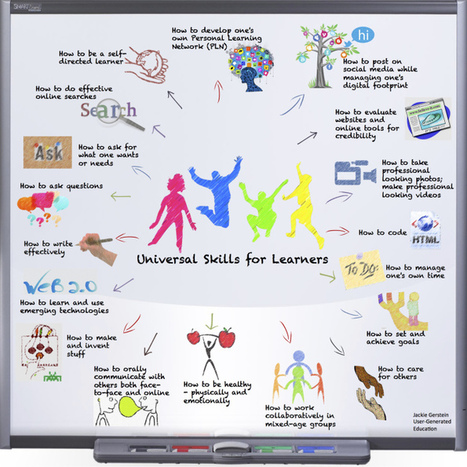
This morning I was thinking about the things that all young people should know how to do regardless of income, geographical location, life goals, etc. I started a list - see below. Some have "alw... Via Ana Cristina Pratas

CTD Institute's curator insight,
January 30, 2015 11:29 AM
This posting in the Jackie Gerstein blog, suggests 20 relevant skills young peeple should know. The suggestions come with links to website for how tos.
Scoop.it!

Photo by Flickr ID Zogh (CC) In the last decade or so, the social web has often been associated with the idea of public participation; a space, virtual but Via Ana Cristina Pratas
Scoop.it!

From
medium

Ethiopia. The land where it all began, where we all are supposedly originated from. Via Ana Cristina Pratas
Scoop.it!
A set of Supreme Court decisions made over 100 years ago has left U.S. territories without meaningful representation. That’s weird, right?

Tanya Townsend's curator insight,
October 12, 2015 10:57 PM
This was amazing! I love him! I am embarrassed to admit that i had no idea about any of this. I did not know that those territories were part of my country. This populations complete commitment to serving our country without any of the benefits is jaw dropping. We should be completely ashamed of our selves. I am honestly completely surprised that even in today's day in age this hasn't been fixed. Everything about this is unconstitutional. How this case loses in a court is beyond me. One of the things that stood out to me the most was the fact that 67% of Guam shows up to vote in though their votes dont count and yet only 61% of all of the US does...that embarrassing. We have clearly taken for granted our freedom to vote. 
Mark Hathaway's curator insight,
December 3, 2015 8:50 AM
The plight of our territories is a smudge on our nations character. The most controversial of these issues is Puerto Ricos status as a territory of the United States. Puerto Ricans are United States citizens by law, yet they have no representation in their government. They can not vote in presidential elections, have no real representation in the congress except their non voting delegate, and they have no representation in the electoral college. Something must be done, to rectify this situation. A possible solution may be to pass a 23rd amendment for Puerto Rico. The 23rd Amendment provides residents of the nations capital the right to vote, and representation in the electoral college. DC is given a number of electoral votes equivalent to the least populous state. That number is 3 electoral votes. The amendment does not provide DC with representation in the Congress. This Amendment has been controversial since the time of its ratification in 1961. Congress later repealed the amendment with a new DC voting rights amendment that gave DC representation in Congress. The new Amendment failed to garner enough support amongst the states for ratification. To me the 23rd Amendment solution is the best possible compromise. It gives Puerto Rico representation, while persevering the rights and sanctity of the states. 
Kelvis Hernandez's curator insight,
December 14, 2018 5:13 PM
John Oliver always does a great job discussing important topics such as this the rights of people in U.S. territories. People who live on the island territories are U.S. citizens but have no real representation. Each gets one representative in the house who has no voting power and the people are not allowed to vote for president or have a senator. From the land of freedom, this is a terrible injustice. If these people are U.S. citizens than they deserve the rights of the constitution. 1
Scoop.it!

Beginning in the 1950s, cities demolished thousands of homes in walkable neighborhoods to make room for freeways.
At the time, this was seen as a sign of progress. Not only did planners hope to help people get downtown more quickly, they saw many of the neighborhoods being torn down as blighted and in need of urban renewal. But tearing down a struggling neighborhood rarely made problems like crime and overcrowding go away. To the contrary, displaced people would move to other neighborhoods, often exacerbating overcrowding problems. Crime rates rose, not fell, in the years after these projects. By cutting urban neighborhoods in half, planners undermined the blocks on either side of the freeway. The freeways made nearby neighborhoods less walkable. Reduced foot traffic made them less attractive places for stores and restaurants. And that, in turn, made them even less walkable. Those with the means to do so moved to the suburbs, accelerating the neighborhoods' decline.

Shane C Cook's curator insight,
May 27, 2015 4:00 AM
It is really interesting to see how urbanization has affected not just us today but our parents and grandparents. Of course with innovation includes consequence whether good or bad it happens. Go America! 
Ryan Tibari's curator insight,
May 27, 2015 10:16 AM
Industrialization changed not only the physical face of cities, but also the social. Innovations such as highways have caused transportation to become widely easier, allowing people from all different regions of the city to travel easily back and forth from place to place.
Scoop.it!

A new report by online fashion site thefashionspot.co.uk has shed light on an alarming lack of diversity in women's fashion ad campaigns.
|
Scoop.it!

Molina Luis Alberto's curator insight,
May 28, 2015 6:40 PM
Interesting and useful article for our daily activities iwith our students ! ;) Luis M.
Scoop.it!

Today's young people are more overscheduled than at any time in history. How families cope with the extracurricular crush. Via Dr. Tom D'Amico (@TDOttawa) , Mark E. Deschaine, PhD

RebeccaMoore's curator insight,
May 12, 2015 4:57 PM
This article presents fairly objective pros and cons on the issue of students being involved in too many (or not enough) extracurricular activities.
Scoop.it!

How international experiences can open the mind to new ways of thinking Via Creativity For Life, Antonios Bouris
Scoop.it!

"Here's what most of us know about creativity: We know that you aren't born with it, and that it can be learned; we know that people can be at their most in group setting; we know that the expression of creativity isn't exclusive to the arts; and we know that you shouldn't wait around for inspiration to strike. But do we know that rewarding creative behaviour can stunt motivation? Do we know the creative brain depends on content just as much as it depends on imagination? Or that expecting one right answer all the time will actually prevent us from finding the right answer?" Via Beth Dichter, Antonios Bouris

Beth Dichter's curator insight,
April 20, 2015 7:10 AM
Is it possible that we believe we are teaching our learners to be more creative, when we may be doing the opposite? This post from InformEd looks at ten habits that actually impede creative growth, although many of us believe that they promote it. Four are listed below, with brief explanations. * Thinking "outside the box" - If by thinking outside the box you believe that constraints are not necessary you may be wrong. This post says "originality may require constraints." * Rewarding good performance - I see this as the question of intrinsic vs extrinsic factors...and research is showing that providing rewards for completing tasks does not foster motivated children. * Using outdated teaching methods - education is constantly changing as we learn more about the brain and how we learn. How many of us hold on to methods that have been proven wrong, such as teacher-centered instruction, right brain/left brain paradigm, and teaching to the test? * Bringing technology to the student - technology has great potential, but it may also be a distraction. The post shares a story of a teacher who used Google Docs to help his students share knowledge, but quickly learned that they did not have the foundation to use Google Docs effectively. He reflected on what he saw happening in his classroom and realized that many students like to move while they think, and created an activity where students would have to work together using butcher paper, post-its and pens...and using this process taught the students how Google Docs works, but without the computer. There is much more information in the post so click through to see six more habits that are creativity killers.
Scoop.it!

After viewing news photographs from China for years, one of my favorite visual themes is "large crowd formations." Whether the subject is military parades or world-record attempts, mass exercises or enormous performances, the images are frequently remarkable. The masses of people can look beautiful or intimidating, projecting a sense of strength and abundance. Individuals can become pixels in a huge painting, or points on a grid, or echoes of each other in identical uniforms or costumes.
Tags: China, East Asia, culture, art, landscape.
Mark Hathaway's curator insight,
November 24, 2015 7:19 AM
These photos invoke both a sense of beauty and intimidation. The photos themselves are majestic. They are almost perfect creations of art. The photos also invoke a sense of intimidation and dread. The Chinese have mastered the art of propaganda. They know how to put on a display that invokes both power and fear. Many of their photos involve military parades. The entire point of parading your military is to show both power and intimidation. It is both a threat and honor at the same time. 
Benjamin Jackson's curator insight,
December 6, 2015 4:30 PM
there were two things i learned from this. first, the Chinese are an insanely regimented society. the government can instill in soldiers the discipline to march in such an exact manner that it looks like a lineup of mirrors. second, the Chinese will beat you at any numbers based world record that catches their attention. 
Olivia Campanella's curator insight,
December 14, 2018 9:50 PM
In this article it lists photographs of the art of large crowds. Some of these are breathtaking
Scoop.it!

Ana Cristina Pratas's curator insight,
June 9, 2013 11:47 AM
Where: Blackboard Collaborate (Elluminate) Thanks to an ongoing grant from http://www.learningtimes.com/
Recording: https://sas.elluminate.com/p.jnlp?psid=2013-06-09.0656.M.7AE801FFB697DA460D4BF25AA8C21B.vcr&sid=75 With thanks to @VanceS
Scoop.it!
my keynote for the "Using Technology to Make a Difference" conference in Texas. Note that the videos will not play and it is video intensive, so please feel fr… Via Ana Cristina Pratas
Scoop.it!
Scoop.it!

Students are compelled to interact online — and to get by in the digital age, they need the skills to do so. Rather than giving in to fears of what might happen when students connect over the internet, educators should bust the myths of online student privacy and use them as teachable moments to turn their students into capable digital citizens. Via Ana Cristina Pratas
Scoop.it!

"In 2013, China replaced Mexico as the top sending country for immigrants to the United States. This followed a decade where immigration from China and India increased while immigration from Mexico decreased."

Gareth Jukes's curator insight,
May 27, 2015 12:31 PM
Push and pull factors, and migration in relation to employment and quality of life- This article explains how China in 2013 had more immigrants going to the US than Mexico. The reasons why were because of jobs and better life styles in the US. This article represents push and pull factors, and migration in relation to employment and quality of life by showing why china had more immigrants going to the US because of job opportunities and better life styles. 
Chris Costa's curator insight,
September 20, 2015 10:18 PM
I can already imagine the reactions I would receive from a couple of people I know if I were to post something like this on Facebook. Too often, popular opinion trumps fact, which contributes to the continued existence of stereotypes and inherently racist beliefs/institutions. I find it particularly humorous that the bulk of anti-immigration sentiment is cast at the Hispanic-American population now knowing that they do not even compromise the largest immigrant populations now entering the country! It makes it painfully obvious that this hate of Hispanic immigrants held by many Americans is less about "job security" and more about racism. I will, however, point out that the census bureau doe not account for illegal immigration to my knowledge, and I would be interested to see how this would affect the data presented in this article.
Scoop.it!

"The map above shows the most prevalent race in each county, based on data from the 2013 American Community Survey 5-year estimates. Select and deselect to make various comparisons."
Tags: cartography, mapping, visualization, census, ethnicity, race.

Seth Forman's curator insight,
May 26, 2015 6:47 PM
Summary: This map shows racial distribution throughout Baltimore.
Insight: This article is relevant to unit 7 because it shows how a city has been planned and built over time around racial discrimination with areas of similar race clumped together. 
Quentin Sylvester's curator insight,
May 27, 2015 12:17 AM
This census map shows the diversity of America, but also largely shows how entire counties, such as those around Baltimore and St. Louis can be seemingly segregated between races, though all persons are American. This leads to bizarre nationalism and continued ethnic and racial divides in society through the uneven distribution of race and ethnicity in the US. 
Sameer Mohamed's curator insight,
May 27, 2015 9:00 AM
I think it is interesting to think about the reasons where certain ethnic groups live. It is sad but also interesting to see that because of the slavery in the south, black americans make a large if not dominant percentage of the majority of the south. It is also interesting to see where Asian Americans living where they do because it is a newer migration pattern. This is reflected in the areas that Asians settle because of how they got to their homes.
Scoop.it!
PLURAL+ is a Youth Video Festival focusing on the themes of migration, diversity and social inclusion jointly organized by the International Organization for...
|







via Random