Colonialism is the establishment, exploitation, maintenance, acquisition, and expansion of colony in one territory by a political power from another territory. It is a set of unequal relationships between the colonial power and the colony and often between the colonists and the indigenous population.
Further information: Atlantic slave trade, Indentured servant, Coolie and Blackbirding Slave memorial in Zanzibar. The Sultan of Zanzibar complied with British demands that slavery be banned in Zanzibar and that all the slaves be freed.
European nations entered their imperial projects with the goal of enriching the European metropole. Exploitation of non-Europeans and other Europeans to support imperial goals was acceptable to the colonizers. Two outgrowths of this imperial agenda were slavery and indentured servitude. In the 17th century, nearly two-thirds of English settlers came to North America as indentured servants.[35]
African slavery had existed long before Europeans discovered it as an exploitable means of creating an inexpensive labour force for the colonies. Europeans brought transportation technology to the practise, bringing large numbers of African slaves to the Americas by sail. Spain and Portugal had brought African slaves to work at African colonies such as Cape Verde and the Azores, and then Latin America, by the 16th century. The British, French and Dutch joined in the slave trade in subsequent centuries. Ultimately, around 11 million Africans were taken to the Caribbean and North and South America as slaves by European colonizers.[36
Abolitionists in Europe and America protested the inhumane treatment of African slaves, which led to the elimination of the slave trade by the late 18th century. The labour shortage that resulted inspired European colonizers to develop a new source of labour, using a system of indentured servitude. Indentured servants consented to a contract with the European colonizers. Under their contract, the servant would work for an employer for a term of at least a year, while the employer agreed to pay for the servant's voyage to the colony, possibly pay for the return to the country of origin, and pay the employee a wage as well. The employee was "indentured" to the employer because they owed a debt back to the employer for their travel expense to the colony, which they were expected to pay through their wages. In practice, indentured servants were exploited through terrible working conditions and burdensome debts created by the employers, with whom the servants had no means of negotiating the debt once they arrived in the colony.
India and China were the largest source of indentured servants during the colonial era. Indentured servants from India travelled to British colonies in Asia, Africa and the Caribbean, and also to French and Portuguese colonies, while Chinese servants travelled to British and Dutch colonies. Between 1830 and 1930, around 30 million indentured servants migrated from India, and 24 million returned to India. China sent more indentured servants to European colonies, and around the same proportion returned to China.[37]
Following the Scramble for Africa, an early but secondary focus for most colonial regimes was the suppression of slavery and the slave trade. By the end of the colonial period they were mostly successful in this aim, though slavery is still very active in Africa.[29]
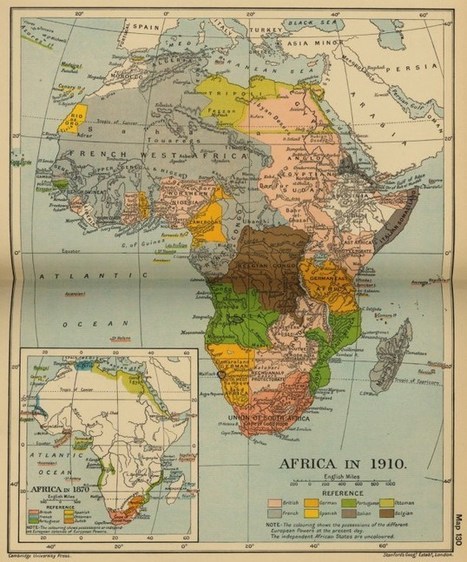
Most people will be forgiven for thinking Africa's borders were always the way they are today. In-fact European colonisation of Africa developed rapidly.
This talk was given at a local TEDx event, produced independently of the TED Conferences. Michael Gavin, associate Professor of human dimensions of natural r...
"Amid expanded college access over the past several decades, as many as 86 percent of on-time high school graduates now continue their education. But the era of “college for all” has yielded a new set of challenges and obstacles for young people and the institutions that serve them, particularly community colleges. In “The New Forgotten Half and Research Directions to Support Them,” James Rosenbaum and colleagues find that many young people who enroll in community college fail to complete their studies and attain a degree, and that these youth fare no better in the labor market than those with only a high school diploma.
"Using data from the nationally representative Educational Longitudinal Survey (ELS), the authors examine the circumstances of youth who drop out of community college before attaining a credential, discuss institutional challenges in the era of increased college access, and outline a research agenda to help youth move beyond "some college" and achieve their potential."
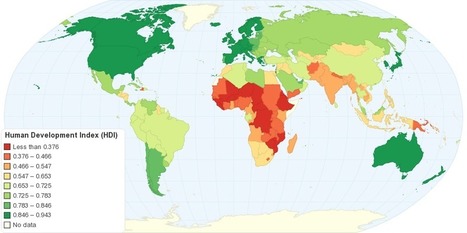
"This map shows Human Development Index (HDI) for 169 countries in the World. The HDI is a comparative measure of life expectancy, literacy, education, and standard of living for countries worldwide. The HDI sets a minimum and a maximum for each dimension, called goalposts, and then shows where each country stands in relation to these goalposts, expressed as a value between 0 and 1, where greater is better. The Human Development Index (HDI) measures the average achievements in a country in three basic dimensions of human development: health, knowledge and standard of living."
This article discusses the Human Development Index (HDI), what it is, and how it is calculated.
This chart displays that the top three spots on the HDI are occupied by Norway, Australia, and the Netherlands respectively, with the USA coming in fourth. As HDI is calculated by comparing aspects like literacy, standard of living, education, and life expectancy, why are two European countries and Australia in the top 3? Something to be looked at is the in-migration of each country. Immigrants arrival in large numbers in some countries can lower HDI if they are refugees or come from a country with a lower HDI, for they may be illiterate, have a low education, and therefore a low life expectancy. With in migration to the US tightly controlled but in constant motion, their HDI could be pulled down to 4th. As Norway and Australia and the Netherlands are not the main destination for refugees, their HDI could be higher.
The HDI is the human development index which ranks countries in many different aspects. The higher the country the more developed and modern it is. The least amount of death and the longest lives are here. It is more stable the higher the country.
This relates to the topic in unit 6 of HDI. this map shows the basic HDIS of the world and the patterns formed by the HDI layout of the world.
This map shows the Human Development Index around the world. The HDI depends on a set list of variables, ranking them from 1st to last. Nations considered to be "Western" are more developed than nations in regions such as Africa and Asia, although all nations are slowly but steadily developing, improving their Human Development Index ranking.
The HDI shows development in nations, although leaving out Inequality factors. This map also allows us to see spatially what regions tend to be more developed as well as developing.
This story of the Palestinians, Israel, Arabs, and Jews has its roots in Germany at the hands of one of the worst dictators the world has ever seen, Adolf Hitler. His ethnic cleansing of Jews via torture, the gas chamber, and starvation, is one of the bleakest times in recorded humanity. The remaining Jews were a people without a land and so it was agreed that Israel would be formed to provide a safe haven. However the land has been disputed, fought over, and the borders changed so many times that it no longer resembles the initial attempt to provide a refuge for the Jews. Ironically, 700,000 Palestinians had been displaced initially and now number 7,000,000 according to the article; all of them designated as refugees. There is no solve for the problems between the Arabs, Jews, Palestinians and Israel as too much blood has been spilled, and forgiveness is a forgotten word. How do you apologize or forgive for generations of bloodshed, displaced families, borders that constantly change, and religions that contradict one another? I'm glad that I wake every day in the USA. We have our own issues to resolve, but nothing approaches the contradictions and paradoxes this area of the world must live with every day.
"For many, a retirement of babysitting grandchildren, golfing and relaxing on the beach is passé. Older people today approach work as a pillar of a retirement lifestyle, planning ahead and adding skills even before leaving their current jobs.
"As demand for more adult learning opportunities accelerates, colleges and universities are trying to figure out how to tap into the market for second careers to bolster their revenue and perhaps build alumni loyalty. The potential audience is huge."
For the purposes of this Scoop.it site, the history of human interaction with information may be divided into 4 eras. The first (spoken) era ended with the invention of writing around 3000-4000 BC. The second era ended with the invention of the printing press in 1440. The third era ended, and the fourth began, with the invention of the Internet (depending how one defines its operational beginning) somewhere between 1969 and 1982. We now exist early, but decidedly, in the fourth era.
All readers may not agree with this interpretation of the history of information, especially with the division and numbering of the eras. That is not the main point. Rather, it is that humankind is presently existing in an era distinctly different from the one that preceded it -- that in fact, this new era is accompanied with, and characterized by, a new - and quite different - information landscape. This new Internet information landscape will challenge, disrupt, and overpower the print-oriented one that came before it. It will not completely obliterate that which preceded it, but it will render it to a subsidiary, rather than primary, level of influence.
Just as the printing press altered humanity's relationship with information, thereby resulting in massive restructuring of political, religious, economic, social, educational, cultural, scientific, and other realms of life; so too will the Internet occasion analogous transformations in the corresponding universe of present and future human activity.
This site will concern itself primarily with how K-20 education in the US, and the people who comprise its constituencies, may be affected by this transformative movement from one era to the next. All ideas considered here appear, to me at least, to impact the learning enterprise in some way. Accordingly, this work looks at the present and the future through a lens that is predominantly, but far from entirely, a digital one. -JL
Opinions expressed, scooped, or copied in this Scoop.it topic are my choice, and are in no way to be connected with my employer.
There is a danger of creating a "them and us" situation by digitising public services, with many people unable or unwilling to go online, a report warns.
An intimate portrait of Amish family life and faith -- this film opens up a world usually kept private. Miriam and David are Old Order Amish and photography ...
Ravisha Mathur Assistant Professor College of Education San José State University Ravisha.Mathur@sjsu.edu
Lisa Oliver Assistant Professor College of Education San José State University loliver@sjsu.edu
Abstract
Building a dynamic international distance education program can be a complex operation. The purpose of this paper is to discuss a model for global learning that utilizes a blended learning approach. This paper will describe how a blended learning approach was implemented in an international instructional technology Master’s program to the benefit of both universities and countries involved. The discussion will focus on a specific framework for developing an international, blended learning program with special consideration of cultural differences in language, teaching philosophy, and education.
The way to eliminate bullying on your campus is to improve school culture. Here are the questions to ask to analyze your school culture, and where to go from there.
Archaeological evidence shows that the Khoikhoi entered South Africa from Botswana through two distinct routes-travelling west, skirting the Kalahari to the west coast, then down to the Cape, and travelling south-east out into the Highveld and then southwards to the south coast. Chiefly, the largest group of the Khoikhoi to remain as a group are the Namas.
Please note this whole section stand UNDER CORRECTION and will change as most of the information is incorrect regarding the Khoikhoi.
This section does not cite any references or sources. Please help improve this section by adding citations to reliable sources. Unsourced material may be challenged and removed. (January 2012)
The Khoikhoi (/ˈkɔɪˌkɔɪ/; "people people" or "real people") or Khoi, spelled Khoekhoe in standardised Khoekhoe/Nama orthography, are the native pastoralist people of southwestern Africa. They had lived in southern Africa since the 5th century AD.[1] When European immigrants colonised the area after 1652, the Khoikhoi were practising extensive pastoral agriculture in the Cape region, with large herds of Nguni cattle. The Dutch settlers labelled them Hottentots (/ˈhɒtənˌtɒts/), in imitation of the sound of the Khoekhoe language,[2] but this term is today considered derogatory.[3]
Archaeological evidence shows that the Khoikhoi entered South Africa from Botswana through two distinct routes—travelling west, skirting the Kalahari to the west coast, then down to the Cape, and travelling south-east out into the Highveld and then southwards to the south coast.[4] Chiefly, the largest group of the Khoikhoi to remain as a group are the Namas.
Contents1 History1.1 Early history1.2 Arrival of Europeans1.3 The Griqua1.4 The Kat River settlement (1829–1856) and the Khoi in the Cape Colony1.5 Massacres in German South West Africa2 Culture2.1 World Heritage3 See also4 References5 Further reading6 External links
History
This section does not cite any references or sources. Please help improve this section by adding citations to reliable sources. Unsourced material may be challenged and removed. (January 2012)
Early history
The Khoikhoi, originally part of a pastoral culture and language group to be found across Southern Africa, originated in the northern area of modern Botswana. Southward migration of the ethnic group was steady, eventually reaching the Cape approximately 2,000 years ago. Khoikhoi subgroups include the Namaqua to the west, the Korana of mid-South Africa, and the Khoikhoi in the south. Husbandry of sheep, goats and cattle grazed in fertile valleys across the region, provided a stable, balanced diet, and allowed the Khoikhoi to live in larger groups in a region previous occupied by the subsistence hunter-gatherers, the San. Advancing Bantu in the 3rd century AD encroached the Khoikhoi territory forcing movement into more arid areas. There was some intermarriage between Migratory Khoi bands living around what is today Cape Town and the San. However the two groups remained culturally distinct as the Khoikhoi continued to graze livestock and the San to subsist on hunting-gathering.
Arrival of Europeans
The Khoi initially came into contact with European explorers and merchants in approximately AD 1500. The ongoing encounters were often violent. Local population dropped when the Khoi were exposed to smallpox by Europeans. Active warfare between the groups flared when the Dutch East India Company enclosed traditional grazing land for farms. Over the following century the Khoi were steadily driven off their land, which effectively ended traditional Khoikhoi life.
Khoikhoi social organisation was profoundly damaged and, in the end, destroyed by colonial expansion and land seizure from the late 17th century onwards. As social structures broke down, some Khoikhoi people settled on farms and became bondsmen (bondservants) or farm workers; others were incorporated into existing clan and family groups of the Xhosa people. The first mission station in southern Africa,[5] Genadendal, was started in 1738 among the Khoi people in Baviaanskloof in the Riviersonderend Mountains by Georg Schmidt a Moravian Brother from Herrnhut, Saxony, now Germany.
The Griqua
See also: Griqua people
Early European settlers sometimes intermarried with the indigenous Khoikhoi, producing a sizeable mixed population known at the time as "Basters" and in some instances still so called, e. g., the Bosluis Basters of the Richtersveld and the Baster community of Rehoboth, Namibia.
Like many Khoikhoi and mixed-race people, the Griqua left the Cape Colony and migrated into the interior. Responding to the influence of missionaries, they formed the states of Griqualand West and Griqualand East which were later absorbed into the Cape Colony of the British Empire.
The Kat River settlement (1829–1856) and the Khoi in the Cape Colony
Khoi marksmen played a key role in the Cape Frontier Wars
By the early 1800s, the remaining Khoi of the Cape Colony were suffering from restricted civil rights and discriminatory laws on land ownership. With this in mind, the powerful Commissioner General of the Eastern Districts, Andries Stockenstrom, facilitated the creation of the "Kat River" Khoi settlement near the eastern frontier of the Cape Colony. The more cynical motives were probably to create a buffer-zone on the Cape's frontier, but the extensive and fertile lands in the region did allow the Khoi to own their land and build their communities in peace. The settlements thrived and expanded, and Kat River quickly became a large and successful region of the Cape that subsisted more or less autonomously. The people were predominantly Afrikaans-speaking Gonaqua Khoi, but the settlement also began to attract numbers from other Khoi, Xhosa and mixed-race groups of the Cape.
The Khoi were known at the time for being remarkably good marksmen, and were frequent and invaluable allies of the Cape Colony in its frontier wars with the neighbouring Xhosa. In the Seventh Frontier War (1846–1847) against the Gcaleka Xhosa, the Khoi gunmen from Kat River distinguished themselves under their leader Andries Botha in the assault on the "Amatola fastnesses". (The young John Molteno, later Prime Minister, led a mixed Commando in the assault, and later praised the Khoi as having more bravery and initiative than most of his white soldiers.)[6]
Harsh laws were still implemented in the Eastern Cape however, to encourage the Khoi to leave their lands in the Kat River region and to work as labourers on white farms. The growing resentment exploded in 1850. When the Xhosa rose against the Cape Government, large numbers of the Khoi, for the first time, joined the Xhosa rebels.
After the war and the defeat of the rebellion, the new Cape Government endeavoured to grant the Khoi meaningful political rights to avert any future racial discontent. William Porter, the Attorney General, was famously quoted as saying that he "...would rather meet the Hottentot at the hustings, voting for his representative, than meet him in the wilds with his gun upon his shoulder",[7] and so the beginnings of the multi-racial Cape franchise was born in 1853. This law decreed that all citizens, regardless of colour, had the right to vote and to seek election in Parliament. This non-racial principle of franchise was later eroded in the late 1880s, and then finally abolished by the Apartheid Government.[8]
Khoikhoi prisoners of war in German South West Africa, 1904
Massacres in German South West Africa
See also: Herero and Namaqua Genocide
From 1904 to 1907, the Germans took up arms against the Khoikhoi group living in what was then German South West Africa, along with the Herero. Over 10,000 Nama, more than half of the total Nama population, perished. This was the single greatest massacre ever witnessed by the Khoikhoi people.
Culture
The religious mythology of the Khoikhoi gives special significance to the Moon, which may have been viewed as the physical manifestation of a supreme being associated with heaven. Tsui'goab is also believed to be the creator and the guardian of health, while Gunab is primarily an evil being, who causes sickness or death.[9]
World Heritage
UNESCO has recognised Khoikhoi culture through its inscription of the Richtersveld as a World Heritage Site. This important area is the only place where transhumance practices associated with the culture continue to any great extent.
See also
South Africa portalHerero and Namaqua genocideNama peopleKhoikhoi mythologyGriqua peopleHistory of South AfricaHottentot Venus
Via KRII-KROTOASA RESEARCH-INTENSIVE INSTITUTE
Understanding and embracing multiculturalism and teaching students cultural competency is critical for competing and succeeding in our diverse democracy. How...
As for-profit colleges proliferate and billionaires publicly push for private charter schools to replace public education, we examine the impact on students, who now carry more debt than the housing sector. David Halperin, a senior fellow at Republic Report, discusses the taxpayer-subsidized for-profit college industry and its successful lobbying efforts. California Competes director Robert Shireman works to rein in abuses by for-profit colleges and student loan companies. He led the Obama administration's efforts to reform student lending. USC researcher, PhD candidate at the Rossier School of Education, and Gates Millennium Scholar Constance Iloh offers a nuanced perspective on the nature of the student presence in the for-profit sector. Her research addresses privatization, access, equity, and the experiences of low-income students and students of color in higher education.
They are out there, hiding in library stacks, whispering in lecture halls, armed with dangerous textbooks and subversive pop quizzes: foreign enemies plotting a stealthy academic invasion of Chinese universities.
So says China’s education minister, Yuan Guiren, who has been issuing dire alarms about the threat of foreign ideas on the nation’s college campuses, calling for a ban on textbooks that promote Western values and forbidding criticism of the Communist Party’s leadership in the classroom.
“Young teachers and students are key targets of infiltration by enemy forces,” he wrote on Feb. 2 in the elite party journal “Seeking Truth,” explaining that “some countries,” fearful of China’s rise, “have stepped up infiltration in more discreet and diverse ways.”
DEFIES MEASUREMENT strengthens the discussion about public education by exploring why it is so important to address the social and emotional needs of every student, and what happens when the wrong people make decisions for schools. For information on how to screen this film for others and for resources to learn more and take action, visit defiesmeasurement.com
"Making allows students to learn by doing and solve problems by tinkering, trial and error. Minecraft is a 3D sandbox game, which has made its way into classrooms because it engages students across a range of subjects. Imagine the learning that happens when these two popular education movements are combined.
"The outcome is a powerhouse of student engagement, says Mike Washburn, head of computer science at Richmond Hill Montessori & Elementary Private School in Toronto, Ontario, Canada. In his mind, games shouldn’t be relegated to the fringes in classrooms. Educators should leverage them to engage students and drive new ways of thinking.
"And when it comes to teaching social studies, a subject that often gets a bad rap when supported by only worksheets and textbook reading, incorporating Minecraft can create an explosion of learning. Game playing takes the “boring” right out of it and can be a highly successful way to teach social studies, Washburn argues."
From ISTE: "Making allows students to learn by doing and solve problems by tinkering, trial and error. Minecraft is a 3D sandbox game, which has made its way into classrooms because it engages students across a range of subjects. Imagine the learning that happens when these two popular education movements are combined.
"The outcome is a powerhouse of student engagement, says Mike Washburn, head of computer science at Richmond Hill Montessori & Elementary Private School in Toronto, Ontario, Canada. In his mind, games shouldn’t be relegated to the fringes in classrooms. Educators should leverage them to engage students and drive new ways of thinking.
"And when it comes to teaching social studies, a subject that often gets a bad rap when supported by only worksheets and textbook reading, incorporating Minecraft can create an explosion of learning. Game playing takes the “boring” right out of it and can be a highly successful way to teach social studies, Washburn argues."
You have to hand it to the Daily Mail. Their writers have perfected the art of pressing people’s buttons; of making highly divisive clickbait, or, as my dad might’ve said, of stirring up sh*t. Last week’s article about British tourists in Greece being outraged by the influx of refugees coming from Turkey caused plenty of outrage and counter-outrage both online and in other parts of the British press. Even by its own standards of outrage, this was outrageously outrageous. Job well done Daily Mail.
The Mail highlighted the incongruous mix of outsiders that have been arriving on the island of Kos in recent weeks. One group are refugees from Syria and Afghanistan, who are seeking refuge in Europe from war, homelessness, and complete desperation back home. The other group are middle- or working-class white holiday-makers from the UK who go to Kos for sun, sea, booze and food. These two groups are not supposed to meet. This isn’t in the script. They might gaze upon at each other’s worlds briefly on TV or computer screens, but physical co-presence between these two worlds is not supposed to happen.
"The branch of China's police in charge of censoring illegal and harmful online information will make its efforts more visible to the public from Monday with the launch of their own ..."
The Chinese government aggressively censors the Internet, blocking many sites it deems could challenge the rule of the Communist Party or threaten stability, including popular Western sites like YouTube, Instagram and Facebook, as well as Google Inc's main search engine and Gmail service. Police in some 50 areas, from metropolises like Beijing and Shanghai to more obscure cities like Xuzhou in Jiangsu province, will open accounts on sites including Weibo, China's answer to Twitter, the ministry said late on Sunday.
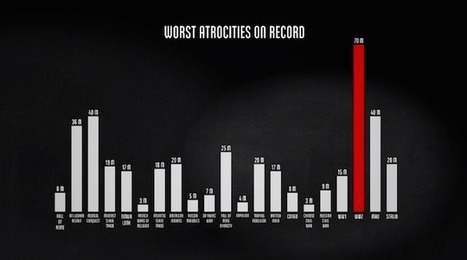
The numbers are truly saddening and absolutely staggering. If you have time on your hands, sit through this illuminating data visualization video that details how many lives were cut short from World War II. It’s a lot. It’s not all bad though, Neil Hailoran, the maker of the video, shows how we’ve grown since then.
A must watch for all the humans, but at the same time don't judge the entire country on the basis of this. I really appreciate the efforts documentary makers...
Kids with Cameras: "And though there is sadness in it [how people live] and though it's hard to face, we must look at it because...it is truth."
Zana Briski's ethnographic cinematography encompassing Calcutta's "red light" district and beyond reaffirms an earlier observation by one of the brothel's children: "She teaches us so well that everything goes into our brains."
"Without help, they're doomed." How does this "Way Out" compare with earlier "ways out" for Australian Aborigines ("Rabbit Proof Fence") and American Indian boarding schools?
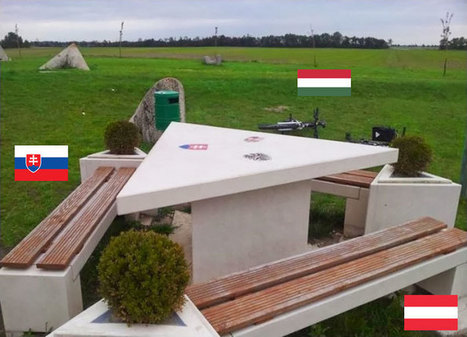
History (and sometimes, unfortunately, current events) shows us just how easily national borders can change, but we still like to think that they are permanent fixtures. These photos of different national borders around the world show you how both friendly and hostile nations like to fence off their turf.
To get content containing either thought or leadership enter:
To get content containing both thought and leadership enter:
To get content containing the expression thought leadership enter:
You can enter several keywords and you can refine them whenever you want. Our suggestion engine uses more signals but entering a few keywords here will rapidly give you great content to curate.


 Your new post is loading...