"What has lead to this marriage squeeze? First, millions women have gone 'missing'. A generation ago, a preference for sons and the greater availability of prenatal screening meant first Chinese couples, then Indian ones, started aborting female fetuses and only giving birth to boys. At its extreme, in parts of Asia, more than 120 boys were being born for every 100 girls. Now, the generation with distorted sex ratios at birth is reaching marriageable age. The result is that single men far outnumber women."
This video talks about the marriage crisis India and China will be facing over the next few decades. The one child rule that was enforced in the region caused many couples to selectively abort their daughters so they could have sons instead, doing this caused a major population gap between men and women. Now as this group of the population where men so drastically outnumber women come of age the countries face a marriage crisis. With men so drastically outnumbering women and marriage being such an important part of the culture in India and China the countries could undergo severe cultural changes.
Check out our ranking list of colleges with the best food, based on ratings and quotes from real students about cafeterias, gluten-free options, and more.
The 49ers quarterback refused to stand for the national anthem Friday, saying, "I am not going to stand up to show pride in a flag for a country that oppresses black people and people of color."
The Boys of '36 premieres August 2, 2016 on PBS American Experience. The story of nine working-class young men from the University of Washington who took the rowing world and the nation by storm when they captured the gold medal at the 1936 Olympic Games in Berlin. Their unexpected victory -- against not only the Ivy League teams of the East Coast but Adolf Hitler's elite German rowers -- gave hope to a nation struggling to emerge from the depths of the Depression.
This was late one night -- actually, early one morning -- in the summer of 2004, at a bustling tavern in Plaka, the social heart of Athens during the Olympics. We could see the Parthenon from our table, where six of us, from six different countries, had just wound up another 16-hour day covering boating, boxing and badminton, convincing our readers in five different languages that we were experts in all of them.
It was the reporter from Naftemporiki, a financial newspaper based in Greece, who said, joking, "I think we all know who wrote the best story today," and he pointed at me.
I was enjoying both my Heineken and the international compliment when the reporter from The Australian newspaper explained the joke to me, which had gone sailing over my head.
"Of course you did, mate," he said. "You wrote it in American!"
This was my colleagues' subtle explanation for what we commonly refer to as the "Ugly American" abroad: a sense of entitlement, however subtle; a feeling of superiority, however unintended. My Aussie friend added, "You aren't really all that ugly. Just slightly disfigured."
Sometimes, as I've traveled overseas, I've been troubled by that notion, of the assumption of the Ugly American. I've thought it a cartoon, a caricature, whose time was surely over.
And then, sometimes, you see someone like Ryan Lochte open his mouth.
And when you hear what comes tumbling out, it all makes perfect sense.
That's the worst part of what Lochte and his stable of stumble-bumbling swimmer pals have done the past few days, now that it's apparent that whatever might have happened to them late one night -- actually, early one morning -- in Rio, it wasn't exactly the way Lochte described it the first time around. In fact, it seems apparent that Lochte and his cohorts in chaos -- Jack Conger, Gunnar Bentz and Jimmy Feigen, all swimmers representing the US in a decidedly different way than Katie Ledecky and Michael Phelps did -- were using the old "robbed-at-gunpoint" chestnut as cover for what was apparently a gas station encounter with a security guard and, quite hilariously, a bathroom door.
Maybe panicky athletes from Kazakhstan or Kenya or Kuala Lampur might have reacted similarly and seized on the easy (though rooted-in-reality) narrative presented for months, that Rio was a cross between the Wild West of yore and the Fort Apache Bronx of the 1970s. Maybe it would have occurred to a rower from Rwanda or a decathlete from Denmark or a sprinter from Spain to go that way. Maybe. But that's not who did this.
Ryan Lochte -- Ugly American with a truly ugly hairstyle -- did it.
So we have him, and his kind, to thank for the suspicious stares we get on the streets of Prague, or the rolled eyes we get standing in line for gelato in Florence, or the curious questions we get from cab drivers in County Clare.
It hasn't been easy being Lochte, who has had to spend his athletic prime competing in Phelps' considerable shadow, who always has been The Other Guy, who always has had to resort to his inherent goofiness to stand out because even his impressive haul of 12 Olympic medals -- six of them gold, including one in the 4x200 freestyle relay last week -- looks like a pauper's pile next to Phelps'. But it hasn't exactly been hard; he's dabbled in show business and reality TV, he dates a Playboy model, he's made millions outside of the pool.
And if what the authorities say happened actually happened: a brawl with a rent-a-cop, a busted door, a little drunk-and-disorderly -- did he really think that was going to hurt his reputation? That's Whitey Bulger fretting over a jaywalking ticket. It's ridiculous.
No, instead he cried wolf and was called on it, and that will be his burden to bear for a good long while -- but not his alone. The Ugly American is alive and well in 2016 thanks to this dope. Thanks for that, Ryan. Now don't let the bathroom door hit you on the ass on your way to Palookaville.
Bangladesh is exposed to threat of hazards resulting from a number of natural disasters and remains classified as one the most vulnerable countries. Majority of the country is affected by cyclone, drought and floods.
Multiple challenges already face residents of Dhaka and Bangladesh in its entirety, but add into the mix climate change and the situation becomes even worse. How does this human induced phenomenon impact upon the population of the developing country and its ever-growing Mega City?
These maps help show all of the natural disasters that Bangladesh is accustomed to. As one look through all of the maps that shows such things such as flood zone, cyclone zones, and drought zones we can tell that this country is ripe with geographical issues that will effect its problems both politically and economically. With this many geographical problems with natural disasters one can only imagine how much money the country spends simply on just rebuilding itself. It is hard to continue to move forward as a country when you need to constantly rebuild. Also you become dependent on other countries with a need for foreign aid for these problems. By needing foreign aid Bangladesh becomes dependent on these countries thus making it harder for them to make good deals for their economy. If you were setting up the perfect location for a country, Bangladesh probably would not be the first place selected. However, we must look at the history of the people that live there and see why this location was chosen? Also we must look at the future and with a changing climate how will it effect Bangladesh geography, and will we eventually see people moving out of the country and how will that effect the surrounding areas and their population.
Why it is important to understand the various communication styles. In business it is essential to build rapport with people that we want to work with. Regardless of whether it is in
American-Indian cooking has all the makings of a culinary trend, but it’s been limited by many diners’ unfamiliarity with its dishes and its loaded history.
The places in this article really gives a whole new meaning to “the middle of nowhere.” People often say they want to settle in the middle of nowhere to be alone, but this article points out that no one actually lives at these exact points, and few people live nearby. This shows that in order to have a successful settlement, people need to have access to both land and water. Without being able to get to both, temperatures become incredibly unbearable, resources are sparse, and access to the rest of the world is very difficult. It is interesting that the part of the earth that is the farthest away from land, Point Nemo, happens to be in Oceania. Oceania is so sparsely populated compared to the other regions of the world, so the fact that the point farthest away from land is located in this region helps to explain this. The closest land to Point Nemo are small islands that are also very isolated. Oceania itself is also generally isolated, since most land is far from the continents, except Australia because it is a continent. The isolation of all these islands means it is difficult to live in these areas, which was probably far worse before globalization brought trade. The people living on the islands of Oceania would have to rely solely on what was on their islands. I am not a person who enjoys isolation very much, so I have no plans to visit these locations any time soon.
In nearly every instance, when the men read from their own compositions, the writing was absorbing, learned and impeccable. All of the men had gained admission, through a competitive application process, to a program initiated by John Jay three years ago that allows prisoners who have high school diplomas or G.E.D.s, and who are eligible for release within five years, to amass college credits, and then when they leave, to complete degrees in the City University system. Ms. Dreisinger is the program’s academic director and founder, overseeing the teaching of art history, F. Scott Fitzgerald, Toni Morrison and so on. She is adamant about the instruction of grammar, which is why the men’s writing stands out even beside what you might find among students at elite high schools where a warning about dangling modifiers is often considered a benighted waste of time.
"The invasion of Iraq was supposed to turn the country into a democracy that posed no threat to the United States, or the rest of the world. Thirteen years later, Iraq has collapsed into three warring states. A third of the country is controlled by ISIS, who have also taken huge amounts of territory in Syria. VICE correspondent Ben Anderson gains exclusive access to the three front lines in Iraq, where Sunni, Shiite and Kurdish forces are fighting for their lives. Anderson visits with the Russian military forces in Syria, meets captured ISIS fighters in Kurdistan, and interviews US policymakers about how the situation in Iraq spun out of control."
It has been said that culture is like an iceberg, that only ten percent of it is visible and the other ninety percent is hidden below the surface. For this reason, ESL teachers must make intentional efforts to teach cultural understanding and tolerance to their students.
Welcome to the Center for Global Peace Journalism at Park University. Learn about peace journalism, explore current projects and read the Peace Journalist Magazine.
Use young children's understanding of differences to teach social justice through age-appropriate literature, news stories, anti-bias lessons, familiar examples, and problem solving.
One more facet of why the field of therapeutic boarding schools, wilderness therapy and RTCs has consistently been growing. How about letting children be children? -Lon
A canyonesque gulf has long existed between open academia and many external subject communities. Since 2011, we have been developing and piloting the public open scholar role (Coughlan and Perryman 2012) - involving open academics discovering, sharing and discussing open educational resources (OER) with online communities outside formal education in order to help bridge this gulf. In 2013 we took the public open scholar into Facebook (Perryman and Coughlan, 2013) to reach an international audience of autism-focussed Facebook groups in India, Africa and Malaysia, with a combined membership of over 5000 people.
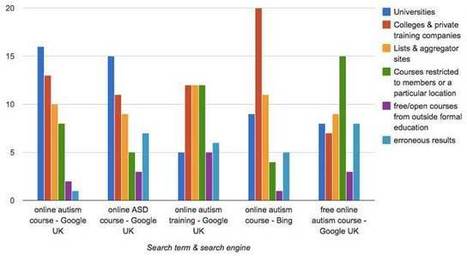
Performing the public open scholar role within Facebook led to our learning from group members about new resources produced by subject communities outside formal education, for example by voluntary sector organisations, government and professional bodies. These resources are surprisingly numerous and compare favourably with those from universities. Seeking to source more such resources we conducted a systematic large-scale search of free online courses, recording not only the number of learning materials available, but also how easy it was to find them.
We found that provision from formal education, especially universities, dominates the returned results when searching for free online courses. Consequently, resources from beyond formal education, while they exist, are difficult to find. Indeed, most aggregators and repositories proudly state that the free online courses they list are from 'Top Universities', appearing oblivious to provision from external subject communities. We extended our research to cover e-textbooks and found a similar situation, with content from formal education again dominating provision.
On the basis of these findings we suggest that the prominence of university-provided content within search aggregators not only marginalises externally produced resources, relegating them to even more obscurity than has been the case thus far, but also marginalises the open educational practices that were involved in the production of these resources. We propose that the OER movement’s questions about ways of involving end-users as co-producers may be answered by looking to external subject communities and, accordingly, we should be supporting and learning from these communities. In addition, there is a need for further research into the open educational practices of external subject communities, who are clearly more than just passive consumers of resources and are involved in both producing and adapting OER.
Our research has also led to our further developing the public open scholar role to include online content curation as a part of the process, on the basis of evidence indicating that online curation has the potential to help increase the discoverability of resources and raise awareness of open educational practices from beyond academia. In particular, we suggest that ‘social curation’ (Seitzinger, 2014) - which foregrounds sharing curated collections as a component of the curation process - has a key role in this regard. We also suggest that further research in this area could be beneficial, for example in exploring the potential for librarians to become involved in curating OER from outside academia. DOI: http://doi.org/10.5334/jime.ab
To get content containing either thought or leadership enter:
To get content containing both thought and leadership enter:
To get content containing the expression thought leadership enter:
You can enter several keywords and you can refine them whenever you want. Our suggestion engine uses more signals but entering a few keywords here will rapidly give you great content to curate.


 Your new post is loading...