Your new post is loading...
Spread the loveIf you have been following my work, you know I spent 7 years a K-12 teacher and 7 years as a university professor, eventually becoming the dean of a school of education. As a teacher, I was passionate about helping students reach their academic potential and become productive citizens. As a professor and education dean, I was devoted to developing the next generation of teachers and education administrators. For the last two and a half years, I have been an education entrepreneur, launching an education company, Lynch Educational Consulting, which also manages the following web properties: The Edvocate, The Tech …
Via Dr. Tom D'Amico (@TDOttawa)
Crowdsourcing should be native to nonprofits, which are designed for collective action and fulfilling the public good. It would be a mistake to see this concept as foreign in the face of a crying need to recommit to substantive engagement as a core practice.
Via june holley
There is even more evidence that African immigrants are more likely to move within the continent than out of it.
Via Igor Espanhol
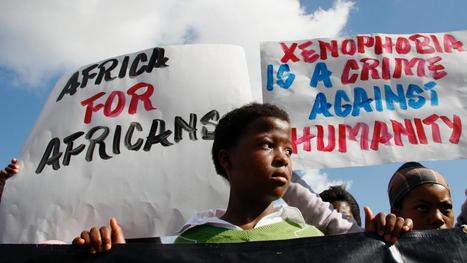
This time, politicians are fuelling the cycle of violence.
Via Igor Espanhol
Dry weather across the East African country is likely to curb its economic growth this year.
Via Igor Espanhol

|
Scooped by
Dennis Swender
April 11, 2019 3:51 PM
|
For those in the Northern Hemisphere, today marks the vernal, or spring equinox, while for those in the Southern Hemisphere, it is the time of the autumnal equinox.
|
|
Scooped by
Dennis Swender
April 11, 2019 12:03 PM
|
What's happened to the vanished Uighurs of Xinjiang?
|
|
Rescooped by
Dennis Swender
from Into the Driver's Seat
April 7, 2019 2:20 AM
|
"In March 23, 1847, a group of Choctaw leaders and others met in eastern Oklahoma to raise money for "the relief of the starving poor in Ireland." They collected $170, which was sent first to the Memphis Irish Relief Committee, then to the General Irish Relief Committee of the City of New York. This gift from an American Indian nation was recognized as extraordinary even at that time; the chairman of the New York committee mentioned it specifically in reports to the Central Relief Committee in Ireland. "Last year, at the beginning of a St. Patrick’s Day visit to the United States, the Irish head of state visited Oklahoma to thank the Choctaw Nation and announce an Irish scholarship program for Choctaw youth. It is not the first time the Irish have remembered the Choctaws' extending their hand. In 1992 a group of Irish men and women walked the 600-mile Trail of Tears, raising $170,000 to relieve suffering in famine-stricken Somalia—$1,000 for every dollar donated by the Choctaw people in 1847. In 2017 a Choctaw delegation took part in the dedication of Kindred Spirits, a sculpture commissioned by the people of County Cork to commemorate the Choctaws' kindness. “These people were still recovering from their own injustice, and they put their hands in their pockets and they helped strangers,” County Councilman Joe McCarthy pointed out at the ceremony. “It’s rare to see such generosity. It had to be acknowledged.”
"The Choctaw Nation was the first of the large southeastern tribes relocated under the Indian Removal Act. Between 1831 and 1833, around 20,000 Choctaw people set out on the journey to Oklahoma from their traditional lands east of the Mississippi River. Historians estimate that 4,000 died along the way. Here Judy Allen, historic projects officer for the Choctaw Nation, describes the Choctaws' original gift to the Irish and how it reflects enduring cultural values." Jim Lerman's insight: Fascinating!
Via Jim Lerman
|
|
Scooped by
Dennis Swender
April 6, 2019 12:55 PM
|
As Jussie Smollett recovers from a racist and homophobic attack in Chicago, his friends are speaking out.
|
|
Scooped by
Dennis Swender
April 6, 2019 12:49 PM
|
Superdiversity has become a popular term to depict the societal impact of migration in Europe, but does its heuristic value justify its popularity? The term sup...
|
|
Scooped by
Dennis Swender
April 6, 2019 12:29 PM
|
[PDF] Download The Flat World and Education: How America s Commitment to Equity Will Determine Our Future (Multicultural Education) Best Ebook download Get Fre…...
|
|
Scooped by
Dennis Swender
April 6, 2019 12:05 PM
|
Abstract
This Article examines the matrix of vulnerabilities that low-income people face as a result of the collection and aggregation of big data and the application of predictive analytics. On one hand, big data systems could reverse growing economic inequality by expanding access to opportunities for low-income people. On the other hand, big data could widen economic gaps by making it possible to prey on low-income people or to exclude them from opportunities due to biases entrenched in algorithmic decision-making tools. New kinds of “networked privacy” harms, in which users are simultaneously held liable for their own behavior and the actions of those in their networks, may have particularly negative impacts on the poor. This Article reports on original empirical findings from a large, nationally-representative telephone survey with an oversample of low-income American adults, and highlights how these patterns make particular groups of low-status Internet users uniquely vulnerable to various forms of surveillance and networked privacy-related problems.In particular, a greater reliance on mobile connectivity, combined with lower usage of privacy-enhancing strategies, may contribute to various privacy and security-related harms. The Article then discusses three scenarios in which big data—including data gathered from social media inputs—is being aggregated to make predictions about individual behavior: employment screening, access to higher education, and predictive policing. Analysis of the legal frameworks surrounding these case studies reveals a lack of legal protections to counter digital discrimination against low-income people. In light of these legal gaps, the Article assesses leading proposals for enhancing digital privacy through the lens of class vulnerability, including comprehensive consumer privacy legislation, digital literacy, notice and choice regimes, and due process approaches. As policymakers consider reforms, the Article urges greater attention to impacts on low-income persons and communities." https://openscholarship.wustl.edu/law_lawreview/vol95/iss1/6/ ;
Via Roxana Marachi, PhD
|
|
|
Scooped by
Dennis Swender
April 13, 2019 12:14 PM
|
Focus on York, Nebraska. Sections include: Diversity in Religion, Immigration, Minorities, KKK, Gypsies, School programs, Flour sack clothes
|
|
Scooped by
Dennis Swender
April 13, 2019 10:25 AM
|
Undocumented Immigrants' State & Local Tax Contributions - Free download as PDF File (.pdf), Text File (.txt) or read online for free. Here is the full report released March 2, 2017 from the Institute on Taxation and Economic Policy.
South Africans are adjusting to the dark a little too easily.
Via Igor Espanhol
Should waving an old flag be declared hate speech when other monuments to apartheid still stand?
Via Igor Espanhol
Facebook is looking to match census data with structure data taken from satellite imagery to better estimate where people are.
Via Igor Espanhol
|
|
Scooped by
Dennis Swender
April 11, 2019 1:32 PM
|
Lee & Low updates our infographic on diversity in children’s book publishing and looks at the 2016 numbers.
|
|
Scooped by
Dennis Swender
April 11, 2019 11:50 AM
|
Each country in the "Now" column was formerly known by a different name, these being presented in the “Then” column. The challenge that awaits you is to match the new monikers with the old ones.
|
|
Scooped by
Dennis Swender
April 6, 2019 12:58 PM
|
Bias is in your brain. Whether or not you're behaving inclusively is in theirs.
|
|
Scooped by
Dennis Swender
April 6, 2019 12:52 PM
|
The ADL said the attack on Jussie Smollet reflected bigotry in America. The ADL has not responded since Smollett's arrest.
|
|
Scooped by
Dennis Swender
April 6, 2019 12:33 PM
|
Lern about what creatures parents use to scare their kids in countries from around the world.
Via Ana Cristina Pratas
"Yes, Virginia, the world did change direction in the late summer of 2001, and it’s been changing us ever since. 9/11 had everything to do it, but it was also the panicky season of the dot.com bust, when little Google, in fear of death, morphed from search service to data mining from its users. Our government, post 9/11, was ready to compromise privacy and underwrite a new science of surveillance—the object was to know everything about everybody. And here we are, not two decades later: Google is a trillion-dollar company, in an industry that knows more than we know about ourselves, and sells it. Omni-analyst Shoshana Zuboff argues we are being re-purposed for a new age of mankind. Shoshana Zuboff is a business school professor and scholar with a Theory of Pretty Much Everything about our American condition in 2019. Unlike most theories of everything, this one is simple enough to remember. It’s also complex and researched enough to feel critically intelligent, not to say: plausible. The theory, in two words, is Surveillance Capitalism, the big business of social-network companies (think: Google, Facebook, Apple) who sift the signals from your phones and laptops to know, moment to moment, your heart’s desire and then sell it to you. Add a fashionable ideology of markets, a culture of consumer comfort, and the force of wealth—and the rest is details. Our disquieting modern condition is not in your mind. It’s in our lopsided landscape, as our guest Shoshana Zuboff maps it in stunning big book, The Age of Surveillance Capitalism."... For original post, see: http://radioopensource.org/under-surveillance-capitalism-in-the-digital-age/# ;
For direct link to audio, see:
http://content.blubrry.com/radioopensource/190124-OS-PODCAST-SurveillanceCapitalism.mp3 ;
Via Roxana Marachi, PhD
|