ED 262 KCKCC Su '26
5.8K views | +10 today
ED 262 KCKCC Su '26
Your new post is loading...
Scooped by Dennis Swender
August 10, 2016 8:33 AM
Scoop.it!

Resources for Creating a Radically Compassionate Classroom

Resources for Creating a Radically Compassionate Classroom | ED 262 KCKCC Su '26 | Scoop.it
As you ponder curriculum, seating, and policies, here are some ideas and resources to consider that will assist you in making your class a welcoming, safe, and inclusive space for your students.
No comment yet.
Scooped by Dennis Swender from Educational Technology News
August 10, 2016 8:29 AM
Scoop.it!

Why You Should be Grading Student Participation in Online Discussion

Why You Should be Grading Student Participation in Online Discussion | ED 262 KCKCC Su '26 | Scoop.it
In online teaching I favor graded participation in discussion rooms. It enhances and fosters learning, while also increasing student-to-student engagement.

Via EDTECH@UTRGV
No comment yet.
Scooped by Dennis Swender from Educational Technology News
August 10, 2016 8:27 AM
Scoop.it!

The Generational Gap in EdTech Perception with Gen Z

The Generational Gap in EdTech Perception with Gen Z | ED 262 KCKCC Su '26 | Scoop.it

"Gen Z members have never known a world without technology, so how can teachers balance their edtech expectations in the classroom?"


Via EDTECH@UTRGV
No comment yet.
Scooped by Dennis Swender from :: The 4th Era ::
August 4, 2016 1:30 PM
Scoop.it!

How international students are keeping US colleges afloat and powering the tech industry

How international students are keeping US colleges afloat and powering the tech industry | ED 262 KCKCC Su '26 | Scoop.it
International students are fundamentally transforming U.S. higher education, but as recent events demonstrate, these young people are not here to simply foot the bill and silently create economic benefits to the U.S. economy. As the country gains more and more students (and eventual workers) from abroad, there are big questions around how institutions need to accommodate these populations and ease the growing pains, from student relations to housing to classrooms and syllabi to student bank accounts and credit cards to work visas.


Via Jim Lerman
No comment yet.
Scooped by Dennis Swender from Educational Technology News
August 4, 2016 1:29 PM
Scoop.it!

What Makes A Successful Online Learner

What Makes A Successful Online Learner | ED 262 KCKCC Su '26 | Scoop.it
Nowadays, there are a lot of different opportunities online to continue your education, take classes, or earn a degree

Via EDTECH@UTRGV
Dr. Helen Teague's curator insight, August 4, 2016 1:13 PM
By Elana Goodwin-- 6 points
Scooped by Dennis Swender from Educational Technology News
July 27, 2016 7:44 PM
Scoop.it!

10 Benefits of Online Learning

10 Benefits of Online Learning | ED 262 KCKCC Su '26 | Scoop.it
If you think classroom training is hard work, you might be interested in the benefits of online learning. There's loads, but here are 10 to get you started.

Via EDTECH@UTRGV
No comment yet.
Scooped by Dennis Swender from MiniTool Software Solution
July 21, 2016 1:06 AM
Scoop.it!

Online learning for beginners: 2. Isn’t online learning worse than face-to-face teaching? | Tony Bates

Online learning for beginners: 2. Isn’t online learning worse than face-to-face teaching? | Tony Bates | ED 262 KCKCC Su '26 | Scoop.it
The short answer to this question is: no, online learning is neither inherently worse – nor better – than face-to-face teaching; it all depends on the circumstances.
The research evidence

There have been thousands of studies comparing face-to-face teaching to teaching with a wide range of different technologies, such as televised lectures, computer-based learning, and online learning, or comparing face-to-face teaching with distance education.

With regard to online learning there have been several meta-studies. A meta-study combines the results of many ‘well-conducted scientific’ studies, usually studies that use the matched comparisons or quasi-experimental method (Means et al., 2011; Barnard et al., 2014). Nearly all such ‘well-conducted’ meta-studies find no or little significant difference in the modes of delivery, in terms of the effect on student learning or performance. For instance, Means et al. (2011), in a major meta-analysis of research on blended and online learning for the U.S. Department of Education, reported:

In recent experimental and quasi-experimental studies contrasting blends of online and face-to-face instruction with conventional face-to-face classes, blended instruction has been more effective, providing a rationale for the effort required to design and implement blended approaches. When used by itself, online learning appears to be as effective as conventional classroom instruction, but not more so.

However, the ‘no significant difference’ finding is often misinterpreted. If there is no difference, then why do online learning? I’m comfortable teaching face-to-face, so why should I change?

This is a misinterpretation of the findings, because there may indeed within any particular study be large differences between conditions (face-to-face vs online), but they cancel each other out over a wide range of studies, or because with matched comparisons you are looking at only very specific, strictly comparable conditions, that never exist in a real teaching context.

For instance the ‘base’ variable chosen is nearly always the traditional classroom. In order to make a ‘scientific’ comparison, the same learning objectives and same treatment (teaching) is applied to the comparative condition (online learning). This means using exactly the same kind of students, for instance, in both conditions. But what if (as is the case) online learning better suits non-traditional students, or will achieve better learning outcomes if the teaching is designed differently to suit the context of online learning?

Via Miloš Bajčetić, Lynnette Van Dyke, MiniTool Software
sordinicomp's comment, July 20, 2016 10:50 PM
Its splendid :)
Scooped by Dennis Swender from Learning & Technology News
July 15, 2016 12:46 PM
Scoop.it!

The Future of Jobs

The Future of Jobs | ED 262 KCKCC Su '26 | Scoop.it
The Fourth Industrial Revolution is interacting with other socio-economic and demographic factors to create a perfect storm of business model change in all industries, resulting in major disruptions to labour markets. New categories of jobs will emerge, partly or wholly displacing others.

Via Nik Peachey
Nik Peachey's curator insight, June 24, 2016 4:55 AM

Interesting in terms of the skills that will be needed by our kids.

Scooped by Dennis Swender from Lambertn's Library Lowdown
July 15, 2016 12:36 PM
Scoop.it!

Don’t blame the students

Don’t blame the students | ED 262 KCKCC Su '26 | Scoop.it
I’ve mentioned before that I’m on this year’s YALSA Excellence in Non-Fiction for Young Adults award committee and will be spending eight hours over this next weekend discussing t...
Via Nancy Jo Lambert
No comment yet.
Scooped by Dennis Swender from Blogging in the Classroom
July 15, 2016 12:31 PM
Scoop.it!

Leaving Good Blog Comments (By Bill Ferriter)

Leave comments that further the conversation!


Via jamie camp
No comment yet.
Scooped by Dennis Swender from digital marketing strategy
July 13, 2016 8:54 AM
Scoop.it!

Constructive engagement in destructive times

Constructive engagement in destructive times | ED 262 KCKCC Su '26 | Scoop.it
The violence in the news has fueled divisive and hateful social discourse. Here are some tips for constructive engagement when the tempers are high.

Via malek
malek's curator insight, July 11, 2016 8:04 AM

some approaches to constructive engagement that can result in win-win situations — even when hate is spewing from people on the other side of the screen.

Scooped by Dennis Swender
July 8, 2016 10:29 AM
Scoop.it!

Report highlights rapid rise in prison spending over education

Report highlights rapid rise in prison spending over education | ED 262 KCKCC Su '26 | Scoop.it
News, voices and jobs for education professionals. Optimized for your mobile phone.
No comment yet.
Scooped by Dennis Swender from Woodbury Reports Review of News and Opinion Relating To Struggling Teens
July 8, 2016 10:21 AM
Scoop.it!

The cult of ignorance in the United States: Anti-intellectualism and the "dumbing down" of America -- Sott.net

The cult of ignorance in the United States: Anti-intellectualism and the "dumbing down" of America -- Sott.net | ED 262 KCKCC Su '26 | Scoop.it
There is a growing and disturbing trend of anti-intellectual elitism in American culture. It's the dismissal of science, the arts, and humanities and their replacement by entertainment, self-righteousness, ignorance, and deliberat

Via Ken Morrison, Lon Woodbury
Lon Woodbury's curator insight, June 16, 2016 11:09 AM

An interesting, and debatable, essay on how we are missing out on the basic  goal of education in the US. -Lon

Scooped by Dennis Swender from Learning & Technology News
August 10, 2016 8:29 AM
Scoop.it!

What Meaningful Reflection On Student Work Can Do for Learning

What Meaningful Reflection On Student Work Can Do for Learning | ED 262 KCKCC Su '26 | Scoop.it
Students who are not naturally inclined to stop and think need explicit practices to nudge themselves toward quality reflection—and digital tools to make it easier. Keeping a log of tasks and habits, for example, gives students a rich source of data to mine when reflecting on their progress, and there are many apps that will collect and aggregate this information in accessible and attractive ways.

Via Nik Peachey
Nik Peachey's curator insight, August 8, 2016 8:59 AM

This is a bit of a sales pitch for a book but worth reading even if you aren't interested in buying the book.

ALLien's curator insight, August 17, 2016 10:09 PM
Meta-cognitive reflection, its importance to learning + digital tools for facilitation
Scooped by Dennis Swender from iPads, MakerEd and More in Education
August 10, 2016 8:28 AM
Scoop.it!

How Art and Dance Are Making Computer Science Culturally Relevant (EdSurge News)

How Art and Dance Are Making Computer Science Culturally Relevant (EdSurge News) | ED 262 KCKCC Su '26 | Scoop.it
This fall, my computer science class will follow the new AP Computer Science curriculum framework while also including culturally responsive instruction that makes use of students’ interests, community settings, and cultural and ethnic backgrounds. Some of the students enjoy freestyle rap and dance, so they will learn how to simulate or enhance their performances using code. Other students study drawing and painting, so they will learn how to use code to create their artwork. This approach is a gateway to computer science, using coding to foster creative expression, and supporting cultural responsiveness that addresses underrepresented students’ lack of exposure to computer science.

Via John Evans
No comment yet.
Scooped by Dennis Swender from :: The 4th Era ::
August 4, 2016 1:31 PM
Scoop.it!

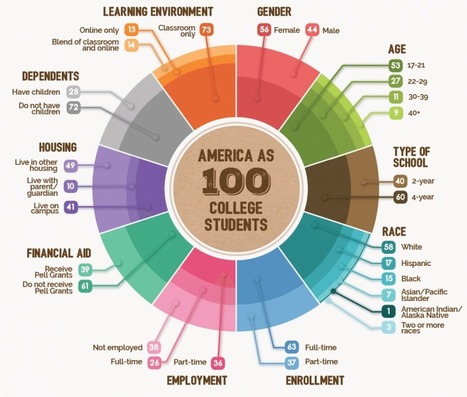
This chart debunks some common myths about university students :: World Economic Forum

This chart debunks some common myths about university students :: World Economic Forum | ED 262 KCKCC Su '26 | Scoop.it
Everybody has an idea of what university is like. Whether you just graduated, left many years ago, or opted to go straight into the workforce, higher education often evokes images of packed lecture theatres, libraries filled with studious young people, and rowdy dorm rooms.

But as this graphic from the Bill and Melinda Gates Foundation shows, modern US higher education doesn’t necessarily conform to those stereotypes.

Via Jim Lerman
Jim Lerman's curator insight, August 4, 2016 11:53 AM

Interesting chart and interesting article

Scooped by Dennis Swender
August 4, 2016 1:30 PM
Scoop.it!

2016’s States with the Best & Worst School Systems

2016’s States with the Best & Worst School Systems | ED 262 KCKCC Su '26 | Scoop.it
No comment yet.
Scooped by Dennis Swender from Educational Technology News
August 4, 2016 1:29 PM
Scoop.it!

What Makes e-Learning Work?

What Makes e-Learning Work? | ED 262 KCKCC Su '26 | Scoop.it
Ethan Edwards discusses the characteristics that make up good e-learning.

Via EDTECH@UTRGV
Tony Guzman's curator insight, August 7, 2016 10:28 PM
While many would consider the needs for successful eLearning different than traditional learning this article shows that not to necessarily be the case.
Scooped by Dennis Swender from MiniTool Software Solution
July 21, 2016 1:06 AM
Scoop.it!

10 Lesson Plans to Develop Digital Literacies

10 Lesson Plans to Develop Digital Literacies | ED 262 KCKCC Su '26 | Scoop.it

Over the last few months I have been working hard to develop a set of commercially available lesson materials. These lesson plans aren't specifically designed for English language learners, though they will be useful for students at higher levels who want stimulating skills based practice or for any teacher interested in developing a CLIL or content based approach to language learning. They were designed to enable any teacher to develop students in a way that is more closely aligned to the kinds of skills they will need to function effectively and critically in the digital world.


Via Nik Peachey, MiniTool Software
Jennifer Furr's curator insight, March 13, 2016 10:42 PM

A collection of 10 of my lesson plans designed to develop critical thinking and digital literacy.

Dave Sharp's curator insight, May 10, 2016 6:21 PM
Lesson plans and activities to help with literacy for all ages. This program is  designed to focus on giving specific skills to a student studying literacy at all levels. The 10 lessons also give the teacher access to relevant information required when catering for a students needs.
Santiago Cordoba Arcila's curator insight, March 9, 2020 1:29 AM
Here we can see how technology can support the process of learning a language by exploring in different ways. Using some visual input and different activities, students are expected to develop spoken fluency, reading comprehension, critical thinking and use of English. This is what this article contains, ten lesson plans that teachers can buy in order to improve their classes with technology.
Scooped by Dennis Swender from Learning & Technology News
July 15, 2016 12:47 PM
Scoop.it!

Tween Online Habits, Revealed

Tween Online Habits, Revealed | ED 262 KCKCC Su '26 | Scoop.it

Most toddlers can swipe an iPad, tap an e-book, and call grandma on mom’s phone, so you’d think that kids in upper elementary school would be seasoned digital users and experts at navigating the web. As it turns out, a new study published in the International Literacy Association’s Reading Research Quarterly has found that we don’t know as much as we thought about the online activities, preferences, and skills of the preadolescent set.


Via Nik Peachey
Nik Peachey's curator insight, June 24, 2016 12:35 AM

Links to a useful report.

Scooped by Dennis Swender from Learning & Technology News
July 15, 2016 12:44 PM
Scoop.it!

The Future of Education

The Future of Education | ED 262 KCKCC Su '26 | Scoop.it
Most importantly we need to be empowering our learners to take charge of their learning, to show them how they may control their pathways and become genuinely agent learning. Such a process is a significant shift for educators and our knowledge of the processes of learning rather than our subject knowledge is what matters most.

Via Nik Peachey
Nik Peachey's curator insight, July 5, 2016 4:31 AM

Not much to disagree with here.

Scooped by Dennis Swender from Lambertn's Library Lowdown
July 15, 2016 12:34 PM
Scoop.it!

Why Digital Natives Need Help With Technology

Why Digital Natives Need Help With Technology | ED 262 KCKCC Su '26 | Scoop.it
Education Week Teacher's take on the latest news, ideas, and resources for teacher leaders.

Via Nancy Jo Lambert
No comment yet.
Scooped by Dennis Swender from Blogging in the Classroom
July 15, 2016 12:28 PM
Scoop.it!

30 Digital Classroom Blogs From Around The World | Edudemic

30 Digital Classroom Blogs From Around The World | Edudemic | ED 262 KCKCC Su '26 | Scoop.it

Via jamie camp
No comment yet.
Scooped by Dennis Swender
July 8, 2016 10:32 AM
Scoop.it!

A New Argument for More Diverse Classrooms

A New Argument for More Diverse Classrooms | ED 262 KCKCC Su '26 | Scoop.it
U.S. Education Secretary John King will argue that interactions with children from different backgrounds prepare students for the workforce.
No comment yet.
Scooped by Dennis Swender
July 8, 2016 10:25 AM
Scoop.it!

If diversity is a priority, here are 40 ways to act on it right now

If diversity is a priority, here are 40 ways to act on it right now | ED 262 KCKCC Su '26 | Scoop.it
Leaving Inspirefest, Lucy Fuggle took away no less than 40 ideas for creating a more diverse and inclusive professional environment.
No comment yet.