More than 6 million students took at least one online course in 2015, representing more than a quarter (29.7 percent) of all higher education enrollments that year, according to a new report from Digital Learning Compass. Among that 29.7 percent, it's almost evenly split between students who took some but not all courses online (15.4 percent) and those who took every class online (14.3 percent). In contrast, total online enrollments in 2002 came in just under 10 percent.
However, digital equity is not a magic fix for closing the achievement gap. The achievement gap existed long before the invention of the internet. Creating true equality for all students is far more complex than simply giving them all laptops. Further studies have shown that even when students in high-poverty schools have greater access to technology than their peers in low-poverty schools, their test scores remain lower.
While digital equity is a part of closing the achievement gap, it's not the solution. Digital technology can be used to widen the achievement gap or to help close it.
While photoshopped imagery seems pretty innocuous, hardcore beliefs about cultures, education, or even language learning itself, can be wrong. Yet despite sometimes overwhelming evidence to the contrary, some individuals in our society refuse to budge.
Even today’s students need support with some areas of digital practice, particularly in an academic context, so it’s important to make sure that these needs are met.
While employability is an obvious driver, developing learners who can learn and thrive in a digital society is a key role for universities and colleges.
The massive shifts technology and globalization are expected to wreak on the workplace have already begun. In many industries and countries, some of the most in-demand jobs didn’t even exist five or 10 years ago — and the pace of change will only accelerate.
In April, Google introduced a revamped, reimagined version of Google Earth, which included a number of new features that go beyond visualizing the planet..
Prominent Native American woman JoAnn Kauffman, Nez Perce, received an honorary doctorate and was among the commencement speakers at Eastern Washington University.
Students say that in order for high schools and colleges to better serve them, it is important to challenge the assumption that students are digital natives. This starts with educating professors about the technological diversity in their classrooms and providing students with workshops and engaging videos to help them learn without shame.
The idea of being a digital native has been unsubstantiated for a while but the myth still persists - this dispels some of that. Remember it's more likely to be digitally confident not competent
I met Luis Torres in 2013 when he enrolled as a freshman. Before he arrived at Williamson, he spent nearly a decade living with various relatives in one of the poorest neighborhoods in Philadelphia because his parents were financially unable to take care of him. Ultimately, he became a discipline problem and had a difficult …
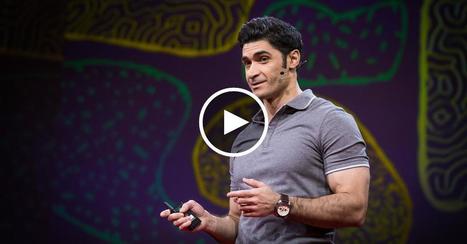
"Attention isn't just about what we focus on -- it's also about what our brains filter out.
By investigating patterns in the brain as people try to focus, computational neuroscientist Mehdi Ordikhani-Seyedlar hopes to build computer models that can be used to treat ADHD and help those who have lost the ability to communicate.
Hear more about this exciting science in this brief, fascinating talk."
According to research, between 10 and 40% of kids who intend to go to college at high school graduation don't show up in the fall. This phenomenon, known as "summer melt," has puzzled universities.
Against this background, learners in the 21st Century will be expected to develop their ability to communicate, interact, clinch deals, and collaboratively work with individuals from other cultural groups across the globe.
by Kristen Campbell Wilcox, Hal A. Lawson & Janet Angelis — 2015, University at Albany
"Purpose/ Research Question: The purpose of the study was to identify differences between schools with typical literacy performance among diverse students and schools where diverse students exceeded predicted performance. Primary research questions were: What qualities of literacy instruction are characteristic of elementary schools with higher literacy achievement among ethnically and linguistically diverse students? Compared to schools with average literacy achievement among diverse students, what are the proximal and distal factors that describe and explain significantly different diverse student literacy achievement outcomes?"
By challenging the assumption that every child growing up today is a one-size-fits all digital native, we can make sure each of them can find their own way to relate to technology — whether using it to accomplish basic tasks or to create new technologies and worlds. Being aware of our kids’ differences now is what could help keep them from drifting apart.
A much more nuanced view, and one that I appreciate. I have long called so-called digital natives "digital naives" because the majority of kids only know enough about tech to use it to accomplish what they wish to accomplish. Tech does not really come any easier for them. Tech is simply more common to them.
"The McDonalds's of the sustainable building industry"
Sky City, which was envisioned to be the world's tallest prefabricated building with 202 floors encased in glass, was scaled back to 57 floors and 800 apartments. Nevertheless, after the foundation was laid, the building was constructed at a rate of 3 floors a day. In the past, super tall buildings demanded 5-10 years to construct, whereas Sky City needed only 19 days, as the floors were assembled like layers of a wedding cake or Lego blocks..
The building is 9 magnitude earthquake-resistant, 5 x energy efficient, and 20 x purer air, making indoor air cleaner than outdoor air. The building is located near Dongting Lake, in the Hunan Province of China, and is one of several sustainable building packages throughout China, Russia, India, and several other 2nd and 3rd world countries.
Constructing a Wall or Constructing a Building, China continues to demonstrate product innovation and excellence. .Several criticisms, however, continue to be voiced by U. S. construction officials.
Only 37% of American 12th-graders were academically prepared for college math and reading in 2015, a slight dip from two years earlier, according to test scores released Wednesday.
Via Advisor Sereno
In class discussions, students often speak only to the teacher—and the teacher responds to every point. Inspired by Stephen D. Brookfield and Stephen Preskill's Discussion as a Way of Teaching, I've written a structured protocol for class discussion that gets students talking to each other. So far, it's leads to much more give-and-take among students.
"As Chung suggests, the 21st-century global citizen’s cognitive skill set includes traditional, testable basics such as math and literacy, but extends beyond that to encompass a particularly strong emphasis on the world in which we live. “Current events highlight some of the fears around otherness,” she says. The key to informed citizenship is getting to know other cultures — and valuing them.
In addition to rounding out kids’ knowledge base to include a nuanced understanding of world geography and cultures, schools must teach them the skills to use this knowledge as active and engaged citizens.”
Spend five minutes taking this quiz, and you’ll find out what factors were working in your favor and what you had to overcome to get where you are today. At the end, you’ll receive an overall score and a personalized summary of the results (and probably a big dose of pride and gratitude). Learn more …
It helps America for the young to study and work abroad in an increasingly globalized world. That’s why I’m pleased to see a surge of interest among Franklin & Marshall College students in the Fulbright Teaching Assistantship program, which sends graduates to teach English in some 50 countries.
To get content containing either thought or leadership enter:
To get content containing both thought and leadership enter:
To get content containing the expression thought leadership enter:
You can enter several keywords and you can refine them whenever you want. Our suggestion engine uses more signals but entering a few keywords here will rapidly give you great content to curate.


 Your new post is loading...