


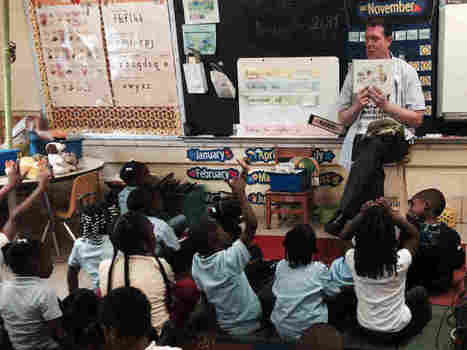

A growing body of research suggests that teaching really young kids how to recognize and express their feelings can help them into their adult lives.

 Your new post is loading...
 Scoop.it! A growing body of research suggests that teaching really young kids how to recognize and express their feelings can help them into their adult lives.
Beth Dichter's insight:
Should schools "teach kids about emotions and conflict negotiation in the same way they teach math and reading?" There are many who say yes to this question, and this piece from NPR provides a look at why it should be considered. There is a program called Promoting Alternative Thinking Strategies (PATHS) that helps students recognize and express their emotions. Twiggy the Turtle is a key character, and with Twiggy students learn skills to use, skills that help them with social-emotional learning. The program has been around since 1980. In 1991 Kenneth Dodge, a psychologist at Duke University, began a long-term study to see how programs that helped teach about social-emotional learning actually worked. His work was recently published in the American Journal of Psychiatry and the data shows they are successful. The joy of finding great resources on PBS is that you can choose to read the text or to listen to the program. To learn more about this work click through to the post.
Scoop.it!
Beth Dichter's insight:
Edutopia has been sharing some of their top posts for 2014 and this one caught my eye. What are 11 habits of effective teachers? Five of the habits are listed above (in the image). The rest may be found in the post. Each is also explained. Do you have other habits that you think should be considered? If so, share them below. (The image comes from Edutopia's Facebook page and is in the photo area.)
Scoop.it!
Beth Dichter's insight:
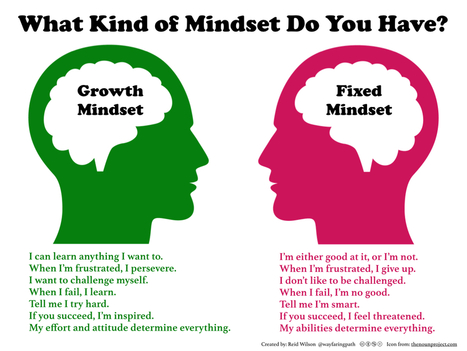
The infographic above is geared to elementary students. Research shows that if we teach students about their brain, and about growth mindset and fixed mindset it makes a difference. Consider sharing this with your students and have them answer the questions. Some may find that they are holding themselves back based on their mindset. Students could share strategies that they use when they find themselves falling into areas of a fixed mindset.
Scoop.it!

What is possible in a learning environment today? One idea you might want to explore is Connected Learning. "CLA is on our short list of thought leaders that help push us to think about how education is changing in a modern world, which is why we’ve shared some of their models in the past, including their iconic Connected Learning model. Recently, we also discovered that they’ve shared the design principles of that model, along with a description of each."
Beth Dichter's insight:
Connected Learning looks at digital technology and how we can use it to aide our learners. The image above shows their learning principles and design principles. There are three of each. Learning Principles: * Interest Powered * Peer-Supported * Academically Oriented Design Principles: * Production-Centered * Openly Networked * Shared Purpose Connected Learning provides opportunities for students "to experience learning that is social, participatory, interest-driven and relevant to the opportunities of our time." You will find additional information on the Learning and Design Principles as well as a short video in the post. 
Tony Guzman's curator insight,
December 30, 2014 10:59 AM
This article shares the Connected Learning model and its principles for learning and how to design your course to follow the model. Anyone using this already?
Scoop.it!
Full Article: http://trainugly.com/portfolio/learning/ Our brains our designed to learn the best when we're operating at the edge of our abilities, stretched...
Beth Dichter's insight:
Learn why it is important to stretch your brain, to try new things (and to fail) and to continue to try and improve. Learn about our "Lizard Brain" (also known as the amygdala),an important component of our brain that impacts how we learn, but the learning is related to the time when humans hunted in the wild. This part of the brain holds us back in many ways, and although it once protected us now it tends to hold us back. What can we do about this? The video explores this and discusses some of the ways we can "dance" with this "Lizard Brain" and move from a fixed mindset to a growth mindset. For more information take the time to watch this video. 
Dr. Helen Teague's curator insight,
December 23, 2014 9:28 AM
especially good at about 6 minutes in... see also the trainugly.com website
Scoop.it!

I love end of year “best of” lists. My own list is what I found to be the most powerful education related videos of 2014. They all, in some way, address the mind, heart, and spirit of education. ...
Beth Dichter's insight:
Finding great educational videos takes time...so I am always excited when I find a list of suggested video. Jackie Gerstein shares her top 11. They range from just over three minutes to about seventeen minutes. Below is a list of the videos. * Malala Yousuf Nobel Prize Speech * Carol Dweck: The Power of Believing You Can Improve * Sir Ken Robinson: Can Creativity Be Taught * President Obama on the Whitehouse Maker Faire * Toxic Culture of Education: Joshua Katz * The necessity of the student voice | Catherine Zhang * Rethinking Learning in the Digital Age – Mitchel Resnick * If I Knew Then: A Letter to Me on My First Day Teaching * Kid President Throws a Surprise Party for a Retiring Teacher * Erzah French: Sportskid of the Year * Malcolm Mitchell Book Club You will find brief descriptions for most of these videos and I suspect that many will choose to watch all of them over a period of time. You may find one or two that would be great to share at a faculty meeting. 
Meg Swecker's curator insight,
December 19, 2014 1:03 PM
A 'must view' list of educationally related videos.
Scoop.it!
Beth Dichter's insight:
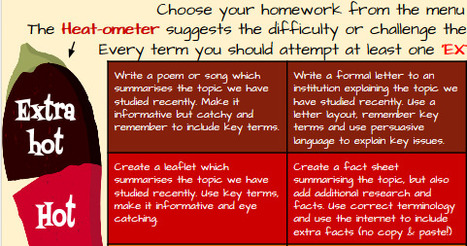
Here is a great idea to provide differentiation in homework. The Heat-ometer provides four levels, from mild (not shown in the image above) to medium (also not shown) to hot and extra hot. each level is more complex than the previous level, and 3 options are provided for each level. The designer of this image also provides links to the original design, which is located at Take Away Homework.
Scoop.it!
Beth Dichter's insight:
Last year I used fast foods as a way to teach students graphing (and nutrition). When surveying students as to their favorite fast food restaurants McDonald's was often at the top. This infographic provides a great deal of information that may be new to students. This infographic shows: * Just how big McDonald's is (and the number may surprise you) * The one location where the Golden Arches are not golden * Where McDonald's are located (a world map with percentages of McDonald's based on area) * The one fast food restaurant that has more locations that McDonald's * The number of employees worldwide (as well as the number of hamburgers and customers served) And much more. You can have fun with maps that look at fast food locations across the US as a tool for students to learn how to interpret visualizations as well as do some calculations. One source you might check out is listed below. * A map of all the McDonald's in the U.S. (published in 2009 and updated in 2010 at http://www.datapointed.net/2010/09/distance-to-nearest-mcdonalds-sept-2010/
Scoop.it!

"Most of the time, it’s nothing more than an innocent effort to save face. Our brain will tell us we’re smarter and better looking than everyone else, and that any fault brought to our attention should probably be blamed on someone else..."
Beth Dichter's insight:
Do you know that your brain may sabotage you? This posts looks at sixteen ways the brain may set "traps" that lead us astray. Additional resources are also listed in many of these "traps." * Equating Knowing With Learning. It takes time for us to really "learn" something, which means we need to review this new information so we can move it from short-term storage to long-term storage. * Being Biased Towards Ourselves. If you bomb a test or assignment do you tend to base blame on others? This is one example of being biased toward ourselves. We blame the book, teacher...the list could go on. * Making Us Think We Can Multi-task. What happens when you multi-task? Your brain is quickly switching back and forth between multiple task your brain becomes overloaded and cannot perform at full capacity. To read more about these three items, and learn about the other 13 ways your brain may try to trick you click through to the post.
Scoop.it!
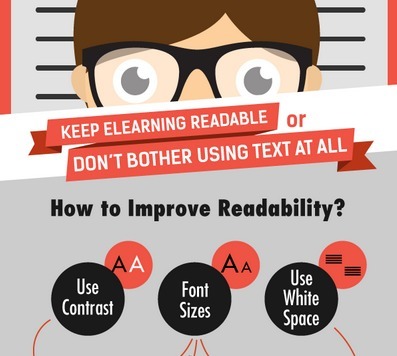
To ensure learners get the most of your written eLearning content make your text as easy as possible to consume. These readability guidelines will help you out.
Beth Dichter's insight:
Do you know the best ways to design an eLearning course? SH!FT provides excellent resources and this post discusses readability. Learn more about: * What makes people want to read * The best fonts to use (think easy to read) * How to design eLearning for readability, which includes - Strategies to improve readability which includes five recommendations You will also find an infographic that shares this information. 
Mike Clare's curator insight,
January 6, 2015 10:08 AM
This may be simple but do we always follow the advice given? I know I am gulity.
Scoop.it!

" "Recently, #cohort21 hosted a twitter chat on a topic near and dear to our hearts: learning models and frameworks. We have our own ideas about what they’re so important, but this isn’t about us, is it? This being 2014, the #twitterchat conversation, of course, quickly turned to SAMR and TPACK, and educators shared their favorite versions, how they used them, and what future needs in the space might be. Archived twitter chats make for wonderful quick reads, and can include some gems (the Starbucks analogy, for example), so, here you go. #twitterchat: Why Teachers Like Learning Models, all in one place."
Beth Dichter's insight:
What happens when you host a twitter chat the the topic turns to learning models and frameworks? Check out this post that takes a twitter chat that discussed this topic and then storified the discussion. If you don't know about SAMR (check out the image above) or TPACK you may find posts in this Scoop.it on each (just type in the keyword). And you may find yourself participating in one of these twitter chats down the road!
Scoop.it!
Beth Dichter's insight:
This issue of the UKED magazine has one article that you should check out. They surveyed teachers and asked ideas they had found on Twitter and implemented in their classroom. The top 25 are shared in this article, and many include a link to additional resources. There are many that you will know, but there are a few that were new to me (at least, the acronyms the used were). Below is a list of five of the ideas, which they refer to as pedagogies. Check out the link to see a larger version of the image above as well as additional information on each.(And this article starts on page 19 in the magazine.) * FiSH feedback (which stands for Friendly, Informative, Specific and Honest feedback) * DIRT feedback (which stands for Dedicated Improvement and Reflection Time) * Virtual Global Exchanges * Takeaway Homework 
Janet McQueen's curator insight,
December 10, 2014 4:32 PM
A resource of ideas that teachers have found implemented in their classrooms. With useful links provided.
Scoop.it!
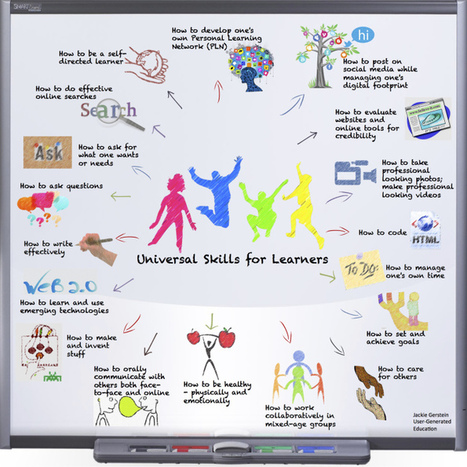
"This morning I was thinking about the things that all young people should know how to do regardless of income, geographical location, life goals, etc. I started a list – see below. Some have “always” been true – some are unique to this century of learning. Let me know of any other universal skills you believe young people should know how to do."
Beth Dichter's insight:
What do young people need to know? Jackie Gerstein provides a great visual as well as a list of 18 ideas, and each has a link for additional information. She also requests that you send her additional ideas. After you review the list you might consider how many of these skills are taught in your school, or consider which should be taught in school. * How to be a self-directed learner – finding and using resources (both face-to-face and online) to learn and improve personal interests * How to evaluate websites and online tools for credibility * How to work in mixed-age groups * How to code * How to set and achieve goals 
Kimberly House's curator insight,
December 7, 2014 12:16 PM
The best question she asks is 'Which are taught in school? Which should be?' These are great questions to explore as a staff in looking at these universal skills. |
Scoop.it!
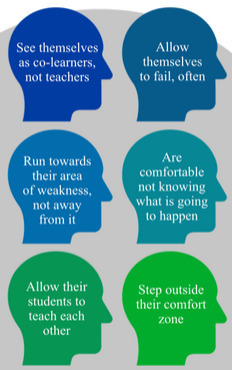
"One of the greatest misconceptions in education today is that certain teachers have a higher natural aptitude in technology than others. This inspirationalgraphic sets out to disprove that notion and remind the audience that external skills are only a function of the internal dispositions that allowed them to grow."
Beth Dichter's insight:
Habits of mind are not only for students but also for teachers. This infographic provides 16 habits of mind that teachers may want to cultivate. What are your thoughts on this? 
SMARTERTEACHER's curator insight,
February 1, 2015 11:23 AM
The simplicity of these statements make this seem so easy, but for many teachers these concepts are difficult and scary. The transition to student focus is a difficult one for many who still believe they are the keeper of the knowledge.
Scoop.it!

If I could ensure that kids come away from science class with one thing only, it wouldn’t be a set of facts. It would be an attitude—something that the late physicist Richard Feynman called “scientific integrity,” the willingness to bend over backward to examine reasons your pet theories about the...
Beth Dichter's insight:
Have you heard about the concept of a paradigm shift? This happens when new information comes in that does not fit what we expected. Unfortunately in many cases we choose not to see this lack of fit, and ignore the information. This post looks at this type of issue but suggests that you have students look it as "surprises" and notes that "we need to actively look for signs that our assumptions are wrong..." How can we do this? Try creating a "Surprise Journal" with your students. Based on one teacher who has done this consider having your students (and you) look for moments of "surprise." Have them respond to two questions: * Why was this surprising? * And what does that tell me about myself? This teacher has collected over 1,000 moments of surprise and shares a few of them in this post. Here is his statement about how it changed his classroom culture (quoted from the post): “In the class culture, acknowledgement that you are mistaken about something has become dubbed a ‘moment of surprise’ (followed by a student scrambling to retrieve their journal to record it),” he wrote to me. “As this is much more value-neutral than ‘I screwed up,’ the atmosphere surrounding the topic is less stressful than in previous years.”
Scoop.it!
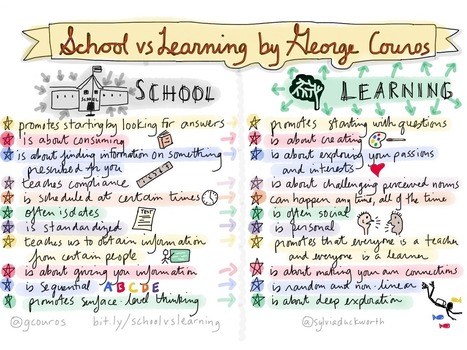
I have been thinking a lot about the "traditional" model of school and how people actually learn. If done the wrong way, school can actually go against what is needed for learning. There are a lot...
Beth Dichter's insight:
What do we mean when we speak of school and what do we mean when we speak of learning? This post by George Couros explores these two concepts by looking at how these two ideas become divergent. For example (and from the post): * School is about consuming. Learning is about creating. * School is about giving you information. Learning is about making your own connections. Couros provides 11 examples of how these two ideas may be divergent and also raises the question of what would happen if you "combined statements" to make some new, something that schools could become. As we approach the end of the year this post may make you think about how you approach work in your classroom and what you might like to do to change the culture of your classroom, or your school to make school and learning step out together. 
Lyne Leblanc's curator insight,
December 30, 2014 9:06 AM
Est-ce que l'école n'a pas l'obligation de favoriser l'apprentissage de tous? 
Lon Woodbury's curator insight,
December 30, 2014 5:32 PM
This idea has been around a long time. When I was an undergraduate, I had some friends state to me something along the lines of: "Now that I've finished my assignments, I can start pursuing my education." The network of schools and programs for struggling teens started in the 1980s were based on many of these ideas, and so far as emotional growth along with academics, the emphasis was on helping the struggling students learn who they are and what they can do with it. The motivation at that time was very much along the line of what the author calls learning. Many of them are still doing that. -Lon
SMARTERTEACHER's curator insight,
February 1, 2015 11:29 AM
WOW! Great concept "SCHOOL does not equal LEARNING". This is a scary thought for many teachers who create content driven classrooms. But as educators it speaks to the value of the building an environment of learning.
Scoop.it!
Beth Dichter's insight:
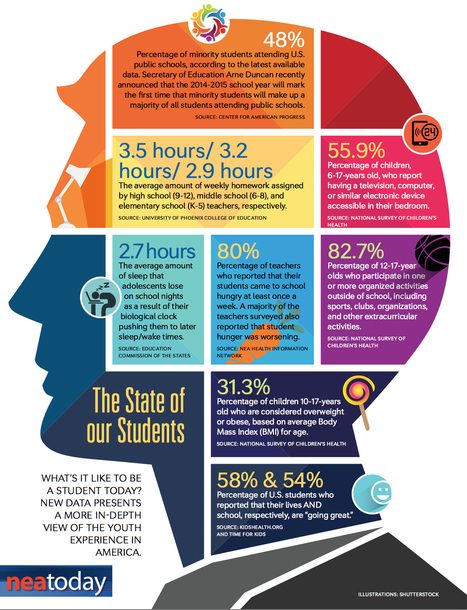
This is a fairly recent (~2 months old) view of a student today. * Did you know that Secretary of State Arne Duncan has said that the majority of students will be minority students this school year? * Did you know that the amount of homework assigned weekly be teachers varies from 2.9 hours in grades K-5 to 3.2 in grades 6-8 and 3.9 in grades 9 - 12? Additional information in this infographic looks at the percentage of students engaged in after school activities; the percentage of students with a television, computer or other electronic device in their bedroom; the average hours of sleep lost by adolescents (based on their biological clock; percentage of overweight students (ages 10 - 17) and more.
Scoop.it!
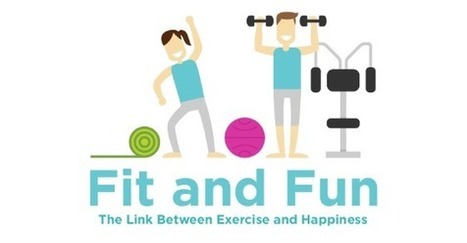
There's a science behind why your workouts boost your happiness. Learn how to optimize your fitness routine for even more joy.
Beth Dichter's insight:
This infographic shares the science behind exercise. Learn how to optimize your workout for maximum happiness, how to have more fun with less work, motivational tips and more. As teachers we often work long days and find it tough to get in our exercise, but if we can find the time we may find ourselves in a better place in the classroom.
Scoop.it!
You shall not pass! Please resist!The word resist means to control yourself and stop yourself from doing something you really want to do, though that's not a...
Beth Dichter's insight:
Can Cookie Monster resist eating a chocolate chip cookie? Watch this short video from Sesame Street and use it with your students to help teach the concept that the ability to control yourself is a good thing to learn...but not necessarily an easy thing to learn.
Scoop.it!

Listen to women from across the Administration tell the stories of their personal heroes across the fields of science, technology, engineering, and math (STEM).
Beth Dichter's insight:
If you are looking for a website that looks at women who have made a difference in STEM check out this site from the White House. Women who work in the White House "tell their stories of their personal heroes across the fields of science, technology, engineering and math." The site also suggest that we honor those women who have come before in the "best possible way: By committing to encourage a young woman to pursue a career in science." Currently the stories of 12 women are shared. You may also write about your "untold STEM history" and share how you will inspire young women to pursue science careers. You can listen to the stories, and they range from just under one minute to about six minutes in length. If you would like additional short talks on women in science you consider checking out some of the programs that WAMC offered in 2009 called Women in Science on the Air. A number of these tell the stories of women who were instrumental in making changes but are not know. You can access them at this site: 
Prof. Hankell's curator insight,
December 18, 2014 9:14 PM
Lydia Villa-Komaroff is considered to be a trailblazer in the field of molecular biology...
Scoop.it!

"Flip learning App, scaffold effective pedagogy with this simple mobile app that works across all platforms."
Beth Dichter's insight:
Verso is a new tool that come to us from teachers in Australia. It provides teachers the ability to create a 'challenge' and provide a prompt, which may be a video, document, website, etc. Add some thought provoking questions and students may answer within Verso. Students must post their own answer before they can respond to others, and all answers are anonymous. Verso provides a number of resources to help you get started, including: * Getting Started - This section "shows you how to Verso in 90 seconds", providing a number of examples (and you may choose one to try with your students). * Strategies to Support Deeper Thinking - This section is very robust, and it is worth the time to check it out. They provide nine strategies to support deeper thinking, including: - Ask for more than one type of response from your student - Be explicit about how you want your students to respond, model an answer in your instruction - Be provocative to promote debate amongst your students - Let your students answer the questions. This section has an excellent resource "Asking Googleable vs NonGoogleable Questions" *Verso Strategies: Building Deeper Collaboration Using Google Drive * How To - Discover a range of videos and examples to help you get started * Example Provocations - Find a wide variety of examples that you may choose to use. They also have a blog that provides additional resources. Their website uses three key words: Challenge, Engage, Learn. This website will allow your students to be challenged, engaged and learn and is worth taking some time to explore.
Scoop.it!

"When your budget is low on dollars, you need to become creative when it comes to everything in your school library. Since we have a computer lab in our library-media center, (and lots of wall space...) I have decorated the lab with posters and infographics...There are also many posters which help students format their research paper, search for Google images, and understanding search results...."
Beth Dichter's insight:
Finding great infographics takes time. In this post Julie Greller shares 74 infographics that she says will be of interest to librarians and language arts teachers. I think that many teachers whom are in other disciplines will also find valuable resources here. Greller provides a list of titles (for the infographics) that are hot linked. Click and off you go.
Scoop.it!

"Peter H. Reynolds, creativity advocate and best-selling author and illustrator, and co-founder of FableVision Learning, has created a new animated short called The Testing Camera — a whimsical poke at high-stakes, standardized testing and a reminder that real assessment is as easy, and — at the same time — as challenging as getting to really know the gifts and talents of every child."
Beth Dichter's insight:
Peter Reynolds shares one view of how students may feel in the high stakes testing environment that exists in schools today. The movie may bring a tear to your eye. The video is short, about 4 minutes, and there is also a poster (shown above). This video could be a great way to begin a discussion on authentic learning and why it is important.
Scoop.it!
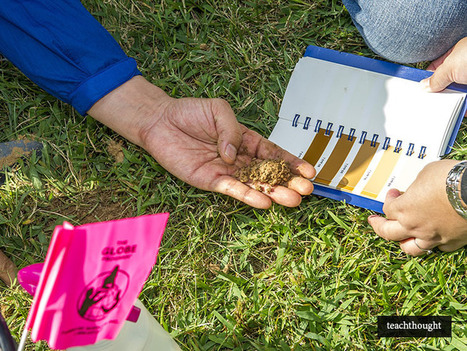
"I recently visited Thetford Academy in Vermont (one of the few and interesting public-private academies in New England) where they have a formal and explicit commitment to “experiential learning.” So, the leaders of the school asked me to visit classes that were doing experiential learning and to talk with staff at day’s end about it."
Beth Dichter's insight:
In this post Grant Wiggins discusses that experiential learning does not equal minds on learning. One can learn from their hands, but not engage their mind. He notes (and this is quoted from the post): Many projects, problems, situations, and field trips do not yield lasting and transferable learning because too little attention is given to the meta-cognitive and idea-building work that turns a single experience into insight and later application. How can we help our students engage their minds? Wiggins provides three examples of a series of questions that may help you come up with questions that you could use with your students. Below is the set of questions that he asks students when he visits classrooms:
For the back story on these questions (and to see the others) click through to the post. 
Charles Nyakito's curator insight,
December 13, 2014 1:27 AM
For sure when using the experiential method of teaching and learning, the teacher must emphasize what areas of the teaching/learning process the learners must master and transfer or otherwise the learners might simply take the learning for granted. 
John G Mandziuk's curator insight,
April 7, 2015 3:26 PM
We must link learning to student passions to make hands on minds on.
Scoop.it!
Beth Dichter's insight:
This eLearning Technology Compass provides another way to help you choose technology tools. Working from the inner circle towards the outer circle you will find * Goals * Competencies * Performance Assessments * Ring of Technologies Under this visual you will also find a detailed table that lists: * Desired Competencies * Rationale * Related Activities * Potential Technologies And the site also provides tutorials on many of the tools. This is like a one stop shop that will help you find great tools to help students grow skills in the desired competencies. 
Becky Roehrs's curator insight,
December 9, 2014 2:48 PM
This eLearning Technology Compass is based on a matrix that helps instructors meet their learning outcomes by choosing the right tech tool for the job. |













Back in the 80s, private schools that emphasized this were called "Emotional Growth" schools. -Lon