Eclectic Technology
230.9K views | +3 today
Eclectic Technology
Tech tools that assist all students to be independent learners & teachers to become better teachers
Curated by Beth Dichter
Your new post is loading...
Scooped by Beth Dichter
February 11, 2015 10:58 PM
Scoop.it!

What Comes First: the Curriculum or the Technology?

What Comes First: the Curriculum or the Technology? | Eclectic Technology | Scoop.it
"It’s hard to imagine now, but there was a time when handing a student a calculator to work through algebraic equations caused many teachers and parents great consternation. It makes you wonder what type of pushback the creators of the abacus faced! In both cases, while the tools students were using may have been more advanced than previous generations’, the goal remained the same – to enhance classroom learning."

Beth Dichter's insight:

 As technology becomes more available through schools many may be asking this question: What comes first, the curriculum or the technology? This article notes that "a great, robust and adaptable academic curriculum" needs to come first, and that technology can be used to (in my words) reinforce, enhance and extend the curriculum.

There suggest that a school consider four questions before bringing in new technology. Two are below.

* Regardless of the technology, what’s the most important lesson for students to learn?

* What will the students do with these tools – during and after class?

The post then discusses "five ways to ensure you’re putting the curriculum before the technology." The short hand version is below. You will find additional information in the post.

* Learn how students are using technology at home

* Don't use technology for the sake of using technology

* Focus on just one tech implementation

* Utilize the SAMR Model

* Actively seek our professional development opportunities

In any school you will have your early adopters and those who will wait as long as possible. Bringing new technology in means you will confront new issues, and at times components will fail, but the class will move forward and overcome those obstacles and technology can help us move to new levels.

Leslie Minton's curator insight, February 12, 2015 7:54 AM

Helpful questions to be asked before buying a new shiny piece of technology.

Scooped by Beth Dichter
February 9, 2015 12:00 PM
Scoop.it!

12 Myths About Student Engagement - InformED

12 Myths About Student Engagement - InformED | Eclectic Technology | Scoop.it
Student engagement is one of the most reliable predictors of gains in learning. We can all agree that students who actively participate in learning are m
Beth Dichter's insight:

How can we tell if our students are engaged? At time we ask students to complete pop quizzes, and we grade on participation, but what about the student who is shy and tends not to participate in discussions.

The post begins with a discussion on what student engagement looks like. One point they made is:

“The opposite of engagement is disaffection. Disaffected [students] are passive, do not try hard, and give up easily in the face of challenges… [they can] be bored, depressed, anxious, or even angry about their presence in [a course]; they can be withdrawn from learning opportunities or even rebellious towards teachers and [peers].”

What can we do? This post provides a number of recommendations as well as their list of 12 myths about student engagement. Three of the myths are listed below. You will find additional information about these three, as well as the nine additional myths in the post.

1. Engagement is schooling is the same as engagement in learning.

2. Participation should be graded.

3. Group projects enhance learning.

This post provides food for thought. It may make you rethink how you approach certain activities in your classroom.

David Baker's curator insight, February 17, 2015 11:08 AM

Teacher actions can influence how students engage [with a course], making it relevant to understand their conceptions of student engagement and how to facilitate it,”

Cited From: http://www.opencolleges.edu.au/informed/features/student-engagement/#ixzz3S1EF19HV


Engagement is more than just sitting and looking attentive. I like how the focus is on what the teacher can do and examines the general beliefs and misconc ptions around engagement through the lens of research. 


SMARTERTEACHER's curator insight, February 19, 2015 11:47 AM

Reminds me of Alfie Kohn, "If a child is off task, perhaps the problem is not the child, but the task."

Richard Gascoigne's curator insight, February 22, 2015 12:57 PM

Synthesised data across the digital & physical campus ensures you are understanding what 'engagement' looks like in context of your institution, www.solutionpath.co.uk for further insights.

Scooped by Beth Dichter
February 5, 2015 5:46 PM
Scoop.it!

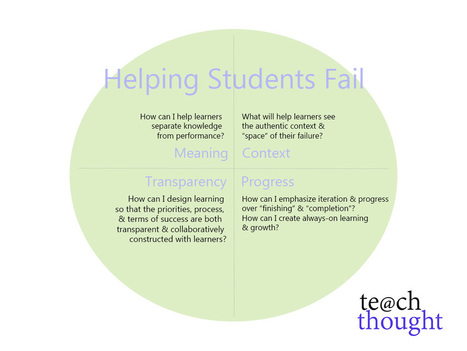
Helping Students Fail: A Framework

Helping Students Fail: A Framework | Eclectic Technology | Scoop.it

"As teachers, allowing students to see failure as a negative experience is one of the worst things we can do.

Granted, this isn’t unique to education. The idea of risk-taking, failing, looking, leaping, try-try-again is ingrained in our cultural DNA. But in education, we certainly have made it dramatic. In fact, we don’t even need the whole word anymore. Failure erodes to fail, which itself erodes to simply F..."

Beth Dichter's insight:

In education we many students are told they have "failed" yet as teachers we know that making mistakes is the norm. Engineers look at failures as a way to learn. What can we do in education?

This post explores:

* What does it mean to "fail"?

* The role of failure in learning

* Helping Students Fail: A Framework which has four sections, each of which provides "the idea" and guiding questions.

Where can you start as a teacher?

* By clarifying the meaning

* By providing context

* By designing transparent processes

* By illuminating progress

Students need to learn that a "failure" is not the end of the road, but a stop on a journey. As teachers this post provides a number of suggestions that may help us better meet the needs of our students and help them see failure in a different light.

luc taesch's curator insight, February 7, 2015 6:14 AM
failing is earning.
Scooped by Beth Dichter
February 3, 2015 8:31 PM
Scoop.it!

Strategies for Encouraging Cooperative Learning - Poster

Strategies for Encouraging Cooperative Learning - Poster | Eclectic Technology | Scoop.it
Cooperative learning is as much a skill for students to develop as it is a reflection on how we work and interact in group situations. Here are some ideas.
Beth Dichter's insight:

Fractus Learning provides a great visual that shares 5 cooperative learning strategies as well as links to additional information including
* A book on Educational Psychology (Creative Commons)

* Additional techniques in a four-page handout called The Basic Collaborative Learning Techniques

* 20 Collaborative Learning Tips and Strategies for Teachers

* 2 Videos

The Common Core promotes cooperative/collaborative learning. These strategies may provide you with new ways to move students on the spectrum of learning, and potentially have your students engaged in project-based learning, which promotes critical thinking skills as well as highly engaged learners who will share their work with a much larger community.

SMARTERTEACHER's curator insight, February 4, 2015 10:56 AM

Clear and concise graphic of Collaborative learning strategies.


Scooped by Beth Dichter
January 29, 2015 9:35 PM
Scoop.it!

This Is Your Brain On Games - InformED

This Is Your Brain On Games - InformED | Eclectic Technology | Scoop.it

"The past year has illuminated many things about the way the brain works, including how it responds to games. It is now erroneous to conflate ten hours of Super Mario with minor head trauma. We know that you won’t go blind if you’re looking for coins and bananas and rings on a screen all day. Your motivation and attention span will remain intact no matter what level you reach in Skyrim. In fact, the very latest science is telling us the exact opposite of what we thought all along: video games actually increase brain function."

Beth Dichter's insight:

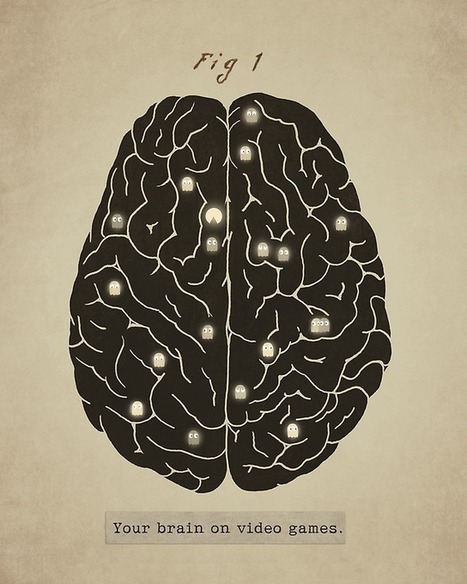
Brain research now shows that action video games impact "brain plasticity, learning, attention, and vision." What does this mean? That video games may make the brain bigger, as in increasing brain volume.

Along with information on how video games may make the brain "bigger, better, faster, stronger" the post also shares information on "using the neuroscience of games to boost learning" and "how to ditch your biases."

A number of studies are quoted in the post with links to additional information.

luc taesch's curator insight, February 7, 2015 6:23 AM

game your biais away ! #antifragile #agile

Scooped by Beth Dichter
January 27, 2015 9:27 PM
Scoop.it!

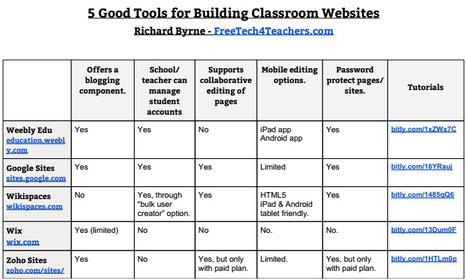
10 Charts Comparing Popular Ed Tech Tools

10 Charts Comparing Popular Ed Tech Tools | Eclectic Technology | Scoop.it

"Over the last six weeks of 2014 I published a series of charts comparing popular ed tech tools. Judging by the number of visits to those posts, the charts were popular. Someone asked me this week if I had put them all together in one place. I hadn't until now. In this Google Drive folder you will find ten charts comparing popular ed tech tools."

Beth Dichter's insight:

Richard Byrne has created 1o charts that provide options for popular ed tech tools. Having published these on his blog within a series of posts, he has not gathered them  into one Google Drive folder. You will find charts that cover the following tools (quoted from his post):

  • Alternatives to Google Image Search
  • Backchannel and informal assessment tools
  • Building classroom websites
  • Building classroom blogs
  • Creating multimedia textbooks
  • Creating multimedia quizzes
  • Audio editing tools
  • Multimedia timeline tools
  • Mind-mapping tools
  • Mobile video creation apps

This is a great resource. Quickly find four or more options to explore. If you want additional information on the tools do a quick search on his blog to find more detailed reviews.

No comment yet.
Scooped by Beth Dichter
January 25, 2015 6:58 PM
Scoop.it!

Words, Pictures, Numbers, WOW! – 2nd Grade Infographics Attract Attention

Words, Pictures, Numbers, WOW! – 2nd Grade Infographics Attract Attention | Eclectic Technology | Scoop.it

"For the past four years, we’ve been using infographics with our students at different grade levels. This year, our second graders were studying New York City to make comparisons between its historical past at the turn of the last century with today. Instead of the typical presentation poster, they made infographics using the Easelly app."

Beth Dichter's insight:

Can 2nd graders create infographics? Based on this post from ASIDE the answer would be yes! The students were able to Easel.ly and create 8 infographics that show their understanding of New York City at the turn of the century and today. Consider trying a similar project with students in your classroom (and make sure to learn to use Easel.ly before you introduce it to your students!).

No comment yet.
Scooped by Beth Dichter
January 22, 2015 9:16 PM
Scoop.it!

DK Find Out! A New Visual Encylopedia

DK Find Out! A New Visual Encylopedia | Eclectic Technology | Scoop.it
Beth Dichter's insight:

This visual encyclopedia comes from the publisher DK. It is new, and therefore somewhat limited but based on the website they have plans to grow it.

This would be great to use with younger students, ELL students and special education students. The site is easy to use and along with the categories shown in the image above you will also find sections called:

* What's New?

* Videos

* Quizzes

* Fun Facts

* Galleries

and coming soon a section called My Space.

As an educator you may create an account and access a lesson planner.

The DK Online World Desk Reference may also be on interest. You need to create an account to use it which takes seconds to do. This site "explores topics in physical and human geography for every country in the world, and practices critical-thinking skills."

Kathy Lynch's curator insight, January 24, 2015 12:05 AM

Awesome ..Thx Beth Dichter

Scooped by Beth Dichter
January 19, 2015 7:52 PM
Scoop.it!

We Were Wrong – A Lesson on Early Grade 21st Century Learning

We Were Wrong – A Lesson on Early Grade 21st Century Learning | Eclectic Technology | Scoop.it

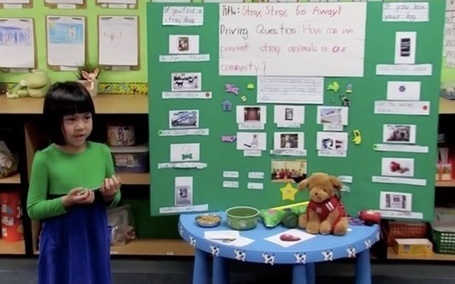
"Driving Question: How early does equal access to 21st century learning start?

Prior to this project, we thought of academics and 21st century skills as separate things. Following a linear approach, first students needed to master important literacy skills, and then we could enhance the learning with integrated projects like "Stray, Stray, Go Away." We even worried that maybe 21st century skills would distract from the foundational skill like learning to read. It was thought that one was more important that the other, and guess what? We were wrong."

Beth Dichter's insight:

What happens when you take a kindergarten class and create a project-based learning opportunity on a local issue? In this case amazing success.

What is critical is to provide appropriate scaffolding so that all students (included English Language Learners) are comfortable and able to help with the presentation.

If you have concerns about implementing PBL in your classroom this article may help you realize that it can be done, even in kindergarten. Click through to the post to read this uplifting article.

No comment yet.
Scooped by Beth Dichter
January 16, 2015 10:01 PM
Scoop.it!

6 questions determine if you're technology rich, innovation poor

6 questions determine if you're technology rich, innovation poor | Eclectic Technology | Scoop.it

"If you answer no to all six questions when evaluating the design of assignments and student work, then chances are that technology is not really being applied in the most innovative ways. The questions we ask to evaluate implementation and define innovation are critical."

Beth Dichter's insight:

This post, by Alan November, ask six question that help districts help "clarify for educators the unique added value of a digital learning environment, and whether their assignments were making the best use of this environment.

November believes that innovation is critical, and shares his perspective that technology needs to move beyond the ability to function and move the school community (teachers, staff and students) to be more innovative, which requires that the "design of learning" that will lead to new levels of student achievement.

The six questions he raises are below:

1.  Did the assignment build capacity for critical thinking on the web?

2.  Did the assignment develop new lines of inquiry?

3.  Are there opportunities for students to make their thinking visible?

4.  Are there opportunities to broaden the perspective of the conversation with authentic audiences from around the world?

5.  Is there an opportunity for students to create a contribution (purposeful work)?

6.  Does the assignment demo “best in the world” examples of content and skill?

Additional information is included with each question in the post. How would you score your school or district?

Kathy Lynch's curator insight, January 17, 2015 11:33 AM

Thx Beth Dichter

Nancy Jones's curator insight, January 18, 2015 12:56 PM

Sounds crazy but probably ore common than you think.

Scooped by Beth Dichter
January 12, 2015 10:04 PM
Scoop.it!

UDL / Digital Resource Toolkit

UDL / Digital Resource Toolkit | Eclectic Technology | Scoop.it
Beth Dichter's insight:

I came across an article in THE Journal called 6 Ways to Engage Every Learner Using UDL. This sent me to the Bartholomew Consolidated School Corporation where I found a range of excellent materials on Universal Design for Learning (UDL). The link provided here will take you to a page where they have three toolkits:

* Action and Expression Digital Resources

* Engagement Digital Resources

* Representation Digital Resources

Each toolkit is 6 - 7 pages long and shares digital tools that will help you each of the three areas.
For example, when you open up the Action and Expression Digital resources you will find the following categories:

  - Options in the mode of physical action

  - Options in the means of navigation

  - Options for accessing tools and assistive technologies

  - Options in the media for communication

  - Options in the tools for composition and problem solving

  - Options in the scaffolds for practice and performance

  - Options that provide effective goal-setting

  - Options that support planning and strategy development

  - Options that facilitate managing information and resources

  - Options that enhance capacity for monitoring progress

You can download each file as a pdf and there is a hot link to each suggested tool.

The site also provides additional information on UDL, including links to a number of other resources that provide an excellent overview and includes videos as well as text based materials.

You may also find the original article (linked to above) of interest. Here is one quote:

"Just like a worksheet can be a barrier and a print text can be a barrier, technology can be a barrier for some students as well. UDL is not about technology but it is about using technology in an intentional way.”

No comment yet.
Scooped by Beth Dichter
January 10, 2015 9:06 AM
Scoop.it!

3 Tips for Teaching Great Question Writing | Teach.com

3 Tips for Teaching Great Question Writing | Teach.com | Eclectic Technology | Scoop.it

"What if you could design questions that engage students at this level in your classroom? What if you could do so without the burden of having to make the subject matter relevant or relatable to every single student?

The secret to writing good questions or problems may surprise you. The key, according to Willingham, is to pose questions or problems that can be solved. That means questions or problems that are not too hard and not too easy, but just right. Think Goldilocks."

Beth Dichter's insight:

How do you teach students to write good questions (or how to ask good questions)? This post suggests that good questions have to be at the right level of difficulty and provides three tips that will help you and your students learn how to write good questions (and I suspect how to ask them as well).

What are the three tips?

1. Shore up the students' prior knowledge

2. Lighten students' cognitive load

3. Un-situate students' learning

Each of these tips is described in more detail int he post and some additional links are also provided.

Teaching students how to question, either in writing or verbally, is a critical skill and this post provides some great ideas on ways to help students with the cognitive load so they are supported in the process. You might also want to check out the post Socrative Smackdown which has students learn discussion strategies, some of which are helpful with questions (and that is geared to students in grades 6 - 12).

Andrew Blanco's curator insight, February 5, 2015 10:57 AM

how to respond to great questions

Scooped by Beth Dichter
January 8, 2015 8:27 PM
Scoop.it!

5 Tips for Helping a Student Find the Right Book

5 Tips for Helping a Student Find the Right Book | Eclectic Technology | Scoop.it
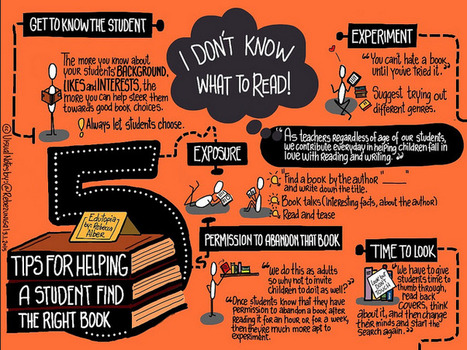
Research shows that children want assistance with finding a reading book. While your students search the stacks, here's some helpful tips for teachers.
Beth Dichter's insight:

Here are five great tips for helping students find books - a great find for librarians and for teachers in elementary school. The short hand version of the tips is below and additional information is located in the post..

1. Get to know the student

2. Experiment

3. Exposure

4. Permission to abandon the book

5. Time to look.

The visual above is not found on the site, but is found on Edutopia's Facebook page and also on Flickr.

No comment yet.
Scooped by Beth Dichter
February 10, 2015 9:21 PM
Scoop.it!

15 Ways to Beat Procrastination [Infographic]

15 Ways to Beat Procrastination [Infographic] | Eclectic Technology | Scoop.it

"Procrastination is definitely not our friend. It makes us randomly search the web, watch funny youtube videos or constantly check twitter stream instead of doing things that matter. It kills our time and leads to failure. Now it's time to beat it! Here are 15 efficient techniques to get rid of procrastination and be more productive!"

Beth Dichter's insight:

Do you procrastinate? Do some of your students procrastinate? If so, this infographic may be one you want to share. It provides 15 techniques to help you beat procrastination. Two of the techniques are listed below. Each technique includes a short description plus a how and a why. To view the other 13 click through to the post.

* Know Yourself

     How - Understand how procrastination affects your life

                Think about the habits that often cause it

     Why - Insight prevents you from feeling inadequate

                Helps you understand the causes of procrastination

* Commit to assignments

     How - List tasks that you're confident you will complete

                Make a point of crossing each task off

     Why - Rebuilds faith in your own abilities

                Commits to making good on promises

This post is geared to students in high school and college, yet you will find that many of the techniques could be shared with students in elementary and middle school.

No comment yet.
Scooped by Beth Dichter
February 9, 2015 8:27 AM
Scoop.it!

3 Simple Strategies to Develop Students' Critical Thinking

3 Simple Strategies to Develop Students' Critical Thinking | Eclectic Technology | Scoop.it

This week we’ve focused on critical thinking using the model developed by the Foundation for Critical Thinking. By now you’re probably excited about the incredible potential that these tools hold…and a little overwhelmed. Where to start...

Beth Dichter's insight:

Teaching student to think...we know this is not as easy as it sounds. This post suggests looking at this through the lens of the visual displayed above (which comes from The Foundation for Critical Thinking) and recommends that you use three simple steps (quoted from post):

1) TELL students that you want them to work on their thinking.

2) Choose ONE element of thought, intellectual standard, or intellectual trait and teach students what it means.

3) Give students something to think about and ask them to practice improving their thinking.  

Each of these ideas are discussed in the post and suggestions are provided to help you implement this in the classroom.

On Feb. 4, 2015 I posted an article "The Question Game: A Playful Way to Teach Students to Think" and a number of people have responded to it. This post provides some additional ways to teach students to think and many of them are playful also. If one of your goals in teaching is to help students gain this skill take the time to read this post.

Charles Fischer's curator insight, February 11, 2015 7:56 AM

A few great ideas for critical thinking. I particularly liked the activity called "telephone" (not the listening game). Teachers can use all the strategies they can to help their students think better!

Scooped by Beth Dichter
February 4, 2015 10:01 PM
Scoop.it!

The Question Game: A Playful Way To Teach Critical Thinking

The Question Game: A Playful Way To Teach Critical Thinking | Eclectic Technology | Scoop.it

"Big idea: Teaching kids to ask smart questions on their own

A four-year-old asks on average about 400 questions per day, and an adult hardly asks any. Our school system is structured around rewards for regurgitating the right answer, and not asking smart questions – in fact, it discourages asking questions. With the result that as we grow older, we stop asking questions. Yet asking good questions is essential to find and develop solutions, and an important skill in innovation, strategy, and leadership. So why do we stop asking questions – and more importantly, why don’t we train each other, and our future leaders, to ask the right questions starting from early on?"

Beth Dichter's insight:

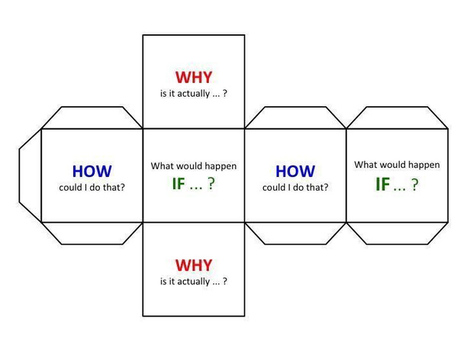
What are the questions students should ask to help them problem solve? What questions should we help students learn to ask at an early age? Warren Berger, who wrote A More Beautiful Question: The Power of Inquiry to Spark Breakthrough Ideas suggests that the "question needs to be phrased openly and positively in order to achieve positive results."

He also suggests three questions:

* Why questions help to find the root of the problem

* What If questions open the floor for creative solutions

* How questions focus on developing practical solutions

The article explores this in more depth and provides directions to The Question Game. You can see the cube you can create in the image above.

Although this was written by a parent and discusses how she used it with his children this could be used in a classroom. You may find that you would like to have more than one cube (and therefore additional questions).

Gust MEES's curator insight, February 8, 2015 7:03 AM

Big idea: Teaching kids to ask smart questions on their own

A four-year-old asks on average about 400 questions per day, and an adult hardly asks any. Our school system is structured around rewards for regurgitating the right answer, and not asking smart questions – in fact, it discourages asking questions. With the result that as we grow older, we stop asking questions. Yet asking good questions is essential to find and develop solutions, and an important skill in innovation, strategy, and leadership. So why do we stop asking questions – and more importantly, why don’t we train each other, and our future leaders, to ask the right questions starting from early on?"


Learn more:


- http://www.scoop.it/t/21st-century-learning-and-teaching?tag=Critical-Thinking


Jewelelelel's curator insight, February 8, 2015 7:56 AM

I agree with the fact that recently,students have been 'trained' to give the correct and not ask smart questions.In school ,teachers usually ask us questions and if we answer that correctly, we get praised.For subjects sciences and humanities require a lot of questioning and thinking in order to understand and to learn  more quickly.In my opinion, i think that teachers should give students a chance to ask questions that they have and not go through a topic blindly.If the students is shy to ask, the teacher could create a website so that the whole class can ask questions whenever they feel like and both the teachers and students themselves can answer the questions.This would enable the student to think out of the box to ask and answer questions by themselves 

niftyjock's curator insight, February 8, 2015 9:32 PM

dice student

Scooped by Beth Dichter
January 31, 2015 9:32 PM
Scoop.it!

Questions to Ask Oneself While Designing Learning Activities

Questions to Ask Oneself While Designing Learning Activities | Eclectic Technology | Scoop.it
I absolutely love planning lessons from scratch.  I just got a job teaching technology units for a summer camp for elementary age students. I can design and teach whatever I want - planning for a d...
Beth Dichter's insight:

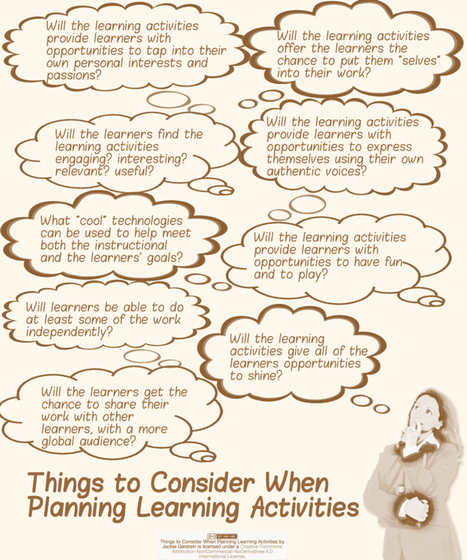
Jackie Gerstein shares nine questions that you might consider asking yourself as you design new units. Two are listed below. The infographic she designed, with nine questions is in the image above, and you can access a list of the nine questions as well as the infographic in her post.

* Will the learners get the chance to share their work with other learners with a more global audience?

* Will the learners find the learning activities engaging? interesting? relevant? useful?

Gerstein's questions help you focus on the learner.They may help you transform lessons in ways you had not envisioned.

Janet McQueen's curator insight, February 1, 2015 5:37 PM

Interesting questions to ask when planning lessons which help to create exciting lesson plans that focus on the needs of the students and to find ways to engage them all. 

Marisol Araya Fonseca's curator insight, February 8, 2015 12:19 PM

Excellent guide to follow when planning our classes.

Dalia Rodriguez's curator insight, February 17, 2016 10:12 PM

This image provides questions to to ask yourself when you want to plan learning activities,. You want to ensure that the activities are age appropriate. 

Scooped by Beth Dichter
January 28, 2015 9:19 PM
Scoop.it!

5 Movement Strategies That Get Students Thinking

5 Movement Strategies That Get Students Thinking | Eclectic Technology | Scoop.it

"Each day more research confirms the link between movement and learning. Brain researcher David Sousa claims that physical activity increases the amount of oxygen in our blood, and this oxygen is related to enhanced learning and memory. A recent Washington Post article suggests that many student behaviors we associate with ADHD may stem from an overall lack of physical movement  – both in and out of school. In addition, a phenomenally popular blog post by Alexis Wiggins recently touched upon how much sitting students actually do every day, and how all that sitting affects energy levels and learning."

Beth Dichter's insight:

What would happen if you incorporated more movement in your classroom, providing students opportunities to get up from their seat and physically move their body? Based on current brain research you may find your students more engaged in their learning. This post provides five suggestions on activities you can incorporate into lessons to allow students opportunities to move. What are they?

1. Gallery Walks/Chalk Talks

2. White Board Meetings

3. North Pole-South Pole/Continuum

4. Musical Mingle

5.  Stations

Each is explained in detail in the post. Do you have ideas on how movement can be incorporated into lessons? If so, share them in the comment section.

No comment yet.
Scooped by Beth Dichter
January 25, 2015 7:14 PM
Scoop.it!

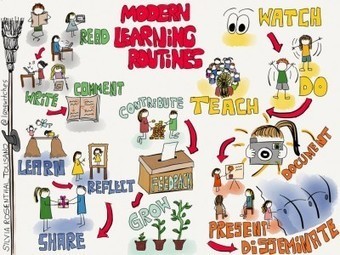
From Visible Thinking Routines to 5 Modern Learning Routines

From Visible Thinking Routines to 5 Modern Learning Routines | Eclectic Technology | Scoop.it
I have been a fan of Visible Thinking Routines which were developed by Project Zero from Havard, for a while now. I have used these routines with students, as  blogging routines and in professional...
Beth Dichter's insight:

Silvia Tolisano shares updated visual thinking routines for:

1. Read > Write> Comment
2. Learn > Reflect > Share
3. Contribute > Feedback > Grow
4. Watch > Do > Teach
5. Document > Present > Disseminate
Along with a visual for each of these routines she also explains each step. She also shares three additional routines that she uses with students, as blogging routines and in professional development.

Vanessa Camilleri's curator insight, January 27, 2015 6:09 AM

A really wonderful representation of what being digital in this era is all about - learning in the digital era, is more of a contribution rather than a passive absorption of online information. 

veroco's curator insight, February 10, 2015 12:42 PM

Nice vision : the "modern learning" routines => Read - Comment - Write / Watch - Do - Teach / Contribute - Feedback - Grow... 

Dr. Deborah Brennan's curator insight, April 2, 2015 9:34 AM

These thinking routines can help teachers move toward teaching processes for learning rather than content alone.  In the era of ever increasing knowledge, we need to help students learn how to learn.


That being said, these routines can also be used as a model for teachers by using them as options for professional development, 

Scooped by Beth Dichter
January 25, 2015 8:19 AM
Scoop.it!

The Public Domain Project - 80,000 Free Media Assets

The Public Domain Project - 80,000 Free Media Assets | Eclectic Technology | Scoop.it

"Download thousands of historic media files for your creative projects.Completely free & made available by Pond5."

Beth Dichter's insight:

If you are looking for public domain materials check out the new Public Domain Project that contains over 80,000 video clips, images, sound recording and 3-D models.

The site is well organized. Each asset is labeled and tagged, and you can quickly download them.

This site would be a great place for students to look for copyright free images. clips, etc. You may also want to have students view a short video Public Domain 101.

No comment yet.
Scooped by Beth Dichter
January 21, 2015 8:02 PM
Scoop.it!

4 Free One-Week Courses on Problem-Based Learning from BIE

4 Free One-Week Courses on Problem-Based Learning from BIE | Eclectic Technology | Scoop.it

" The following online classes are developed and facilitated by BIE, and focus on project design, management and assessment. After taking these classes, you will be able to improve your own PBL practice and share your knowledge with others. Additional classes will be added throughout the year."

Beth Dichter's insight:

The Buck Institute for Education (BIE) is a go to site for learning about Problem-Based Learning, and they are offering four free one-week courses during February and March. The courses are:

* How to Create a Driving Question

* How to Manage Student Presentations

* How to Assess Critical Thinking

* How to Include Content and Competencies

You may register for the first two courses now. Registration for the other two will open on Feb. 4, 2015.

Additional information is available on the courses at the website (click through to the course).

There is a maximum enrollment of 300 so if you are interested in checking these out it would be good to go to the website sooner rather than later.

Kathy Lynch's curator insight, January 24, 2015 12:03 AM

Great resource! Thx Beth Dichter

Scooped by Beth Dichter
January 17, 2015 6:43 PM
Scoop.it!

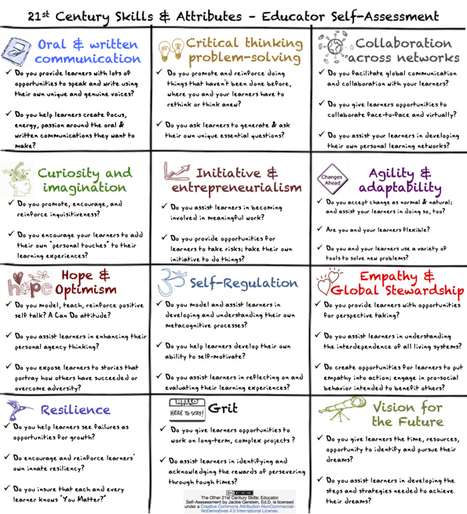
The Other 21st Century Skills: Educator Self-Assessment

The Other 21st Century Skills: Educator Self-Assessment | Eclectic Technology | Scoop.it

I've posted about The Other 21st Skills and Attributes.  This post provides links and resources about these skills as well as an educator self-assessment.  This assessment contains questions to ass...

Beth Dichter's insight:

Jackie Gerstein has written quite a number of posts that look at The Other 21st Century Skills and Attributes. This post provides an infographic that includes two or three questions that you should ask yourself to see if you are 'facilitating these skills and attributes in the learning environment.

Gerstein also includes links to previous posts where she discusses the specific skills and attributes in more detail.

David Baker's curator insight, February 17, 2015 10:54 AM

The power of the Infographic is that it references both teacher and student actions and habits. I have shared it with my teachers. This might become a solid self-assessment tool for coaching conversations with teachers.

jane fullerton's curator insight, March 29, 2015 10:21 AM

Love the graphics in this post.

Kristen McDaniel's curator insight, April 3, 2015 12:05 PM

Interesting graphic with some great ideas on interpreting 21st century skills as they pertain to teaching

Scooped by Beth Dichter
January 14, 2015 6:05 AM
Scoop.it!

34 Reasons Why Play Matters - Infographic

34 Reasons Why Play Matters -  Infographic | Eclectic Technology | Scoop.it

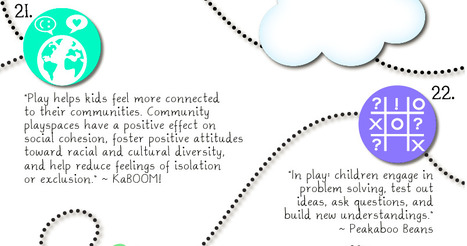
"To fly a kite you need a hearty breeze and lots of space. In a whimsical sense, humans are a lot like kites! Play gives both kids and adults the freedom and momentum to truly soar. For kids, play is a natural state that sparks learning, nurtures confidence, and builds communication skills. For adults, play provides a haven from the daily grind, inviting fresh ideas and spontaneity. For everyone, play is an ideal way to find ourselves and be ourselves! This infographic is a celebration of why play matters, gathering quotes and facts from advocates who believe in the power of play."

Beth Dichter's insight:

Do you know that when children engage in play they are also problem solving, testing out ideas, asking questions, building muscle and bone strength and much more? This infographic provides 34 reasons why play is important and includes the resources used.

As many schools continue to decrease play time and focus on teaching core subjects this may remind us that time to play is critical.

No comment yet.
Scooped by Beth Dichter
January 11, 2015 10:20 PM
Scoop.it!

The 5 Best Interactive Infographics For 2015

The 5 Best Interactive Infographics For 2015 | Eclectic Technology | Scoop.it

"...far too few students today are being properly schooled in the skill of curation. Curation is a key proficiency in face of today's instantaneous access to information. Sifting through a sea of sources and aggregating the most relevant research are critical expertises in the world of big data. Alan November actually recommends that on the very first day of school, teachers should train children in proper online searching.
In this vein, we have curated five fascinating interactives to help inspire learners for the year ahead."

Beth Dichter's insight:

ASIDE has just published a post that shares five interactive infographics that look at history, geography, sociology and globalization. They are:

* The Infographic History of the World

* In Charted Waters - Mapping a Brave New World

* Manifest Destiny - The Story of the U.S. Told in 141 Maps

* The Story of All of Us - The Age of Exploration

* The Kid's Aren't All Right

If you click through to the post you will find a paragraph that discussed each of these interactive infographics as well as additional links that provide information on how to teach with interactive infographics.

Gilbert C FAURE's curator insight, January 12, 2015 4:21 AM

Each January, the folks from Lake Superior State University (LSSU) release their (vaguely snarky) list of Words Banished from the Queen's English for Mis-Use, Over-Use, and General Uselessness. This year, the term "curated" was put on the chopping block for being, as one commenter noted, a "pretentious way of saying 'selected.'"

Even though Pinterest and One Kings Lane may have catapulted "curated" into popular jargon, we respectfully disagree with the lexicographers at LSSU. Rather than being over-used or hackneyed, far too few students today are being properly schooled in the skill of curation. Curation is a key proficiency in face of today's instantaneous access to information. Sifting through a sea of sources and aggregating the most relevant research are critical expertises in the world of big data. Alan November actually recommends that on the very first day of school, teachers should train children in proper online searching.

Scooped by Beth Dichter
January 8, 2015 9:28 PM
Scoop.it!

Socratic Smackdown, a Game from the Institute of Play

Socratic Smackdown, a Game from the Institute of Play | Eclectic Technology | Scoop.it

"Teacher-tested, student-approved games for difficult-to-learn skills and concepts"

The visual above comes from the materials and there are additional strategies that are not shown.

Beth Dichter's insight:

Here is a print-and-play games from the Institute of Play that you may find helpful in your classroom.

Socratic Smackdown helps students practice "argumentation around any topic or text." You may use it to help students become self-directed learners. There is a great video that quickly walks you though the process and you may download a pdf that provides Game Basics, Game Play, Student Resources and Teacher Resources. This game is geared to students from Grades 6 - 12.

Below are some of the rules of the game (found in the pdf).

* Create teams of four to six players and provide a topic, text or issue that will be discusses as well as a question set

* Share that discussion skill strategies are part of the game

* Set chairs in fishbowl pattern when ready to start

* Choose one student from each team to play

* Have 2 or more students as scorekeepers who will use Socratic Smackdown Scorecards

* Coaching cards will be used by students not keeping score, or by all students after the end of the match (if all are also scoring)

* Students "play" for 6 minutes and Scorecards are collected

Playing Socratic Smackdown with students will help them develop discussion and debate skills, a component of Common Core Speaking and Listening,  and a rubric is also provided.

María Dolores Díaz Noguera's curator insight, January 9, 2015 5:34 AM

Método de Discusión ... socrático Smackdown, un juego en el Instituto de Reproducción |scoopit travésBethDichter http: //sco.lt / ...

Sue Alexander's curator insight, January 18, 2015 2:10 PM

Thanks again Beth, for sharing your toys. Students learning critical thinking and CC literacy skills while having FUN? Yes!