


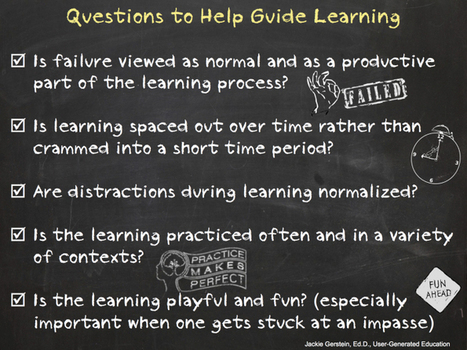
If I ask you or your students, "How do you learn," how many of you could clearly articulate this process? If you can, are the strategies you're using the best ones for learning? Furthermore, if the...

 Your new post is loading...
 Scoop.it! If I ask you or your students, "How do you learn," how many of you could clearly articulate this process? If you can, are the strategies you're using the best ones for learning? Furthermore, if the...
Beth Dichter's insight:
In this post Jackie Gerstein raises the question "if the research on the process of learning is compared to the practices being implemented in school, does this research influence school practices?" After reflecting on her experience at school she shares five questions (shown in the image above) that will help guide learning: * Is failure viewed as normal and as a productive part of the learning process? * Is learning spaced out over time rather than crammed into a short time period? * Are distractions during learning normalized? * Is the learning practiced often and in a variety of contexts? * Is the learning playful and fun? (especially important when one gets stuck at an impasse) Each is discussed and there is also a link to a short video that provides a brief overview of learning from the book How We Learn by Benedict Carey. Do you share current research on learning strategies with your learners? This post also references a post from Mind/Shift that discusses current learning strategies. Click through to the post to learn more and consider sharing this information with your learners as well as parents and staff in your school.
Scoop.it!

National Geographic has embraced digital extremely well and provides a huge set of resources that can be used to inspire and teach students about the world.
Beth Dichter's insight:
National Geographic has a wealth of resources and this post from Fractus Learning shares many of them. You will find: 1. Ideas, Activities and Lesson Plans that are easy to search. 2. Five thousand plus amazing videos 3. The best photography in the world 4. Online games and apps - many interactive resources 5. This day in geographic history - help students learn geographic facts by using this resource There is also a section that provides additional links and resources. 
María Dolores Díaz Noguera's curator insight,
March 12, 2015 5:40 AM
Versatile and Free Teaching Resources from National Geographic | @scoopit via @BethDichter http://sco.lt/... 
SMARTERTEACHER's curator insight,
March 13, 2015 12:32 PM
Always of great quality when National Geographic is involved.
Scoop.it!

"We offer these lesson plan ideas to help teachers cover important skills in English/Language Arts and Social Studies. Each SKILLS-BASED IDEA and CONTENT-BASED IDEA suggests specific ProCon.org topics and resources that are particularly well-matched to the lesson and designed to help you meet multiple curriculum goals."
Beth Dichter's insight:
Beth Dichter's insight: ProCon is one of my favorite websites. The mission of the site is to promote 'critical thinking, education, and informed citizenship by presenting controversial issues in a straightforward, nonpartisian, primarily pro-con format." There are 52 controversial topics that are available, and they have just released 20 lesson plans. Seventeen of the lesson plans are skill- based and three are content-based. The lesson plans are geared to learners in grades 5 - 12. Below is a list of two skill-based lessons and two content-based lesson, along with the grade levels. Skill-Based (material quoted from site): * Critical Thinking Quotes - Engage students in a metacognition exercise about critical thinking and also practice research and informational writing skills using ProCon.org's collection of critical thinking quotes. Grades 9 -12. * Main Ideas of Visual References - Use charts and graphs on ProCon.org to engage students in a visual literacy exercise. Grades 6 - 8. Content-Based * Exploring Controversial Issues in Literature - To introduce a novel, use ProCon.org to help students build background knowledge and examine the novel’s controversial issue(s). Grades 5 - 10. * Drug Ads Over Time: Analyzing Historical Images - Use ProCon.org's Gallery of Drug Ads to give students an opportunity to practice ad analysis and recognize how methods and messages have changed over time. Grades 5 - 10. To access the 52 issues that have detailed information and provide references (and links) to the materials used click on the Home page and you will find topics in Education, Elections & Presidents, Health & Medicine, Media & Entertainment, Money & Business, Politics, Religion, Science & Technology, Sex & Gender, Sports, and World/International. 
Kathy Lynch's curator insight,
March 8, 2015 12:44 PM
Thx Beth Dichter! Great skills building via content-based articles that center on hot topics in the news related to science concepts (and others).
Scoop.it!

The Maker Movement is a technological and creative revolution underway around the world. Fortunately for educators, the Maker Movement overlaps with the natural inclinations of children and the power...
Beth Dichter's insight:
Jackie Gerstein has created a new website that explores the Maker Movement. If this is an area that you would like to explore you will find 10 areas that you can explore: * Paper Circuits * Squishy Cirtuits * Bare Conductive Paint * Sew Electrics * Operation Game * Toy Take Apart * Soldering Projects * LittleBits * Makey Makey * Hummingbird Robotics Each of these areas leads to a webpage and the ones I checked out included a number of videos to help you understand the topic as well as some documentation and additional resources. She also includes a brief video that helps you understand what the Maker Movement is (and you hear from learners involved in a number of projects). In addition there is a ThingLink (based on the image above) that provides links to additional resources. The Maker Movement provides learners with opportunities to create something that is new to them. It is authentic learning and learners will go through iterations as they work through the process, and potentially experience failure that will help them become successful.
Scoop.it!

"...identify three words, two phrases and one quote..."
Beth Dichter's insight:
Check out this activity from The Common Core Writing Book by Gretchen Owocki. One of the activities she suggests is using a 3-2-1 strategy to help students summarize text. The student must choose three key words, find two phrases that are important and also one quote. They can then share this with a small group, and move to sharing in larger groups. The post suggests that this may used for the following (quoted from the post):
Scoop.it!
From
twitter

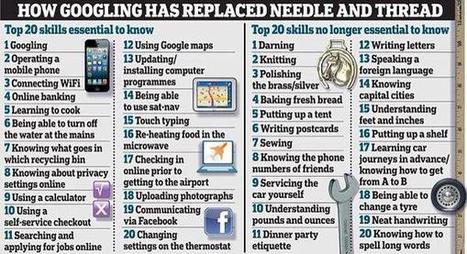
"21st Century Learning has now created new essential skills and made others obsolete."
Beth Dichter's insight:
This image looks at 20 skills essential today, and 20 skills that are no longer essential to know. What are your thoughts? Do you agree with the two lists? What would your students think? 
Julie Bourguignon's curator insight,
March 2, 2015 4:58 AM
Do skills get obsolete? This is a list of important skills based on frequency of use, rather than actual purpose. This is a comprehensive list, but remembering to carry your phone/tablet charger should be part of it!
SMARTERTEACHER's curator insight,
March 2, 2015 11:10 AM
There have been more changes in the last 10 years than in the first 40 I spent on the planet. These exponential changes are only scratched in this list.
Scoop.it!
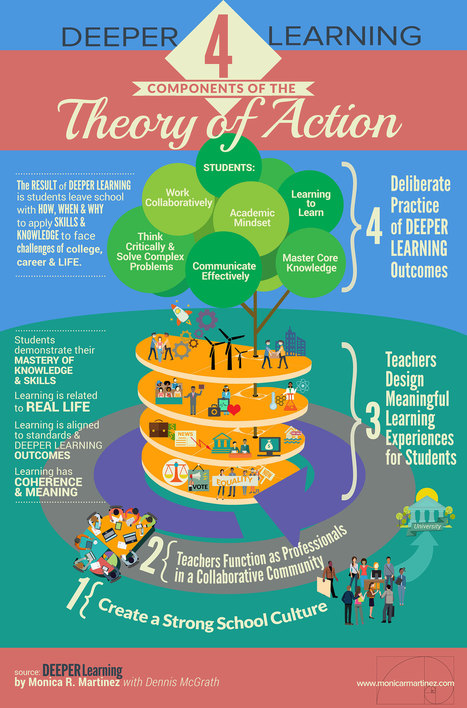
The Theory of Action Infographic by Carol Ehrlich …
Beth Dichter's insight:
This infographic is one resource found at this site, which also provides a detailed planning guide for Deeper Learning. Click through to the site and you will find a section on: * The DL Learning Guide which provides a series of exercises and a set of resources that demonstrate how you can create conditions necessary for Deeper Learning. * The User Guide an overview and framework. You will also find a Table of Contents. * You can access each phase from this section or you can move to the section called DL Phases. Phase 1 helps you Establish a Vision for Students. Phase 2 focuses on Understanding and Assessing the Conditions for Deeper Learning. Phase 3 guides you on Planning for Deeper Learning. Phase 4 is on Monitoring Your Plan for Deeper Learning. If your district or school is considering Deeper Learning this is a great resource to share, or to create a focus group to explore the concept and decide if it is the right time for your building.
Scoop.it!

" Nowadays, it's less about putting pen to paper and more about turning on your laptop. But are we losing about by letting the art of penmanship die?"
Beth Dichter's insight:
Cursive writing? Should we teach it or not? Many states are still requiring cursive writing be taught, but it is not part of the Common Core. This infographic provides information about why it is important that students learn cursive. 
Bart van Maanen's curator insight,
February 21, 2015 10:17 AM
Uit onderzoek is gebleken dat leerlingen lesstof beter opnemen als ze handgeschreven notities maken. Gewoon leren schrijven en het ontwikkelen van je handschrift blijft dus van groot belang.
Scoop.it!

"When researching student motivation and gamification late last year, I came across the most comprehensive gamification framework I’ve ever seen. Developed by gamification expert Yu-kai Chou, it was an ambitious effort that distinguished black hat gamification (which is “bad”–think Farmville and Candy Crush) from white hat gamification (which is “good”–think Minecraft or even an ACT score)... While it is designed not as an educational framework, but rather as a way to demonstrate gamification and its many strands, gamification is about human encouragement and motivation. For educators, student motivation is one of the pillars of a academic performance..."
Beth Dichter's insight:
Terry Heick takes the image (as shown above) and relates the 8 key ideas to 8 "core drives of student motivation." Each one is described by Yu-kai Chou (who created this graphic) and followed by a section called Educator Takeaways and a What if (which is related to education). The eight core drives are: 1) Epic Meaning & Calling 2) Development & Accomplishment 3) Empowerment of Creativity & Feedback 4) Ownership & Possession 5) Social Influence & Relatedness 6) Scarcity & Impatience 7) Unpredictability & Curiosity 8) Loss & Avoidance The description provided by Yu-Kai Chou relates to gaming, but Terry Heick the links it to education in the Educator Takeways. He then provides a look at how this interpretation could help move us in new directions in our classroom. Why is this important? It has the potential to help us create better assessments, lessons, units and learning models. This is another post that provides much food for thought. 
Halina Ostańkowicz-Bazan's curator insight,
February 19, 2015 9:34 AM
For educators, student motivation is one of the pillars of a academic performance. While the terms are sometimes misunderstood–and risk becoming cliche as we continue to talk about them topically rather than specifically–student motivation and student engagement are prime movers in the learning process. Without either, teaching is an uphill battle. 
luc taesch's curator insight,
February 22, 2015 5:43 AM
motivation motivatio, it is all about motivation... see the life in pink .. ;-) 
Claudia Cornejo Happel's curator insight,
March 19, 2015 1:22 PM
8 Core Drives Of Student Motivation - gleaned from research on gaming 1) Epic Meaning & Calling 2) Development & Accomplishment 3) Empowerment of Creativity & Feedback
4) Ownership & Possession Educator Takeaways? Space, place, voice, and choice are among the principles of student-centered learning. A sense of agency can be both empowering and overwhelming for students. 5) Social Influence & Relatedness Educator takeaways? How can we design learning so that students need to connect to clarify a need for knowledge, to create knowledge, or to share knowledge? Pushed further, how does social influence change the knowledge and competencies we choose to value? 6) Scarcity & Impatience Yu-kai Chou explains, “This is the drive of wanting something because you can’t have it….”
7) Unpredictability & Curiosity 8) Loss & Avoidance What if….we could somehow design a unit, for example, that “forced” the student to “start over” if they made certain mistakes, but through other principles of student motivation outlined above, they were somehow motivated to do so?
Scoop.it!
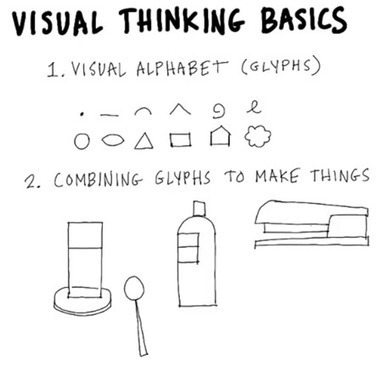
Want to communicate the right way in your e-learning courses? One trick is to apply visual thinking skills. This post on visual thinking offers some tips.
Beth Dichter's insight:
Many more schools are considering blended learning, and this may mean that you will be asked to put more of your materials online in a learning management system. If you have questions about the best way to design components of an online course this post will help you learn about visual thinking and how to apply visual thinking to an online course (where it is so critical). The post includes the following sections: * What is visual thinking? * How to learn more about visual thinking * Good books on visual thinking * Your next steps... There are quite a few visuals in this post that help you learn some of the basic techniques as well as six videos that will help you learn drawing skills, the process of visual thinking, and more. 
Patricia laronze's curator insight,
February 18, 2015 11:17 AM
How to convert your text-based information to images and text that show concepts and the flow of ideas. 
Cristian David Muñoz Alvarez's curator insight,
October 3, 2015 9:43 AM
Herramientas que transforman la educación
Scoop.it!
Beth Dichter's insight:
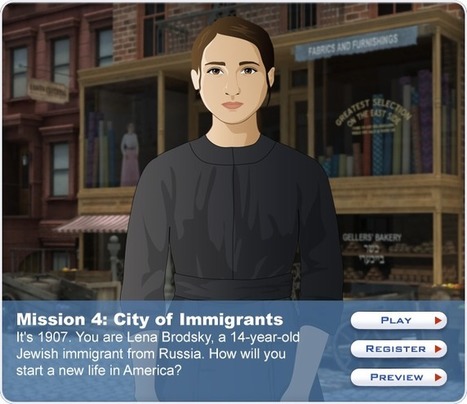
Mission US has just released a new mission: City of Immigrants. This game allows learners to learn about issues of immigrants ad they become Lena Brodsky, a 14 year old immigrant from Russia. During the game learners meet people in Lena's community, gaining a better understanding of the dynamics of immigrant communities. Throughout the game learners will need to make choices, which are not necessarily easy. These games are geared to middle and high school learners. The other games found at Mission US are: * For Crown or Colony (1770) * Flight to Freedom (1848) * A Cheyenne Odyssey (1866) You will also find teaching materials on the website.
Scoop.it!
What are some of the most encouraging known facts about learning? From taking a walk to learning a new language, there are countless things we can do to
Beth Dichter's insight:
How do we learn? New research continues to inform us and we should help our learners discover that making some shifts in their practices may lead them to being more successful learners. This post provides "fifteen steps towards a better brain." Four of the steps are below. * Laughter boosts brain function. * You can improve your memory with one simple step. * Bilingual brains process information better. * Higher vocab increases cognition Some of the steps in this post may be new to you. Each is explained in more detail in the post, and every step includes at least one (or more) links to additional information. As you read through think about what you can do in your classroom to help your learners and yourself "build a better brain." 
Lisa Gorman's curator insight,
March 5, 2015 7:25 PM
An excellent article for parents of children or indeed ADULTS who are interested in maximising their learning... lots of references to brain-based studies for your exploration here!
Scoop.it!

"I thought I could read my students' body language. I was wrong. As an experiment, I used Socrative when I taught binary numbers. What I learned forever changed my views on being a better teacher."
Beth Dichter's insight:
This post begins with the author writing about an experience teaching binary numbers...and learning that students may raise their hands to say they understand when in fact they do not. If instead of raising hands you use one of the many free new tools that allow for quick formative assessment you may make a better choice. Why use free online tools? You get immediate feedback. Some tools will work well with the entire class (such as Socrative or Plickers, where your feedback from all students comes in quickly). If you are have students watching videos Zaption is a great tool to check out as you can embed questions that students need to answer correctly to move on. Five free tools are discussed in this post: * Socrative * Plickers * Kahoot * Zaption * Back Channel Chat Tools Each is described in more detail in the post. You may also want to check out the comment section. There are a number of additional tools suggested by some readers that may be of interest.
Halina Ostańkowicz-Bazan's curator insight,
February 12, 2015 11:40 AM
Good formative assessment removes the embarrassment of public hand raising and gives teachers feedback that impacts how they're teaching at that moment. Instant feedback. We can do this now. How??? 
K.I.R.M. God is Business " From Day One"'s curator insight,
February 13, 2015 1:47 AM
ITS HARD TO TEACH THOSE YOU CAN'T UNDERSTAND HOW! AND IS WHY TEACHING IS A GIFT THAT IN TO DAYS SEASON IT'S TEACHING FROM A BOOK AND NOT THE HEART. WHILE THE CHILDREN OF TODAY ARE OUR FUTURE BUT ACCORDING TO THE EDCATION SYSTEM THEY ARE OR ARE NOT ALLOWED TO BE TAUGHT IN , THEY ARE EDUCATED TO BE FUTURE "WHAT" WHEN THE TIME COMES WE WILL FIND OUT! 
Melody Watson's curator insight,
February 22, 2015 3:16 PM
Great ideas to use in the computer lab, or even with just one device. |
Scoop.it!
Beth Dichter's insight:
When we ask students to become better questioners we are asking them to use critical thinking skills. The infographic/visual above is based on an article published by Edutopia called 5 Ways to Help Students Become Better Questioners. The post, by Warren Berger, suggests five ideas to encourage learners to ask more questions: * Make it safe. * Make it "cool" * Make it fun * Make it rewarding * Make it stick Additional information is found in the post.
SMARTERTEACHER's curator insight,
March 19, 2015 1:29 PM
Because student questions and curiosity should drive the learning. @ramusallam
Scoop.it!

You can't search for something you've already found, can you? In the case of deeper learning, it appears we've been doing just that: aiming in the dark a
Beth Dichter's insight:
Deeper Learning. Is this something new? This post explores deeper learning, sharing what it is, and what it is not. Two definitions of the term will make it clear that deeper learning is a goal of educators, but one that may not be reached. There is an in-depth discussion of deeper learning followed by suggestions on how to put deeper learning into your practice. Five principles are shared. 1. The three competencies - cognitive, intrapersonal and interpersonal 2. Test format - learning study strategies that allow students to learn the difference between surface learning and deep learning, which requires that they be "cognitively active learning behaviors" (as opposed to "cognitively passive learning behaviors) 3. Predicting and retrieving 4. Source diversity 5. Curriculum wide adoption Additional information is found for all the principles in the post. Click through to learn more.
Scoop.it!

"Creativity isn’t always something that just happens. It can take quite a bit of work to nurture, grow, and develop creativity, even for those who are immersed in creative and dynamic fields. For educators, it can be even more of a challenge to inspire creativity in students or embrace your own creativity while trying to juggle academic requirements, testing, and other issues in the classroom. It may be difficult but it’s certainly not impossible, and accomplishing it can help to create a classroom environment that’s more motivational, interesting, and educational for both you and your students."
Beth Dichter's insight:
Are you looking for ideas on how to be more creative in your classroom? Check out this list from Te@chThought. It is divided into the areas listed below. * Finding Creative Inspiration * Capitalizing on the Creative Spark * Inspiring Students * The Creative Classroom * Creative Activities * Sharing and Collaborating * Educate Yourself Have fun exploring! 
SuperTeacherWks's curator insight,
March 9, 2015 8:00 AM
This is a fun article from TeacherThought.com. :) 
Dr. Joe Boutte's curator insight,
March 23, 2015 8:30 PM
Why not parents and managers too, ? Be creative in all things. I like #19, but would flip it to say "treat you business as a classroom".
Scoop.it!

There’s a letter from an 1815 issue of General Music Journal where Mozart describes his creative process as instantaneous: no struggle or writer’s block. The muse simply showed up and he was ready. The problem? The letter is a fraud. Much like […]
Beth Dichter's insight:
Are we born creative or can we learn to be creative? New research provides insights into creativity, and this post looks at five myths that many of us have about creativity. The five myths are listed below, and they are explained in depth in the post. 1. Creativity is something you're born with 2. You can't control when inspiration will strike 3. You can't learn to be creative 4. Creativity happens in isolation (the myth of the lone creator) 5. Creativity comes to those with time and means There are many resources that are included in this post. You may also find some ideas on ways to help your students learn to become more creative, and you as well.
Scoop.it!
Regardless of whether you think every infant needs an iPad, I think we can all agree that technology has changed education for the better. Today's learne
Beth Dichter's insight:
Where will technology make the biggest impact on education? This post shares nine areas, based on research, where the use of technology is making an impact. What are the ten areas? Below is a list of the top five. Find additional information on each by clicking through to the post, as well as links to other resources. 1. Critical Thinking - In this area four kinds of thinking are discussed: Analogical, Expressive Experiential, and Problem Solving. 2. Mobile Learning 3. Access to Education 4. Continuous Feedback 5. Unlimited and Immediate Learning Please note that the title on the post days there are ten areas, but number four is missing in the document (or there are only nine areas). I renumbered the areas above so that they are consecutive. 
Matthew M.'s curator insight,
March 4, 2015 12:32 AM
This post relates to the readings because it talks about the way critical thinking is important to acquiring knowledge and how technology affects our learning. One of the significant aims of education is to produce learners who are well informed, that is to say, learners should understand ideas that are important, useful, beautiful and powerful. Another is to create learners who have the appetite the appetite to think analytically and critically, to use what they know to enhance their own lives and also to contribute to their society, culture and civilization.
Scoop.it!
“Failing Forward” is a relatively recent entry into our cultural lexicon–at least as far has headlines go anyway–that has utility for students and teachers. Popularized from the book of the same name, the idea behind failing forward is to see failing as a part of success rather than its opposite. Provided we keep moving and pushing and trying and reflecting, failure should, assuming we’re thinking clearly, lead to progress, So rather than failing and falling back, we fail forward. (Quoted from post)
Beth Dichter's insight:
Failing forward is a new term that has come into the field of education. We know that learners fail, and many see failure as an end point. Others see failure as a lesson learned and move forward. This post provides 21 ideas that you may find useful in your classroom, as you rephrase failure for learners, allowing them to see that what we have viewed as failure is part of the road to success. Each of the 21 ideas is explained with a brief description and then the question "How does this promote failing forward?" is asked and answered, with an example. Below are three of the ideas. Click through to the post for more. * Design iterative work. * Connect students with communities * Recognize it with badges, feedback and celebration You may find one or two ideas that you would like to implement quickly, or consider looking ahead to next year and how some of these ideas might help learners become more successful.
SMARTERTEACHER's curator insight,
March 2, 2015 11:12 AM
We should find every means possible to celebrate the process of failure in order to achieve success.
K.I.R.M. God is Business " From Day One"'s curator insight,
March 23, 2015 11:19 AM
Great for even adult having to learn in a different way different from their norm! Because even for adults failing to be able to properly teach is frightening because you don't know how, and the relearning differently process is frustrating to a point but the fact that we are yet alive with the opportunity and new resources to try to learn by different methods and with failure made a positive instead of a negative along the way, the failure of that way does not leave the negative effect that it once did that makes us feel like giving up but some how brings an attitude of ok this didn't work but there is something else lets try that. I am thankful to all for the posting about education an learning tools, resources, techniques as I am hopeful and thankful that that new way to learn will come if I faint not.
Scoop.it!
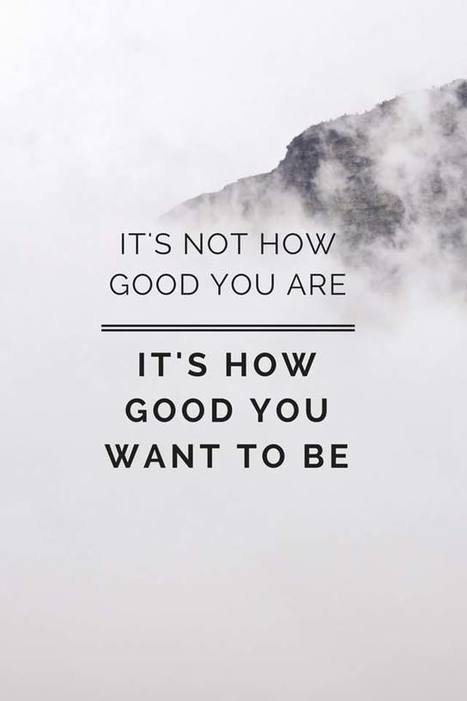
"In one world, effort is a bad thing. It, like failure, means you’re not smart or talented. If you were, you wouldn’t need effort. In the other world, effort is what makes you smart or talented." Carol Dweck
Beth Dichter's insight:
Carol Dweck has been studying mindset for many years, and this post shares information from her work. There is a discussion on growth mindset and fixed mindset as well as a discussion on how a growth mindset can help one learn (which also shares information from some of her research). This is followed by a list of 25 ways to help students develop a growth mindset. Five are listed below. * Acknowledge and embrace imperfections. * View challenges as opportunities. * Follow the research on brain plasticity. * Value the process over the end result. * Provide regular opportunities for reflection. What would happen if your class or your school chose one suggestion a week and had it become a part of the school culture? Would students learn more about growth mindset and be more willing to take risks? To understand that everyone fails at different points in their life, but they have the ability to move on (and potentially share information about people who have failed and led a successful life)? What are your thoughts on this subject? And remember to click through to the post to see all 25 suggestions (as well as links to additional resources). 
Mika Auramo's curator insight,
March 3, 2015 12:08 AM
There is very useful listing how to improve understanding about growth mindset in classroom.
Scoop.it!

Reshan Richards discusses the use of Explain Everything & iPads to build a Qualitative Formative Assessment Toolkit.
Beth Dichter's insight:
As mobile devices come into our classrooms we need to provide opportunities for students to create formative assessments that show their process of learning. You may have a tablet, an iPad or SmartPhone...and all of the have the ability to record, be it an image, video, screencast or screenshot. You will also find examples of what a 5th grade student might have done in a math unit. 
Kimberly House's curator insight,
February 22, 2015 12:53 PM
Good reminders for teachers with iPads!
Scoop.it!
The middle school mind is…different. As 13-year-old Logan LaPlante described in his Ted Talk Hack Schooling Makes Me Happy, “Neuroscientists say that the teenage brain is pretty weird: our prefrontal cortex is underdeveloped, but we actually have more neurons than adults, which is why we can be so creative, and impulsive, and get bummed out.” Truer words were never spoken around this subject.
Beth Dichter's insight:
How different is the mind of a middle school learner? This infographic is divided into the following sections: * Who are middle school students? * How do they learn? * How can you teach to reach them? * How can we change that statistic? There is also a white paper that you can receive a copy of (although you will need to provide your contact information). The white paper, Nurturing the Middle School Mathematical Mind, will provide additional information.
Scoop.it!
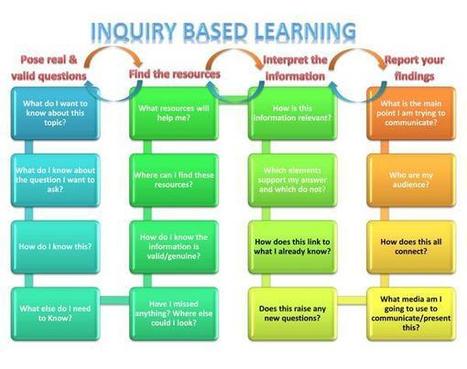
Another visual I use with students: inquiry approaches to learning - again, great to promote 'soft skills' #sunchat pic.twitter.com/NhnwNMeehv
Beth Dichter's insight:
This visual on Inquiry Based Learning provides four questions in four areas: * Pose real and valid questions * Find the resources * Interpret the information * Report your findings If you provide opportunities for learners to use inquiry based approaches this visual may be helpful for students to have as they work through the process.
Scoop.it!
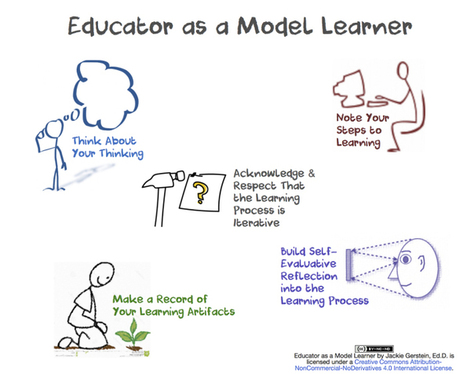
I have discussed educators as model learners before: The educator's role has or should change in this age of information abundance or Education 2.0-3.0. The educator's role has always been to model...
Beth Dichter's insight:
Has your role as a teacher shifted? Do you model being a learner with your learners? This post by Jackie Gerstein shares why it is important that the educator "needs to understand and be able to articulate and demonstrate the process of learning, him or herself." How can you go about doing this. Gerstein recommends that "educators pick something new to learn and practice doing the following: (below quoted from the post)
Gerstein then discusses each of these five steps/procedures/strategies, providing links to additional resources as well as one additional visual as well as a video that looks at how the learning process is iterative (and may provide you with an idea you would like to do with your class). 
Lisa Norris's curator insight,
February 16, 2015 2:12 PM
If we want to build expert learners...we need to take the time to model this ourselves.
SMARTERTEACHER's curator insight,
February 19, 2015 11:34 AM
The "Sage on the Stage" model must give way to the "Guide on the Side". Concurrently the teacher must model the learners mentality of facilitator of learning.
Scoop.it!

Here’s a quick list of questions your learners will be asking, ask them yourself when designing your eLearning course.
Beth Dichter's insight:
Many schools are asking teachers to consider using online learning management systems, providing students with access to course material online. Creating an online course requires teachers to learn new skills. This post from SH!FT suggests that you think like the learner when you design a course and provides four questions you should consider in this process. The four questions are below. Additional information is found in the post. 1. Why would they want to see and read through a screen? 2. Does the course look good? 3. Can they control the course and find their way around it? 4. Was the learning experience worthwhile? Additional resources are also provided in the post. |









añada su visión ...