Your new post is loading...
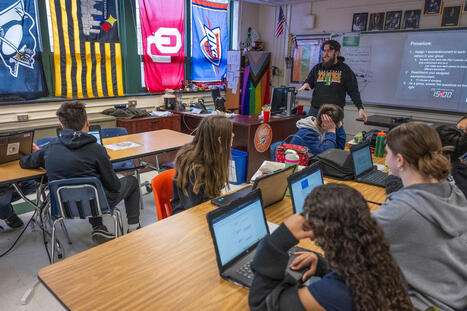
Faced with quadratic equations, Richard Scott couldn’t resist the temptation. The Pennsylvania eighth-grader knew that the Google search box on his school laptop was essentially an AI chatbot that would helpfully spit out answers. He started popping algebra questions into the search bar to quickly finish off his daily schoolwork. By the end of the school year, Scott’s grades were tanking. He had started leaning on Google’s AI-assisted search for other classes, like when he needed to label the parts of a volcano or write an essay about Edgar Allan Poe’s “The Raven.” His grades in math—a subject he’d done well at previously—suffered the worst. Even though he got mostly B’s in the quarterly marking periods, according to his transcript, he failed the final. “It slowed my thinking down,” the now-15-year-old said. “When I was in a test and I couldn’t use AI, it was hard to think.”
Arrvig announces... Arvig announced today that it distributed more than $130,000 to local K-12 schools this past year through its long-standing Internet School Partnership Program. Building on a multi-year legacy of community support, Arvig is also expanding its school partnerships to include Let’s Talk Tech, part of its Digital Life Skills educational resources. In the many years Arvig’s Internet School Partnership Program has been active, the company has given nearly $1.86 million directly to participating school districts across the region. The program gives local families a free and easy way to support their school district. As an Arvig internet customer, all they need to do is designate a school to support, and Arvig does the rest.
State and National Policy Context
State Digital Equity Capacity Grant Program
● The total amount appropriated by Congress for
the State Digital Equity Planning Grants
(including administrative costs) = $60 million
● Total amount appropriated for State Digital Equity
Capacity Grants = $240 million.
- NTIA Planning Grant NOFO (2022)
iSchool at Illinois 2
Ashley Stewart examines how growing restrictions on cellphones and other devices in classrooms may affect students differently. Ahead of students returning to the classroom in the fall, the majority of states have advanced restrictions or bans on cellphones or personal devices in K-12 schools. A smaller but growing body of legislation is beginning to impose similar restrictions on artificial intelligence (AI). These policy surges reflect genuine and well-documented concerns among educators, parents, and lawmakers about attention, adolescent mental health, and the volume of time that young people spend on their devices. However, as these policies move from legislatures into classrooms, their distributional consequences merit closer scrutiny. The question of whether device restrictions will serve a legitimate pedagogical purpose is a central one and should exist alongside whether the costs and benefits of that purpose will be distributed evenly across student populations.
Many schools rely on consumer fees funneled through the federal government to cut internet costs. FCC Chairman Brendan Carr called for ending this program before Donald Trump tapped him for the job. A program that helps connect schools and libraries to the internet at discounted rates is under review by the Federal Communications Commission. Educators and advocates are bracing for the funding to shrink or be eliminated. The so-called E-Rate program, created in the 1990s, has considerable bipartisan support. The agency's recent focus on the program has left educators, including David Thurston, on edge.
OAKLAND — On Thursday night, Free Press and other core partners in the Block the Merger coalition filed an amicus brief calling for a federal court in California to reject the consent decree 12 state attorneys general struck with Paramount Skydance and Warner Bros. Discovery.
The groups — which in addition to Free Press include the Committee for the First Amendment, the Freedom of the Press Foundation, the Future Film Coalition and the International Documentary Association — are represented by attorney Brendan Benedict, of Benedict Law Group PLLC in New York City. They submitted the brief after Judge Araceli Martínez-Olguín granted their emergency motion requesting the opportunity to weigh in on the consent decree’s many shortcomings. “The court should reject this deal outright," says Jessica J. González, Co-CEO, FreePress.net. "It doesn’t address the anti-competitive concerns that state attorneys general themselves identified in their initial lawsuit."
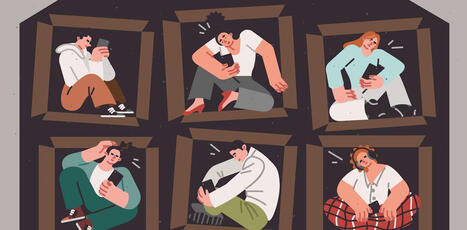
Students in this course learn about the biology and sociology of friendship, but also put their studies to the test by going to eat a meal with a peer, and tracking their experience. The first skill I learned when I became a political science professor nearly 20 years ago was how to quiet a room full of chatty undergraduates. These days, I often walk into a silent room, with students staring at their phones and barely acknowledging the classmates beside them. As I read more about the United States’ loneliness crisis, I began noticing a version of it among my students. In a 2026 national survey of over 40,000 college students, nearly 6 in 10 said they felt lonely sometimes or always. At the same time, federal time-use data show that the share of Americans who socialized in person with family, friends or others on an average day fell from 38% in 2015 to 30% in 2025.
The proposed Kids Act adds to the European Union’s digital policy toolkit, complementing existing safety and privacy rules for children prescribed under the Digital Services Act (DSA), the GDPR, AI Act, the Digital Markets Act (DMA), and the Audiovisual Media Services Directive (AVMSD). It has received a lot of attention in terms of supervisory fees and the age-tiered social media ban implemented through age verification. But the proposal’s provisions on interoperability and third-party tools demand a closer look. Section 6 of the draft envisions tools and allows guardians to manage screen time limits, account settings, receive warnings about potential risks and — for Very Large Online Platforms (VLOPs) — use interoperable third-party guardian tools to “further enhance usability and effectiveness.” While some elements are now ubiquitous in online child safety laws globally, interoperability offers a different approach by giving parents and minors more control over how safety measures work rather than leaving that control entirely to platforms. The proposal’s approach builds on a broader debate over whether third-party tools can make online spaces safer, more private and more responsive to users’ needs.
My students and I were talking this morning about press freedoms in the U.S. and in other Western democracies. How, I asked, could countries like Britain, Canada, Germany and France ensure such freedoms in the absence of something like the First Amendment? The answer is that they can’t, at least not as comprehensively as we do. Libel protections and the right to publish information about criminal trials, government secrets and the like are in fact more robust here than they are in other countries. Yet according to the Press Freedom Index published by Reporters Without Borders, the U.S. ranks just 64th, behind Botswana but ahead of Panama. Norway is No. 1. How can this be?
The Province of British Columbia and Board of Education of School District No. 59 just sued Sam Altman and OpenAI for their role in the mass shooting at Tumbler Ridge involving the shooter
Jesse Van Rootselaar, who used ChatGPT at one point. Altman already issued an apology to Tumbler Ridge community for OpenAI’s failure to alert law enforcement after internal protocol at OpenAI had flagged disturbing chats by Van Roostelaar and some OpenAI safety employees had reportedly recommended notifying law enforcement in June 2025. OpenAI decided not to, but terminated the account. On February 10, 2026, Van Rootselaar killed 8 other people: her mother, 11-year-old half brother, 5 students at Tumbler Ridge school, and a teacher, before killing herself. This is lawsuit Tumbler Ridge lawsuit No. 38. We updated to our case tracker. DOWNLOAD COMPLAINT
Large language models (LLM) can uphold falsehoods they or human users state, despite being presented with evidence to the contrary. When you ask an LLM a question, the reply may include falsehoods, and if you challenge those statements with facts, the AI may still uphold the reply as true. That’s what my research group found when we asked five leading models to describe scenes in movies or novels that don’t actually exist. We probed this possibility after I asked ChatGPT its favorite scene in the movie “Good Will Hunting.” It noted a scene between leading characters. But then I asked, “What about the scene with the Hitler reference?” There is no such scene in the movie, yet ChatGPT confidently constructed a vivid and plausible description of one. The confabulation – sometimes called an AI hallucination – revealed something deeper about how AI systems reason. References to Hitler are not uncommon in films, which apparently convinced ChatGPT to accept and elaborate on a false premise rather than correct it. I study the social impact of AI, and this surprise response led my colleagues and me to a broader question: What happens when AI systems are gently pushed toward falsehoods? Do they resist, or do they comply?
For generations, the SAT has loomed large in the lives of teenagers. The quest for a perfect or near-perfect score has filled many test takers with dread. In this episode, a listener's question makes us wonder... who decided the SAT was the best and brightest way to filter students? And how did it become the pathway to higher education in America?
|
n the new issue of Journalism History, Professor Victor Pickard writes about how redbaiting, “the process of discrediting — and ultimately silencing — particular groups and individuals by associating them with left-wing ideologies,” influenced the early communication field. His essay, “Ideological Steering of US Media Research: The Role of Redbaiting in the Early Communication Field,” examines how redbaiting influenced the direction of the nascent field of communication in the 1930s and ‘40s. Ideological currents not only influenced what type of scholarship was funded, encouraged, and celebrated, but also who was allowed to conduct it, he writes. In the essay, he traces how both implicit and explicit redbaiting shaped the early field, steering it away from critiques of commercial media industries and media reform activism and alienating and stigmatizing scholars who carried out these critiques. He also calls on us to reckon with this history to avoid further acts of intellectual repression. We asked Professor Pickard to discuss the essay and its implications for current communication research and scholars.
In all, there are roughly two dozen state student loan lenders that offer broad-based assistance to help students fill education funding gaps.
A report from a federal agency told American broadcasters in 1949 to cover controversial public issues and to carry opposing views, and no Congress ever voted that rule into law. The same agency erased it in 1987, and the power it had formalized worked again in 2025 with no such rule in force.
Gazing into her canvases, you enter vast space. Is it the sky? Are you looking through a lagoon? Into the deep recesses of the universe? You’re surrounded by ethereal, tranquil work by an artist who spent her life observing the natural world, creating abstractions causing you to pause and contemplate. The masterful work in Emmi Whitehorse: Intimate Landscapes is on view at Santa Fe’s Wheelwright Museum of the American Indian through October 3, 2026. This retrospective was mounted in two parts this year so that some of her recent large-scale canvases could have room to breathe in the hogan-inspired main gallery of the Wheelwright.
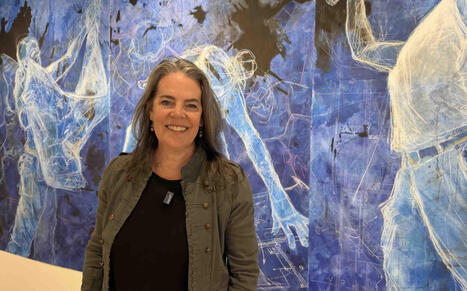
25 September 2026 - BARNSTABLE, MA - Muralist and multi-media artist Jackie Reeves opens her latest show at the Higgins Gallery at the Cape Cod Community College. The show runs through October 09 and includes a reception October 1, 5-7 pm at the gallery. Reeve’s studio is in Barnstable Village.
What is Reeve’s work like? Her work on display reflects her personal history as a child of architects, with five sisters and three daughters. Themes of building and following chance flow through her works, as does a playfulness with scale. “Scale plays an important role. In a lot of the work in this show you’ll see I’m playing with scale, the idea of things being really big then shrinking them down really small,” she explained.
Public media survived the loss of federal funding, but is survival enough? In his September “Innovation in Practice” op-ed, E&P columnist Chad Davis contends that public media is at a pivotal moment that calls for the DIY spirit of punk and a willingness to rethink what public media can be. Davis explores how collaboration with nonprofit newsroom, filmmakers, game developers and other nontraditional partners could help usher in public media’s next era.
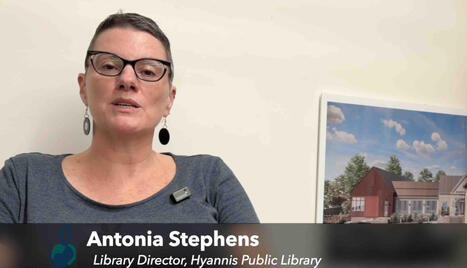
24 September 2026 - HYANNIS, MA - The remodel of Hyannis Public Library includes includes a sprung floor and a plan for kinetic literacy to help connect Cape Cod with the language of dance.
What is kinetic literacy?
Dance and libraries might not seem like an immediate pairing, but at the new Hyannis Public movement forms one more part human understanding.
“We tend to think of literacy as just being able to read and write but it’s really about understanding a system of some sort,” says Antonia Stephens, Library director for the Hyannis Public Library.
You’ve heard the Middle Class Parent’s college affordability lament: America’s truly wealthy can pay full freight without blinking. America’s poor get financial help. Folks in the middle – the families who make six figures, own a home, save for retirement – can get caught in an aid desert. That’s why I sat up and took notice when Middlebury College, an elite liberal arts school in Vermont, announced it’s going tuition-free for students with family incomes up to $175,000 “and typical assets.” The program will start with first-years next fall. “We want to open our doors wide to ensure that talented and dedicated students from all backgrounds have the opportunity for a Middlebury education and the futures it opens,” Middlebury President Ian Baucom said. “In the coming years, we hope and expect to push the tuition-free threshold even higher.”
The annual U.S. News Best Colleges rankings were released today, with a large portion of ranked schools changing categories compared with previous editions due to the 2025 update of the Carnegie Classification of Institutions of Higher Education. The large majority of schools U.S. News surveyed continued to report data: 73% of the nearly 1,500 ranked institutions returned their statistical information in the spring and summer of 2026, compared with 79% last year. This includes 99 of the top 100 ranked National Universities and 98 of the top 100 ranked National Liberal Arts Colleges. Here's a look at the top-ranked schools in their respective ranking categories in the 2027 edition of the Best Colleges.
To celebrate over six decades of the revolutionary educational institution, museum of the Institute of American Indian Arts (IAIA) decided to showcase the breadth and scope its spectacular contemporary jewelry collection made by students, faculty, and artists-in-residence. The Stories We Carry shows that wearable art can convey ancient tales, speak truth to power, and incorporate surprising materials in the hands of forward-thinking innovators. The exhibition – which has occupied the upper floor of Santa Fe’s IAIA Museum of Contemporary Native Arts for a four-year run – is on view through September 28, 2026.
The words "climate change" are slowly being removed from textbooks in Florida and from the state's education standards. A MARTÍNEZ, HOST: Students in Florida are reading watered-down versions of some science textbooks. Authors blew the whistle in 2024, saying the state pushed back on facts about human-caused climate change. Jessica Meszaros of member station WUSF and the Hechinger Report uncovered emails showing the state's demands. JESSICA MESZAROS, BYLINE: Climate change was swapped for changes in the environment in the Florida version of McGraw Hill's marine science book. The word polluting vanished from in front of coal-burning power plants in an environmental science text by publisher Cengage that's only available in Florida. And detailed facts were crossed out in both books, like how a World Health Organization study shows climate change is killing at least 150,000 people per year, or how college students helped their school buy renewable electricity. Ken Miller has authored one of the nation's most popular biology textbooks for nearly 30 years. But two years ago, he says, something shifted. KEN MILLER: The Florida Department of Education was pressuring publishers to reduce or eliminate coverage of climate change as a condition for getting on the approved list.
Research shows that overprotective parenting is linked to rising rates of anxiety and depression in children and teens. Parents across the country have been investigated or arrested for allowing their kids to play outside unsupervised, but research shows that overprotective parenting is linked to rising rates of anxiety and depression in children and teens. So how much independence should children have? Peter Gray, a research professor at Boston College and author of the upcoming book, “Restoring Childhood: How To Set Kids Free in the Age of Anxiety," joins host Indira Lakshmanan to discuss.
|