Akakū's mission is "Empowering the community’s voice through access to media".
Akakū is our community's voice in Maui Nui.
The Hawaiian word, “Akakū,” means “a reflection, as if in a mirror”. We reflect the beauty, creativity, politics and culture of our Maui Nui community across all four of our beloved islands.”
In exchange for the use of valuable public rights of way, the Cable Communications Policy Act of 1984 expressly provided for state or local jurisdictions to be able to require a cable operator to set aside channels for public, education, and government uses (PEG). Facilities and equipment for access use can also be required as part of a public benefits package negotiated in exchange for the use of public rights of way.
Akakū: Maui Community Television is the Department of Commerce and Consumer Affairs (DCCA) designated Public, Education and Government Access (PEG) provider for the County of Maui.
Akakū: Maui Community Television is a non-profit 501(c)3 community organization that provides education classes, training, editing and studio facilities for the Maui County community to express its right to free speech through public access to the media. Akakū is able to provide this access via Akakū’s cable television channels, 52, 53 and 54.
The Library as Incubator Project is delighted to partner with Carnegie Library of Pittsburgh and guest blogger Emily Fear to showcase a new digital literacy initiative at CLP called The Labs. For this installment, we examine the nuts and bolts of launching a digital makerspace in a large library system by taking a look at policies and equipment.
Don’t miss Emily’s other blogs in this exciting series: The Labs @ Carnegie Library of Pittsburgh offers an introduction to the program and how it got started, and The Labs @ Carnegie Library of Pittsburgh | Hip-Hop on L.O.C.K Workshops profiles The Labs’ partnership with a local outreach group for a teen sound mixing program.
Click headline to rea dmore and access hot links--
The Discovery District, the creative quarter of Downtown, is in flux, aptly enough. And when the construction dust settles, its transformation should benefit the city center.
The Columbus College of Art & Design has an ambitious idea to reconfigure its campus to match its curriculum and allow more students to attend and live there full-time. At the same time, businesses are planning to build and move in nearby, and the city wants to revamp that section of Gay Street.
This flurry of interest and activity sets the stage for something unique to emerge on that side of Downtown.
The college hasn’t filled in the details of the plan, such as a budget or a timeline; trustees have much to discuss in the coming months. It features a lot of moving parts because the city will be developing the district at the same time.
CCAD recently consolidated its curriculum into two areas of study: physical studio arts and digital design arts. The plan is to arrange the campus according to those two areas, creating “ subset neighborhoods of campus,” according to CCAD President Denny Griffith. The construction likely will start with a new dormitory, probably within three years.
Urban planners envision a more pedestrian-friendly Gay Street through campus, with green spaces, big windows on the academic buildings and “art alleys,” where students’ artwork is displayed for passersby.
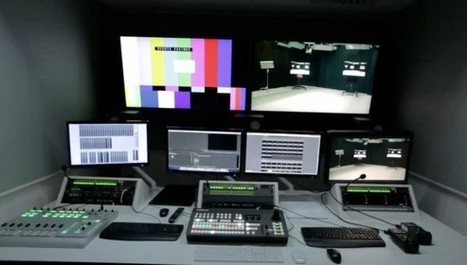
Google has launched the YouTube Creator Space, a video recording and editing hub at the company’s London, UK office promising the latest kit for partners to use. Available to rent – with no word on exactly how much – to YouTube partners and those in education across Europe, Africa and the Middle East, the setup will include HD video cameras and DSLRs, green screen suites and more.
There will be editing suites for piecing together footage, with two main studios for recording it in the first place. YouTube will have professionals on-hand to help get the best out of the equipment.
YouTube’s Next Lab team will be handling the bookings, with the eventual goal being more professional-quality content from the army of hitherto-bedroom-broadcasters that pump content onto the video sharing site every day. Membership in YouTube’s partner program is free, though Google hasn’t said if it will be charging for use of the Creator Space kit.
One of the reasons that I enjoy blogging and digital content creation is that it combines a lot of the different traits that make me who I am, namely, a logical sense of analyzing what works, an appreciation for creativity and good content, and a a willingness to try new things.
But there’s definitely a trend emerging as more and more brands start becoming “media shops” and creating content to distribute, hoping customers consume it.
Everyone wants the content they create to produce results for their businesses. (And can you blame them? If you work in business, you should get that concept pretty readily). However, this puts a rather large emphasis on analyzing performance, which includes tracking metrics like clicks to the links you share, time spent reading and/or watching (“views” is another similar metric), or even total number of shares. Not to mention SEO optimization of things like headlines and paragraph structure.
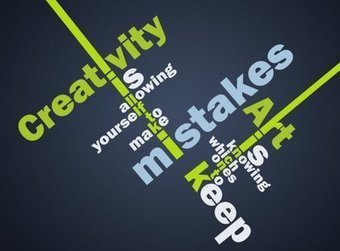
That’s all well and good, but there’s a big ingredient missing when all you do is focus on the data-driven side of the business of content, and that’s creativity.
Google officially announced the details of its fiber service in Kansas City today. If you don't remember, after doing a nationwide search, Google chose Kansas City (both the Kansas and the Missouri ones) as a sort of testbed.
For years, we've pointed out that the real problem in broadband is the lack of competition. It's that lack of competition that leads companies like Verizon to stop investing in fiber networks, and companies like Comcast to only offer serious broadband where its competing with fiber. Competition is the key, and sadly, it's lacking in most places.
The Google setup was intriguing in that it was a true new entrant in the market, and one that seemed to acknowledge that what was most important wasn't appeasing the short term thinking on Wall Street that pushes against faster speeds and more innovation (too expensive!).
Instead, it was going to see what it could do to increase speeds and decrease limits -- and now we've seen a glimpse of what that looks like with the official details -- many of which probably have the traditional broadband players quite annoyed.
This past June, I attended the ISTE (International Society of Technology Education) conference in San Diego. The annual conference brings over 20,000 folks including educators, administrators, and academics.
My purpose for attending, besides catching up on the newest technologies, was to also make a presentation on connecting media literacy education to digital technologies. There was a wide attendance—which was excellent—but what was most evident was that there was still a disconnect for many people about this idea of literacy education as related to teaching technology.
The many teachers, educators, and college administrators that I spoke with were intrigued at this idea of connecting a literacy education piece which asks student to analyze, evaluate, access, and produce information that is thoughtful.
It isn’t the production piece that is holding students back as we know that they are producing all sorts of things online –both good and bad. The issue is that they are just putting up information without really considering its impact on their audience, on themselves, or their peers.
New media technologies are changing rapidly. The opportunities and challenges for parents and their children can be both exciting and intimidating. This slideshow from Common Sense Media gives a good overview of the changing media landscape and provides a framework for understanding its impact on your kids.
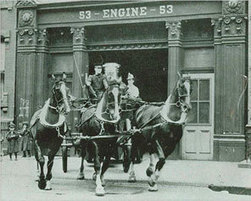
In 2007, MNN committed to expand its community media services and identified the East 104th Street Firehouse as a potential site for this purpose. After conducting an extensive architectural, engineering and environmental assessment of the Firehouse, MNN decided to purchase it. The historic building constructed in 1883 achieved landmark status, and MNN began a total renovation.
By the end of 2011, the old Firehouse was successfully transformed into a state-of-art production and broadcast facility housing three studios, several editing suites, a classroom, and a community meeting space.
MNN continues the journey to create the community media center envisioned as a place of education and learning, creativity and inspiration, collaboration and action. With outreach to neighborhood residents, activists, artists, and producers, the MNN El Barrio Firehouse Community Media Center is in the process of developing educational programs, community activities, and trainings to certify MNN Firehouse producers. The Firehouse is slated to open in 2012.
Click headline to access MNN's Barrio Firehouse CMC webpage--
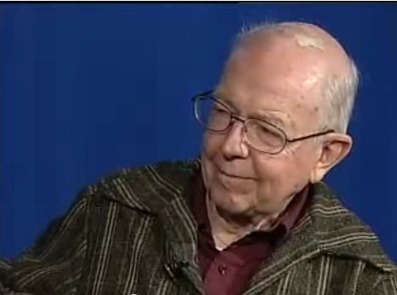
Pioneering documentary filmmaker, Pubic Access TV champion and Manhattan Neighborhood Network (MNN) Board member George Stoney passed away July 12 at his home in Greenwich Village.
“As a filmmaker and documentarian, George Stoney was truly a pioneer of the fine art and craft of revealing truth through cinematic and electronic media,” said Dr. Norris Chumley, the Chair of the MNN Board. "The entire MNN community mourns his passing and sends our deepest condolences to his family."
In honor of George’s contributions, MNN recently unveiled the George C. Stoney Community Studio at the MNN El Barrio Firehouse Community Media Center, MNN’s new state-of-the-art satellite facility in Upper Manhattan.
The Region 2000 Technology Council, Central Virginia Community College, Future Focus Foundation, and the school divisions of Amherst, Appomattox, Bedford, Campbell, and Lynchburg, along with area business partners are moving closer to launching a Career and Technical STEM (science, technology, engineering and math) Academy in our area. Dovetailing with current K-12 STEM activities and workforce development initiatives, the goal of this institution will be to help close the gap between education and industry, furthering the economic vitality of this region.
Implementation of Governor’s CTE-STEM Academies in Virginia began under the Kaine administration in 2007. There are currently 14 approved STEM Academies in Virginia, many of which are the product of Governor McDonnell’s initiative to double the number of STEM Academies in Virginia by the end of his administration.
This type of STEM Academy differs from the Regional Governor’s School for Science and Technology in the type of curriculum and courses offered. CTE-STEM Academy courses will have a career and technical education focus with the curriculum driven by the needs and projected growth of regional industry. Currently the two identified student pathways to be offered at the academy include healthcare and mechatronics; the latter being the blending of mechanical and electrical engineering disciplines.
The Department of Labor said that its almost 2,800 American Job Centers will start providing digital literacy outreach as part of the Federal Communications Commission/Obama Administration/broadband industry Connect2Compete initiative.
That came in an announcement Monday at an employment center in Arlington, Va.
FCC chairman Julius Genachowski joined Labor secretary Hilda Solis and others to unveil that new effort, as well as an early 2014 public service campaign through the Ad Council, which puts together pro bono creative with donated ad space and time from TV and radio stations.
The campaign will promote a new database and training locator tool to help identify computing centers and training, which will be released this fall.
As part of Monday's announcement, Connect2Compete released preliminary results from its San Diego pilot program offering $9.95-per-month standalone broadband and $150 laptops to households with school kids eligible for school lunch programs, where more families bought the service from Cox -- the participating cable provider -- during the two-month test than had been projected, according to the FCC.
We're delighted to announce that in the next few weeks we'll be opening the doors to our new creator space, housed in the offices of Google London's Soho office. Our partners from all over Europe, Middle East and Africa will be able to book time in the space to create and collaborate with other creators, learn new techniques, as well as gaining access to state-of-the-art audio visual equipment, to help them generate great new content for their channels. The creator space is complete with the latest equipment such as DSLRs and cinema cameras, two studios including a green screen and fully staffed editing suites.
Follow us on LinkedIn One of the many influences of modern technology on social interaction is the growing use of online gaming as a medium for social interactions. The importance of social interaction in games can be put into perspective by the fact that social interaction is becoming an increasingly important theme in multiplayer gaming. Also, mirroring the trend is growing replacement of individual game consoles, which once ruled the video games industry, by online games.
Social games, in particular allow users to utilize games as a means of communication and interaction with other players. Social games are increasingly being perceived as viral mechanisms that help promote qualities of cooperation and healthy competitiveness.
Incremental improvements in the quality of social games and superior in-depth gameplay have over the last couple of years, encouraged more number of consumers to access the social gaming scene. The simplicity of gaming formats and easy accessibility over social networks have thrown open these games to a much wider community, including non-gamers such as housewives and busy professionals. Although the demand curve slightly leans towards the younger generation, social games transcend the age factor, even appealing to senior citizens.
"The real problem is not adding technology to the current organization of the classroom, but changing the culture of teaching and learning.” - Alan November
My colleague Nicole Sprainger, has created an iBook "iPads for Literacy & Learning" which has been developed to assist K-10 teachers in utilising the iPad in their classroom literacy learning programs. It recognises that our students live in an increasingly sophisticated and media-rich society, in which digital texts are ubiquitous. Our students need therefore to become multiliterate - to be critical consumers of digital media texts. They also need to develop the ability to construct new knowledge, communicating their own ideas and information by composing using digital tools and processes.
Nicole says the iBook itself is intended simply to be a stimulus - a spark to encourage teachers to consider some ways to provide explicit learning opportunities for their students to access, use, understand and create multimodal texts while utilising the iPad.
Click headline to read more and access the download of the iBook--
MediaSmarts is a Canadian not-for-profit charitable organization for digital and media literacy. Our vision is that children and youth have the critical thinking skills to engage with media as active and informed digital citizens.
To achieve this goal we develop and deliver high-quality Canadian-based digital and media literacy resources; provide leadership in advancing digital and media literacy in Canadian schools, homes and communities; and contribute to the development of informed public policy on issues related to the media.
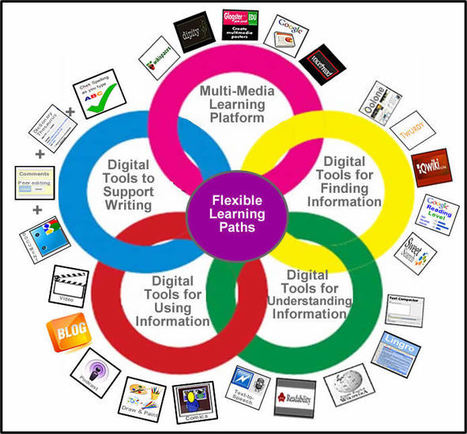
An attempt to add Digital Media Literacy to a traditional Language Arts curriculum, welcome students to the New Alexandrian Era & the ePub Generation, facilitate 21st Century skills & Conceptual Age Aptitude acquisition...and a throw in a hefty dose of EduHeresy as well!
Click headline to access and explore the Flexible Learing Paths as you move your cursor over the graphic--
After more than two years of anticipation, Google finally announced Thursday that the company’s ultra-high speed internet service Google Fiber would become available to the residents of its test community Kansas City starting in September.
Offering an internet connectivity speed of one gigabit per second, Google said the service will be about 100 times faster than the speed most Americans have with current broadband connections, reported Xinhua.
Instead of a broadband connection, Google Fiber is composed of thin optical fiber lines that run directly from a person’s home to a data centre, which is then in turn connected to the national internet backbone.
According to Google, it is this “direct connection” from a person’s home to the national backbone that will allow users to experience such high internet speeds.
Google said it was inspired to develop Google Fiber in line with the Federal Communication Commission’s 2010 National Broadband Plan, which calls for making high speed internet more widely available in the US.
Despite the fact that internet was invented in the US, according to content delivery network Akamai’s 2011 State of the Internet report, the US ranks only 12th globally in internet connection speed, with an average connection of 5.8 megabits per second. South Korea ranks first, with an average speed of 17.5 megabits per second.
This FREE, pioneering curriculum is designed to empower students to think critically and make informed choices about how they create, communicate, and treat others in our ever-evolving, 24/7 digital world. Browse the units to find the topics and lessons that are just right for your students.
As the media industry reshapes itself, a tremendous opportunity emerges for America’s journalism programs. Neither news organizations nor journalism programs will disappear, but both must rethink their missions, particularly now that many more people can be journalists (at least, on an occasional basis) and many more people produce media than ever before.
Journalism education programs have an opportunity to become “anchor institutions” in the emerging informational ecosystem. Many schools have long embraced elements of this vision, but satisfying the information needs of communities will require schools to take on all the challenges of engaging as serious and valuable producers of meaningful journalism. To date, some programs have avoided or shirked these responsibilities, failing to leverage broadcast licenses as part of their educational mission or inadequately supporting the pursuit of meaningful journalism by students….
As Nicholas Lemann, dean of the Graduate School of Journalism at Columbia University, has written, “Like teaching hospitals, journalism schools can provide essential services to their communities while they are educating their students
Founded in 1992, Manhattan Neighborhood Network (MNN) is New York City’s free, public access cable network. We operate four channels (Community, Lifestyle, Spirit, and Culture), reaching 620,000 cable subscribers in the Manhattan area.More than just a local TV station, MNN is the largest public access cable network in the nation with programs airing in over 40 languages. We also offer free training in video production, editing, and broadcasting to Manhattan residents who wish to become Certified Producers with MNN.
We actively strive to empower Manhattan residents to exercise their First Amendment rights in an open, uncensored, and equitable forum.
MNN is responsible for administering the public access cable TV services in Manhattan. Our purpose is to ensure the ability of Manhattan residents to exercise their First Amendment rights through moving image media to create opportunities for communication, education, artistic expression and other non-commercial uses of video facilities on an open and equitable basis.
In providing services, we seek to involve the diverse racial, ethnic and geographic communities of Manhattan in the electronic communication of their varied interest, needs, concerns and identities.
"This is the new public art. Not bronze statues of dead white guys or static plop art, but dynamic media art that reflects the city and the time we live in, and give the energy of the city back to us.
"Digital displays the size of buildings, wearable computers the size of t-shirt logos, and every programmable surface in between are becoming the new canvas for artistic expression.
Boston Cyberarts is bringing media art to two urban screens in downtown Boston, taking our city to the forefront of the artistic use of large urban screens. At the Boston Convention Center, 17 art projects play in rotation with convention information and advertising, and at the Harbor Island Pavilion on the Rose Kennedy Greenway, computer artists will generate real-time, constantly changing imagery to visualize data the National Park Service has collected from the harbor for 20 years.
Click headline to read more and watch George Fifield's presentation--
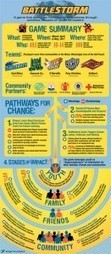
In an increasingly visual culture, the old ways of communicating lessons learned are startlingly out of touch with how we want and expect to get information. That’s why the John S. and James L. Knight Foundation decided to try a new approach to sharing lessons they were learning from the evaluation of two social impact games.
One game, Battlestorm, was a youth-based game to improve hurricane preparation awareness and habits on the Gulf Coast. The other, Macon Money, used an alternative form of local currency to connect residents to each other and to attract and expose people to local businesses in Macon, Georgia. For both evaluations, the foundation wanted to communicate its findings in ways that were just as appealing, interactive, and forward-thinking as the games themselves.
Hershey Cause Communications led the evaluation team and produced a suite of interactive data visualizations, infographics, PowerPoints and publications to communicate the results. The idea was to communicate the findings in real-time over the course of the games and again when the final analysis was complete.
For more details, check out what popular philanthropy blogger, Lucy Bernholz, recently called “… the most fun evaluation report you’ve ever seen.” Or in keeping with the idea that visuals can sometimes say more than words, you can experience the website here and via the links mentioned below.
We learned two key lessons from this process of combining evaluation and communications to share valuable information:
Click headline to read more and access hot links--
NTEN aspires to a world where all nonprofit organizations use technology skillfully and confidently to meet community needs and fulfill their missions.
We are the membership organization of nonprofit technology professionals. Our members share the common goal of helping nonprofits use all aspects of technology more effectively.
We believe that technology allows nonprofits to work with greater social impact. We enable our members to strategically use technology to make the world a better, just, and equitable place.
NTEN facilitates the exchange of knowledge and information within our community. We connect our members to each other, provide professional development opportunities, educate our constituency on issues of technology use in nonprofits, and spearhead groundbreaking research, advocacy, and education on technology issues affecting our entire community.
To get content containing either thought or leadership enter:
To get content containing both thought and leadership enter:
To get content containing the expression thought leadership enter:
You can enter several keywords and you can refine them whenever you want. Our suggestion engine uses more signals but entering a few keywords here will rapidly give you great content to curate.


 Your new post is loading...