Your new post is loading...

|
Scooped by
Kim Flintoff
February 10, 2016 9:25 PM
|
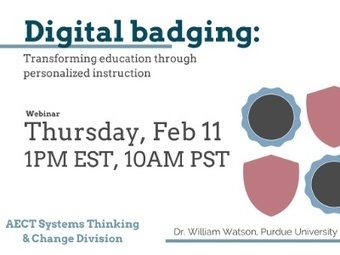
The AECT Systems Thinking and Change Division would like to invite you to an upcoming webinar on Thursday, February 11th, 1pm EST/10am PST, titled Digital badging: Transforming education through personalized instruction. Dr. William Watson will will examine the problems of education through a systems thinking lens and discuss how digital badges can play an important part in transforming education to a personalized, learning-focused paradigm. Register now at: https://cc.readytalk.com/cc/s/registrations/new?cid=yw7wlpiqgv83
|
|
Scooped by
Kim Flintoff
February 1, 2016 12:54 AM
|
Tom Vander Ark of Getting Smart has argued that “parent-managed learner profiles” will by key to both enabling and scaling personalization in education. As Tom envisions, these profiles would include all of the elements of traditional school transcripts, supplemented with richer, more nuanced, and actionable information about student learning attainment, achievement, and needs. Critical to this vision is the ability for the student transcript to both be easily portable (and under direct parent/student control) and decentralized (in that traditional education institutions should not completely control or dictate its contents).
While digital badging and its underlying technical approach points a way forward to solving some of the issues associated with a ‘distributed proof of learning’ system, there has emerged another approach that might hold even more promise: blockchain technology.
For those not familiar with the concept of the blockchain (and I wasn’t until I serendipitously learned of Gridcoin, the socially-conscious kissing cousin to the more famous crypto-currency Bitcoin), here’s a simplified description:
The blockchain is a secure, openly replicated and distributed, ledger of every…transaction ever executed. In addition to this data being openly shared amongst all participating services, there is a mechanism to constantly identify discrepancies and test them across the entire network, automatically identifying and overriding illegitimate transactions as it goes.
(excerpted from Forget Bitcoin – Blockchain is coming: Blockchain will be the banking MP3 disruptor) In essence, blockchain technology allows a system of trust to be maintained in the absence of a central authority.
|
|
Scooped by
Kim Flintoff
January 26, 2016 9:20 PM
|
Open digital badges are changing how individuals’ credentials are recognized as publicly viewable artifacts that not only contain claims to learning, but also provide evidence of that learning. Used in a myriad of ways to acknowledge achievements, badges can circulate in social networks to transform how learning is achieved, evidenced and distributed in real time. Badges act as a way for us to take a closer look at the skill sets a person has acquired in formal informal and online settings. Learning occurs naturally outside the classroom setting, but rarely is it recognized or valued in the same way that formal learning is. Badges help connect different types of learning settings, locations and experiences.
|
|
Scooped by
Kim Flintoff
January 11, 2016 7:23 AM
|
The Open Badges project is growing up. We’re now in our 5th year, so in many countries around the world, we’d be about ready to enter school. There has been a continuous community gathered around this technology from the very start, populated by dedicated individuals, organizations, companies, nonprofits, and foundations. We came together in 2014 to form the Badge Alliance, to stake a claim in this belief that when we build a distributed ecosystem of educational credentials together, we will give people the tools to manage their digital footprints themselves, without requiring a relationship with any one particular mega-corporation. We believe that by working together in the open, we can build systems that improve access and equity of educational and career opportunities.
|
|
Scooped by
Kim Flintoff
November 17, 2015 8:48 PM
|
Here is a personal history of #OpenBadges in 50+ articles from 2013 through the middle of 2015.
|
|
Scooped by
Kim Flintoff
November 11, 2015 6:51 AM
|
Micro-credentials could have a hugely beneficial impact on teacher professional development if they are part of a well-organized system. Just 15 percent of teachers in the survey said they are even somewhat familiar with the concept of micro-credentials, which the report defines as addressing “the need for competency-based learning for educators by allowing them to identify specific competencies they wish to develop, submit evidence of their competence and then receive recognition for that learning through digital badges.” However, after reading a description of micro- credentials, more than 70 percent of teachers surveyed said they are at least somewhat interested in them, and 65 percent of those surveyed said they are at least somewhat likely to try to earn micro-credentials as part of their professional development.
|
|
Scooped by
Kim Flintoff
October 20, 2015 3:14 AM
|
|
|
Scooped by
Kim Flintoff
October 12, 2015 8:05 PM
|
The photographic, media, telecommunication and taxi industries have all experienced the pain of digital disruption but academia has so far been immune. That may be about to change.
|
|
Rescooped by
Kim Flintoff
from Digital Delights - Digital Tribes
September 6, 2015 7:17 PM
|
By Tom Vander Ark - A system of micro-credentials is how educators will be prepared and how they will be recognized for their professional learning.
Via Ana Cristina Pratas
|
|
Scooped by
Kim Flintoff
August 30, 2015 9:49 PM
|
OBHE Library curated by James WIllis III
|
|
Scooped by
Kim Flintoff
August 21, 2015 10:26 PM
|
DeakinDigital, Credly team up to offer digital credentials for professional skills.
digital-badgingDeakinDigital, a wholly owned subsidiary of Deakin University, is partnering with Credly in the delivery of its new credentialing program, which it touts as an alternative to traditional education models.
The move could drastically reduce the time it takes to attain certain degrees, university representatives said.
|
|
Scooped by
Kim Flintoff
August 20, 2015 8:54 PM
|
Once employers start seeing qualified candidates with alternative educational backgrounds, the ability of the four-year colleges to hold students hostage to increasingly worthless degrees will gradually weaken. Then, the traditional academic institutions can choose to evolve or perish.
|
|
Scooped by
Kim Flintoff
August 14, 2015 8:44 PM
|
A community effort is making badges practical in one city this summer This summer, as schools let out, thousands of Pittsburgh students streamed into digital media programs, drop-in maker spaces, and paid internships across the city. As they shuffle back to school, or even enter into the workforce, many will be adding shiny new digital badges to their online portfolios as a record of their hard work.
The opportunity comes courtesy of Pittsburgh City of Learning, which is working with major community partners to provide more than a hundred different, mostly free, summer programs to about 5,000 learners. And digital badges play a big part.
|
|
|
Scooped by
Kim Flintoff
February 5, 2016 8:49 PM
|
As the federal government of Prime Minister Malcolm Turnbull seeks to lift economic growth by encouraging more innovation, it seems likely that blockchain applications will be on the agenda of the Digital Transformation Office.
|
|
Scooped by
Kim Flintoff
January 30, 2016 6:11 PM
|
What’s Ahead
In 2016, Mozilla will continue to support the Open Badges ecosystem we helped seed. We’re taking on a smaller role, and working alongside several players, but remain committed to the initiative. We’ll also apply what we learned: Open Badges can evolve best as a collaborative, community-driven effort. Its future is brightest when the community comes together to carry it forward.
|
|
Scooped by
Kim Flintoff
January 18, 2016 8:21 PM
|
Although I’m not aware of an official announcement from the Badge Alliance, I think it’s worth making three points here.
1. You can still use Persona
2. Persona is not central to the Open Badges Infrastructure
3. A post-Persona badges system has its advantages
|
|
Scooped by
Kim Flintoff
December 16, 2015 8:43 PM
|
Key Takeaways This study investigated the potential for digital badges to certify andshowcase the competencies students gain while participating in campus-based clubs.Thirty-one young professionals who were active in student clubs during college were asked about the value that digital badges might have had for their careers if the badges had been available when they were students.Most (58 percent) said that using digital badges to certify and highlight competencies gained through student club activities would have been useful as they entered the job market after college.Study participants' views varied depending on their club experiences; those who focused on knowledge acquisition and leadership in their clubswere more favorable toward digital badges than those whose involvement emphasized professional networking.
|
|
Rescooped by
Kim Flintoff
from :: The 4th Era ::
November 13, 2015 7:45 AM
|
While badging for students shows real promise, a partnership between the Houston Independent School District (HISD) and VIF International Education demonstrates that in the short run the best approach to scaling digital badging is not to focus on students, but on their teachers.
Beginning this past fall, HISD launched a global learning initiative in 28 elementary schools. The district will expand the program to a total of 51 elementary schools for the 2015-16 school year. To ensure program quality for our students, we partnered with VIF to provide our teachers with globally themed online professional development and a customized digital badging system. Within the professional development platform, they also have access to curricular resources and a community of fellow educators to spur and support collaborative projects and innovative approaches. But the core of the system is the badging approach to professional development.
Via Jim Lerman
|
|
Scooped by
Kim Flintoff
November 4, 2015 5:11 PM
|
Certified skills are a valuable form of academic and professional capital. In this edition of the NMC Beyond the Horizon virtual event series, we will explore the use of digital open badges. These portable machine-readable credentials can verify the mastery of competencies demonstrated across the learning experience while connecting learners to new opportunities and workforce demand.
The panelists draw on experience supporting a range of institutions in developing digital credential badge programs that verify achievements in competency-based education degree programs, open online courses, cross-curricular literacies, co- and extra-curricular activities, student affairs, and faculty development — among other areas. This online program considers topics including new ways of thinking about assessing skills as well as how digital credentials can inform new programs and strengthen relationships.
|
|
Scooped by
Kim Flintoff
October 17, 2015 2:31 AM
|
Official Full-Text Publication: An Online Badging System Supporting Educators' STEM Learning on ResearchGate, the professional network for scientists.
Competency-based learning measures knowledge, not time.
Via Mark Smithers
|
|
Scooped by
Kim Flintoff
September 3, 2015 9:31 PM
|
Competency-based education has been gaining momentum across the American higher education landscape over the past five years, but in the medical education field competencies have been king since 2000. That said, some main campuses are still wary of the competency-based approach to credentialing and management tools, for the most part, are lagging behind in helping institutions to support these students. In this interview, Larry Gruppen discusses competency-based programming through the medical education lens, reflects on some of the reasons why he and his colleagues launched their Master’s of Professional Health Education program and discusses some of the challenges of managing this program in the current postsecondary climate.
|
|
Scooped by
Kim Flintoff
August 26, 2015 7:32 PM
|
An Australian university with an international online student body expects to begin accepting digital badging in 2016 that could reduce the amount of time required for people to obtain their master's degrees in IT.
|
|
Scooped by
Kim Flintoff
August 20, 2015 9:32 PM
|
The strong relationship between education and personal achievement is a basic tenet of our society, as well as an often-examined topic of social science research. Much of this research relies on traditional measures of educational attainment based on academic degrees, including high school diplomas, associate’s degrees, bachelor’s degrees, and advanced degrees. However, in recent years, attention has been called to the variety of educational credentials other than academic degrees that have labor market value. Policy makers and researchers have begun to consider the role of these “alternative educational credentials” in job placement, earnings, and career advancement.
|
|
Scooped by
Kim Flintoff
August 20, 2015 8:46 PM
|
New “unbundled” higher education providers are constrained by the regulatory system’s reliance on the traditional bundled model.
|