Devops for Growth
121.1K views | +0 today
Devops for Growth
For Product Owners/Product Managers and Scrum Teams: Growth Hacking, Devops, Agile, Lean for IT, Lean Startup, customer centric, software quality...
Curated by Mickael Ruau
Your new post is loading...

Popular Tags

Scooped by Mickael Ruau
November 6, 2021 6:08 AM
Scoop.it!

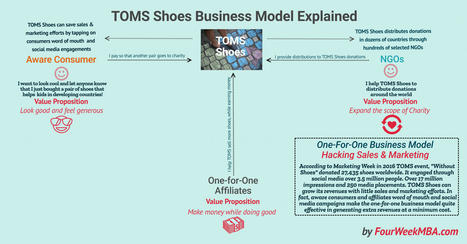
How Does TOMS Shoes Make Money? The One-For-One Business Model Explained

How Does TOMS Shoes Make Money? The One-For-One Business Model Explained | Devops for Growth | Scoop.it
TOMS Shoes’ business model is called one-for-one. It means that for each pair of shoes sold, the company gives one pair back to kids in developing countries. The one-for-one model allows the company to monetize through consumers’ word of mouth and social campaigns, with a minimum effort in terms of sales and marketing.  The one-for-one … Continue reading How Does TOMS Shoes Make Money? The One-For-One Business Model Explained
No comment yet.
Scooped by Mickael Ruau
November 6, 2021 3:57 AM
Scoop.it!

Alternatives To Business Model Canvas

Alternatives To Business Model Canvas | Devops for Growth | Scoop.it
The business model canvas is a tool devised by Alexander Osterwalder and Yves Pigneur in the book Business Model Generator, to design successful businesses. As alternatives to the business model canvas, you can use tools like blitzscaling canvas, lean canvas, VTDF framework, 3C business model, and more. ContentsAlternative tools to the business model canvasLean Startup CanvasBlitzscaling … Continue reading Alternatives To Business Model Canvas
No comment yet.
Scooped by Mickael Ruau
November 6, 2021 2:46 AM
Scoop.it!

Lessons On Running Lean With Ash Maurya [Lecture]

Lessons On Running Lean With Ash Maurya [Lecture] | Devops for Growth | Scoop.it
Ash Maurya is a practitioner and entrepreneur. Author of Running Lean, Scaling Lean and the Lean Canvas, built on top of the Business Model Canvas. Ash is also the founder of LEANSTACK. I took the chance to ask Ash a few questions. I tried to limit those as I had so many things I wanted … Continue reading Lessons On Running Lean With Ash Maurya [Lecture]
No comment yet.
Scooped by Mickael Ruau
November 5, 2021 6:19 AM
Scoop.it!

Méthode pour un sauvetage de projet efficient

Méthode pour un sauvetage de projet efficient | Devops for Growth | Scoop.it
Cet article se propose de vous donner les clés pour sauver un projet en distinguant différentes étapes :
1. Est-il possible de sauver le projet ?
2. Quelles sont les pistes pour résoudre les problèmes
humains ?
3. Comment résoudre les problèmes techniques ?
No comment yet.
Scooped by Mickael Ruau
November 5, 2021 3:34 AM
Scoop.it!

How to Build a CI/CD Pipeline for Salesforce

How to Build a CI/CD Pipeline for Salesforce | Devops for Growth | Scoop.it
Share this article...Digital transformation and the shift to online operations means companies are increasingly reliant on Salesforce to manage many of their operations. New business requirements and opportunities are steadily increasing the workloads for Salesforce teams. Against this backdrop, teams are turning to CI/CD to… Read More
No comment yet.
Scooped by Mickael Ruau
November 5, 2021 1:44 AM
Scoop.it!

The power of early adopters: how to get the right first 1,000 users for your product

The power of early adopters: how to get the right first 1,000 users for your product | Devops for Growth | Scoop.it
When you’re launching a new product, your first set of users can make or break your project. Here’s how to get these early adopters right.
Mickael Ruau's insight:

Create a lead capturing landing page

Even if your logo is not ready, you can start with text as your logo. How easily you can convey your product to your end user will matter a lot. It will help you capture some email addresses even before you launch your product/service. Sending emails beforehand lets you share your product with those who are already interested.

You can contact your designer or developer to help you with this landing page. Also, you can use services like Launchrock, Lead pages, and Wix to create a quick landing page. But be sure to keep some key points in mind while designing the page:

  • Easily convey what your app is all about.
  • Keep an email address capturing field.
  • Keep your social accounts linked on your website from the beginning.

Identify the early adopter communities for your product

Identify your customers well. The product UX/UI depends on it, along with the marketing/brand strategy. If your app is a product targeted at college students, you must discover where those students hang out. If your target is school students, you might want to consider where the parents will get the maximum visibility for your product.

Knowing your early adopters well from the beginning will help you identify niche online communities to target for marketing your product. Online platforms to keep in mind to push circulation of your app include Reddit, Hacker News, Product Hunt, BetaList, AngelList, Betabound, Facebook groups, and Google+ communities.

Once your landing page is ready you can circulate it to the prospective online communities. It will help you understand your prospective users’ mindsets. Sometimes you might even get questions to help you sharpen your product. Keep the following points in mind when checking out early adopter communities:

  • The audience.
  • Finding a niche community must be your top priority. For example, in Reddit, find niche SubReddits, and in Google+, find niche communities.
  • Read and behave according to community guidelines. Don’t get carried away.
  • Keep the email addresses or phone numbers handy in a CRM or an excel sheet.
  • If you use MailChimp or a similar service, remember your user data will be in the database of that service. For safety, you might want to keep an additional backup of the data elsewhere.
  • You can send your product link to the same email addresses later once it is launched.
No comment yet.
Scooped by Mickael Ruau
November 5, 2021 12:44 AM
Scoop.it!

2021 Toolkit: Managing Hybrid and Remote Teams

2021 Toolkit: Managing Hybrid and Remote Teams | Devops for Growth | Scoop.it
Download this best-practice collection of HR checklists, templates and insights to help engage and drive your remote and hybrid teams in 2021.
Mickael Ruau's insight:


What’s inside:

  • Managing hybrid and remote teams ebook
  • Quick guide to mental health and wellbeing
  • 1:1 Manager-team check in template
  • Goal setting template
  • Remote onboarding checklist
  • Project retrospective template
  • Psychological safety exercise
No comment yet.
Scooped by Mickael Ruau
November 4, 2021 12:24 PM
Scoop.it!

6 Conseils Pour Travailler En Mode Projet Efficacement

6 Conseils Pour Travailler En Mode Projet Efficacement | Devops for Growth | Scoop.it


Le mode projet est un modèle d’organisation et de gestion de projets transversal qui favorise le travail collaboratif. L’accent est mis sur la réalisation d’un objectif commun par des salariés de différents métiers ou de différents services, dans le cadre d’un budget et d’un calendrier donnés, pas simplement sur la réalisation d’activités spécifiques au département. Il est donc nécessaire de fédérer des groupes d’horizons professionnels, de compétences, de qualifications et d’expériences différentes ou complémentaires, pour mener à bien un projet de A à Z.
Le chef de projet

Agissant plus comme un leader que comme un manager, le chef de projet motive et embarque son équipe vers la réalisation des objectifs. Tel un chef d’orchestre, il veille à l’exécution du projet à l’écoute de ses collaborateurs, montre l’exemple et n’hésite pas à déléguer des responsabilités.

Si vous voulez adopter le mode projet, voici 6 conseils pour vous aider à le faire de manière efficace.
No comment yet.
Scooped by Mickael Ruau
November 4, 2021 11:47 AM
Scoop.it!

From “Delta Force” to “Fire Rescue”. Practical Agile Implementation

From “Delta Force” to “Fire Rescue”. Practical Agile Implementation | Devops for Growth | Scoop.it


To sum up, we implement the following “Natudologies” actually:

SCRURAILY aka. “Delta Force” - We choose for new, well-planned projects where you can safely prepare sprints. When the team starts the “action”, it is not wise to stop or change anything. We can fail our misson or have KIA(killed in action). Best fit for fixed-price, build from scratch projects.


KANBAILY aka. “Fire Rescue” - Simple, fast and efficient by limiting the amount of work-in-progress. There is no time-boxing, which is good for projects in maintenance or when client frequently changes project backlog and his priorities. The team is always ready to jump into action. Best fit for t&m projects.


WATERFAILY aka. “Pain&NoGain” - just kidding ;)

No comment yet.
Scooped by Mickael Ruau
November 4, 2021 10:58 AM
Scoop.it!

Articles We Recommend

Articles We Recommend | Devops for Growth | Scoop.it
Jeff Sutherland articles: Scrum and CMMI – Going from Good to Great by Jakobsen and Sutherland.  Systematic. Mature Agile with a twist of CMMI by Carsten Ruseng Jakobsen, Kent Aaron Johnson. Systematic. Take No Prisoners by Sutherland and Altman Shock Therapy by Sutherland, Downey and Granvik Scrum in Church by Rev. Arlene Conan Sutherland, Jeff …
No comment yet.
Scooped by Mickael Ruau
November 4, 2021 10:16 AM
Scoop.it!

Software Project Rescue | Bamboo Agile

Software Project Rescue | Bamboo Agile | Devops for Growth | Scoop.it
Risk management
1
Following the identification, evaluation, classification and prioritization of risks related to a software project, we take preventive actions to ensure that the most crucial ones will be avoided or at least minimized. As part of the software project rescue plan, Bamboo Agile reports on risks or blockers appearing during the development process, and action points which aim to solve these issues.
Data protection
2
With the data protection regulations in force, it is not a question anymore of ensuring compliance in software development processes. Bamboo Agile provides solid user data protection, combining multiple data encryption and pseudonymization methods, including AES, RSA, or Twofish, advanced data recovery capabilities and compliance with standards like GDPR, HIPAA, and more.
Documentation
3
Adhering to traditional Agile practices, we prepare the system and user documentation embracing requirements, designs, architecture design descriptions, source code review, and help guides, as well as user manuals, and tutorials. Our guides feature system dependencies, software project reports and metrics, coding standards and more.
Guarantees
No comment yet.
Scooped by Mickael Ruau
November 4, 2021 9:20 AM
Scoop.it!

Turning Around a Troubled Project

Turning Around a Troubled Project | Devops for Growth | Scoop.it


The five actions that are taken in a project recovery are to:

Improve communication and stakeholder management: Clear communication is of utmost importance when saving a project. Furthermore, the stakeholders must manage the recovery smoothly to ensure a quick recovery and that the employees get back on track afterwards.
Redefine the project: Reduce the scope, re-justify the financial parts of the project; do what needs to be done to turn the situation upside-down.
Add or remove resources: Altering your resources can ensure a quick recovery, to ensure the right person is assigned the right job.
Resolve problematic technical issues: Fixing environments, nuisances like a malfunctioning laptop or the new update supposed to go on everyone’s laptop can aid in the recovery process.
Bring in additional help to manage the recovery: Sometimes, the project manager is not enough to handle the retrieval process. In those cases, adding an additional person with recovery experience will most definitely help.

Key success factors cited by most firms include:

Increasing the budget.
Re-planning the project.
Adding qualified resources.
Open communication.
Bringing in highly experienced project managers.

Turning around a troubled project is not impossible. It simply requires deep level analysis, turn around measures, communication and teamwork.

Mickael Ruau's insight:

Attention aux antipatterns !


Adding qualified resources. -> ça n'est une solution que si l'équipe en place manque de compétences. Amener un expert technique qui accompagnera l'équipe pour livrer est effectivement souvent intéressant. Mais d'une manière générale, se souvenir qu'ajouter des ressources ne fait que ralentir un projet (Loi de Brooks)

No comment yet.
Scooped by Mickael Ruau
November 4, 2021 9:02 AM
Scoop.it!

Recalibrating the Agile Scrum: Leading Recovery with the Right Team | Quay Consulting | Project Management Consultants | Sydney

Recalibrating the Agile Scrum: Leading Recovery with the Right Team | Quay Consulting | Project Management Consultants | Sydney | Devops for Growth | Scoop.it


The Cost of Failure vs the Cost of Good People

Failing to pay the right money for the right people can often sound the death-knell for a project in trouble. The cost of failing once is high. The cost of failing a second time can be catastrophic.

Experience, cultural alignment, and the ability to communicate and collaborate does not generally come cheap. People – and especially the right people – are critical to the success of recovery projects and they are usually in demand.

Being able to articulate the cost of a second failure to decision makers is imperative to helping secure the funding for the team you need, not just what can be afforded today.
No comment yet.
Scooped by Mickael Ruau
November 6, 2021 5:00 AM
Scoop.it!

Business Model Canvas Vs. Lean Canvas

Business Model Canvas Vs. Lean Canvas | Devops for Growth | Scoop.it
The business model canvas is a framework to understand the key building blocks and components of a company. The lean startup canvas is a variation of the business model canvas, and it serves the same scope but with an emphasis on startups. Therefore, where the business model canvas is more suitable to understand the core components of larger organizations, a lean canvas is primarily focused on problems and solutions as key foundational elements for a startup.
No comment yet.
Scooped by Mickael Ruau
November 6, 2021 3:22 AM
Scoop.it!

How to Get Startup Ideas: The Meat Grinder Approach

How to Get Startup Ideas: The Meat Grinder Approach | Devops for Growth | Scoop.it

How will I get the first 25 customers? Then the next 250?

Viral word of mouth or put it up in the Apple App Store are not valid answers here. If I can’t think of an easy way to find and get in front of the first 25 customers, the idea is toast. Good answer: I’m building an app for construction companies so I will go on Yelp, find 50 of them, call them and go to their office to pitch them the business. Bad Answer: I’ll launch my music app for tween girls in the App Store and tell my friends to tell their younger sisters. Then it will go viral!

Then I start to think about the next 250 customers. Is there at least one scalable way to reach large groups of potential customers. Do they hang out in places online or in physical places. If your product is for traveling vacuum salesmen… ditch it! How are you ever going to find them and literally get your idea in front of their eye balls?

By the way, these numbers are geared towards B2B businesses. If you want to sell direct to consumers, multiply them both by 10x.
No comment yet.
Scooped by Mickael Ruau
November 5, 2021 11:52 AM
Scoop.it!

Nommer vos tableaux Excel en les préfixant, c'est simplifier la rédaction de vos formules et de votre code VBA - Blogs - Forum du club des développeurs et IT Pro

Nommer vos tableaux Excel en les préfixant, c'est simplifier la rédaction de vos formules et de votre code VBA - Blogs - Forum du club des développeurs et IT Pro | Devops for Growth | Scoop.it
Nommer vos tableaux Excel en les préfixant, c'est simplifier la rédaction de vos formules et de votre code VBA Pierre Fauconnier
No comment yet.
Scooped by Mickael Ruau
November 5, 2021 5:05 AM
Scoop.it!

Lean Startup Stack - Free Software for Startups

Lean Startup Stack - Free Software for Startups | Devops for Growth | Scoop.it
The Lean Startup Stack includes free legal, operations, tech, design, marketing, and financial software products and resources for startups.
No comment yet.
Scooped by Mickael Ruau
November 5, 2021 2:31 AM
Scoop.it!

Redresser un projet en déroute

Redresser un projet en déroute | Devops for Growth | Scoop.it
Réaliser un redressement de projet n’est pas une tâche amusante ou facile, mais le déploiement d’une stratégie simple aidera le gestionnaire de projet à redresser la situation soit :

Livrer ce qui était promis (respecter l’envergure)
Livrer à temps (respecter l’échéancier)
Livrer dans le budget (respecter…eh le budget!)
Mickael Ruau's insight:

Le fait de franchir les quatre étapes suivantes aidera le gestionnaire de projet à y arriver.

1. Identification

La première étape consiste à identifier le problème. Vous ne pouvez même pas envisager d’essayer de récupérer un projet qui est en difficulté si vous ne savez pas quel est le problème en premier lieu.

Bien qu’il puisse sembler un problème assez simple à diagnostiquer, il peut s’avérer difficile de déterminer la cause exacte qui a mis le projet en danger en premier lieu. Peut-être que les exigences n’étaient pas assez bien définies, ou peut-être que l’échéancier dicté par le client était trop agressif. Peut-être que celui-ci ne cesse de demander des changements.

Des entrevues avec l’équipe du projet et une analyse minutieuse de la situation vous aideront à identifier le problème et à aller de l’avant. Mais assurez-vous de déterminer la cause du problème.

Le simple fait de mettre une aide à la bande sur les symptômes n’aidera pas à ce stade.

2. Discussion

Une fois que vous avez identifié le problème, il est temps d’en discuter avec les parties prenantes et de déterminer le plan d’action qui permettra de redresser le projet.

Ce n’est peut-être pas une discussion facile si les gens avec qui vous discutez font partie du problème!  Il est important, cependant, d’avoir une conversation franche et de garder la discussion axée sur le problème, pas la personne. Ce n’est pas le temps de pointer du doigt les responsables!

Le gestionnaire de projet devrait avoir toute l’information à portée de main et être en mesure de refaire l’historique des raisons pour lesquelles le projet est en difficulté. Cette discussion devrait déboucher sur une solution qui ramènera le projet à l’atteinte de ses objectifs. Dans bien des cas, un remue-méninge s’impose à cette étape question de ne pas tomber trop rapidement dans les solutions « faciles ».

3. Mise en œuvre

Après toute la discussion et l’analyse, il est temps de mettre en œuvre la solution qui permettra de redresser le projet.

La solution pourrait consister à modifier l’échéancier, à mettre à jour l’envergure (le scope) du projet ou même à apporter des modifications à l’équipe de projet. La solution devrait être bien documentée et communiquée à toutes les parties prenantes qui participeront au redressement du projet.

Toutes les étapes de la récupération doivent être soigneusement décrites et détaillées. Il ne devrait pas y avoir de questions sur ce qui doit être fait et quand cela doit se produire afin de remettre le projet sur les rails. N’hésitez pas à « trop » communiquer à cette étape.

Cette partie du processus de redressement devrait être bien pensée et approuvée par la direction et le client. De cette façon, la reprise peut se poursuivre sans plus tarder.

4. Redressement

Une fois la reprise du projet en cours, le gestionnaire de projet et l’échéancier devraient communiquer ce qui se passe pour redresser le projet.

Tout ce qui se passe dans le redressement doit faire partie de l’envergure et de l’échéancier de projet. À l’avenir, les tâches du redressement s’intègrent dans plan de travail du projet.

C’est un excellent moment pour réévaluer l’ensemble du projet et déterminer si quelque chose doit être mis à jour ou modifié afin que le projet soit une réussite.


Lors du redressement d’un projet en difficulté, identifiez le problème, déterminez comment récupérer la situation, mettez en œuvre les solutions apportées par l’équipe et révisez l’échéancier. Travailler séquentiellement sur ces quatre étapes devrait vous permettre de viser un atterrissage en douceur.

No comment yet.
Scooped by Mickael Ruau
November 5, 2021 1:27 AM
Scoop.it!

Early Adopters: Who They Are, And Why They Matter for Your Startup | by Etienne Garbugli | B2B SaaS

Early Adopters: Who They Are, And Why They Matter for Your Startup | by Etienne Garbugli | B2B SaaS | Devops for Growth | Scoop.it

Note that the people you’ll interview can’t be friends or family members, and that if you can’t find early adopters, you can’t build a business.

If you can’t find early adopters, you can’t build a business. — Trevor Owens, Lean Startup Machine CEO

Mickael Ruau's insight:


We typically recognize early adopters by these signs:

  • They’re actively looking for a competitive edge;
  • They have the ability to find new uses for a technology;
  • They seek out and sign up for early trials and betas;
  • They like to be unique and share new products (it makes them feel good);
  • They exert some kind of technological leadership in their companies (although they may not be in a leadership position);
  • They will use a product which isn’t complete.

You’ll want to define a common profile of organizations.

The subtleties and differences in profiles will emerge as you learn and move forward doing customer interviews.

To get consistent data points, you’ll want to target a specific role within organizations.

As a rule of thumb, the founders are typically the best point person for companies under 100 employees. They act a bit like quarterbacks, forwarding requests, projects and assignments to other team members.

The best entry points for organizations between 100 to 250 people are at director-level. At this stage, functional leaders tend to have their own budgets and greater operational independence.

For larger organizations, you’ll need to uncover the start points via customer discovery.

Your target profile will be a hypothesis (maybe CEOs are the wrong place to start for your startup). We’ll refine these hypotheses as we move forward.

No comment yet.
Scooped by Mickael Ruau
November 4, 2021 12:30 PM
Scoop.it!

Bien faire la différence entre mode opératoire, processus et procédure

Bien faire la différence entre mode opératoire, processus et procédure | Devops for Growth | Scoop.it
Le mode opératoire, les processus et procédures sont au coeur de l'industrie. Pourtant ces termes ont une signification bien précise !
No comment yet.
Scooped by Mickael Ruau
November 4, 2021 11:50 AM
Scoop.it!

Kanban Everything: How to Add Trello-Like Boards to Gmail, Evernote, and More

Kanban Everything: How to Add Trello-Like Boards to Gmail, Evernote, and More | Devops for Growth | Scoop.it
ou can easily add a Kanban board to popular apps you already use, like Gmail, Evernote, Google Chrome, Outlook, and WordPress. Visualize your emails, notes, tabs, and more using the free tools below.

Kanban for Gmail

Kanban for Evernote

Kanban for Chrome

Kanban for Outlook

Kanban for WordPress
No comment yet.
Scooped by Mickael Ruau
November 4, 2021 11:09 AM
Scoop.it!

How to rescue an agile project

How to rescue an agile project | Devops for Growth | Scoop.it
Dear Bob ... With respect to "How to rescue a project," I don't consider the lack of a project plan to necessarily indicate some kind of bad disease related to the project. It could be that the project is being run in a particularly "agile" fashion -- after all, what's the point of trying to figure out when the project will be complete, if it won't be delivered (= declared done) "until it's ready" and the first
No comment yet.
Scooped by Mickael Ruau
November 4, 2021 10:49 AM
Scoop.it!

Shock Therapy – Revisited: Bootstrapping Hyper-productive Scrum Teams —

Shock Therapy – Revisited: Bootstrapping Hyper-productive Scrum Teams — | Devops for Growth | Scoop.it
The references here are intended to capture all of the current topic information I could find. But it’s changed. For example, I used to be able to view the paper that Jeff and Scott wrote for the agile conference. I can no longer find a free version of it.

From Jeff Sutherlands, ScrumInc blog: https://www.scruminc.com/shock-therapy-bootstrapping/
And a PowerPoint deck from Jeff’s blog: http://jeffsutherland.org/scrum/SelfOrganizationShockTherapy.pdf
From OpenView: https://www.scruminc.com/shock-therapy-bootstrapping/
From Bjorn Granvik: https://bjorngranvik.wordpress.com/tag/shock-therapy/
http://www.jayway.com/2008/11/17/scrum-shock-therapy-part-1/
http://www.jayway.com/2008/12/17/scrum-shock-therapy-part-2/
From David Koontz: http://agilecomplexificationinverter.blogspot.com/2009/10/shock-therapy-good-for-team.html
Mike Cottmeyer: http://www.leadingagile.com/2010/06/hyperproductivity-in-scrum/
No comment yet.
Scooped by Mickael Ruau
November 4, 2021 9:48 AM
Scoop.it!

11 How Agile Methodology Can Assist in a Recovery - Rescue the Problem Project [Book]

11 How Agile Methodology Can Assist in a Recovery - Rescue the Problem Project [Book] | Devops for Growth | Scoop.it
Case Study 11-2 examines an implementation process at a company that was skeptical of change. It then discusses the technique of applying agile methodology as a recovery tool and the logic of the compromises in the methodology’s implementation that make it beneficial.
No comment yet.
Scooped by Mickael Ruau
November 4, 2021 9:05 AM
Scoop.it!

How to Recover a Failing Project

How to Recover a Failing Project | Devops for Growth | Scoop.it
Learn from others

No one enjoys admitting defeat, but it happens. In the end, it’s not about how perfect the project is, but how well it delivers on its promise to the business, no matter the bumps along the way.

Stay positive, stay smart and soon project recovery will be a skill you can pull out at any time.

Do you need to check the “health” of your project? Contact us today on 1300 70 13 14.

[1] https://www.pmi.org/learning/library/critical-steps-recovering-troubled-projects-7352

[2] http://www.techrepublic.com/blog/tech-decision-maker/develop-an-it-project-recovery-plan/

[3] http://www.projectmanagement.com/pdf/recoverypmtechnique.pdf

[4] https://www.pmi.org/learning/library/project-recovery-dont-always-recover-project-5998

[5] http://www.projectmanagement.com/pdf/recoverypmtechnique.pdf

[6] https://www.pmi.org/learning/library/critical-steps-recovering-troubled-projects-7352

[7] http://www.techrepublic.com/article/getting-derailed-projects-back-on-track/

[8] http://www.aim.com.au/blog/crisis-management-%E2%80%93-lessons-leadership

[9] http://www.techrepublic.com/article/getting-derailed-projects-back-on-track/
No comment yet.