




L'adoption du cloud computing a pris d'assaut le monde. Selon le rapport annuel de Flexera sur l'état du cloud pour 2020, 93 % des personnes interrogées ont utilisé un cloud multi ou hybride.

 Your new post is loading...
 Scoop.it! L'adoption du cloud computing a pris d'assaut le monde. Selon le rapport annuel de Flexera sur l'état du cloud pour 2020, 93 % des personnes interrogées ont utilisé un cloud multi ou hybride. 
No comment yet.
Sign up to comment
Scoop.it!

Microsoft offre la possibilité à celles et ceux déçus par Windows 11, de repasser sous Windows 10. Malheureusement, ce retour en arrière n’est possible que pendant 10 jours. Il est cependant facile d’allonger cette durée. Via Frédéric DEBAILLEUL
Scoop.it!

Main Attributes of a Growth Mindset Workplace
Scoop.it!
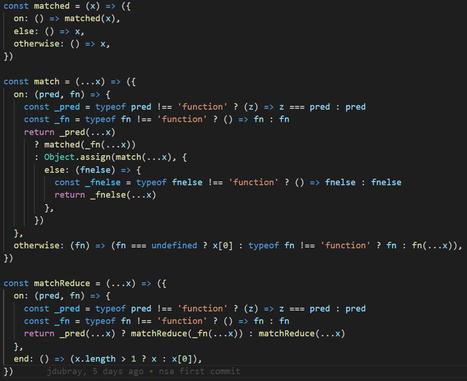
Even Uncle Bob has addressed the subject. In npm alone, countless packages have been released to provide an alternative. People tend to think that the catch with Contact and if-then-else is that the more branches in your code, the more opportunities for untested and unexpected behavior. Each branch requires different use cases to be thoroughly tested, and although some tools, such as Istanbul, provide an indication of how many branches have been performed, in addition to the traditional feature coverage. But branches are part of the nature of programming, there is nothing we can do about it. In this brief statement, I would like to give a new spin on when to use control structures and when to use some functional alternatives.
Mickael Ruau's insight:
Ever since I discovered Dr. Lamport’s Temporal Logic of Action, my programming style has changed to become more explicit about tasks versus mutations of the application mode and more aware of temporal logic. For me, there are three core patterns in programming: object-oriented programming, functional programming, and temporal programming. One developer should master all three and use them accordingly, no pattern wins over the other. We can not write good programs with only one pattern. One of the key concepts in temporal programming is the concept control mode: when the light is off, and if the switch is in the off position, I can trip the light is on Or else check the switch (in bold we have actions as expected in a given control mode). These are extremely familiar concepts we use every day, but for some reason we rarely come across control mode in the code we write. My view of this is that the situation arose due to the lack of alternative constructions with a good enough developer experience, and partly due to the ease of use of the switch and if-so-otherwise, over the stringency required to use temporal programming constructions, but that discussion is for another article. I would like to focus here on something that is much simpler and more practical. First, we must absolutely stop using these control structures for (complex) tasks, it leads to some pretty ugly code that is hard to read and debug. How many times have you written such a code? plain on, tell me in the comments … How about a functional alternative?
Scoop.it!
Scoop.it!

I approached this article with broad strokes to move beyond the typical list. Let's take a look at the software engineering best practices that high-performing teams follow.
Scoop.it!
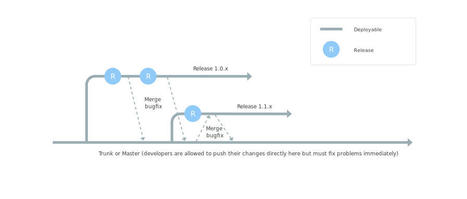
How to choose the right branching strategy for your project
Mickael Ruau's insight:
Choosing the right branching model can save you a lot of time in development. It also helps your dev team to work efficiently. Coming to the point, we are gonna discuss two branching models today
Branch based developmentThis is a very common strategy and most of them know it. You have a stable branch like a master. Then you have a feature branch like develop. So whenever you develop new features or fix any bugs, you take a branch from develop and finish your work. Then you raise a PR to the feature branch. After the code review, the branch will be merged. When you have finalized the changes, then you merge the feature branch to master for the main release. I know how common it is. Most of the open-source software use this method.
Trunk based developmentOn the other side, trunk based development doesn’t use branches or has very limited use of branches. You have the main branch like master Every developer will do all the changes in the main branch and push it directly to the main branch. There are no PRs, branches, merge conflicts. Just push directly to the main branch.
Seems very dangerous right? With trunk-based development, you mostly can’t control who pushes the code and which code is being merged to the stable branch. But there are things we have to consider with Trunk based development. Trunk based development is useful when you want to deliver software in a fast phase. And this method is always accompanied by best practices in writing software like TDD, CI/CD integration, Automation testing, high code coverage, pair programming, etc. Trunk based development is a required practice of Continuous Integration (CI). With CI you get a deployment pipeline where you can run all tests and other integration jobs and safely deploy the code to production. Most companies who are practicing CI often welcome Trunk based strategy. Trunk based development is often practiced in a group of professional engineers. Because they have experience in writing software and know the best practices often. This comes with a high advantage. Imagine a small group of professional engineers (maybe 10) who know best practices in development like TDD, Automation testing, etc, and are following Trunk based development. This group can deliver software in a fast and efficient way to its full potential. This type of development is highly encouraged in Agile methodologies where you have to ship software frequently to get feedback often.
Scoop.it!

Au sommaire
Scoop.it!

Intrusion, Hacking et Pare-feu : En février dernier, Manutan a été victime d'une attaque par ransomware. Une expérience racontée en toute transparence et sans langue de boi
Scoop.it!

Scoop.it!
This is my summary of the The Pragmatic Programmer, by Andrew Hunt and David Thomas. I use it while learning and as quick reference. It is not intended to be an standalone substitution of the book so if you really want to learn the concepts here presented, buy and read the book and use this repository as a reference and guide.
Scoop.it!

“The Pragmatic Programmer” est une bible pour les développeurs. Il est l’œuvre d’Andrew Hunt et Dave Thomas d’après leurs expériences en tant que développeurs. Leur objectif est simple, faire du lecteur un Pragmatic Programmer, un développeur fier de son travail et qui utilise les meilleures techniques à sa disposition pour faire un travail de qualité.
Mickael Ruau's insight:
Scoop.it!
This list is not complete, as there are always some new and good books, but these ones made the most impact in the careers of many software developers.
|
Scoop.it!

The traditional approach for turning around a failing company is simple and ruthless. You brutally restructure the organization and cut costs. But it shouldn’t be that way.
Mickael Ruau's insight:
There are 7 key points I want to highlight. They outline a radically different approach to business. Watch the full recording of the webinar here and sign up for future webinars here. 1. Start by fixing what’s brokenThere were several operational issues Hubert identified when he joined Best Buy:
He had to fix what was broken. When you join a company that’s failing, the last thing you need is vision. What you need is execution. A board member at a previous company taught Hubert an important lesson. Make quick progress on the basic operational level of your business. This will afford you strategic level freedom from your stakeholders later on. Business activities live on an uncertainty continuum. At Strategyzer, we call this the Explore-Exploit continuum. Creating new growth engines and managing existing business(es) are on opposite ends of this continuum. If you need to turn around a company, start with fixing what’s broken (exploit). Then you can focus on creating new growth engines (explore.) It’s not always the right time to prioritise the explore side and that’s ok, as long as it’s a deliberate decision.
2. Work on your purposeOnce Best Buy stabilised and started to grow, Hubert paused for a moment. This was when he moved from execution mode to strategy. He began to ask, what type of company do we want to become? What is our purpose? Talking about purpose has become very popular and rightly so. Hubert argues that it’s fundamental to innovation. What Hubert realised was that Best Buy was not in the retail business. They were in the happiness business. This is about enriching people’s lives through technology and addressing key human needs. That’s more inspiring of course and also vastly expanded their addressable market. Focusing on purpose is what leads to innovation. This is how Best Buy went on to introduce the in-home advisor program. That's where if your need is too complex, they’ll come to your home for free. It’s also how they got into the health space. They help aging seniors stay independently in their homes for longer. They do this by putting sensors in their homes, remotely monitoring them and then making an intervention if needed. They sell this service through insurance companies, not through Best Buy stores. So reimagining your company’s purpose is a key foundation for innovation. Hubert created a Business “purpose-o-meter” which is based on principles from The Heart of Business book. This tool will help you assess the strength of your company’s purpose. VulnerabilityBe vulnerable as a leader. Most people think the leader is supposed to be a superhero, somebody who knows everything and is there to tell other people what to do. Nobody wants to follow that. What people really want is someone who is real and vulnerable.
Scoop.it!

Product-minded engineers are developers with lots of interest in the product itself. They want to understand why decisions are made, how people use the product, and love to be involved in making product decisions. They're someone who would likely make a good product manager if they ever decide to give up the joy of engineering. I've worked with many great product-minded engineers and consider myself to be this kind of developer. At companies building world-class products, product-minded engineers take teams to a new level of impact.
Mickael Ruau's insight:
Tips to become a more product-minded engineerIf you work on a user-facing product, here are a few tips I've seen work well, to growing your product-minded muscle.
Scoop.it!

You must collect data when you get out of the building. But analyze it with a critical eye. Don't just add up the columns. Look for insight!
Questions for You
Mickael Ruau's insight:
Suggested Readings
Tools and exercisesBlank, Steve. Slideshare. The Tactics of Conducting Customer Discovery. Blank, Steve. Founders Workbook. A companion to the Startup Owner’s Manual. (Website: Zoomstra.com/foundersworkbook)
Scoop.it!

Deux articles ont récemment été publiés par SoundCloud pour décrire l'évolution de leur architecture de service vers la mise en oeuvre de Domain Gateways, en passant par les Value-Added Services. Les auteurs décrivent comment ces patterns basés sur le Domain-Driven Design ont aidé à réduire les doublons et à homogénéiser la logique métier et le contrôle d’accès.
Scoop.it!

La France compte plus d'1 millions de start-up de moins de 8 ans qui emploient 1,5 millions de personnes. Si la crise liée à la pandémie de Covid-19 a conduit à une baisse des effectifs, les start-up sont plus créatrices d'emplois que leurs homologues non start-up, affirme l'Insee qui a réalisé un panorama sur les start-up et l'emploi. Via Nelly Renard
Scoop.it!

Following are the various factors to look at before selecting Trunk based vs feature branching.
Scoop.it!
Scoop.it!
Scoop.it!

Tools for Working Effectively With Legacy Code
Scoop.it!

Notes by Jeremy W. Sherman, October 2013, based on: Feathers, Michael. Working Effectively with Legacy Code. Sixth printing, July 2007.
Scoop.it!

Martin Fowler est un auteur, conférencier, informaticien et consultant américain dans la conception de logiciels d'entreprise. Ses centres d'intérêt principaux sont la programmation orientée objet, la refactorisation (refactoring), les patrons de conception (design patterns), UML et les méthodes de programmation agile où il est un pionnier et une référence.
Mickael Ruau's insight:
Table des matières
Scoop.it!
This list is not complete, as there are always some new and good books, but these ones made the most impact in the careers of many software developers.
|




