


Here are 7 project recovery techniques which can bring back a project that is about to go haywire.

 Your new post is loading...
 Scoop.it! Here are 7 project recovery techniques which can bring back a project that is about to go haywire. 
No comment yet.
Sign up to comment
Scoop.it!

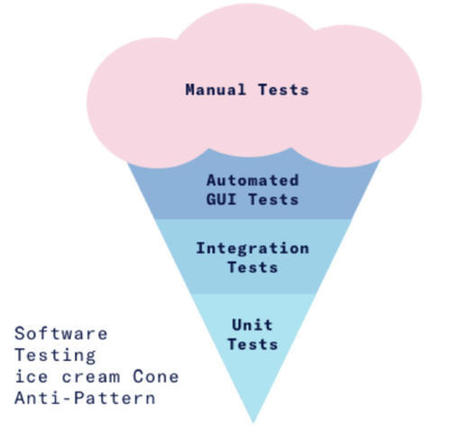
Even before the ascendancy of agile methodologies like Scrum, we knew we should automate our tests. But we didn’t. Automated tests were considered expensive to write and were often written months, or in some cases years, after a feature had been programmed. One reason teams found it difficult to write tests sooner was because they were automating at the wrong level. An effective test automation strategy calls for automating tests at three different levels, as shown in the figure below, which depicts the test automation pyramid.
Scoop.it!

Une tentative de réponse à ce casse-tête de product manager ! Construire une roadmap, bien prioriser les projets et bien la communiquer.
Scoop.it!

Rescuing a project in trouble isn't for the faint hearted. Read on for a six step process you can follow if you need to rescue a troubled project
Mickael Ruau's insight:
Current state assessmentBefore you even start trying to plan the recovery you need to know what the current status of the project is. The best way to do this is to audit the project. If you can, it’s worth getting an expert in to do this bit of work as they’ll know exactly what to look for. If you can’t, here’s a process you can use: 1. Document reviewThe document review will give you a lot of critical information. You should be able to understand exactly what the project was supposed to deliver, when and how it was to deliver it. Documents you need to review include:
When you’re reviewing the documents there are a number of red flags you should be looking for:
Once you’ve finished the document review you should have a good idea where the project’s at. It’s time to move on to the next phase of the audit. 2. Interviews with the key stakeholdersNever underestimate the power of a face-to-face interview. This is often the point where you’ll get to the real root cause of the project’s problems.
You’re looking to get insights into why those parties think the project is in trouble and if they have any ideas on how to get the project back on track. This can be a useful source of information you may not otherwise get access to.
During the interviews, make sure it’s clear that anything said is confidential and that you’re looking for a full and frank discussion.
Scoop.it!

Voici un nouvel article qui mérite attention si l'on se voit chargé de remettre un projet sur les rails. Article original en anglais de Joanne Wortman: http://www.pmhut.com/rescuing-a-project-diagnosis Joanne nous dit: J'ai déjà parlé de triage de portefeuille de projet. Le résultat de l'effort de triage est d'identifier ces projets le plus dans le besoin d'intervention…
Scoop.it!

The project will run the risk of missing the deadline. Project manager will have to take drastic measures in order to get the project back on track.
Mickael Ruau's insight:
2. Stop scope creepScope creep is one of the biggest and most common causes of project delays. It causes a radical reassignment of priorities and resources, which can derail momentum and hamper focus. The project team also has to waste time backtracking and review finished work to ensure that nothing is adversely affected by the new scope. To avoid this, project managers will have to go back to the client/stakeholders and refuse any more unnecessary changes to the scope. Or, barring that, the client will have to sign off on a new timeline that accounts for the scope creep and be billed accordingly. 3. Parallel productionWhen a project team is pressed for time, it may be a good idea to start working on things in parallel. This is roughly equivalent to how chefs in a kitchen work: one chef chops up the vegetables while the other prepares the beef roast. The dish is then finished in half the time than if they had done it sequentially. Note that this tip only works if the tasks you’re working on aren’t dependent on each other (like cooking seasoning the meat before roasting it, for example).
Scoop.it!

The case method and business plans are the antithesis of how entrepreneurs create startups
Scoop.it!

Is project recovery possible? 5 key questions
Scoop.it!

Scoop.it!

The Flow System is a built on a foundation of The Toyota Production System, known as TPS & LEAN, plus a triple helix structure, the DNA of Organizations.
Scoop.it!

Silva travelled to Silicon Valley – with then digital secretary Jeremy Hunt in tow – for a meeting with then Google CEO Eric Schmidt. Silva did not even have a name for the cluster yet, but somehow hoped that Schmidt would be won over by the vision, and throw Google’s weight and money behind it. “I said we were going to do something really big to get behind this digital cluster emerging in East London. ‘It's gonna be great, we would love for you to be involved’,” Silva recalls. Schmidt was curt: he had heard similar spiels before; he was not going to send Google folks to a business park in the middle of nowhere. Silva then rattled off the bountiful attractions of Shoreditch – its independent art galleries, its cafes, its clubs. “That cultural life of East London was what persuaded him,” Silva says. Schmidt initially proposed to buy the whole Olympic Park, but Silva convinced him to do something slightly less dramatic – open a Google-run space near the roundabout. The result was the Google Campus: a seven-storey coworking space – including free coworking in the building’s basement cafe – and event venue that opened on Bonhill Street in 2012.
Scoop.it!
Scoop.it!

Abstract
|
Scoop.it!

The roller coaster of project management can get stressful—especially when you’re working on a project that has taken an unexpected turn for Doomsville. (And sometimes, it’s what’s being said around the office that’s the tell-tale sign your project’s in trouble.) Here, we look at 5 ways to pull your project back from the brink of disaster—or prevent it the next time around.
Mickael Ruau's insight:
1. Sign of trouble: “What problem are we trying to solve here?” Midway through any project, hearing this question should trigger a reassessment. It’s time to ask some hard honest questions, like: How has the project veered away from its original aims? What have you achieved so far? Is it enough that you still can accomplish at least some of the objectives? Is it best to stop now or modify the project? You know the project most intimately, so try to step back and look at the big picture with that knowledge of the details. Separate the consequences on your own career (it’s tough) from the best path for the project. If you’re convinced the project can succeed, make a powerful argument to clarify objectives and double-down on completing the project. This experience need not be a personal disaster, but how you finish the project can have broad implications. 2. Sign of trouble: “Failure is not an option.” Of course it is. Projects are risky—and you want to embrace the possibility of failure so that your team develops skills in recognizing signs of trouble and then responding to issues as they present themselves. The trick, as Liquid Planner guest blogger Susanne Madsen notes, is to fail productively: “It’s OK to experiment and to fail—in fact it’s necessary at times. How else can we find that ingenious new solution to our client’s problem?” Failure and mistakes can be productive as long as they propel organizations closer to the end goal. As Madsen states, the danger lies in the “demand for perfection, smooth execution and certainty” that leads people to “choose the safe option which gives them quick wins and fast results.”
3. Sign of trouble: “We should take this in a whole new direction.” This screams scope creep—or a project that’s grown out of its original goals, so address the situation directly. Sometimes, projects rewrite themselves as they get underway and do need to be re-assessed. If this happens, figure out what you need in order to change direction, declare the updated goals and get everyone on board. Identify the resources you have and the ones you’ll need to move forward. Then, reassess—and realign—stakeholder expectations. And lastly, take a lesson from #2, and learn from where the original project plan failed. You don’t want to make that mistake a second time in a row. 4. Sign of trouble: “You’re over budget.” It’s time for a mid-course correction, and it needs to happen soon. First, figure out how you got into this budget mess. Second, identify how to fix it going forward. Third, go to the Guardians of Your Budgets (and your boss) with an improved plan for finishing the project either within the original budget or with a button-down case for what the additional funds will yield. Fourth, learn from the first three steps so next time you can stay within budget—or set a more realistic budget.
5. Sign of trouble: “You’re way behind schedule.” Start by assessing why you’re late: Were key people pulled away from your project? Was the task more difficult than expected? Then devise a plan that goes beyond throwing more bodies at the problem. For example, get more time for your team from key producers. Prioritize needs and scale back on objectives. See if you can get more time from key producers on your team. Unfortunately, working faster or harder (more hours) usually produces more mistakes then getting you closer to your goal. The key here is to be flexible and know how to adapt when you miss the first milestone, because that’s when you’re headed off track. Also, use project management software that alerts you when you’re falling behind schedule before it’s too late.
Scoop.it!

Working as a Version Control Focal Point
Scoop.it!

The purpose of this article is to conceptualize and identify troubled projects and allow their evaluation and possible recovery, minimizing the…
Mickael Ruau's insight:
ESI International (ESI, 2005) developed an assessment process of troubled projects based on a process of interviews, analysis and consolidation of results that allow us to assess the problem’s potential and the chances of recovering the project. The process is highlighted in Exhibit 05. In this process the participation of the main stakeholders and their personal perceptions are the key to the success of a possible recovery of the project. Exhibit 05 – Troubled project assessment model (ESI, 2005). Several other models can be developed to identify scenarios in each organization. However, all these models should include a brief, quick, direct assessment; otherwise, when a project is identified as a problem it might be too late to recover it. Project Recovery vs. Project TerminationOnce the troubled project is assessed, we have to make the decision of aborting or recovering the project. Different factors may influence this process, but some basic considerations have to be observed. LONG (2003) proposes five key questions that should be considered to decide if the project will be recovered or aborted, as follows:
As a complement to the five previous questions, several factors can evidence that there is no chance of recovering the project. The most common factors are as follows:
If you decide to discontinue the project, its early termination can be carried out in two different ways, each with its own level of complexity, speed, and stress. STEWART & SHEREMETA (2000) assessed the different drivers and impacts involved in the early termination of a project. They say that there are basically four ways to terminate a project, as follows:
Scoop.it!
Scoop.it!
Agile version control is very different to traditional version control. It is performed using many small feature branches which are being continually merged back into the trunk (or main development stream). This is necessary for the practice of Continuous Integration (CI) which is a core part of the Agile approach.
Mickael Ruau's insight:
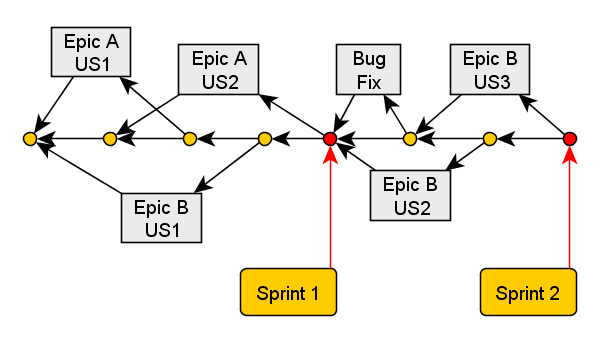
Agile version control using Git is simple. A developer branches the code to work on a User Story. Git makes it easy to merge the branch back into the trunk. A simple example is shown in the following diagram where all User Story branches are merged back into the trunk by the end of each sprint. Diagram 6. Agile Version Control
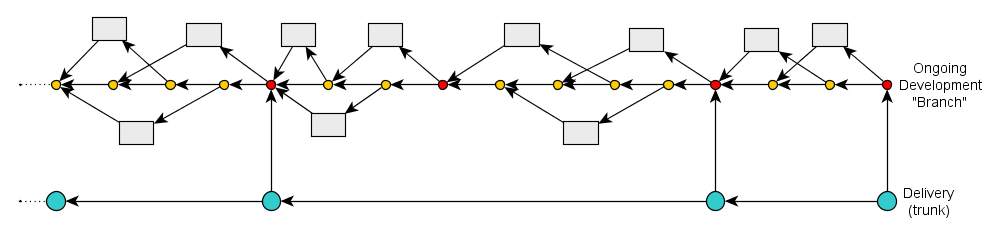
Diagram 7. Dual Streams
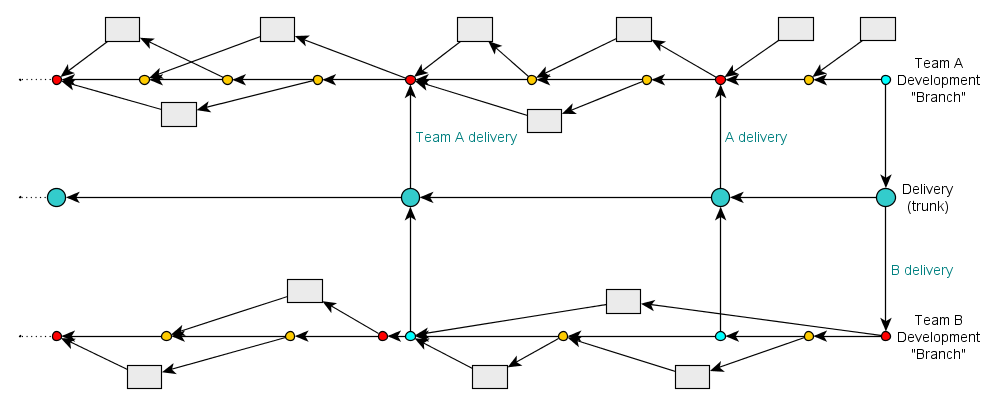
Diagram 8. Multiple Development Streams
Scoop.it!

Scoop.it!

When making changes to a system you are not familiar with, follow these steps to reduce churn:
Scoop.it!

Let me start by saying that Scrum has an empirical design model at its heart, but the use of Scrum is mostly not empirical. To understand this, we have to go back in time a little.
Mickael Ruau's insight:
Key Takeaways otherwise known as TL:DR
Scoop.it!
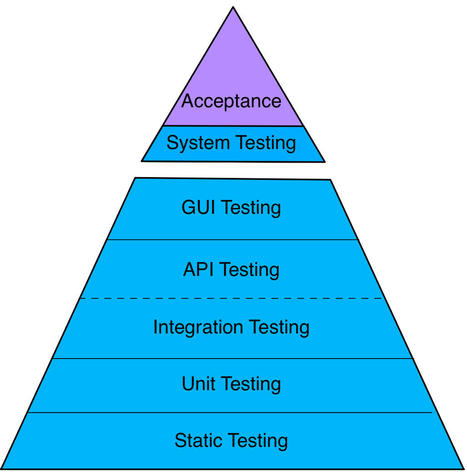
On this page, an overview of test automation pyramids can be found. The collection started as an exploration of the development of models in software testing. The test automation pyramid turned out to be a very popular model and has seen a great deal of modifications and varations since its conception by Mike Cohn in 2004.
Scoop.it!
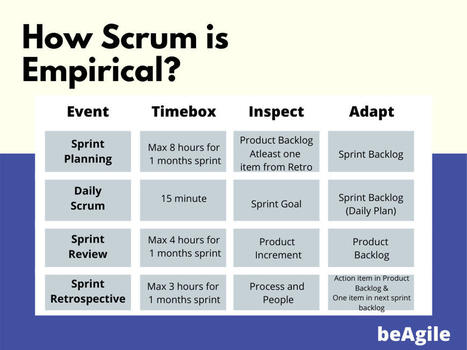
very event in Scrum provides a moment to inspect and adapt —
Scoop.it!
 Exaptation - WikipédiaUn article de Wikipédia, l'encyclopédie libre. Dans la théorie de l'évolution, l' exaptation est une adaptation sélective opportuniste, privilégiant des caractères qui sont utiles à une nouvelle fonction, pour laquelle ils n'avaient pas été initialement sélectionnés. Par exemple, les plumes des théropodes, initialement sélectionnées parce qu'elles assureraient leur thermorégulation, ont permis l'adaptation au vol.
Mickael Ruau's insight:
Confusion entre pré-adaptation, adaptation et exaptationEntre 1901 et 1909, Lucien Cuénot élabore la théorie de la préadaptation qui rencontrera moins de succès que celle de l'exaptation « plus conforme aux standards scientifiques du XXe siècle », la formulation de Cuénot étant trop téléologique selon Gould et Vrba. Ces deux concepts se révèlent complémentaires : « la préadaptation concernerait le caractère avec sa fonction d'origine tandis que l'exaptation concernerait le caractère avec sa fonction dérivée3 ». Bien que les termes adaptation et exaptation soient souvent associés, ils ont des sens distincts :
Bien souvent, la littérature parle de l’exaptation comme d’un phénomène secondaire à l’adaptation. Toutefois, une adaptation peut également se produire à la suite d’une exaptation. On dit alors qu’un caractère subit une exaptation primaire, suivie d’une adaptation secondaire4. Types d'exaptationOn considère généralement deux grands types d'exaptation4 :
Scoop.it!
Mickael Ruau's insight:
Hypothesis: Latent demand for product concept X makes product development worthwhile
|





3) Shoot down the schedule
There are two ways to do something. One is hard work which translates to overtime in our case. The second is to work smart. Working smartly means eliminating the unnecessary steps and choosing the critical path to get the thing done. An article by Microsoft shows how to select the most critical parts and make your schedule flexible.
4) Fast Track Tasks
The idea here is what we call partial overlapping. With this approach, you find that tasks that could be started right before their predecessors are completed effectively. Which means you can pick and choose to complete tasks which are not dependent on any other tasks first.
5) Scope Change, not anymore
As mentioned earlier in Matt Alderton’s article, defining the scope of the project is the tricky part. If you don’t determine the scope right from the start, constant changes in the scope will only serve to confuse the workers and creep them out. Try not to change the scope every now and then.
6) Slackening the Horizon of the project
Perhaps the initial horizon of the project was too expansive and the allocated time was not enough to complete the project, which resulted in slackening the project and killing its core. It is wise to keep the horizon of the project as wide as you can manage.