Your new post is loading...

|
Scooped by
Mickael Ruau
January 26, 2022 1:49 AM
|
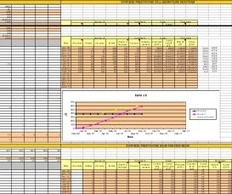
Pour prévenir les difficultés, il est impératif de suivre de près l'avancée des travaux et les écarts avec le prévisionnel . Voilà à quoi sert un tableau de bord de pilotage : identifier très tôt les risques, pour les prévenir avant qu'il ne soit trop tard. Vous êtes alors à même de titrer la sonnette d'alarme auprès du comité de pilotage, ou simplement votre patron (suivant la structure de votre entreprise).Toutefois,lorsque le mal est fait, quelles sont les solutions à votre disposition ?
La première étape consiste à mener un rapide diagnostic afin de redéfinir les objectifs et les actions à mener d'urgence : posez-vous, rencontrez les décideurs et négociez les nouvelles échéances, budgets et moyens humains, le cas échéant. Faites face à la situation avec lucidité pour ne pas persévérer... dans l'erreur.
Si le projet est sur la voie de l'échec, il est fortement probable que la phase de cadrage a été déficiente ou que des événements imprévus se sont invités au cours du jeu...
Vous noterez que ce diagnostic peut d'ailleurs conclure à l'arrêt du projet !
Construisez un plan de redressement avec le chiffrage des moyens et la nouvelle planification.
Mettez en place les nouvelles actions avec un suivi très rigoureux. N'oubliez pas : vous êtes en situation de crise. Votre mission est de sauver le projet avec votre plan de bataille.
Pour terminer, capitalisez sur cette expérience en analysant les causes du dérapage. Le plus grave n'est pas de faire des erreurs, mais de ne rien en retenir !
|
|
Scooped by
Mickael Ruau
January 26, 2022 1:04 AM
|
Contents
1. Poor Communication
2. Underrated Timeliness
3. Lack of Detailed Documentation
4. Poor Resource Allocation
5. Lack of Risk Management Strategy
1. Refocus the Scope
2. Determine The Cost
3. Draw Up The New Schedule
4. A Thorough Review
5. Learn From The Mistakes
|
|
Scooped by
Mickael Ruau
January 25, 2022 7:49 AM
|
L'impact mapping permet à l'équipe d'aligner son activité avec les objectifs métiers en facilitant les décisions stratégiques. Découvrez cet outil !
|
|
Scooped by
Mickael Ruau
January 25, 2022 1:31 AM
|
Key Takeaways
Problem software delivery projects can be recovered mid-flight if Value Stream Management (VSM) analytics are used in a forensic way to uncover the root-cause of the issues
Values Stream Management (VSM) analytics platforms adopt a root-cause framework, to surface metrics in a forensic way that consider all possible causes of the problem (separating causes within the control of the delivery team and those in the control of external stakeholders).
The seven root-cause metrics areas in control of the delivery team are: People Availability and Focus; Team Makeup and Stress; Backlog Health and Estimation Accuracy; Dependability and Sprint Accuracy; Delivery Process Efficiency; Story Management and Complexity; and Defect Generation and Rework
The two root-cause metric areas in control of stakeholders are: Changing Scope and Requirements; and Delayed Feedback and Project Input
The approach provides a quantitative root-cause RAG Report which enables mitigations to be put in place in flight, which are based on a detailed understanding of the underlying causes of the project’s problems. This greatly increases the chance of project recovery.
|
|
Scooped by
Mickael Ruau
January 25, 2022 1:19 AM
|
This is a case study that describes how Kanban and lean development techniques were used to rescue a distressed project.
|
|
Scooped by
Mickael Ruau
January 24, 2022 1:03 AM
|
Un projet peut être mis en difficulté pour diverses raisons. Voici le top 5 :
Exigences : manque de clarté, contradictions, absence de priorités, ambiguïté, etc.
Ressources : manque de ressources, conflits de ressources, manque de formation, départ de collaborateurs clés, perte de motivation, etc.
Délais: trop serrés ou trop longs, irréalistes, etc.
Planification : basée sur des données insuffisantes, éléments manquants, détails insuffisants, mauvaises estimations.
Risques: non identifiés ou hypothétiques, absence de gestion des risques.
On note que pour les petites entreprises, la gouvernance du projet (absence de gestion, inefficacité, priorités différentes, aucune implication réelle) remplace la planification dans ce top 5.
|
|
Scooped by
Mickael Ruau
January 22, 2022 7:47 AM
|
Vous-êtes vous déjà demandé de quel coach agile vous-avez besoin pour vous accompagner dans contexte ? Oui ? Cet article est fait pour vous !
|
|
Rescooped by
Mickael Ruau
from Time to Learn
January 22, 2022 6:28 AM
|
No-code app templates & plugins for Bubble, courses, backends, webview packages for native apps. Now you can build apps without code even faster
Via Frédéric DEBAILLEUL
|
|
Scooped by
Mickael Ruau
January 21, 2022 1:56 AM
|
As recently as earlier this year I was having conversations fairly regularly with executives who were resistant of allowing Agile project delivery methods to be used in their businesses. They accepted it had a place in software development projects and had made some allowances for more ‘small a’ agile approaches to things like planning, but they still saw most of their projects delivered using traditional methods. These were predominantly large organizations in well-developed industries, often with a high degree of regulation. For those executives, the large multi-year initiatives that they pursued were ideally suited to traditional project delivery and there was no need to change.
To be fair to those leaders, they knew that agile projects were being successfully delivered at lower levels of their organizations but those rarely reached a level of importance that resulted in executive visibility. So as far as those leaders were concerned, Agile didn’t exist in their business and that was OK with them. But things have changed very rapidly.
Those same executives are now being forced to accept Agile as an enabler of recovery, there simply is no other way. The path to recovery is still highly uncertain but there will inevitably be peaks, troughs and direction changes throughout the process. Projects will need to deliver significant business results quickly with teams working …
|
|
Scooped by
Mickael Ruau
January 20, 2022 1:18 AM
|
Learn how to save a project that seems to be spinning out of control.
|
|
Scooped by
Mickael Ruau
January 19, 2022 1:39 AM
|
Turning the Project Team into a Rescue Task Force
By now you should have addressed and resolved most if not all of the politics surrounding your failed project. Now is the time to set it up properly, and to make sure you and your team are doing the right thing, at the right place, at the right time. A rescue team needs to be close to the scene. If the project is at a remote site, this works to your benefit. Set up temporary offices close to that remote site and arrange for appropriate accommodation. Make sure the team is always collocated, at work and after hours, because this will help them bond quicker and work together more effectively. If the project is not at a remote site, and is within either the performing or client organization, collocation is still necessary. A make-shift project office in a meeting room close to the project location will suit the purpose.
Afterhours and downtime are as important as working hours: in my case, I made it a point that we all have meals together, and spend the evenings in disguised team-building activities based on leisure and entertainment (board games and other trivia come in handy). Eight years later, we all share the stories and memories of those “good old days.”
In all cases, maximize the benefit of collocation. Use the project-office walls for visibility. All of the tools addressed below should be on display on the walls of this room, giving all stakeholders and more importantly the project team, access to any and all information pertinent to rescuing the project at all times. Not only should the tools be available, but they should be generated by the project team and updated regularly. Each member should have something that belongs to him or her on the wall. This is addressed under “The Participatory Approach” below. Plans, issue logs, minutes of meetings, photos, task lists, time lines, performance reports, team breakdown structures, are but examples of what should go on that wall.
One last important constituent of transforming the project team is to break convention. This has great psychological impact on the members; sending messages that we are not a business as usual team, but a special task force. Have them isolated from business as usual, come to work in smart casual attire if they usually wear suits, make your own working hours, and give them a non-routine environment to work in. Agree with your sponsor on incentives, both financial and moral, that will be dispersed to the team when they turn the project around. Ideally, you will invite the sponsor and client to visit the project-office at least once at the onset of the rescue mission to announce these incentives to the team. Team members will get the message that they are supported by senior management; this will work as a much needed morale booster at the onset of your rescue endeavor.
|
|
Scooped by
Mickael Ruau
January 19, 2022 1:07 AM
|
8 Steps to Getting a Slipping IT Project Back on Track. As many organization leaders are aware, few (if any) IT projects materialize without runnin
|
|
Scooped by
Mickael Ruau
January 18, 2022 2:13 AM
|
When most of our efforts are focused on automation at the UI level, the focus is on finding bugs, whereas, with the agile pyramid, the idea is to prevent them.
|
|
|
Scooped by
Mickael Ruau
January 26, 2022 1:40 AM
|
To save or not to save: Rescue vs Termination
The sequence of actions with troubled IT projects is basically four stages: Assessment, Recommendation (decision), Planning and Execution. So after a thorough assessment, management is faced with a big decision to make – recover a project or terminate it.
Naturally, you’d weigh in all the pros and cons of both scenarios. Here are a few analysis directions to begin with:
Learn how to deal with troubled IT projects.
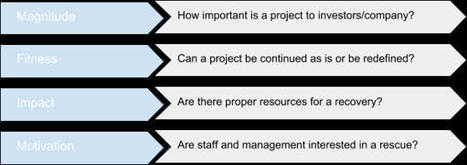
If market conditions and technical aspects/requirements haven’t changed drastically, and business benefits can still be gained in a reasonable time, a project might be worth rescuing.
|
|
Scooped by
Mickael Ruau
January 25, 2022 2:28 PM
|
Why are so many organizations stuck in the "middle" of DevOps evolution? What's preventing them from achieving higher levels of organizational performance des…
|
|
Scooped by
Mickael Ruau
January 25, 2022 1:49 AM
|
In this paper/talk we’ll chronicle the turnaround of a failing enterprise scale (200+FTEs) Oracle – COTS (Commercial Off The Shelf) Implementation in a public agency. A decision was made to do a hard reset from a waterfall to a agile methodology.
A delivery methodology was designed and implemented which included practices at enterprise, program, and team levels. This methodology encompassed elements from agile, scrum, lean, and SAFe frameworks.
While we did not have a specific intent to use the SAFe framework it turns out that we ended up using some key elements of the framework at the different levels
|
|
Scooped by
Mickael Ruau
January 25, 2022 1:21 AM
|
Dans cet article, Lucas Didier donne des pistes sur comment utiliser des biais cognitifs et des modèles persuasifs pour développer de meilleurs produits
|
|
Scooped by
Mickael Ruau
January 24, 2022 1:58 AM
|
So, when it comes to recovering the projects, a lot of it is revisit why are we running the project in the first place, get back to the business and say “Look, this is the initiative. What's the real goal here and the vision and therefore what are we trying to achieve from a benefit point of view? And, is the solution we have in place really doing that? ” And, then we'll get back to the key elements of that solution and what do we actually need to do.
A few years ago we were looking at recovering an outsourcing program for a financial institution in Australia and they were trying to outsource a lot of their developing work. The problem was that the original guys who got involved and got too deep into one particular aspect, which was designing the network connection between Australia and the outsourcing country, well they forgot to look at the bigger picture, and so it became very evident that we needed to go back and find out what are we supposed to be doing here. In fact, they didn’t even have a plan in place quite frankly, so that was one big indicator they weren't going very well, and therefore they'd lost the focus on everything because they’d got too deep into the picture and we had to pull them right back out and look at the bigger picture and then try and work out “What are we actually trying to achieve here? How do we do that? And what are the key elements to help us do that?” So, these are some of the tools that help us find out and realign the project back to what it's supposed to be doing. And, of course, one of the key elements we have done is prioritization, for which there are various methods – Moscow is probably one of the most useful ones – but prioritizing your project is key even when you're starting it up, but certainly when it comes to troubleshooting, so I think that's one of the first things to think about.
|
|
Scooped by
Mickael Ruau
January 22, 2022 7:50 AM
|
Dans la première partie de cet article (Coach agile, une créature hybride), j’ai présenté les trois axes d’agilité que le coach agile cherche à développer au niveau de l’équipe. Ces trois axes se déclinent en trois rôles :
axe technique -> expert en ingénierie logicielle améliorant l’efficience de la production),
axe métier -> rôle du Product Owner augmentant la production de valeur
axe processus -> rôle du Scrum Master facilitant l’adaptabilité.
|
|
Scooped by
Mickael Ruau
January 22, 2022 7:46 AM
|
Beaucoup d’entreprises mettent aujourd'hui en place des organisations Agile à l’échelle. Mais quel framework choisir ? Découvrez le grâce à 10 questions !
|
|
Rescooped by
Mickael Ruau
from Time to Learn
January 22, 2022 6:27 AM
|
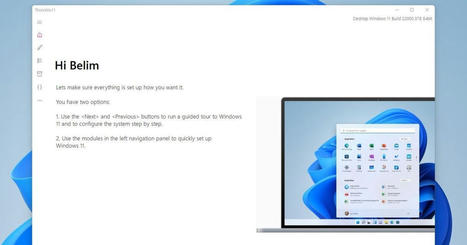
ThisIsWin11 est un outil gratuit (similaire aux PowerToys de Microsoft d'après l'éditeur) qui permet de personnaliser Windows 11
Via Frédéric DEBAILLEUL
|
|
Scooped by
Mickael Ruau
January 20, 2022 1:48 AM
|
In our second roundtable as part of the KZenEdge Thought Leadership series, we covered the topic of Project Rescue for non Waterfall methodologies. The focus of this discussion rested on Agile, Scrum, Kanban, and Hybrid type projects. We examined the indicators that might flag a watermelon project (green on the outside, but red on the inside), what might be the root cause of these problems, and finally how one might approach the “rescue” or resolution. The team shared some excellent insights and the feedback was very positive.
The attached article summarizes the discussion points and learnings.
Roundtable 2 – Notes on Project Rescue – Article
|
|
Scooped by
Mickael Ruau
January 20, 2022 12:50 AM
|
Pour cette étude de cas, d’abord un peu de contexte au moment de la reprise : un projet de plus de 350 jours, une équipe de 4 personnes chez le client, un engagement au forfait et plus de 40% de dépassement prévu en fin de projet …
Alors oui, il y avait des tableaux excel de suivi avec des indicateurs projets, des calculs de coûts, des courbes et tout ça. Mais en donnée cruciale en entrée il y a encore et toujours le fameux reste à faire. Vous aurez beau avoir les plus beaux outils du monde pour piloter vos projets, si vous et votre équipe ne maîtrisez pas votre reste à faire, vous ne maitrisez rien.
|
|
Scooped by
Mickael Ruau
January 19, 2022 1:13 AM
|
Dans la mesure où le but de chaque organisation est de soutenir les initiatives de progrès pour obtenir des résultats significatifs, la tendance actuelle est de vouloir en faire le plus possible de la manière la plus rapide qui soit. Malheureusement, ce comportement est souvent contre-productif et apporte chaque jour son lot de déceptions au sein des équipes voire même un certain découragement. Il est pourtant tout à fait possible d’obtenir des résultats rapidement, mais il faut pour cela réduire le travail en cours nommé « WIP » pour Work In Progress et c’est sur ce point que la loi de Little peut apporter une réponse pertinente.
La loi de Little tient son nom de son inventeur, John Little, qui a réfléchi à la théorie des files d’attentes dans les années 50 pour énoncer en 1961 son principe de la manière suivante : le nombre de clients dans une file d’attente est égal au taux d’arrivée moyen des clients multiplié par le temps de traitement.
Souvent reprise par les démarches de Lean Management dans l’industrie afin de réduire le « Lead Time » (le temps moyen passé dans le système de production entre le début et la finalisation d’une tâche) et ainsi augmenter la capacité à produire, la Loi de Little permet d’établir un lien entre l'en-cours de production (WIP), le temps de traversée de la production (le Lead Time) et le débit de la production (« Throughput »). Cette formule est souvent énoncée de la manière suivante :
WIP = T x LT ou LT = WIP / T
Le résultat est que toute augmentation de l’en-cours augmente mécaniquement les délais. Cette formule est d’autant plus intéressante que l’on a généralement tendance à faire l’inverse dans les entreprises. On augmente régulièrement les encours avec l’espoir d’augmenter les sorties alors que cela se traduit souvent par une pluie de météorites sur les équipes et une véritable catastrophe pour les délais des projets !
|
|
Scooped by
Mickael Ruau
January 18, 2022 3:20 AM
|
Welcome to the new (but in development) Agile Glossary & Reference Library. Find content from around the web on all things Agile.
|