NodObjC exposes the Objective-C runtime to NodeJS in a high-level, easy to use fashion. It uses the BridgeSupport files to dynamically generate an API from an Objective-C "Framework" at runtime, and uses node-ffi to dynamically interact with Objective-C's runtime. Essentially, NodObjC is similar in nature to the other popular Objective-C scripting bridges: - JSCocoa - PyObjC - CocoaRuby So you can write Objective-C based applications entirely with Node and JavaScript! Eventually even iOS native apps as well! So what are you waiting for? Get to coding!
PhantomJS is an headless browser based on an embedded webkit, suitable for testing of web applications involving JavaScript usage where simpler tools do not cut it.
Worklight provides open, complete and advanced mobile application platform and tools software for smartphones and tablets. Our products help organizations of all sizes to efficiently develop, run and manage HTML5, hybrid and native applications using a powerful and flexible mobile IDE, next-generation mobile middleware, end-to-end security and integrated management and analytics capabilities. Worklight technology enables rich, cross-platform apps without requiring code translation, proprietary interpreters or unpopular programming languages.
A few weeks ago Midnight Coders released a communication library for iOS which provides an excellent mechanism for integrating iOS applications with various server-side technologies. The library enables client-server integration via the RTMP protocol and thus requires the server-side code to be deployed into an RTMP. One of the servers the library supports is Wowza Media Server. The video below provides a demonstration of the integration between iOS and Java classes deployed in Wowza. The examples demonstrate the following: - Invocation of Java methods from iPhone - Java data push via an invocation of the Objective C method from Java - Usage of Remote Shared Objects hosted in Wowza Media Server
According to Ohloh, MySQL and MongoDB have little in common. One’s seen commits from over a thousand people, the other shy of sixty. One’s 1.1M+ lines of code, the other not even two hundred thousand. And architecturally, the projects are quite distinct.
But in many respects, MongoDB is the new MySQL.
Not because MongoDB is a replacement, as Joseph Ritchey argues in his piece “MongoDB is the New MySQL.”
It is certainly true that there are instances of MongoDB replacing MySQL. It is equally true that there are instances of MongoDB being replaced. In at least one instance, by MySQL. What MongoDB is doing, however, and doing well, is playing a role similar to the one MySQL began playing a decade ago.
Every so often a piece of technology comes along and changes everything. Once we experience this new way of doing things, we can no longer understand how we survived without it. After we sent our very first emails, walking to the post office to drop mail seemed unearthly. And who’d replace an IDE with a text-editor?
Cross-Origin Resource Sharing (CORS) is a specification that enables a truly open access across domain-boundaries. With this site we want to support the adoption of CORS.
If you have public content that doesn't use require cookie or session based authentication to see, then please consider opening it up for universal JavaScript/browser access.
JSON (Java Script Object Notation) is a lightweight data-interchange format. It is easy for humans to read and write. It is easy for machines to parse and generate. It can be used as a data interchange format, just like XML. When comparing JSON to XML, it has several advantages over the last one. JSON is really simple, it has a self-documenting format, it is much shorter because there is no data configuration overhead. That is why JSON is considered a fat-free alternative to XML.
However, the purpose of this post is not to discuss the pros and cons of JSON over XML. Though it is one of the most used data interchanged format, there is still room for improvement. For instance, JSON uses excessively quotes and key names are very often repeated. This problem can be solved by JSON compression algorithms. There are more than one available. Here you'll find an analysis of two JSON compressors algorithms and a conclusion whether JSON compression is useful and when it should be used.
[Are cross-platform tools a better solution than HTML5 to the challenges of platform fragmentation? Guest author Jonas Lind reviews the landscape of cross-platform tools and argues that such tools may become as important as the native platforms themselves.]
All the useful pointers to : - Core platform - Graphics and typography - Media - Platform interaction, events, messaging - Storage and file-system interaction - Real-time communication - Performance optimization and analysis - HTML bonus features - Other core-platform bonus features - Foundations - Various others
In development, with the right tools can be easier.Today, this article to share the latest collection of 15 of very useful JavaScript development tool.
Here are the top five areas that I think will become job requirements by 2015 for many programmers and web developers :
1. Git or any “Distributed Version Control System” 2. Server-side Javascript with node.js 3. Concurrent Programming Languages 4. NoSQL 5. Responsive Web Design
Want to add voice calls and IM chat to iPhone, iPad or Android apps? In this quick video, Tim Panton shows how you can use the the brand new Phono Mobile toolkit and the PhoneGap mobile platform to create an iPhone app that connects users together in a conference call. Check it out… and then get started building your own iPhone and Android apps using Phono Mobile!
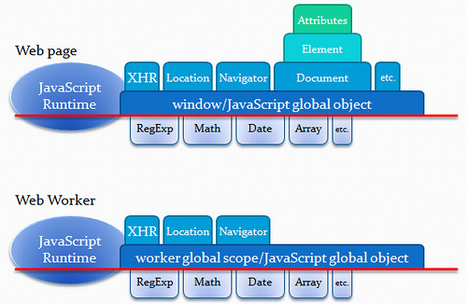
An HTML5 application is obviously written using JavaScript. But compared to other kind of development environments (like native one), JavaScript historically suffers from an important limitation: all its execution process remains inside a unique thread. This could be pretty annoying with today multi-cores processors like the i5/i7 containing up to 8 logical CPUs and even with the latest ARM mobile processors being dual or even quad-cores. Hopefully, we’re going to see that HTML5 offers to the web a way to better handle these new marvelous processors to help you embrace a new generation of web applications.
NodeJS has demonstrated impressive performance potential as an HTTP server. By combining highly optimized HTTP parsing algorithms with the speedy V8 JavaScript engine and using an event-based architecture, Node has posted eye-opening request handling numbers. However, Node historically has been limited by its inability to provide true concurrent request handling, greatly limiting its ability to leverage increasingly multiple core servers. The latest release of Node introduced new functionality for socket sharing that can be coupled with child process spawning to achieve concurrent multi-process request handling for a single TCP socket. Multi-node exists to leverage this capability to make it simple to start up a multi-process Node server.
The Particle Platform is an open and extensible cross-platform end-to-end solution that enables developers to create native applications for smartphone platforms as well as HTML5 web applications. It allows developers to code in modern object-oriented languages like Java and ActionScript3, while working in the popular Eclipse IDE with a robust WYSIWYG front-end to manage User Interface design on various devices.
HybridAuth A PHP Library for authentication through Facebook, Twitter, Google, Yahoo, MySpace, LinkedIn, AOL, Vimeo, FourSquare, OpenID and other Identity providers...
Relational databases define a strict structure and provide a rigid way to maintain data for a software application. Apache's open source CouchDB offers a new method of storing data, in what is referred to as a schema-free document-oriented database model. Instead of the highly structured data storage of a relational model, CouchDB stores data in a semi-structured fashion, using a JavaScript-based view model for generating structured aggregation and report results from these semi-structured documents. CouchDB has been developed from the ground up with Web applications as the primary focus and has its sights on becoming the de-facto database for Web application development.
Cuepoint.js is a jQuery plugin for handling subtitles and creating cue-points in HTML5 video.
It simply works by creating "an array of subtitles with the seconds" that they will be displayed.
And, a setTime event that can be attached to any element helps skipping the media to the second mentioned.
P.S. For subtitle, "for how long a subtitle will be displayed can not be mentioned but this can be accomplished by adding empty subtitles to the array.
Using only standards like HTML5 and JavaScript, it allows developers and integrators to quickly create native and dedicated web apps for browsers, Node.JS, desktops, smart phones, smartTVs and CONNECTED OBJECTS.
HTML5 is becoming on the of the biggest things to hit the internet. Unfortunately it has also meant that Selenium 1 has hit a wall in with which technologies it can interact with. It can't play with these new technologies like canvas.
The new Selenium 2 API is trying to solve a number of these problems with the way that it drives the browser. One of the good things that has come out of the work on Selenium 2 is the ability to control elements on the page like a user would. This could be dragging items around a page or even working with canvas applications. Using the mouse, or keyboard, at a low-level to do some really good things.
Every project manager can successfully integrate agile in a waterfall environment to improve project predictability, cost effectiveness and ultimately success.
Agile was once considered by project management professionals to be a fad. In the 10 years since the agile manifesto was written agile has matured; it has moved from being fringe to being a core methodology and from small software companies to the point where it is used, to some extent, in a majority of enterprise organizations today. Agile isn’t a silver bullet though and agile methods need to adapt to the changed context of the enterprise. The purpose of this paper is to examine how project managers can successfully apply agile to their projects in an enterprise context.
To get content containing either thought or leadership enter:
To get content containing both thought and leadership enter:
To get content containing the expression thought leadership enter:
You can enter several keywords and you can refine them whenever you want. Our suggestion engine uses more signals but entering a few keywords here will rapidly give you great content to curate.


 Your new post is loading...