Your new post is loading...

|
Scooped by
Nicolas Weil
September 25, 2011 3:08 AM
|
It's an ultramodern CSS-Framework which comes with common magazine design elements such as pagination, gutters and of course a basic grid. Some hihlights : - Magazine Grid takes use of html5-elements to structure your magazine page. - Magazine Grid is designed to work best on the iPad in portrait and landscape orientation - Fallback style for devices with smaller displays such as the iPhone or iPod Touch - Lighter than 4kB
|
|
Scooped by
Nicolas Weil
September 25, 2011 2:50 AM
|
I've been working on implementing SPDY as an experiment in Firefox lately. We'll have to see how it plays out, but so far I really like it. Development and benchmarking is still a work in progress, though interop seems to be complete. There are several significant to-do items left that have the potential to improve things even further. The couple of anecdotal benchmarks I have collected are broadly similar to the page load time based reports Google has shared at the IETF and velocity conf over the last few months. Faster is all well and good (and I mean that!) but I'm going to make a long argument that SPDY is good for the Internet beyond faster page load times. Compared to HTTP, it is more scalable, plays nicer with other Internet traffic and brings web security forward. SPDY: What I Like About You #1: Infinite Parallelism with Shared Congestion Control. #2: SPDY is over SSL every time. #3:Header compression.
|
|
Scooped by
Nicolas Weil
September 23, 2011 8:41 AM
|
Having a web API is an essential part of doing business online today. We wanted to help get you started. So we took some time to pull together a list of the RESTful or RESTish (however you choose to view it) API frameworks, that can help you deploy your API faster.Today we are going to take a look at seven RESTful API frameworks for PHP: - Dave - Epiphany - FRAPI - Recess - Slim - Tonic - Zend Framework
|
|
Scooped by
Nicolas Weil
September 16, 2011 4:54 AM
|
What are streams? Streams are an easy to use data structure similar to arrays and linked lists, but with some extraordinary capabilities. What's so special about them? Unlike arrays, streams are a magical data structure. They can have an infinite number of elements. Yes, you heard right. Their power comes from being lazily evaluated, which in simple terms means that they can contain infinite items.
|
|
Scooped by
Nicolas Weil
September 10, 2011 2:58 AM
|
This past week I undertook a pretty cool project as the Intern here at Cykod. We were wondering how easily a smart phone –specifically using its gyroscopes and accelerometers– could be used as a controller for a multi-player game on a larger screen. With a bit of Node.js and HTML5 magic, it turned out to be pretty simple. Concept : We want to use a desktop (laptop, iPad, etc. something with a bigger screen that multiple players can easily look at) connection to act as the common game space. Once that screen is initialized, each player connects to a specific URL in their phone browser that links them to that game instance. We'll follow this basic outline: - Register new connections to the server and decide if it is a room or mobile user: - Create a new room, - Or add the connection to an existing room - Constantly poll the mobile device for orientation data - Use said data to update the HTML5 Canvas game - Handle dropped connections appropriately Result : The proof-of-concept full game is up at http://bit.ly/G4LSpaceWords
|
|
Scooped by
Nicolas Weil
September 9, 2011 4:32 AM
|
Web pages and applications normally interact with web servers and other pages in a client-to-server relationship, in which the client addresses the server in one manner, paradigm and API, and the server addresses the client in a totally different one. In addition, methods for web applications to address and talk to other web applications are not even defined. The Web Connectivity API solves all of these issues. Sending messages with Web Connectivity is almost instantaneous. Data is pushed out to the web applications, and immediately sent to the web servers. Web Connectivity also abstracts away the details of the transports used to establish the connection, allowing you to develop an application without having to contend with transport issues. In addition, it provides services to make life easier for both clients and servers.
|
|
Scooped by
Nicolas Weil
September 7, 2011 9:28 PM
|
Rapid development of new smart phones and tablets demand more and effective applications on mobile platform which can easily perform the desired task for a user, thus there are a lot of mobile developers who are giving their 100 percent to make perfect mobile applications. Mobile web development is not an easy task, demands a lot of determination and dedication towards coding. Mobile developers need various applications to debug, testing, and delivering web contents perfectly on different mobile devices.
Here at STG we explored Google and collected these 6 Mobile Applications which can be pretty useful while developing effective applications, developers can create effective web galleries, can debug their codes and applications can check the preview of the websites on different mobile phones with the help of these applications.
|
|
Scooped by
Nicolas Weil
September 5, 2011 4:20 PM
|
We're huge open-source fans at Browserling and we have open-sourced 90 node.js modules. More modules coming as we keep developing Browserling and Testling!
|
|
Scooped by
Nicolas Weil
September 4, 2011 3:19 AM
|
In the beginning (well, beginning with jQuery 1.2.3 in early 2008) there was the jQuery.data() API. It offers a way to associate JavaScript data — strings, numbers, or any object — with a DOM element. As long as you manipulate the DOM element with jQuery, the library ensures that when the DOM element goes away, the associated data goes away as well. This is especially important for older versions of IE that tend to leak memory when JavaScript data is mixed with DOM data. Most jQuery code sets data values using the higher-level .data() API; for example, $("div").data("imaDiv", true) sets a boolean value on every div in the document. This API, in turn, calls down to jQuery.data() with each element to set the value. For completeness, there are also jQuery.removeData() and .removeData() to remove data elements, and jQuery.hasData() to determine if any data is currently set for an element. So to recap: At the inception of these APIs, they were only about getting and setting values associated with DOM elements in memory. Most importantly, the data was managed to ensure no memory would leak when the DOM elements were removed. Many internal jQuery features such as event handling and toggle state memory use these data APIs and their benefits.
|
|
Scooped by
Nicolas Weil
September 3, 2011 10:25 PM
|
One of the prerequisites for successful SOA implementations is service repository–a place to store and track changes of the existing Services portfolio.
|
|
Scooped by
Nicolas Weil
September 2, 2011 4:43 AM
|
Use Sideline in development to troubleshoot bugs, munge data, live-edit functions, test code snippets. Connect Sideline over SSH to troubleshoot production instance. Run Sideline in standalone mode and use model objects to mess with the database. Sideline talks CoffeeScript. Add a shell to your Web server
|
|
Scooped by
Nicolas Weil
August 30, 2011 6:20 PM
|
Introducing osmus, a multiplayer HTML5 game written with web sockets, canvas and a game engine that runs shared code on the client and server.
|
|
Scooped by
Nicolas Weil
August 30, 2011 5:35 PM
|
Nitobi, creators of the HTML5-based mobile app framework PhoneGap, have today launched the PhoneGap Facebook Connect plugin. The addition of the plugin means that developers building apps using Web technologies like HTML and JavaScript can now simplify the log in process for their apps by allowing users to login with their Facebook credentials.
|
|
|
Scooped by
Nicolas Weil
September 25, 2011 2:57 AM
|
Interesting presentation - get ready for prototyping !
|
|
Scooped by
Nicolas Weil
September 23, 2011 12:09 PM
|
Puppet Enterprise 2.0 is an enhanced open source management platform for the cloud and on-premise servers that features new cloud provisioning, change monitoring and management orchestration from a sole console and new GUIs. Puppet doesn’t just allow customers to deploy workloads in the cloud or enterprise. It tells virtual machines what to do. Puppet Enterprise 2.0 is available on October 21, Customers may download and manage up to 10 nodes free of charge.
|
|
Scooped by
Nicolas Weil
September 18, 2011 5:16 AM
|
While many architects believe that as an architectural style, REST is simpler and more straightforward that Web Services-based SOA, our research is turning up continued confusion over the principles of REST and how best to implement them. Everybody seems to get the basics—operate on resources at URIs with the four HTTP-centric operations GET, POST, PUT, and DELETE—but most people seem to miss the subtleties. Combine that confusion with the fact that you can do REST without SOA, the specifics of REST-based SOA are even more elusive, as we must pare down the essentials of both REST and SOA to understand the true nature of the combined approach. How, therefore, should we handle Service abstractions, contracts, and compositions – arguably, the essence of SOA – in a REST-based SOA world?
|
|
Scooped by
Nicolas Weil
September 15, 2011 8:31 AM
|
The mysqlnd replication and load balancing plugin for mysqlnd makes using MySQL Replication from PHP much easier. Details here : http://blog.ulf-wendel.de/?p=316
|
|
Scooped by
Nicolas Weil
September 10, 2011 2:35 AM
|
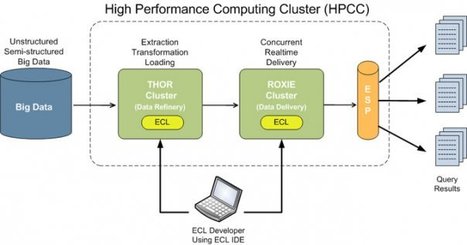
HPCC Systems, the division of LexisNexis Risk Solutions dedicated to big data, has released the open source code of its data-processing-and-delivery software it’s positioning as a better version of Hadoop. The High Performance Computing Cluster code is available on Github, and it marks the commencement of HPCC Systems’ quest to build a community of developers underneath Hadoop’s expansive shadow. The HPCC architecture includes the Thor Data Refinery Cluster and the Roxy Rapid Data Delivery Cluster. As I explained when covering the HPCC Systems launch in June, “Thor — so named for its hammer-like approach to solving the problem — crunches, analyzes and indexes huge amounts of data a la Hadoop. Roxie, on the other hand, is more like a traditional relational database or database warehouse that even can serve transactions to a web front end.” Both tools leverage the company’s Enterprise Control Language, which Escalante describes as easier, faster and more efficient than Hadoop MapReduce. Aside from the open source Community version, HPCC Systems also offers a paid Enterprise version of the HPCC product. The core code is the same, Escalante explained, with the major differences being additional enterprise-grade capabilities such as management tools and support and services.
|
|
Scooped by
Nicolas Weil
September 9, 2011 12:41 AM
|
Heard about HTML5 yet? It's the new standard for the web. Apple loves it. Microsoft fully supports it. Google says it rocks. And Radi lets you enjoy it without learning to code. Radi is designed from the ground up to help you create content that will take full advantage of HTML5 features. An important highlight of the new standard is support for multimedia and realtime graphics. These new <video> and <canvas> elements are second nature to Radi. What's unique about Radi is that it separates your editable content from the HTML elements that are used to render it in the web browser. When you create vector graphics and animations in Radi, you don't need to decide upfront whether it should be displayed as a video file or as a realtime animation. Imagine the following: you have created a complex vector animation, but then you find that it renders too slowly on a mobile phone. You could make it run faster by pre-rendering parts of the animation into a video file... But how to render a web page into a video file? With Radi, it's as simple as clicking the <video> element and dragging the content layers into the new element. Done!
|
|
Scooped by
Nicolas Weil
September 5, 2011 4:22 PM
|
When you need data input in a web context, you send a GET/POST request to your script. On the command line, things work differently. In this blog post, we will talk obout input and output in php-cli.
|
|
Scooped by
Nicolas Weil
September 4, 2011 2:31 PM
|
Superfeedr released a Node XMPP Server. “Since astro had been doing an amazing work with his node-xmpp library to build Client, Components and even Server to server modules, the logical next step was to try to build a Client to Server module so that we could have a full blown server. That’s what we worked on the past couple days, and it’s now on Github! Joyent’s Mark Cavage released LDAP.js. “ldapjs is a pure JavaScript, from-scratch framework for implementing LDAP clients and servers in Node.js. It is intended for developers used to interacting with HTTP services in node and express. Microsoft’s Tomasz Janczuk released iisnode “The iisnode project provides a native IIS 7.x module that allows hosting of node.js applications in IIS.
|
|
Scooped by
Nicolas Weil
September 3, 2011 10:33 PM
|
A chat application allows users to communicate with others via texting, messaging, video and audio conferencing. While developing a web application web masters always think that they should communicate with their audience directly rather than emails, phone or contact forms, or chat applications can be used in various web applications such as social networking sites, business sites for live support etc. We understand the needs of webmasters and that’s why we searched and explored myriad of Google’s pages to find out these 5 free open source chat applications, webmasters can use them in their upcoming and current projects and with the help of these applications users not only can communicate via messaging but they can also communicate with audio and video conferencing. These applications are open source applications and can be used in different projects Php, ruby Jason and many others. If developers are really interesting about these applications they can further work on these applications with the help of their API’s.
|
|
Scooped by
Nicolas Weil
September 3, 2011 10:24 PM
|
Most people who write UIs don’t care about testing. You know why? Because it’s hard. So hard, they’d rather not even bother and test things manually. You have multiple browsers. You have multiple platforms. And worse, you have all these frameworks and toolkits which are difficult to test. I’ll pick on GWT here for a moment. It takes 20 seconds to start a test – let alone a server side component to interact with or the time it takes to run your test. Testing as an afterthought doesn’t work for SaaS/PaaS offerings though. You’re deploying multiple times a week or even day. You need to be sure that you’re not breaking anything. And there is only one way to do this: tests! And I mean real, actual-in-the-browser-dealing-with-crazy-cross-browser-bugs tests.
|
|
Scooped by
Nicolas Weil
September 1, 2011 6:54 PM
|
Today we are presenting top cross browser testing tools. This is highly significant because its the virtual way to check how our web page look across different browsers while you work on only one system. Every site looks different in each browser and also in different browsers. Checking your site across different browsers is difficult and time consuming and mostly impossible. Thus you can use these Cross Browser Testing tools to make sure your webpage look great in any Browser and PC/OS.
|
|
Scooped by
Nicolas Weil
August 30, 2011 5:55 PM
|
While SQL databases are insanely useful tools, their monopoly of ~15 years is coming to an end. And it was just time: I can't even count the things that were forced into relational databases, but never really fitted them. But the differences between "NoSQL" databases are much bigger than it ever was between one SQL database and another. This means that it is a bigger responsibility on software architects to choose the appropriate one for a project right at the beginning. In this light, here is a comparison of Cassandra, Mongodb, CouchDB, Redis, Riak, Membase, Neo4j and HBase:
|