(Reuters) - Germany's Economy Ministry said on Wednesday that Germany's security council, which examines arms exports to non-NATO states, had approved the export of a submarine to Israel.
Israel already operates German-built submarines, manufactured by ThyssenKrupp Marine Systems. The vessels are considered by Israel to be a vanguard against foes like Iran.
Il s'agit en fait d'un feu vert de M. Sigmar Gabriel pour le 3ème et dernier sous-marin de la série Dolphin 2 AIP. Plus de précision dans un article du journal allemand "Der Spiegel" :
In previous navy purchases, Germany agreed to cover one third of the cost as a way of expressing its commitment to Israel’s security.
Israel is seeking to buy advanced missile boats from Germany to protect drilling operations in its offshore natural gas fields. The government is hoping the deal can be concluded at a cost of about 1 billion euros.
Israel previously bought six Dolphin submarines from Germany. The German government agreed to cover one third of the cost of those purchases, as a way of expressing its commitment to Israel’s security.
Berlin hasn’t yet responded to the current request, partly because the new government elected in September hasn’t yet been sworn in. Chancellor Angela Merkel will need to consult her new foreign and defense ministers before making a decision.
A senior Israeli official said Israel needs three or four missile boats to protect the gas fields, which are located in the Mediterranean Sea. On October 21, the Israeli business daily Globes reported that the navy had drawn up a list of the equipment it needs to protect the fields and presented it to the diplomatic-security cabinet. The paper also reported that Israel had obtained price quotes from shipyards in Germany, South Korea and the United States.
The diplomatic-security cabinet discussed the matter and decided to try to purchase the boats from Germany. But in contrast to the submarines, which Israel never seriously considered buying from any country but Germany, the planned missile boat deal has sparked interest from several other countries.
Germany’s largest shipyard is currently in difficult economic straits and is hungry for new projects.
Depuis octobre, l'enveloppe a grimpé à 1 milliard d'euros, ce qui représente une somme conséquente pour une telle acquisition.
Du côté allemand, selon le Bild Zeitung relayé par l'AFP, il s'agirait d'un accord d'un montant similaire mais pour seulement 2 unités de la taille destroyer (???)
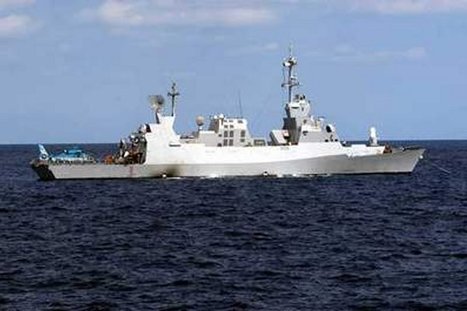
On s'attendait pourtant à voir Israël investir dans le nouveau modèle de mini-corvette Saar 72 d'Israel Shipyards dévoilé au salon IMDEX en mai dernier et coûtant moins cher qu'une Saar 5 :
On peut rappeler, qu'en 2010, Israël avait regardé de près l'acquisition de corvettes modulaires furtives Meko CSL de TKMS (proches de la LCS de Lockheed Martin) :
TEL AVIV, Israel, Oct. 11 (UPI) -- Israel Aerospace Industries is developing a new missile warship that will give its navy greater firepower, but it's looking for foreign investors and says several countries are interested. In the meantime, IAI, the flagship of Israeli's bustling defense industry, is moving ahead with a Defense Ministry order for three advanced Super Dvora Mark III patrol craft to boost protection for the Jewish state's natural gas fields in the eastern Mediterranean. The Globes business daily reported the new design is still on the drawing board at IAI's Ramta plant in the Negev Desert city of Beersheva, but it will be the largest warship developed by the state-owned company amid an unprecedented upgrade for the navy. The 96-foot vessel will be known as the Multirole Super Dvora. Nitzan Shaked, a reserve navy officer with command experience who's the general manager at the Ramta plant, observed: "We're in the preliminary development stage ... . The basic idea is to offer a ship with many more capabilities, while making sure it won't be too expensive or too big." The MSD is the latest in IAI's line of surface combat ships, starting with the Dabur torpedo patrol boat. Fifteen of them remain in service. The Dabur evolved into the larger and faster Dvora, which in turn produced the Super Dvora patrol craft that the navy still procures. IAI announced in September the navy had ordered three more Super Dvora Mark IIIs to add to the four already in service, acquired under a 2004 contract. Globes reported the aging Daburs will be mothballed when the new MSDs are commissioned. The MSD is expected to be armed with various versions of IAI's Barak air-defense missile, which is also carried by the navy's three Saar 5-class corvettes, Israel's largest warships, and 8 Saar 4.5 coastal patrol craft. The new craft will be equipped with the advanced radar developed by IAI subsidiary Elta systems, along with anti-missile defense systems and electo-optical systems for operating at night and in bad weather. The Multirole Super Dvoras, like the Super Dvoras, will be powered by engines manufactured by Germany's MTU Aero Engines AG at its Detroit facility. Otherwise, the MSDs will be fitted with Israeli systems, including the 25-30mm Typhoon cannon built by state-owned Rafael Advanced Defense Systems, and the communications systems made by Orbit Technologies.
The Barak 8 medium range missile is designed to intercept airborne threats, including enemy aircraft, UAVs, anti-ship missiles and cruise missiles • System could be operational on Saar 5 missile boats within the coming months.
Israel's Navy has begun installing a new defense system on its missile boats which would protect them from the feared Russian Yakhont anti-ship missile.
The Barak 8 medium range missile is designed to intercept airborne threats, including enemy aircraft, unmanned aerial vehicles, anti-ship missiles and cruise missiles. "History has never seen ships capable of controlling territory as well as Israel's Navy using the Barak 8 missile," according to a source familiar with the weapon.
The Barak 8 would provide Israeli naval craft with a defense against the Russian Yakhont missile, a potent anti-ship weapon which Israel sees a threat to its navy, especially if fallen into the hands of Lebanese terrorist group Hezbollah. A Russian shipment of the Yakhont missiles was allegedly destroyed in Syria by Israel a few weeks ago.
The navy has decided to install the Barak 8 systems on its Saar 5 missile boats for the time being. It is believed that the system will be operational on the boats within the coming months.
Israel Shipyards has won major orders to build six 62 m offshore patrol vessels (OPVs) for an unidentified customer along with six Shaldag Mk V fast patrol boats for another customer.
The 62 m OPVs are identical to the two that were delivered to Equatorial Guinea in February 2011. They are based on the Saar 4.5 hull, of which 33 hulls in four variants have been built by Israel Shipyards. The OPVs, which have a small flight deck for a light helicopter, have a length of approximately 62 m, a beam of 7.62 m, a mean draft of 2.77 m at full load, and a full load displacement of 470 tons.
The OPVs are powered by four MTU 16 V 4000 series engines driving four shafts for a maximum speed of 32 kt, although 28 kt is the maximum sustained speed. Range is approximately 3,200 n miles at speeds of 12-18 kt, while endurance is around two weeks. The OPV is designed for a complement of 26-35, as well as a special forces detachment of up to 24 persons.
Israel Shipyards is expanding the SAAR class of missile boats, extending the range from missile boats into ‘Mini Corvette’ class vessels. The new class is addressing the growing requirements of Israel and other nations in extending maritime control and sovereignty far from their territorial waters. Defense-Update reports from IMDEX 2013.
The Israel Navy is required to expand the security and responsibility over much larger area while doing that with an ageing fleet of Saar 4, 4.5 missile boats and 5 corvettes. If only to maintain the numbers of boats in service, the Israel Navy will require several new vessels in the coming years. Many of these vessels are becoming obsolete – some of the oldest missile boats in service – INS Atzmaut (Independence) and INS Nitzahon (Victory) are reaching 35 years in service – an age considered the end of service life for such boats. Therefore, new platforms will be required in the near future. Through the years the Navy acquired 20 Saar 4/4.5 vessels, but the cash-strapped service could not afford to buy larger vessels, and, therefore limited the procurement of the larger Saar 5 corvettes to the three vessels built in the U.S. funded by Washington’s Foreign Military Sales (FMS).
The new Saar S-72 unveiled by Israel Shipyard at the recent IMDEX event in Singapore fits between the Navy’s existing Saar 4.5 missile boats, and Saar 5 corvettes. Through the years Israel Shipyards have built 33 Saar 4 and 4.5 class missile boats; 20 were delivered to the Israel Navy over the years. With the new Mini Corvette the shipyard hopes to expand it’s offering to meet the evolving requirements, of the Israel Navy, as well as of international customers overseas.
For Coast Guards and non-military operations the S-72 is a new platform that better fits the category of Offshore Patrol Vessel (OPV). For naval applications the same 800-ton vessel can be finished as a versatile ‘Mini Corvette’. Both are highly applicable to asymmetric warfare at sea, providing sufficient space for command and control, accommodation for special task forces on military or counter terror missions, or supporting rapid response or rescue operations. The large hangar stores a medium size helicopter and UAVs. The adjacent 15 meter long flight deck supports medium size helicopters up to AW139 class. The vessel is configured with loading crane, storage and berth deploying rubber boats / RHIB’s or unmanned surface vessels.
In the military configuration the Saar-72 will offer a significant upgrade over the current Saar 4.5 – in performance and combat capabilities. Applied with a slanted stealth finish, recessed exhausts, and radar integrated mast, designed to host both emitters (radar, EW) and passive sensors (ESM) without interference. The vessel can accommodate the IAI Elta EL/M-2258 Advanced lightweight Phased Array (ALPHA) multi-mission naval radar, designed for blue water and littoral warfare support. This radar was selected by the Israel Navy for the upgrading of existing vessels as well as for its new combatants. The vessel can carry different weapons, including IAI’s Barak 8 type missiles, various anti-ship missiles and precision surface attack weapons. The naval configuration is also fitted with an advanced naval gun.
Saar 72 type vessels are designed with spacious accommodation to 50 crewmembers plus 20 additional accommodations for passengers or special troops. It is equipped to sail on a 21 day missions, with mission range above 3000 NM.
Sources at the Israeli shipyard said they can complete the design and construction of the lead S-72/Saar-72 ship within a period of 30 months, and produce follow-on vessels in eight months. The shipyard can build the 72m’ vessel with its current facilities, but to accommodate the 85 meter version some expansions will be necessary.
Des sous-marins israéliens auraient été repérés au large des côtes sud du Liban.
Des forces françaises de la FINUL au Sud Liban ont indiqué avoir vu des sous-marins israéliens pendant plusieurs jours, naviguant depuis Nakura près de Tyr jusqu’à Sidon, rapporte ce lundi le quotidien israélien Maariv, reprenant des informations publiées par le site libanais Addiyar Online.
L’article explique que l’ONU a été informé du mouvement israélien, mais le Hezbollah n’a pas reçu d’information à ce sujet.
Au cours des dernières semaines, le Liban a plusieurs fois accusé Israël de violer son espace aérien en envoyant des drônes espion pour des survols et d’avoir effectué des exercices d’attaque aérienne.
NEW DELHI: The closure of the infamous Barak kickbacks case will come as a big relief for the Navy because it's grappling with a critical shortage of missiles to arm the Israeli Barak-I anti-missile defence (AMD) systems fitted on 14 frontline warships. Sources on Tuesday said the Rs 393 crore procurement of an additional 262 Barak-I missiles, which successive Navy chiefs have dubbed "a critical operational requirement", is now "likely to be cleared" by the A K Antony-led defence acquisitions council (DAC) in its next meeting on December 23. The Navy has for long been sounding the alarm over its fast depleting stock of missiles for the Barak-I AMD systems - which intercept hostile incoming sea-skimming missiles at a 9-km range - that act as a defensive shield for aircraft carrier INS Viraat, the latest Shivalik stealth frigates and guided-missile destroyers. India had ordered the first Barak system for INS Viraat in the late-1990s to counter Pakistan's acquisition of sea-skimming Exocet and Harpoon missiles. DRDO's abject failure to develop the indigenous Trishul AMD system paved the way for further Barak orders after the 1999 Kargil conflict. But in recent times, Navy was even forced to curtail practice firings of the Barak systems due to the shortage of missiles. The defence ministry has kept the fresh Barak order on hold for five years now due to the pending CBI case, with "the three-volume thick file" doing the rounds as well as opinions being sought from the law ministry and the attorney general. The attorney general, earlier this year, left it to MoD to take a decision on the matter. The DAC in November had then referred the Barak acquisition case to "an independent group" for evaluation, with the caveat that "a final decision" would be taken within a month. Interestingly enough, despite the CBI case of October 2006, MoD refused to blacklist Israeli Aerospace Industries (IAI) and Rafael on the ground that it would be "counter-productive" to national security. This was in sharp contrast to the blacklisting of other armament companies like South African Denel, Singapore Technologies Kinetics, Rheinmetall Air Defence (Zurich) and Corporation Defence of Russia for irregularities. Israel is the second-largest defence supplier to India, with sales worth around $1 billion every year. Of the several projects currently underway, IAI and DRDO are jointly developing a long-range surface-to-air missile (LR-SAM) system for Rs 2,606 crore to arm Indian warships and a medium-range SAM system for IAF at a cost of Rs 10,076 crore. Both these systems, with an interception range of 70-km each, were to be ready long ago but have repeatedly missed deadlines. The naval LR-SAM, approved in December 2005, is now slated for completion by December 2015. The MR-SAM project, sanctioned in February 2009, has a "probable date of completion" by August 2016, say sources.
NEW DELHI — After a five-year delay in acquiring a Russian aircraft carrier, the Indian Navy will have to wait further before the vessel is equipped with its proposed air defense system.
The Indo-Israeli joint project for the Long Range Surface to Air Missile (LRSAM) system for the carrier has been hit by technical snags, meaning the Admiral Gorshkov, now renamed Vikramaditya, which was formally received by Defence Minister A.K. Antony Nov. 15, will arrive in India without an air defense system. The system is based on the Israeli Barak missile.
An Indian Navy official admitted the carrier initially will have no air defense system. The carrier, however, will have an advanced electronic warfare jamming system and will be protected as part of a carrier group, the official added. It also will be equipped with an AK-630 rapid-fire gun system to destroy incoming missiles and aircraft.
“The main weaponry of the ship would be the ship-based aircraft, i.e. aircraft and helicopters with their integral weapons,” an Indian Navy spokesman, P.V. Satish, told Defense News.
However, a Navy source said the weaponization would include the fitting of a variety of guns, primarily of 20mm and 30mm.
The LRSAM, which is being jointly developed by India’s Defence Research and Development Organisation and Israel Aerospace Industries (IAI), is facing technical snags, an Indian Navy spokesman said, but gave no details. The joint development program was conceived in 2007, and LRSAM was to be ready for the Vikramaditya in 2014.
The LRSAM will have a multifunctional acquisition radar, one 3-D S-band guidance radar, one command-and-control system and four launchers, each carrying eight missiles.
IAI can independently install an air defense system, but there have been disputes regarding technology transfer.
The Indian Defence Ministry said it has expressed its concern to Israel about the delay. IAI executives here declined to comment.
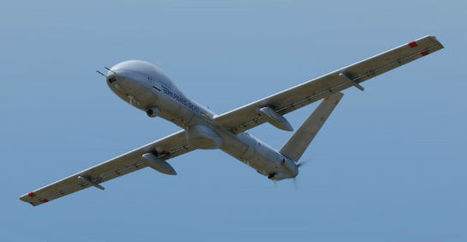
The Chilean navy is evaluating a possible procurement of Elbit Systems' Hermes 900 tactical unmanned air vehicle for maritime patrol tasks.
In 2011 Elbit won a contract to supply Hermes 900 systems to the Chilean armed forces, with the nation's air force currently operating three UAVs on strategic reconnaissance missions. One of these is equipped with a maritime search radar. Santiago selected the type after a competition also involving the Israel Aerospace Industries Heron.
A larger system based on Elbit's combat-proven Hermes 450, the Hermes 900 has a maximum take-off weight of 1,100kg (2,420lb), including a payload capacity of up to 300kg. With a 15m (49.2ft) wingspan, the type can be flown to an altitude of more than 30,000ft (9,140m).
The Rafael “Protector” Unmanned patrol boat will be fitted to work with Unmanned air systems (UAS), according to sources in the Paris Air Show.The Protector is an integrated naval combat system, based on Unmanned, autonomous, remotely controlled surface vehicles. Highly maneuverable and stealthy, the Protector can conduct a wide spectrum of critical missions, without exposing personnel and capital assets to unnecessary risk.
i-HLS Israel Homeland Security
The Protector’s anti-terror mission module payload includes sensors and weapon systems. The search radar and the Toplite electro-optical (EO) pod enable detection, identification and targeting operations. The weapon systems are based on Rafael’s Typhoon remote-controlled, stabilized weapon station, capable of operating various small caliber guns. The highly accurate, stabilized weapon station has excellent hit-and-kill probability.
Protector is missionreconfigurable through its plug-and-play design, allowing utilization of various mission modules:
- Anti-terror Force Protection (AT/FP)
- Intelligence, Surveillance and Reconnaissance (ISR)
- Naval warfare: ASW, MIW, MCM, ASUW, EW
- Maritime, Port Security
Oron Oriol Rafael’s executive VP marketing told i-HLS that the Protector is now competing in South America “Some countries in this region have a problem of protecting their undersea natural resources and our system is a major part of the solution”.
According to the updated plans for protecting Israel’s offshore gas rigs, the Israeli Navy will equip the rigs with Barak missiles for defense against Yakhont missiles. The gas rigs are located at a distance of nearly 80 miles from the coasts of Israel, and near the coasts of Lebanon. The plans additionally include the acquisition of four new missile boats, as well as naval observation and collection measures, including UAVs. The use of the Barak missiles is intended to solve the severe problem troubling the Israeli Navy – the Russian missile Yakhont that Russia sold to Syria and which according to assessments will also be transferred to Hezbollah (if it has not been transferred already). In the past year, the supply of the missile to Syria has become a done deal. The Yakhont can hit naval vessels at a distance of up to 300 kilometers with considerable precision, and it is equipped with a warhead containing 200 kilograms of explosives. The missile flies towards its target at a speed twice the speed of sound. The Yakhont’s characteristics make its interception very difficult: at a distance of several kilometers from the attacked target, the “sea-skimming” missile descends to a cruise altitude of roughly ten meters above sea level, making it difficult for radars to detect it. The Yakhont’s homing head is build so that it is very difficult for electro-optic defense systems to get a lock on it while in flight. The Israeli Navy presently possesses the Barak-1 missile, jointly developed by Israel Aerospace Industries (IAI) and Rafael a decade ago. The intent is to equip the rigs with Barak-8 missiles, which are in advanced development stages at IAI. The system is intended to protect not only the rig or the vessel carrying the missiles, but also fleets of vessels sailing together in a given expanse. The objective is to supply comprehensive perimeter defense to the entire navy, with command and control (C2) systems receiving data from the radar systems of the different vessels and integrating them to create a shared combat and threat picture. The Barak-8 system includes an advanced C2 center, developed by IAI’s Mabat Missiles factory. The system integrates mission management towards managing an individual fire system or managing fire from several units in parallel. The Barak-8 has a radar system that presents a 360-degree hemispheric picture, above the vessel or the vessel layout. It has a high resolution and can detect missiles with a very low radar cross section area. The system is also suitable for countering naval “seaskimming” cruise missiles, as well as threats to aircraft or helicopters.
The Barak-8 missile is single-staged: the missile has fixed stabilizers in its lower section and driving surfaces in its bow. The interceptors are stabilized with carrying and launch containers, which are fixed vertically below the deck of the missile boats. Once a target is received, the missile is launched vertically and immediately transitions to horizontal flight in order to hit and destroy the target, while receiving indications and data from the vessel’s guidance system. Once the target is within range of its self-detection systems, it locks on it and destroys it. The interceptor possesses advanced homing capabilities, suitable for intercepting aircraft and missiles flying at a low altitude above the water, in all weather conditions. The Barak missile family also includes an surface-to-air variant for protecting against aircraft. IAI has thus far sold the system to foreign countries (primarily to India) at billions of dollars, and it is anticipated that additional sales in the scope of billions will take place.
Back in 2009, Israel discovered huge natural gas reserves just off its Mediterranean coast. Those reserves have been estimated to be in the region of 950 billion cubic meters, and a surge in exploration means that by the end of the year there should be 18 new platforms drilling for gas.
The growth of the fields offers a new problem to Israel. The investment going into the new platforms, and the economic importance that they are growing to represent, must be protected. The offshore platforms are ripe targets for attack, and that means that Israel's underfunded navy has just found itself in demand.
From the outset, as reassurance to foreign firms investing in the development of the reserves, the Israeli government has stated its intentions to protect the new gas fields.
Captain Ilan Lavi, head of the navy's planning department, explained that "the gas fields are a strategic asset and Israel will defend them. They may not be too complicated to attack, but we are aware of the threats and are prepared for them."
Currently the navy is under-equipped to adequately patrol the waters and protect the drill rigs.
He suggested that they will "have to build an entire new defensive envelope. But you can't have a defense system that costs more to build than the gas itself."
The platforms are within rocket range of the Gaza Strip. which is ruled by the Palestinian Islamist group Hamas. The Shi'ite military group Hezbollah poses an even bigger threat from Lebanon. Then there are other enemies such as Iran, and various Islamist groups from Iraq.
Lavi suggested that a suitable defense system would cost $700 million to deploy, and then $100 million a year to maintain.
To get content containing either thought or leadership enter:
To get content containing both thought and leadership enter:
To get content containing the expression thought leadership enter:
You can enter several keywords and you can refine them whenever you want. Our suggestion engine uses more signals but entering a few keywords here will rapidly give you great content to curate.


 Your new post is loading...


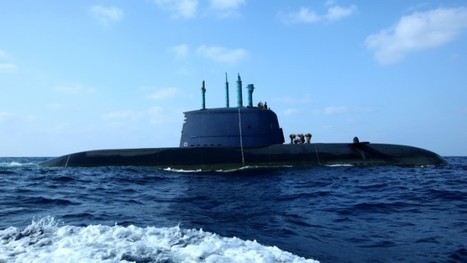











Il s'agit en fait d'un feu vert de M. Sigmar Gabriel pour le 3ème et dernier sous-marin de la série Dolphin 2 AIP. Plus de précision dans un article du journal allemand "Der Spiegel" :
http://www.spiegel.de/politik/deutschland/u-boot-fuer-israel-bundesregierung-genehmigt-heiklen-export-a-981289.html
Le "Tannin" et le "Rahav" de cette même série ont déjà été livrés. Voir la publication de la "Newsletter navale" de l'an dernier :
http://www.scoop.it/t/newsletter-navale/p/4000763032/2013/04/29/la-marine-israelienne-a-receptionne-le-5eme-sous-marin-dolphin-2eme-de-la-serie-dolphin-ii-a-kiel